Lecture on Cell Signalling Through Cell Surface Receptors
 Studied by 6 people
 Call Kai
 Learn
Learn Practice Test
 Spaced Repetition
 Match
Match Flashcards
 Knowt Play
1/19

Earn XP
Description and Tags
These flashcards cover key concepts related to cell surface receptors, G-proteins, and the Ras signalling pathway in cell signalling.
Name | Mastery | Learn | Test | Matching | Spaced | Call with Kai |
|---|
No analytics yet
Send a link to your students to track their progress
20 Terms
What is the function of adenylyl cyclase and phospholipase C in G-protein signalling?
They are activated by trimeric G-proteins to produce second messengers.
What are the second messengers produced by adenylyl cyclase and phospholipase C?
Adenylate cyclase - Cyclic AMP (cAMP)
Phospholipase C - inositol 1,4,5-triphosphate (IP3), and diacylglycerol (DAG).
How does phospholipase c work?
Cleaves phosphoinositol 4,5-biphosphate (PIP2) to produce IP3 and DAG
What do IP3 and DAG do?
IP3 - Release Ca2+ from the ER
DAG - Activates protein kinase C
The Ca2+ and DAG released act together to activate Protein Kinase C
Why can Ca2+ be used as a second messenger?
Cytosolic Ca2+ levels (10-7) are usually lower compared to extracellular levels (10-3)
How does Ca2+ function as a secondary messenger
Ca2+ binds to proteins and induces conformational changes in those proteins.
What is calmodulin and its role in calcium signalling?
Calmodulin binds 4 Ca2+ ions and activates target proteins upon conformational change.
What are enzyme linked proteins?
Single span transmembrane proteins
Have cytosolic domains that either have intrinsic enzymatic activity, or are associated with an enzyme
What characterizes receptor tyrosine kinases (RTKs)?
They are a common type of enzyme-linked receptors with intrinsic kinase activity.
How do RTKs have intrinsic kinase activity?
When the ligand binds to growth factor receptors, it causes them to cross link
Oligomerisation of the RTKs allows for cross phosphorylation (auto-phosphorylation)
What is Ras?
A small monomeric G protein that is the main signal transducer protein for growth factors such as fibroblast growth factor (FGF) and epidermal growth factor (EGF). Ras plays a key role in regulating cell proliferation and survival.
Difference between monomeric and trimeric proteins?
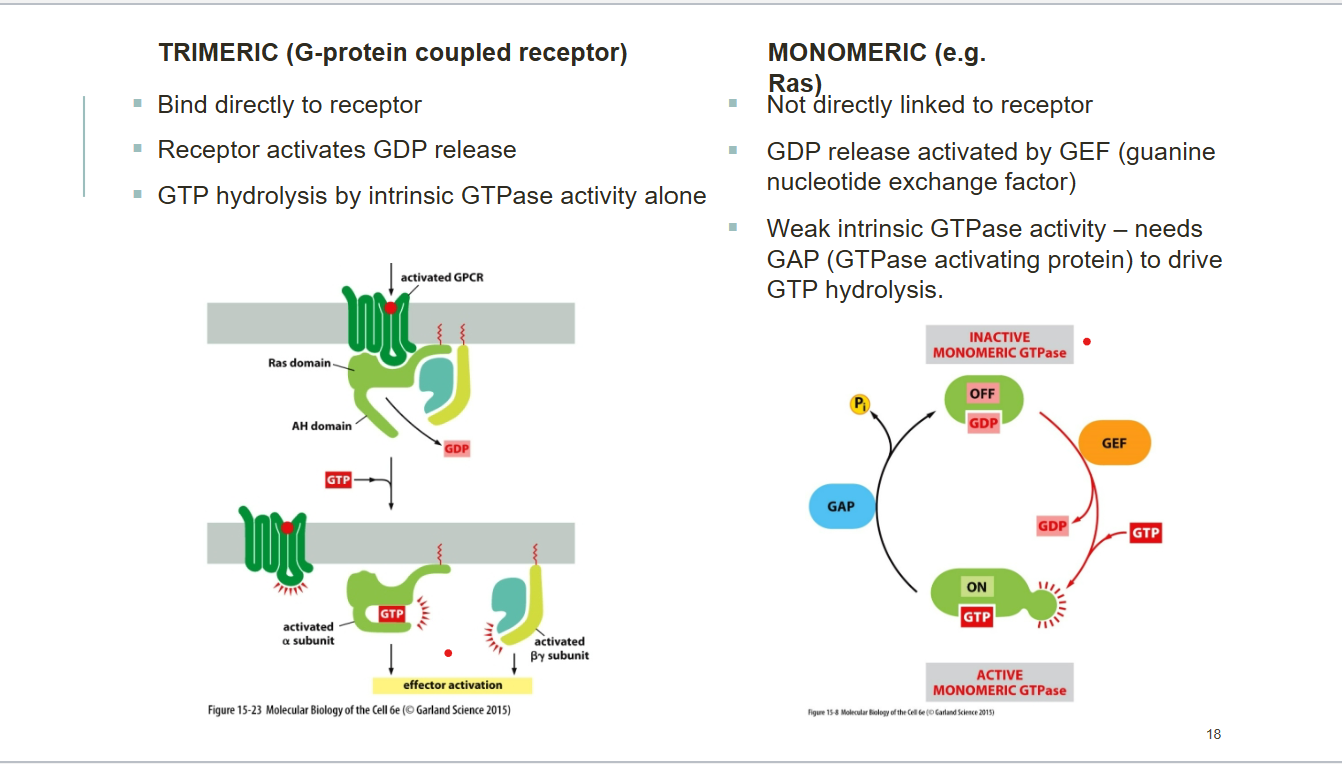
What is the Ras-MAPK pathway's role in cell signalling?
It transduces signals from growth factors leading to cell proliferation and differentiation.
How is the RAS-MAPK pathway activated?
1 - A growth factor (like EGF or insulin) binds to its receptor, activating it.
2 - The RTKs auto-phosphorylate and become docking sites for intracellular signal proteins
3 - Grb2 binds to the receptor, and Ras-GEF (SOS) binds to it, and is activated
4 - SoS then promotes the exchange of GDP for GTP, activating Ras.
The activated Ras triggers a downstream phosphorylation cascade
What is the pattern of the RAS phosphorylation cascade?
Raf (MAP kinase kinase kinase), MEK (MAP kinase kinase), and ERK(MAP kinase)
What does ERK phosphorylate?
Protein X and Y (that cause change in protein activity)
Transcription regulatory protein A and B (that cause changes in gene expression)
What types of cancers are associated with Ras mutations?
20-30% of human cancers, especially 80% of pancreatic cancers.
What role do GTPase-activating proteins (GAPs) play in Ras signalling?
GAPs help drive the hydrolysis of GTP to GDP, inactivating Ras.
What happens when there are mutations in the Ras gene?
Mutations can reduce GTP hydrolysis activity, leading to continuous cell proliferation.
What are some inhibitors targeting the Ras signalling pathway?
Examples include vemurafenib used in melanoma patients with specific mutations.
 Note
Note  Flashcards (23)