DNA Replication
 Call Kai
 Learn
Learn Practice Test
 Spaced Repetition
 Match
Match Flashcards
 Knowt Play
1/34

There's no tags or description
Looks like no tags are added yet.
Name | Mastery | Learn | Test | Matching | Spaced | Call with Kai |
|---|
No analytics yet
Send a link to your students to track their progress
35 Terms
DNA Replication
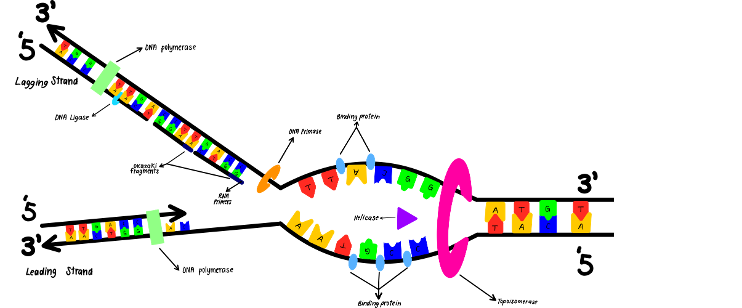
What is the correct order of enzymes in DNA Replication
Topoisomerase relieves tension
Helicase unwinds DNA
Single-strand binding proteins stabilize strands
Primase adds RNA primers
DNA polymerase III elongates DNA
DNA polymerase I replaces primers
Ligase seals fragments

What is the function of Helicase?
To separate the DNA double helix by breaking hydrogen bonds between pairs.

What is the function of Topoisomerase?
Relieves twisting and supercoiling ahead of the replication fork.

What is the function of Primase?
Synthesizes short RNA primers so DNA polymerase can begin replication.
Why are RNA primers necessary?
DNA polymerase cannot start synthsis on its own; it needs a free 3’-OH group.
What is the function of DNA Polymerase III?
Adds DNA nucleotides to the growing strand in the 5’ → 3’ direction.
What is the function of DNA Polymerase I?
Removes the RNA primers and replaces them with DNA nucleotides.

What is the function of Ligase?
Seals the gaps between DNA fragments by forming covalent bonds in the sugar-phosphate backbone.
What is the function of single-strand binding proteins?
They bind to separated DNA strands after helicase unwinds the DNA, preventing strands from rejoining and protecting them from degradation.
Why are single strand bind proteins important?
They stabilize the unwound DNA so replication enzymes can copy the strands efficiently.
What molecule class are Helicase, DNA Polymerase, and Ligase part of?
Proteins (Enzymes)
DNA Replication follows which model?
Semi-Conservative Replication
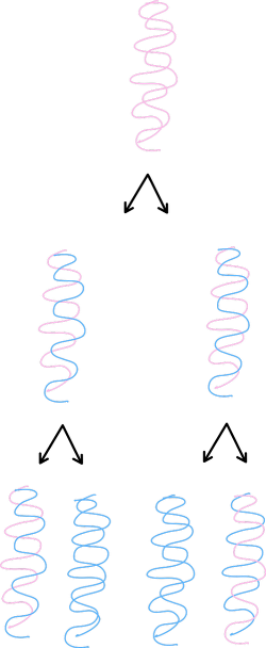
What is Semi-Conservative Replication?
Each new DNA molecule contains one original strand and one newly synthesized strand.
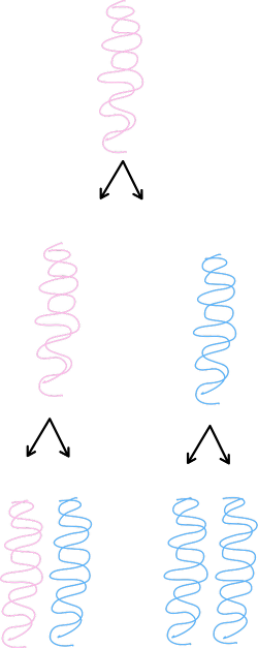
What is Conservative Replication?
THe original DNA molecule stays completely intact, and an entirely new DNA molecule is made from 2 newly synthesized strands.
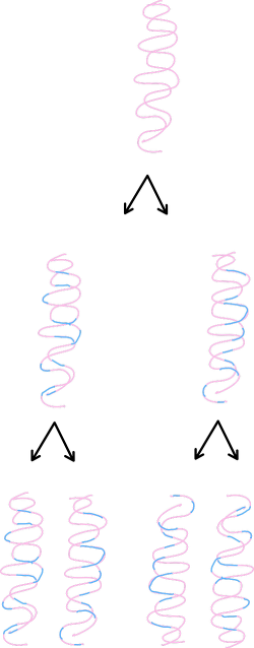
What is the Dispersive model of DNA replication?
Each daughter DNA molecule contains interspersed segments of olda nd new DNA mixed together throughout both strands.
In which direction is DNA synthesized?
5’ → 3’
Where are the new nucleotides added?
To the 3’ OH end of the growing strand.
What is the leading strand?
DNA synthesized continuously toward the replication fork.
What is the lagging strand?
DNA synthesized discontinuously away from the fork.
Why are the leading and lagging strands synthesized differently?
DNA polymerase only synthesizes DNA 5′→3′, so one template allows continuous synthesis while the opposite template requires discontinuous synthesis.
What are Okazaki fragments?
Short DNA segments formed on the lagging strand.
What are the 3 parts of a nucleotide?
Phosphate group, Sugar group, and a nitrogen base.
What form the DNA backbone.
Covalent phosphodiester bonds between sugar and phosphate.
What bonds hold DNA strands together?
Hydrogen bonds between bases.
What is a purine?
Double-ring bases (A & G)
What is a pyrimidine?
A single-ring base (C & T).
How do bases pair?
Purines pair with pyrimidines via hydrogen bonds.
Which bases pair together?
A-T and G-C
What did Chargaff discover?
The %A is about %T and %G is about %C in DNA.
What are the ends of DNA strands called?
5’ end and 3’ end.
How is a nucleotide added during replication?
the 5’ phosphate forms a covalent bond with the 3’ OH of the growing strand.
Equal A-T and G-C percentages indicate what?
Double stranded DNA.
Presence of uracil (U) indicates what molecule?
RNA
How does DNA differ from RNA
DNA: deoxyribose, double-stranded, thymine, stores genetic information, nucleus
RNA: ribose, single-stranded, uracil, protein synthesis roles, nucleus & cytoplasm

