Genes and alleles part 1: intro + genetic diagrams
 Studied by 0 people
 Call Kai
 Learn
Learn Practice Test
 Spaced Repetition
 Match
Match Flashcards
 Knowt Play
1/28

There's no tags or description
Looks like no tags are added yet.
Name | Mastery | Learn | Test | Matching | Spaced |
|---|
No study sessions yet.
29 Terms
What determines our features/characteristics? How?
Genes
By coding for a particular sequence of amino acids (a specific protein)
Gene
A section of a molecule of DNA that codes for a specific protein
Each protein that a gene codes for contributes towards a particular body feature. Sometimes it is visible (hair colour) sometimes it is not (e.g type of haemoglobin in red blood cells)
Examples of specific proteins in our bodies
Structural proteins: keratin in skin, myosin in muscles
Enzymes
Haemoglobin
Some hormones
What are alleles?
Alleles are alternative forms of a gene.
What do alleles do? How?
They give rise to differences in inherited characteristics and variation within a species
Alleles have small differences in their DNA base sequences, which lead to different versions of a characteristic
How does alleles give rise to differences in inherited characteristics?
Genes are passed down from one generation to the next
Genes can have alternative forms called alleles
Each individual has 2 copies of each chromosome, one from each parent as the gametes only have one allele per feature
Therefore humans have two copies of each gene
And therefore two alleles for each gene in humans
One allele can be dominant over the other
Alleles code for the same feature but not for the same expression of the feature.
For example, an individual has 2 copies of the gene for eye colour but one allele could code for brown eyes and the other one for blue eyes
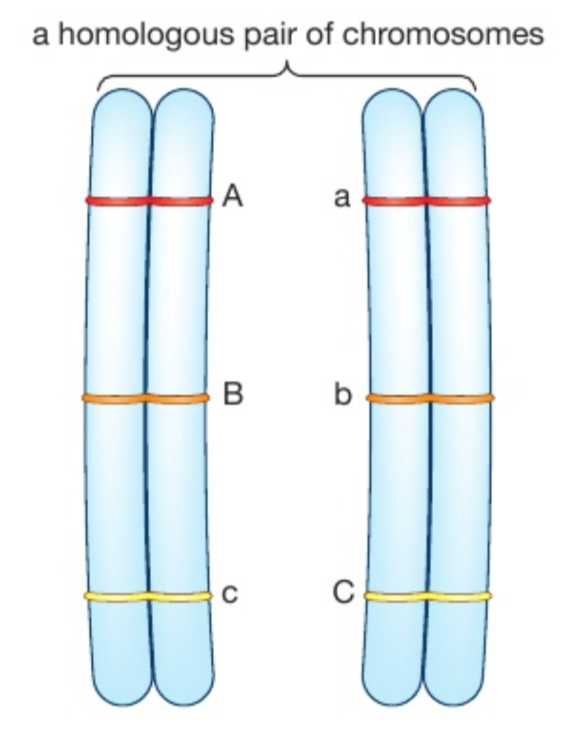
Homologous chromosomes carry genes for the same ___ in the same _____, but the ___ may not be the same.
What can we conclude based on this?
fHomologous chromosomes carry genes for the same feature in the same sequence, but the alleles may not be the same.
Both chromosomes in a homologous pair have the same sequence of genes (gene A, gene B, gene C)
A and a, B and b, C and c are different alleles of the same gene. They control the same feature (e.g earlobe shape) but code for different expressions of that feature (e.g attached or free).
Some features are determined by a single gene (e.g earwax, fur colour in mice) while (most) others are determined by several different genes that interact with each other (e.g height, that is why there are so many diff heights)
We can conclude that the DNA in the 2 chromosomes is not quite identical
Dominant. How do we represent a dominant allele on paper?
An allele that is always expressed even if only one copy is present (if homozygous dominant or heterozygous)
Capital letter
Recessive. How do we represent a recessive allele on paper?
An allele that is only expressed if two copies are present (only when homozygous recessive)
Lower case
Homozygus
having two of the same alleles for a trait
Heterozygous
having two different alleles
Genotype
the combination of alleles that control each specific characteristic
Phenotype
the observable characteristics of an organism that results from the genotype
Monohybrid crosses:
What is monohybrid inheritance? What is the name for the genetic diagram we use in these cases?
It is the inheritance if characteristics controlled by a single gene.
Punnet square
What is a punnet square used for?
To predict the possible genotypes (combinations of alleles) of offspring.
From this, the ratio of these combinations can be worked out
Constructing punnet squares.
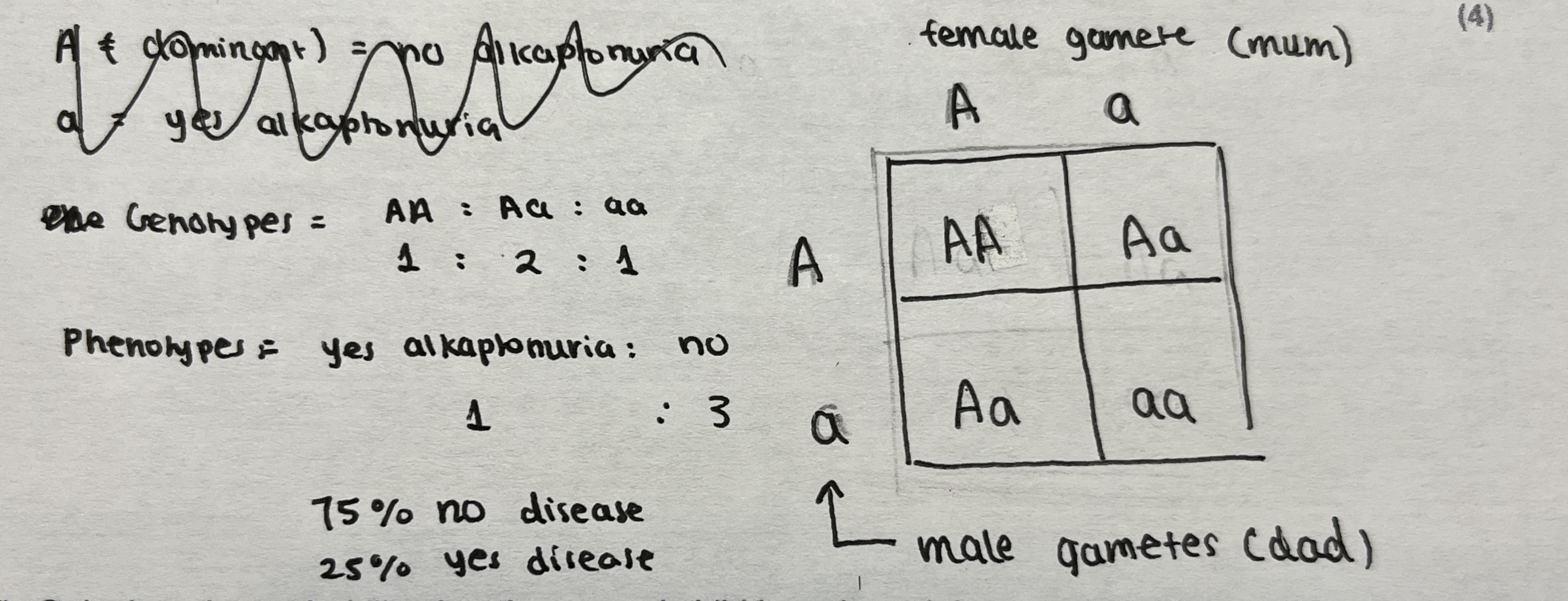
a) A woman and a man do not have alkaptonuria. They have a child who has the condition. The woman and the man are expecting a second child.
Draw a genetic diagram + conclusions to show the probability of the child having alkaptonuria (4)
b) Calculate the probability that the second child is male and does NOT have the condition
Determine the parental genotypes: Parents Aa and Aa (1).
gametes A and a (1) CLEARLY SHOWN
offspring genotypes AA Aa aa (1) combinations written down
offspring phenotypes or ratio 3 no symptoms to 1 alkaptonuria / eq (1).
Mr wilson says to write percentage as well (75% no disease 25% yes disease)
b) 3/4 x 1/2 = 37.5%
3/4 will not have the condition
1/2 male (the other 50% female)
TOP TIP
Use letters that are visibly different when they are lower case and upper case (e.g Aa, Bb, Dd)
Do not use ones like (Cc, Ss, Ww)
It is important to remember that in genetic crosses, ratios such as 3:1 are PREDICTED ratios.
In breeding experiments and in nature the ACTUAL numbers of offspring are unlikely to EXACTLY fit a 3:1 ratio
(e.g if you flip a coin 20 times the ratio should be 1:1 (10 and 10) but it would not be rare to get 9 times tales and 11 times heads)
Suggest why the ratio was 2.84:1 and not the predicted ratio of 3:1 using punnet squares in Mendel's breeding experiment (about plants with dwarfism or not)
Because of 'chance' events. There are a number of factors that affect survival of the plants: some pollen may not fertilise some ova, some seedlings may die before they mature, etc
Key point:
In his breeding experiment Mendel initially used only plants that had 'bred true' for several generations. For example any tall pea plant he used came from generations of pea plants that had all been tall
Working out genotypes:
You cannot tell by looking at a tall pea plant (or human) whether it is homozygous (TT) or heterozygus (Tt).
You could work it out if you knew the genotypes of its parents. But if you don't know the genotypes of its parents, what is another way to figure it out?
Carrying out a breeding experiment called a test cross
What is a test cross?
crossing an organism with the dominant feature with one showing a recessive feature
How will you determine the unkown genotype of the plant by carrying out a test cross?
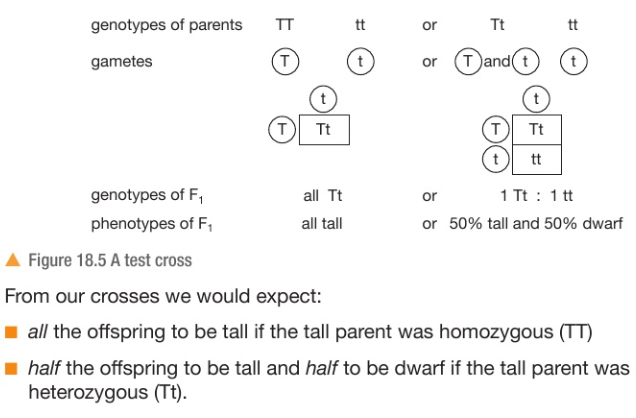
Breed the unkown tall plant (TT or Tt) with a dwarf pea plant (tt)
Draw a genetic cross (punnet diagram) fpr both possibilities (TT with tt + Tt with tt) and predict the outcome for each
Then compare the result of the breeding experiment with the predicted outcome to see which result matches the prediction most closely.
Why do you need to breed the plant with unkown genotype with a plant showing the recessive phenotype?
Because you must control every other possible variable including the genotype of the plant you breed it with.
The only genotype you can be certain of is the plant showing the recessive phenotype as they must be homozygous recessive (tt)
What is the thing that is not determined by genes? What determines it?
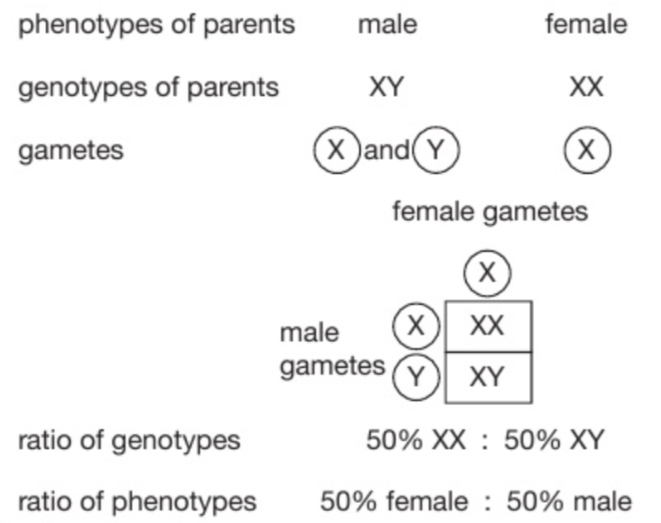
Our sex (female or male)
The sex chromosomes (X and Y)
Draw a diagram to represent the pattern of inheritance of sex in any family.
Predicted genetic ratios are usually only met when _ are involved
large numbers
You cannot say that the Y chromosome is 'dominant' because it is a term that can only be applied to individual alleles
The book is obsessed with saying PREDICTED RATIOS so I guess you should say predicted ratios
 Note
Note  Flashcards (34)