Ch 24: Childbirth at Risk: Labor-related complications
 Call Kai
 Learn
Learn Practice Test
 Spaced Repetition
 Match
Match Flashcards
 Knowt Play
1/39

There's no tags or description
Looks like no tags are added yet.
Name | Mastery | Learn | Test | Matching | Spaced | Call with Kai |
|---|
No analytics yet
Send a link to your students to track their progress
40 Terms
1. What would be a normal cervical dilatation rate in a first-time mother ("primip")?
A) 1.5 cm per hour
B) Less than 1 cm cervical dilatation per hour
C) 1 cm per hour
D) Less than 0.5 cm per hour
Answer: A
Explanation:
A) Dilatation in a "multip" is about 1.5 cm per hour.
B) Less than 1 cm cervical dilatation per hour is prolonged labor.
C) Cervical dilatation in a first-time mother is just over 1 cm per hour.
D) Dystocia is a rate of cervical dilatation of less than 0.5 cm per hour.
Page Ref. 585
2. Dystocia encompasses many problems in labor. What is the most common?
A) Meconium-stained amniotic fluid
B) Dysfunctional uterine contractions
C) Cessation of contractions
D) Changes in the fetal heart rate
Answer: B
Explanation:
A) Meconium-stained amniotic fluid is a sign of nonreassuring fetal status.
B) The most common problem is dysfunctional (or uncoordinated) uterine contractions that result in a prolongation of labor.
C) Cessation of contractions is a symptom of possible uterine rupture.
D) Changes in the fetal heart rate (FHR) are a sign of nonreassuring fetal status.
Page Ref. 584
Risk factors for tachysystole include which of the following?
Note: Credit will be given only if all correct choices and no incorrect choices are selected.
Select all that apply.
A) Cocaine use
B) Placental abruption
C) Low-dose oxytocin titration regimens
D) Uterine rupture
E) Smoking
Answer: A, B, D
Explanation:
A) Cocaine use is a risk factor for tachysystole.
B) Placental abruption is a risk factor for tachysystole.
C) High-dose oxytocin titration regimens are a risk factor for tachysystole.
D) Uterine rupture is a risk factor for tachysystole.
E) Smoking is not risk factor for tachysystole.
Page Ref. 584
A woman has been having contractions since 4 a.m. At 8 a.m., her cervix is dilated to 5 cm. Contractions are frequent, and mild to moderate in intensity. Cephalopelvic disproportion (CPD) has been ruled out. After giving the mother some sedation so she can rest, what would the nurse anticipate preparing for?
A) Oxytocin induction of labor
B) Amnioinfusion
C) Increased intravenous infusion
D) Cesarean section
Answer: A
Explanation:
A) Oxytocin is the drug of choice for labor augmentation or labor induction and may be administered as needed for hypotonic labor patterns.
B) Amnioinfusion would not change the ineffective labor pattern.
C) Increasing the I V infusion would not change the ineffective labor pattern.
D) Because C P D has been ruled out, a cesarean section is not anticipated.
Page Ref. 586
Nonreassuring fetal status often occurs with a tachysystole contraction pattern. Intrauterine resuscitation measures may become warranted and can include which of the following measures?
Note: Credit will be given only if all correct choices and no incorrect choices are selected.
Select all that apply.
A) Position the woman on her right side.
B) Apply oxygen via face mask.
C) Call the anesthesia provider for support.
D) Increase intravenous fluids by at least 500 m L bolus.
E) Call the physician/CNM to the bedside.
Answer: B, C, D
Explanation:
A) The nurse would position the woman on her left side.
B) The nurse would apply oxygen via face mask.
C) The nurse would call the anesthesia provider for support.
D) The nurse would increase intravenous fluids by at least 500 m L bolus.
E) The nurse would not call the physician/CNM to the bedside.
Page Ref: 585
The nurse is performing a vaginal exam on a client who was admitted to the birthing unit after her membranes ruptured, and discovers a cord prolapse. Which intervention is priority at this time?
A) Pushing the presenting fetal part upward
B) Administering oxygen
C) Initiating intravenous fluid
D) Inserting an indwelling bladder catheter
Answer: A
Explanation:
A) Pushing the presenting fetal part upward is a life-saving measure that relieves pressure on the umbilical cord and supports fetal gas exchange.
B) Administering oxygen is performed, but at a later time.
C) Initiating intravenous fluid is performed, but at a later time.
D) Inserting an indwelling bladder catheter may be later used to fill the woman's bladder and relieve pressure on the umbilical cord, but this should not be done in place of pushing the presenting fetal part upward.
Page Ref: 603
While caring for a client admitted to the birthing unit, the nurse suspects that the client may be experiencing a uterine rupture. Which assessment finding should the nurse expect to appear first?
A) Nonreassuring fetal heart rate
B) Constant abdominal pain
C) Loss of fetal station
D) Cessation of contractions
Answer: A
Explanation:
A) A nonreassuring fetal heart rate is commonly the earliest warning sign of a possible uterine rupture.
B) Constant abdominal pain is a finding that may be present, but is not commonly the earliest sign of uterine rupture.
C) Loss of fetal station is a finding that may be present, but is not commonly the earliest sign of uterine rupture.
D) Cessation of contractions is a finding that may be present, but is not commonly the earliest sign of uterine rupture.
Page Ref: 604
What are the primary complications of placenta accreta?
Note: Credit will be given only if all correct choices and no incorrect choices are selected.
Select all that apply.
A) Maternal hemorrhage
B) Insomnia
C) Failure of the placenta to separate following birth of the infant
D) Autonomic dysreflexia
E) Shoulder dystocia
Answer: A, C
Explanation:
A) The primary complications of placenta accreta are maternal hemorrhage and failure of the placenta to separate following birth of the infant.
B) Insomnia is not a complication of placenta accreta.
C) The primary complications of placenta accreta are maternal hemorrhage and failure of the placenta to separate following birth of the infant.
D) Autonomic dysreflexia is a rare complication that can occur in women with a spinal cord injury.
E) The most significant complication in macrosomia is shoulder dystocia.
Page Ref: 606
Risk factors for labor dystocia include which of the following?
Note: Credit will be given only if all correct choices and no incorrect choices are selected.
Select all that apply.
A) Tall maternal height
B) Labor induction
C) Small-for-gestational-age (SGA) fetus
D) Malpresentation
E) Prolonged latent phase
Answer: B, D, E
Explanation:
A) Short maternal height, not tall, is a risk factor of dystocia.
B) Labor induction is a risk factor of dystocia.
C) Large-for-gestational-age (FGA) fetus, not small, is a risk factor of dystocia.
D) Malpresentation is a risk factor of dystocia.
E) Prolonged latent phase is a risk factor of dystocia.
Page Ref. 584
In succenturiate placenta, one or more accessory lobes of fetal villi have developed on the placenta, with vascular connections of fetal origin. What is the gravest maternal danger?
A) Cord prolapse
B) Postpartum hemorrhage
C) Paroxysmal hypertension
D) Brachial plexus injury
Answer: B
Explanation:
A) Cord prolapse is not considered a danger of succenturiate placenta.
B) The gravest maternal danger is postpartum hemorrhage if this minor lobe is severed from the placenta and remains in the uterus.
C) Paroxysmal hypertension is a symptom of autonomic dysreflexia.
D) Brachial plexus injury is an injury due to improper or excessive traction applied to the fetal head during birth.
Page Ref: 600
The nurse knows that the maternal risks associated with postterm pregnancy include which of the following?
Note: Credit will be given only if all correct choices and no incorrect choices are selected.
Select all that apply.
A) Polyhydramnios
B) Maternal hemorrhage
C) Maternal anxiety
D) Forceps-assisted delivery
E) Perineal damage
Answer: B, C, D, E
Explanation:
A) Polyhydramnios is not associated with postterm pregnancy.
B) Maternal symptoms and complications in postterm pregnancy may include maternal hemorrhage.
C) Maternal symptoms and complications in postterm pregnancy may include maternal anxiety.
D) Maternal symptoms and complications in postterm pregnancy may include an operative vaginal birth with forceps or vacuum extractor.
E) Maternal symptoms and complications in postterm pregnancy may include perineal trauma and damage.
Page Ref: 587
The client is at 42 weeks' gestation. Which order should the nurse question?
A) Obtain biophysical profile today.
B) Begin nonstress test now.
C) Schedule labor induction for tomorrow.
D) Have the client return to the clinic in 1 week.
Answer: D
Explanation:
A) A biophysical profile is a commonly used assessment for the postterm fetus.
B) The nonstress test is a commonly used assessment for the postterm fetus.
C) Most practitioners consider induction at 41 gestational weeks to reduce maternal and fetal-newborn risks associated with postterm pregnancy.
D) Many practitioners use twice-weekly testing, providing the amniotic fluid level is normal. One week is too long a period between assessments
Page Ref: 588
During labor, the fetus was in a brow presentation, but after a prolonged labor, the fetus converted to face presentation and was delivered vaginally with forceps assist. What should the nurse explain to the parents?
A) The infant will need to be observed for meconium aspiration.
B) Facial edema and head molding will subside in a few days.
C) The infant will be given prophylactic antibiotics.
D) Breastfeeding will need to be delayed for a day or two.
Answer: B
Explanation:
A) There is no mention of meconium-stained fluid that would cause the nurse to assess for meconium aspiration.
B) Any facial edema and head molding that result from the use of forceps at birth will subside in a few days.
C) There is no reason to place the infant on antibiotics.
D) There is no reason to delay breastfeeding.
Page Ref: 592
The multiparous client at term has arrived to the labor and delivery unit in active labor with intact membranes. Leopold maneuvers indicate the fetus is in a transverse lie with a shoulder presentation. Which physician order is most important?
A) Artificially rupture membranes.
B) Apply internal fetal scalp electrode.
C) Monitor maternal blood pressure every 15 minutes.
D) Alert surgical team of urgent cesarean.
Answer: D
Explanation:
A) Artificial rupture of the membranes is contraindicated with a transverse lie because of the high risk for prolapsed cord.
B) An internal fetal scalp electrode cannot be applied until membranes have ruptured.
C) The fetus is at risk for hypoxia secondary to prolapsed cord if the membranes rupture. The maternal blood pressure is less important than getting the cesarean under way.
D) This is the highest priority because vaginal birth is impossible with a transverse lie. Labor should not be allowed to continue, and a cesarean birth should be done quickly.
Page Ref: 596
The nurse should anticipate the labor pattern for a fetal occiput posterior position to be which of the following?
A) Shorter than average during the latent phase
B) Prolonged as regards the overall length of labor
C) Rapid during transition
D) Precipitous
Answer: B
Explanation:
A) Overall labor is often prolonged, not shorter.
B) Occiput posterior (O P) position of the fetus is the most common fetal malposition and occurs when the head remains in the direct O P position throughout labor. This can prolong the overall length of labor.
C) Overall labor is often prolonged, not more rapid.
D) Overall labor is often prolonged, not precipitous.
Page Ref: 589
Maternal risks of occiput posterior (OP) malposition include which of the following?
Note: Credit will be given only if all correct choices and no incorrect choices are selected.
Select all that apply.
A) Blood loss greater than 1000 mL
B) Postpartum infection
C) Anal sphincter injury
D) Higher rates of vaginal birth
E) Instrument delivery
Answer: B, C, E
Explanation:
A) Blood loss greater than 500 m L is a maternal risk of O P.
B) Postpartum infection is a maternal risk of O P.
C) Anal sphincter injury is a maternal risk of O P.
D) Higher rates of cesarean birth are a maternal risk of O P.
E) Instrument delivery is a maternal risk of O P.
Page Ref: 589
If the physician indicates a shoulder dystocia during the delivery of a macrosomic fetus, how would the nurse assist?
A) Call a second physician to assist.
B) Prepare for an immediate cesarean delivery.
C) Assist the woman into McRoberts maneuver.
D) Utilize fundal pressure to push the fetus out.
Answer: C
Explanation:
A) The vaginal delivery of a macrosomic fetus does not require a second physician.
B) Although a cesarean might be necessary, it would not be an immediate need.
C) The McRoberts maneuver is thought to change the maternal pelvic angle and therefore reduce the force needed to extract the shoulders, thereby decreasing the incidence of brachial plexus stretching and clavicular fracture.
D) Fundal pressure should not be performed, because this can further wedge the shoulder against the suprapubic bone.
Page Ref. 598
While performing a uterine assessment on a client in the birthing unit, the nurse notes a loss of fetal station and a change in uterine shape. The client reports constant abdominal pain, uterine tenderness, and is exhibiting signs of shock. Which condition should the nurse suspect?
A) Uterine rupture
B) Anaphylactoid syndrome of pregnancy
C) Circumvallate placenta
D) Breech presentation
Answer: A
Explanation:
A) The assessment findings are consistent with uterine rupture, which may also include a nonreassuring fetal heart rate, hematuria, and cessation of contractions.
B) Anaphylactoid syndrome of pregnancy is characterized by shortness of breath, hypoxia, cyanosis, and cardiovascular and respiratory collapse.
C) Circumvallate placenta may result in antepartum hemorrhage, prematurity, and abnormal bleeding during or following the third stage of labor.
D) Assessment findings consistent with breech presentation include palpation of the fetal sacrum in the lower part of the maternal abdomen and fetal heart tones present above the umbilicus on auscultation.
Page Ref: 604
The nurse is caring for a client experiencing a uterine rupture. Which outcome demonstrates that the plan of care has been effective for the client?
A) The mother remains hemodynamically stable throughout emergency cesarean birth.
B) The mother has additional knowledge regarding the problems, implications, and treatment plans.
C) The FHR remains in normal range with supportive measures.
D) The family is able to cope successfully with fetal or neonatal anomalies, if they exist.
Answer: C
Explanation:
A) An emergency cesarean birth is warranted in the case of a client experiencing a uterine rupture. Hemodynamic stability is a major goal of interventions performed for a client with a uterine rupture.
B) Knowledge deficit is not a priority nursing diagnosis for a client experiencing a uterine rupture.
C) In the case of a uterine rupture, fetal heart rate anomalies are often already present.
D) Uterine rupture is not indicative of fetal or neonatal anomalies.
Page Ref: 604
True post-term pregnancies are frequently associated with placental changes that cause a decrease in uterine-placental-fetal circulation. Complications related to alterations in placenta functioning include which of the following?
Note: Credit will be given only if all correct choices and no incorrect choices are selected.
Select all that apply.
A) Increased fetal oxygenation
B) Increased placental blood supply
C) Reduced nutritional supply
D) Macrosomia
E) Risk of shoulder dystocia
Answer: C, D, E
Explanation:
A) Decreased, not increased, fetal oxygenation is a complication related to alternations in placenta functioning.
B) Reduced, not increased, placental blood supply is a complication related to alternations in placenta functioning.
C) Reduced nutritional supply is a complication related to alternations in placenta functioning.
D) Macrosomia is a complication related to alternations in placenta functioning.
E) Risk of shoulder dystocia is a complication related to alternations in placenta functioning.
Page Ref: 587
The nurse examines the client's placenta and finds that the umbilical cord is inserted at the placental margin. The client comments that the placenta and cord look different than they did for her first two births. The nurse should explain that this variation in placenta and cord is called what?
A) Placenta accreta
B) Circumvallate placenta
C) Succenturiate placenta
D) Battledore placenta
Answer: D
Explanation:
A) In placenta accreta, the chorionic villi attach directly to the myometrium of the uterus.
B) A circumvallate placenta has a double fold of chorion and amnion that form a ring around the umbilical cord, on the fetal side of the placenta.
C) In succenturiate placenta, one or more accessory lobes of fetal villi will develop on the placenta.
D) In battledore placenta, the umbilical cord is inserted at or near the placental margin.
Page Ref: 600
A woman is admitted to the birth setting in early labor. She is 3 cm dilated, -2 station, with intact membranes and FHR of 150 beats/min. Her membranes rupture spontaneously, and the FHR drops to 90 beats/min with variable decelerations. What would the initial response from the nurse be?
A) Perform a vaginal exam.
B) Notify the physician.
C) Place the client in a left lateral position.
D) Administer oxygen at 2 L per nasal cannula.
Answer: A
Explanation:
A) A drop in fetal heart rate accompanied by variable decelerations is consistent with a prolapsed cord. The nurse would assess for prolapsed cord via vaginal examination.
B) The vaginal exam should be done before the physician is notified.
C) Repositioning the client will not relieve the decreased heart rate if the cord is compromised.
D) Administering oxygen will not relieve the decreased heart rate if the cord is compromised.
Page Ref: 602
The nurse is caring for a client in active labor. The membranes spontaneously rupture, with a large amount of clear amniotic fluid. Which nursing action is most important to undertake at this time?
A) Assess the odor of the amniotic fluid.
B) Perform Leopold maneuvers.
C) Obtain an order for pain medication.
D) Complete a sterile vaginal exam.
Answer: D
Explanation:
A) Although it is important to assess amniotic fluid for odors, checking the cervix to assess for cord prolapse is a higher priority.
B) This assessment is not called for at this time.
C) Pain medication is a low priority at this time.
D) Checking the cervix will determine whether the cord prolapsed when the membranes ruptured. The nurse would assess for prolapsed cord via vaginal examination.
Page Ref: 602
During labor, the client at 4 cm suddenly becomes short of breath, cyanotic, and hypoxic. The nurse must prepare or arrange immediately for which of the following?
Note: Credit will be given only if all correct choices and no incorrect choices are selected.
Select all that apply.
A) Intravenous access
B) Cesarean delivery
C) Immediate vaginal delivery
D) McRoberts maneuver
E) A crash cart
Answer: A, B, E
Explanation:
A) When an amniotic fluid embolism is suspected, intravenous access is obtained as quickly as possible.
B) Shortness of breath, cyanosis, and hypoxia are symptoms of an amniotic fluid embolus, which necessitates immediate cesarean delivery.
C) The client is only 4 cm, so vaginal delivery will not take place immediately.
D) McRoberts maneuver is used with shoulder dystocia.
E) The chances of a code are high, so the crash cart needs to be available.
Page Ref: 604
On assessment, a laboring client is noted to have cardiovascular and respiratory collapse and is unresponsive. What should the nurse suspect?
A) An amniotic fluid embolus
B) Placental abruption
C) Placenta accreta
D) Retained placenta
Answer: A
Explanation:
A) Cardiovascular and respiratory collapse are symptoms of an amniotic fluid embolus and cor pulmonale.
B) Placental abruption does not have any of these symptoms.
C) Placenta accreta does not have any of these symptoms.
D) Retention of the placenta beyond 30 minutes after birth is termed retained placenta and does not have any of these symptoms.
Page Ref: 604
A 26-year-old client is having her initial prenatal appointment. The client reports to the nurse that she suffered a pelvic fracture in a car accident 3 years ago. The client asks whether her pelvic fracture might affect her ability to have a vaginal delivery. What response by the nurse is best?
A) "It depends on how your pelvis healed."
B) "You will need to have a cesarean birth."
C) "Please talk to your doctor about that."
D) "You will be able to delivery vaginally."
Answer: A
Explanation:
A) Women with a history of pelvic fractures may also be at risk for cephalopelvic disproportion (C P D).
B) Not all clients will be able to deliver vaginally, but not all will need cesarean birth.
C) It is not therapeutic to tell a client to talk to someone else.
D) Not all clients will be able to deliver vaginally, but not all will need cesarean birth.
Page Ref: 605
A fetal weight is estimated at 4490 grams in a client at 38 weeks gestation. Counseling should occur before labor regarding which of the following?
A) Mother's undiagnosed diabetes
B) Likelihood of a cesarean delivery
C) Effectiveness of epidural anesthesia with a large fetus
D) Need for early delivery
Answer: B
Explanation:
A) There is a possibility of undiagnosed diabetes, but that is not the current concern because the client is close to delivery.
B) The likelihood of a cesarean delivery with a fetus over 4000 grams is high. This should be discussed with the client before labor.
C) The weight of the fetus has no bearing on the effectiveness of epidural anesthesia.
D) The client is already at term, so it is too late to discuss an early delivery.
Page Ref: 597
A woman has been in labor for 16 hours. Her cervix is dilated to 3 cm and is 80% effaced. The fetal presenting part is not engaged. The nurse would suspect which of the following?
A) Breech malpresentation
B) Fetal demise
C) Cephalopelvic disproportion (CPD)
D)Abruptio placentae
Answer: C
Explanation:
A) A breech presentation would not prevent the presenting part from becoming engaged.
B) Fetal demise would not prevent the presenting part from becoming engaged.
C) Cephalopelvic disproportion (CPD) prevents the presenting part from becoming engaged.
D) Abruptio placentae has specific complications; however, it would not prevent engagement of the presenting part.
Page Ref: 605
What is one of the most common initial signs of nonreassuring fetal status?
A) Meconium-stained amniotic fluid
B) Cyanosis
C) Dehydration
D) Arrest of descent
Answer: A
Explanation:
A) The most common initial signs of nonreassuring fetal status are meconium-stained amniotic fluid and changes in the fetal heart rate (FHR).
B) Cyanosis is not a common sign of nonreassuring fetal status.
C) Dehydration is not a common sign of nonreassuring fetal status.
D) Arrest of descent is not a common sign of nonreassuring fetal status.
Page Ref: 588
The client gave birth to a 7 pound, 14 ounce female 30 minutes ago. The placenta has not yet delivered. Manual removal of the placenta is planned. What should the nurse prepare to do?
A) Start an IV of lactated Ringer's.
B) Apply anti-embolism stockings.
C) Bottle-feed the infant.
D) Send the placenta to pathology.
Answer: A
Explanation:
A) In women who do not have an epidural in place, intravenous sedation may be required because of the discomfort caused by the procedure. An IV is necessary.
B) Anti-embolism stockings are used after major surgery that leads to immobility, thus increasing the risk of embolism. However, anti-embolism stockings are not needed for this client.
C) The client's partner or family member, or a nursery nurse, can feed the infant. Preparation for manual removal of the placenta is a higher priority at this time.
D) The placenta might be sent to pathology after it is removed, but preparing the client for manual removal of the placenta now is a higher priority.
Page Ref: 606
The client delivered 30 minutes ago. Her blood pressure and pulse are stable. Vaginal bleeding is scant. The nurse should prepare for which procedure?
A) Abdominal hysterectomy
B) Manual removal of the placenta
C) Repair of perineal lacerations
D) Foley catheterization
Answer: B
Explanation:
A) Abdominal hysterectomy is not required.
B) Retention of the placenta beyond 30 minutes after birth is termed retained placenta. Manual removal of the placenta is then performed.
C) Repair of perineal lacerations would not ensue until after the placenta was delivered.
D) There is no indication of urinary retention that requires a Foley catheter.
Page Ref: 606
Lacerations of the cervix or vagina may be present when bright red vaginal bleeding persists in the presence of a well-contracted uterus. The incidence of lacerations is higher among which of the following childbearing women?
Note: Credit will be given only if all correct choices and no incorrect choices are selected.
Select all that apply.
A) Over the age of 35
B) Have not had epidural block
C) Have had an episiotomy
D) Have had a forceps-assisted or vacuum-assisted birth
E) Nulliparous
Answer: C, D, E
Explanation:
A) The incidence of lacerations is higher among childbearing women who are younger.
B) The incidence of lacerations is higher among childbearing women who have had an epidural block.
C) The incidence of lacerations is higher among childbearing women who undergo an episiotomy.
D) The incidence of lacerations is higher among childbearing women who undergo forceps-assisted or vacuum-assisted birth.
E) The incidence of lacerations is higher among childbearing women who are nulliparous.
Page Ref: 606
After delivery, it is determined that there is a placenta accreta. Which intervention should the nurse anticipate?
A) 2 L oxygen by mask
B) Intravenous antibiotics
C) Intravenous oxytocin
D) Hysterectomy
Answer: D
Explanation:
A) Use of oxygen will not assist in the separation of the placenta.
B) Use of intravenous antibiotics will not assist in the separation of the placenta.
C) Use of intravenous oxytocin will not assist in the separation of the placenta.
D) The primary complication of placenta accreta is maternal hemorrhage and failure of the placenta to separate following birth of the infant. An abdominal hysterectomy may be the necessary treatment, depending on the amount and depth of involvement.
Page Ref: 606
What is required for any woman receiving oxytocin (Pitocin)?
A) CPR
B) Continuous electronic fetal monitoring
C) Administering oxygen by mask
D) Nonstress test
Answer: B
Explanation:
A) CPR is not required for a woman receiving oxytocin.
B) Continuous electronic fetal monitoring (EFM) is required for any woman receiving oxytocin (Pitocin).
C) Administering oxygen by mask is not required for a woman receiving oxytocin.
D) Nonstress test is not required for a woman receiving oxytocin.
Page Ref: 586
The client has delivered a 4200 g fetus. The physician performed a midline episiotomy, which extended into a third-degree laceration. The client asks the nurse where she tore. Which response is best?
A) "The episiotomy extended and tore through your rectal mucosa."
B) "The episiotomy extended and tore up near your vaginal mucous membrane."
C) "The episiotomy extended and tore into the muscle layer."
D) "The episiotomy extended and tore through your anal sphincter."
Answer: D
Explanation:
A) A fourth degree laceration is through the rectal mucosa.
B) A first degree laceration is through the vaginal mucous membrane.
C) A second degree laceration involves skin and muscle.
D) A third degree laceration includes the anal sphincter.
Page Ref: 606
Answer: C
Explanation: C) In a brow presentation the head is molded forward. Choice 1 is an occiput anterior presentation. Choice 2 is an occiput posterior presentation. Choice 4 is face presentation.
Page Ref: 586
36) A fetus has a brow cephalic presentation. Which head shape should the nurse expect when the infant is delivered?
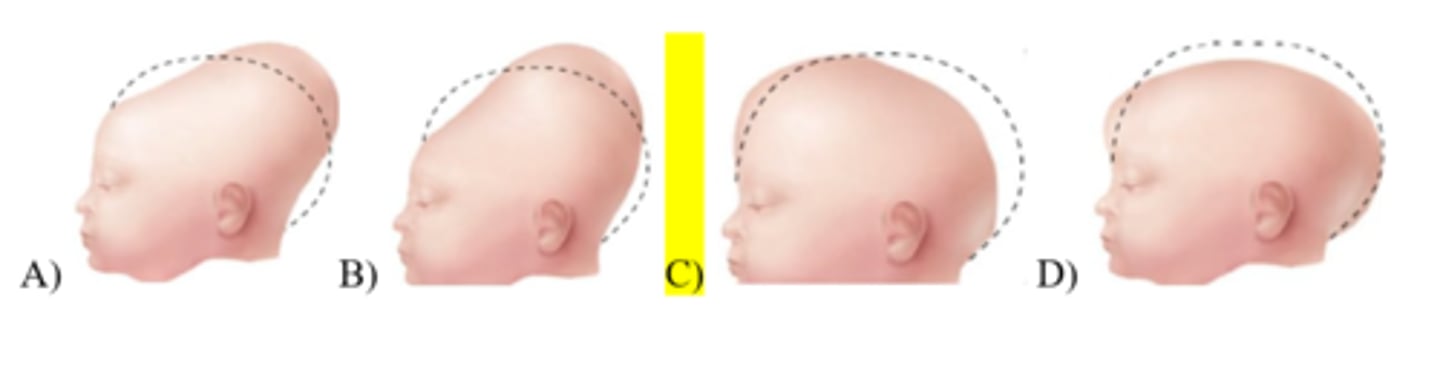
Answer: C
Explanation: C) In a brow presentation, the forehead of the fetus becomes the presenting part and the head is slightly extended instead of flexed, which results in the head entering the birth canal with the widest diameter of the head (occipitomental) foremost. If a vaginal birth is attempted, the woman will probably need an episiotomy and may require extension of the episiotomy at the moment of birth. In a normal cephalic presentation, the occiput is the presenting part, and the head is flexed with the chin on the chest. The military presentation is probably the least difficult for the woman and fetus. In most cases, as soon as the head reaches the pelvic floor, flexion occurs and a vaginal birth results. In a face presentation, the face of the fetus is the presenting part. The fetal neck is hyperextended.
Page Ref: 591
37) A laboring patient is attempting a vaginal birth. An episiotomy has already been performed and the healthcare provider is prepared to extend the episiotomy if necessary. What is this fetus's most likely presentation?
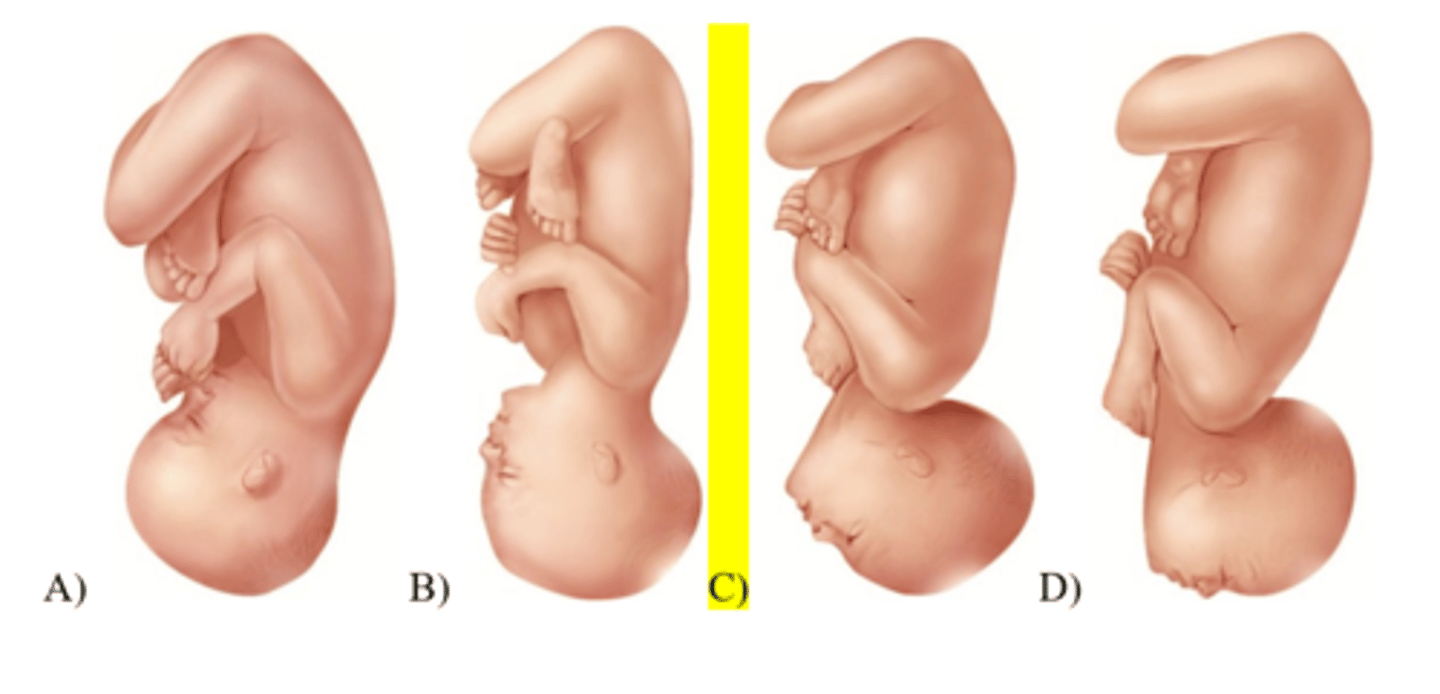
Answer: A
Explanation: A) On vaginal examination of a breech presentation the nurse may feel the anal sphincter. The tissue of the fetal buttocks feels soft. In a shoulder presentation the nurse may feel the acromion process as the fetal presenting part. In the occiput face presentation the nurse may palpate the nose. In the occiput brow presentation the nurse may palpate the forehead.
Page Ref: 594
38) During an intrapartum vaginal examination the following is palpated. In which type of presentation is this fetus?
A) Breech
B) Shoulder
C) Occiput face
D) Occiput brow
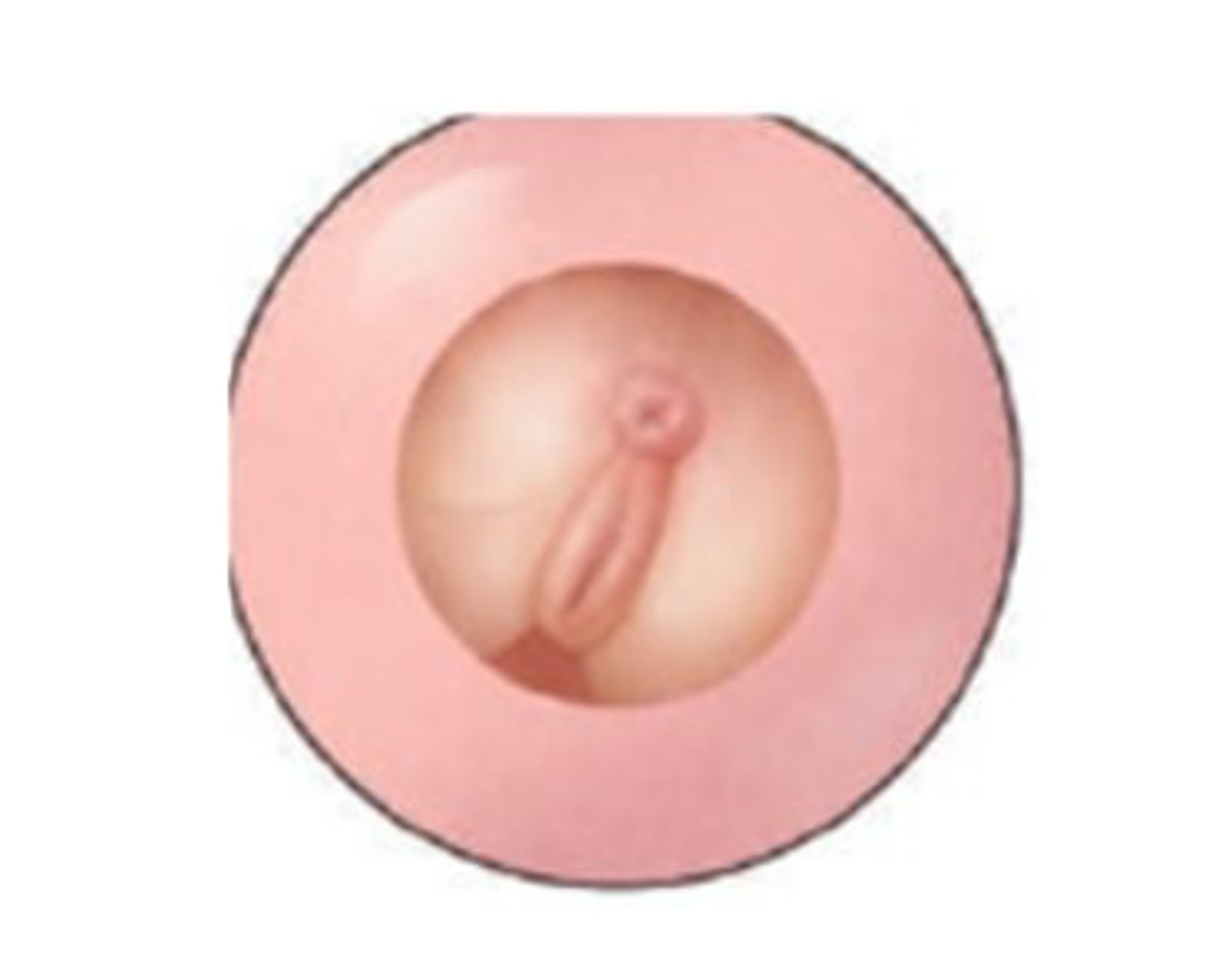
Answer: B
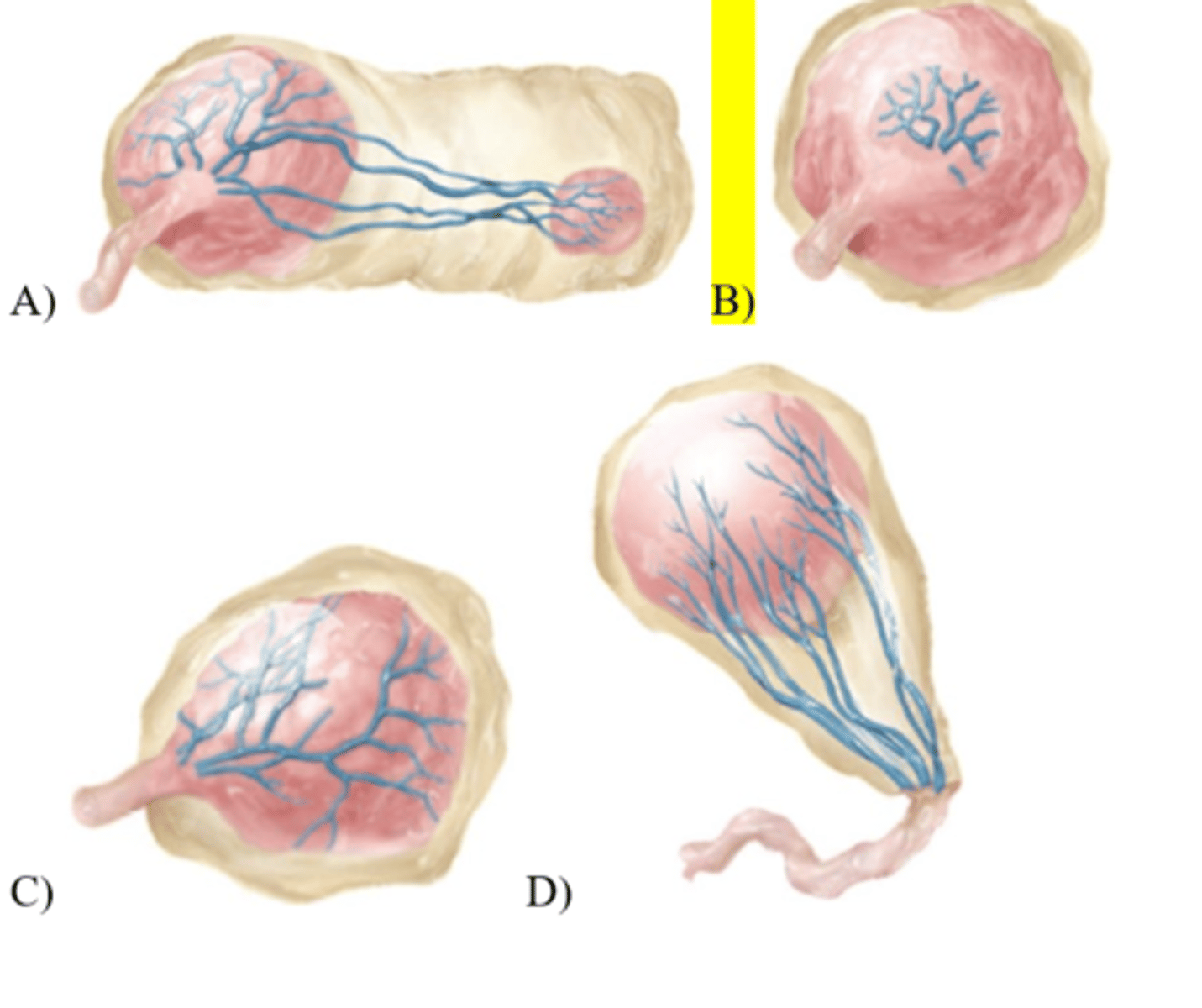
Explanation: B) A circumvallate placenta has a double fold of chorion and amnion that forms a ring around the umbilical cord, on the fetal side of the placenta. Choice 1: In a succenturiate placenta, one or more accessory lobes of fetal villi develops on the placenta. Choice 3: In a battledore placenta, the umbilical cord is inserted at or near the placental margin. Choice 4: In a velamentous insertion of the umbilical cord, the vessels of the umbilical cord divide some distance from the placenta in the placental membranes.
39) A patient's placenta it is identified as having a double fold of chorion and amnion that formed a ring around the umbilical cord on the fetal side of the placenta. What should the nurse expect when examining this placenta?
Answer: D
Explanation: D) The knee-chest position is used to relieve cord compression during a cord prolapse emergency. The supine, side-lying, or lithotomy positions are not beneficial to the fetus in cord prolapse.
Page Ref: 603
40) During an intrapartum vaginal examination the following is assessed. In which position should the patient be placed at this time?
A) Supine
B) Side-lying
C) Lithotom
D) Knee-chest