food tests
 Studied by 0 people
 Call Kai
 Learn
Learn Practice Test
 Spaced Repetition
 Match
Match Flashcards
 Knowt Play
1/14

There's no tags or description
Looks like no tags are added yet.
Name | Mastery | Learn | Test | Matching | Spaced | Call with Kai |
|---|
No analytics yet
Send a link to your students to track their progress
15 Terms
enzymes
-biological catalysts to speed up chemical reactions in living things
properties
-they are all large proteins
-there is a space within the protein molecule called the active site
-each enzyme catalyses a specific reaction
-work best at a specific temp and pH called the optimum
the lock and key theory
Theory of enzyme catalysis stating that the active site's structure is complementary to the structure of the substrate.
so the substrate fits into the enzyme like a key to a lock
Denaturing
Where high temperature and extremes of pH make enzymes change shape.
The enzyme cannot work once it has been denatured, because the substrate cannot fit into the active site - the lock and key no longer fit together.
enzymes in digestion
digestive enzymes are produced by specialized cells in glands and in the lining of gut
1)The enzymes pass out of the cells into digestive system
2) They come in contact with food molecules
3)They catalyse the breakdown of large insoluble food molecules into smaller soluble molecules
protease
-is produced in the stomach,pancreas and small inestine
-breaks down proteins into amino acids
-pH2 required
amylase
- is produced in the salivary glands and the pancreas
-is a carbohydrase that breaks down starch into sugar(maltose)
-pH8 required
lipase
-is produced in the pancreas and small intestine
-breaks down lipids (fats_) into fatty
acids and gycerol
-pH 8 required
Protease and Peptidase
-digest polypeptides to produce amino acids
-pH8 required
reagents solutions
idoine solution(orange solution) - carbohydrates
benedict(requires heat-blue solution)- suagr
Biurret(blue solution)-proteins
Ethanol(clear) - lipids
perparing for a food test
1)Use a pestle and mortar to break up the food into small particles.
2)Add the crushed food to a test tube containing water and shake the test tube to get the chemicals you are testing for to dissolve in the water. If you are testing for a fat, you need to use ethanol as fats are not soluble in water.
3)Remove any undissolved solid material. This can be done by filtering the solution or in some case waiting for the solids to settle and then decanting the solution into another test tube.
starch test
Iodine solution will react with starch to produce a dark blue-black colour. It will work with starch dissolved in water or just by placing the iodine solution directly on a solid food that contains starch.
protein test
The biuret solution contains sodium hydroxide and copper sulphate, which gives it a blue colour. In the presence of protein it produces a violet(purple) colour. The intensity of the colour give a rough indication of the amount of protein.
Fat test
ethanol(alcohol) added to a solution gives a cloudy white layer if a a lipid is present so when ethanol is added to the distilled water mixture(with the food) it is causes a milky emulsion on the surface of the test tube
image when you add oil to hot water
sugar test
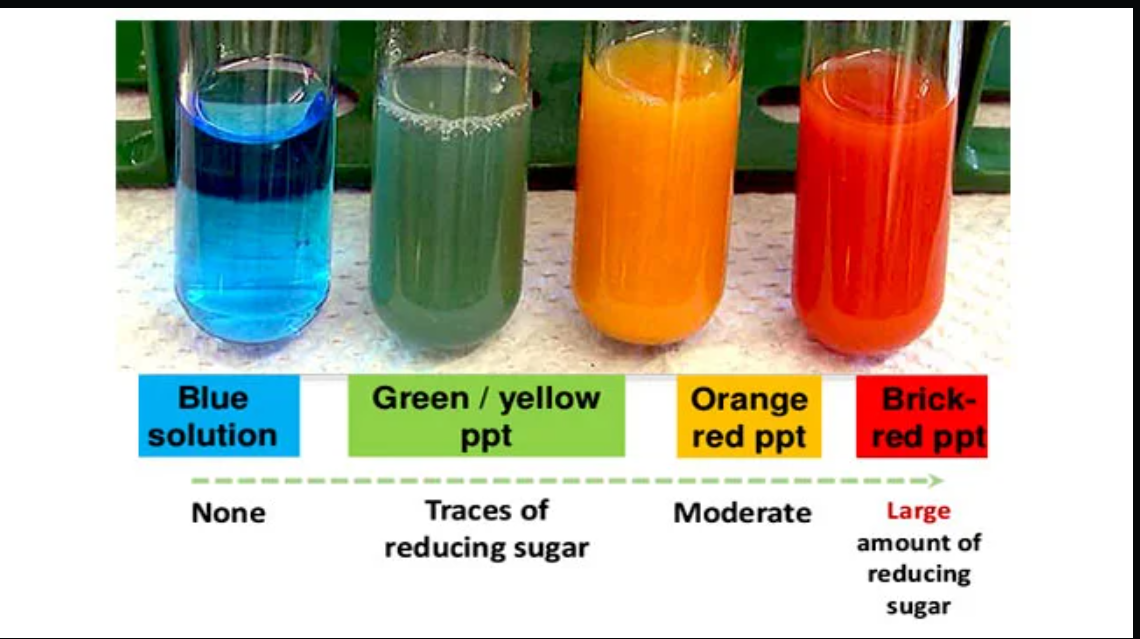
The Benedict's test will only work for reducing sugars (e.g. glucose).It will not work with non reducing sugars (e.g. sucrose)
The colour change depends on the amount of sugar present.
The Benedict's test detects reducing sugars (like glucose, fructose, maltose) by heating a sample with Benedict's blue solution, causing a color change to green, yellow, orange, or brick-red precipitate, indicating increasing sugar concentration, with brick-red being the highest
polymers
large compound formed from combinations of many monomers
-lipids are not polymers as the often contain multiple monomers(fatty acids)
 Note
Note  Flashcards (66)