ESS W1 L1 p2 - biosphere
 Call Kai
 Learn
Learn Practice Test
 Spaced Repetition
 Match
Match Flashcards
 Knowt Play
1/24

Earn XP
Description and Tags
part 2 - biodiversity - life on earth
Name | Mastery | Learn | Test | Matching | Spaced | Call with Kai |
|---|
No analytics yet
Send a link to your students to track their progress
25 Terms
what is biodiversity
‘variability among living organisms from all sources including inter alia terrestrial, marine and other aquatic organism and the ecological complexes of which they are part; this includes diversity within species, between species, and of ecosystems’ – UN convention 1992
biodiversity - within a species
genetic variation – individuals of the same species are not all identical
biodiversity -between species
variety of different species on same habitat
biodiversity -between ecosystems
ecosystem variation – different environments support different kinds of life
Global biodiversity:
On a global scale diversity isn’t uniform
Species biodiversity:
8.7 mil eukaryotic organisms catalogued so far
86% existing specie son earth (terrestrial) and 91% species in ocean still await description – more at al 2011
Habitats still need exploring
Different ways we define species – advancements on DNA analysis helping
Small stuff 0 difficult to detect
Changing methods and technology – human id vs. DNA analysis
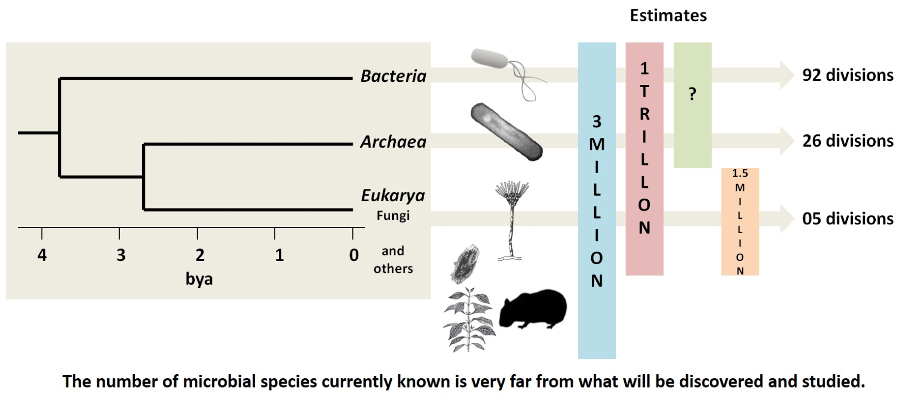
Microbial diversity
‘100 mil times as many bacteria in the oceans (12 x 10^28) as there are stars in the known universe’ - microbiology by numbers
Bacteria been around for biliions years – oldest and most biodiverse group/ kingdom, followed by archaea and fungi
Estimated 3 mil – 1 tril estimated living organisms– difficult to know
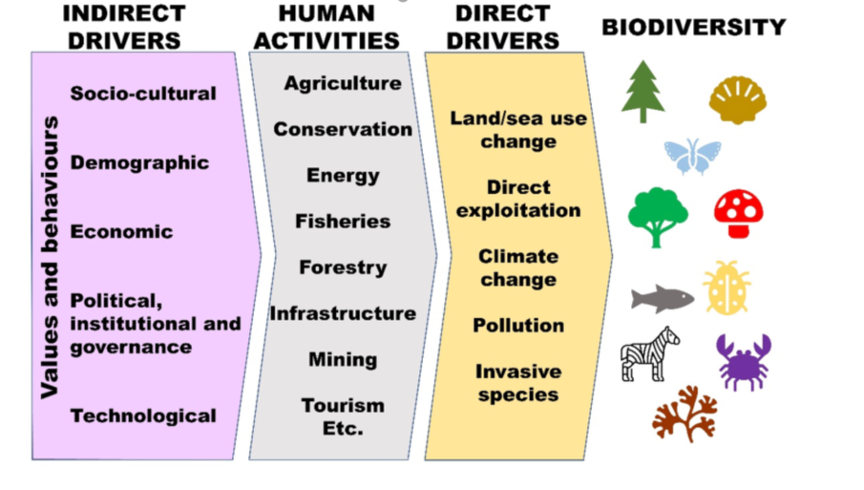
Biodiversity loss:
Estimated 130 animals and plant species go extinct every day – Vitorino and Bessa 2018
A huge global challenge mainly driven by human activity
Biodiversity needed for healthy ecosystem
E.g. flying insects declined 60% in 20 years
Important for food chains
Pollution, deforestation, over fishing, industrial scale farming, urban landscapes, human induced climate change drives wildfires and makes parts of the world uninhabitable for some species as our climate warms
Evolution:
Persistence of bacteria over time
All species evolved from a single ancestor
All linked together via evolutionary tree – tree of life
genetic variation
Differences between organisms caused by differences in DNA
A gene is the basic unit by which characteristics are passed from generation to the next
Slightly different forms of a gene (mutation) called an allele
Evolution = change in genetic material (genotype) of a population or organisms across generations
Change in an organism’s appearance (phenotype) is influenced by genetics and environment
When an allele persist in a population – the trait gets passed down from one generation to the next – this is when evolution occurs
Genotype vs phenotypes: example
Peppered moth – biston betularia
Get two phenotypes
Require camo against pred birds
Light pheno – thrive in non-polluted areas – disguised by lichen on trees
Dark pheno – thrives in polluted areas, where sulphur kills lichen on trees
Related to the environment
Uk – industrial revolution – influences persistence of dark phenotype
From 1% to 90% of population
Natural selection:
Charles Darwin – on the origins of species 1859
Natural selection
A process in which individual organisms that possess more favourable charactertics are more likely to survive and reproduce
Operates by challenges in allele frequencies (genetics not understood at the time)
Environment a driving factor for evolution
Speciation:
Evolutionary process by which reproductively isolated biological populations evolve to become distinct species
Isolation:
Physical isolation (geographical processes)
Reproductive isolation (mutation changes)
Results in significant changes in genetics that means the isolated group can no longer reproduce with the original population
Leads to new forms of life and biodiversity
What is a species:
Biological species concept:
Species are groups of interbreeding natural populations that are reproductively isolated from other groups
Geography involved in speciation:
So explains species diversity and distribution
Biodiversity not equally distributed across the planet. Tropical regions – highest number of different species (of vascular plants) and species vary across the planet
speciation
process of a single lineage splitting into two or more daughter lineages. When populations are spatially isolated, they no longer exchange genes and can diverge
Geographical isolation: allopatric speciation
new sub population evolve due to geographic separation e.g. formation of a mountain range or tectonic plate movement
one population of living organisms become subdivided in two separate subpopulations due to a geographical boundary between them.
The two subpopulations stop interbreeding and thus new mutations can not be exchanged for generations. This leads to appearance of new and different variations in the two subpopulations, and the isolated subpopulation eventually fails to interbreed with the parental population (even when the barrier is removed) giving rise to a new species.
Geographical isolation: vicariance
physical splitting of populations
Isolation causes genetic divergence, so plays a key role in speciation.
we can imagine examples e.g. movement of continents, mountain formation, volcanic island formation (and dispersal to them with subsequent isolation), SLC
differences in the local conditions in the two land bodies may then result in adaptation to those settings and the development of new species
so geographic isolation, breading amongst separated groups resulting in genetic divergence, which then leads to reproductive isolation
this separation by geographic barriers resulting in new species from an original group is known as vicariance
Geographic Isolation
leads to genetic divergence.
e.g. one species split by the rise in a mountain range- new genotypes will appear in the separate populations,
sympatric speciation
evolution of new species from an ancestral species, while both inhabit the same geographic region.
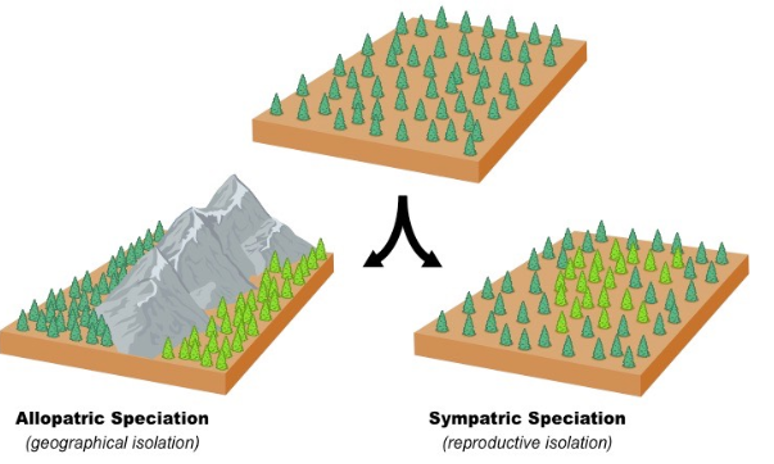
variation types
Plate tectonics:
Driver of speciation
Splitting of Pangea (200 ma) caused isolation, in turn speciation
But a lot of species diversity happened in last 60 ma
But doesn’t explain all biodiversity
Geological processes and biological evolution:
Formation of mountain ranges – e.g. south America has led to biodiversity hot spots
Volcanic activity has formed new islands, creating new habitats
Species have adapted to these environments and evolved in situ and are endemic (unique) to these places
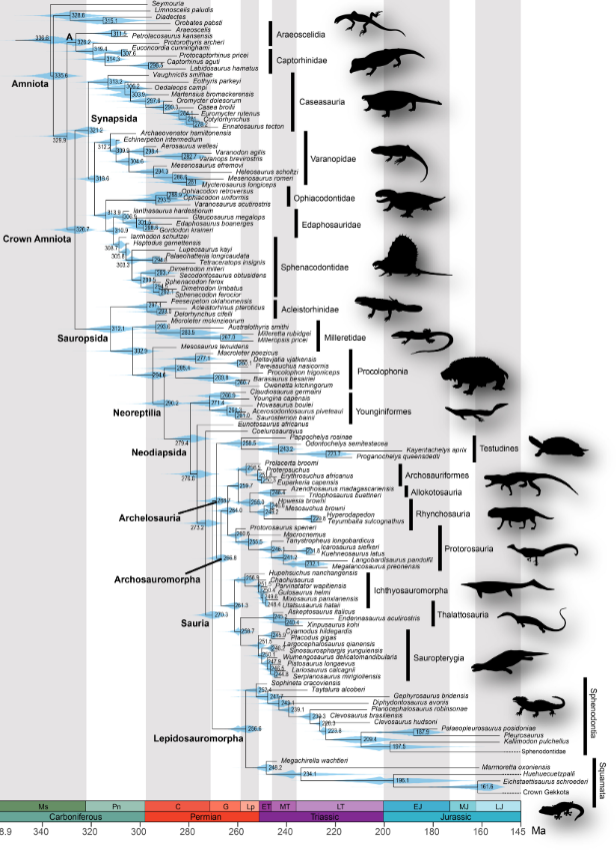
Climate change and evolution:
Climate change has driven evolution too
‘successive climate crises in the deep past drove the evolution and radiation (diversity) of reptiles’
Correlation between morphological features of species and climate
Individual species may adapt to environmental changes or disperse to new locations

