Chapter 2: Conditional Probability
 Studied by 0 people
 Call with Kai
 Learn
Learn Practice Test
 Spaced Repetition
 Match
Match Flashcards
 Knowt Play
1/12

There's no tags or description
Looks like no tags are added yet.
Name | Mastery | Learn | Test | Matching | Spaced | Call with Kai |
|---|
No study sessions yet.
13 Terms
Conditional probability
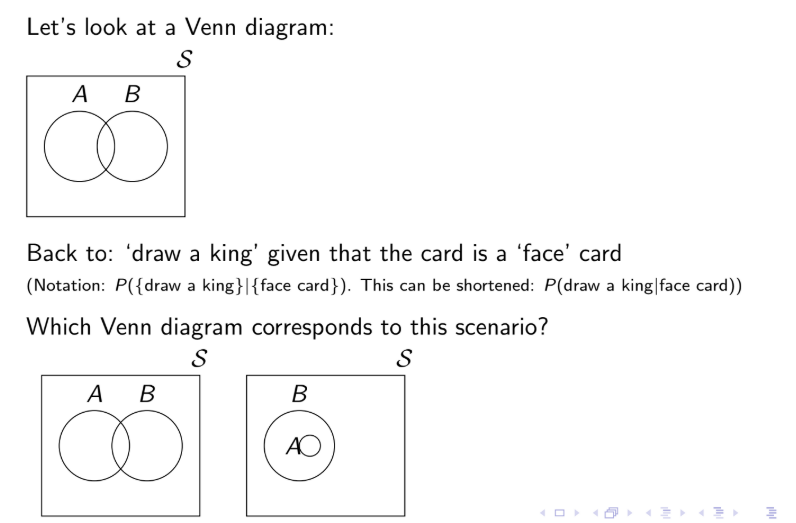
of the event A given the information that event B has occurred is denoted by P(A|B) and equals
Example: someone rolls a 6 sided die and tells you the result is even. What is the probability it is a 4 given that it is even? (Ans: 1/3)

Inutuition
if we say “given” or “conditional” on an event occurring, the effective sample space has changed.
Conditional Prob: Emails and spam
Example: about 50% of all emails are spam (S)
0.5% of all emails involve a subject line that is all-caps (C)
Given an email contains in all-caps subject line, the probability is not spam is .11 (P(S^c|C))
Some practice questions:

Definition of independence
Two events A and B are independent if ‘information’ about event A doesn’t provide ‘information’ about event B
Two events A and B are __ if ‘information’ about event A doesn’t provide ‘information’ about event B
independent
two events A and B are independent if and only if
This means we can conclusively prove events are independent or not
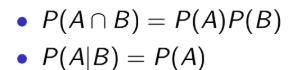
Independence and disjoint are not the
same
If two events A and B are independent
A^c and B are also independent
A and B^c are also independent
A^c and B^c are also independent
Summary: Effectively, any combination of events and complements are independent
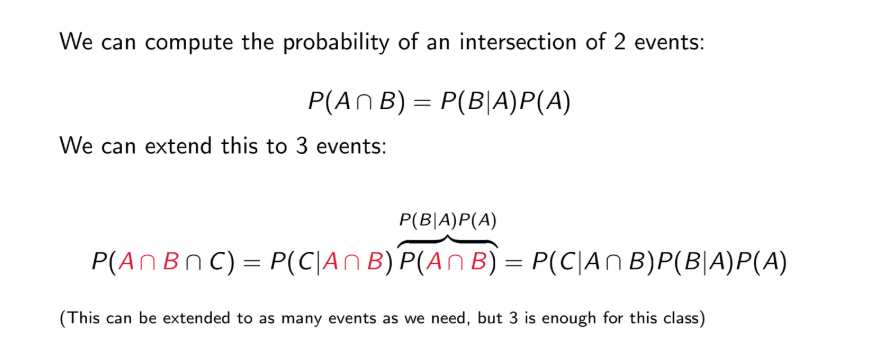
Multiplication rule
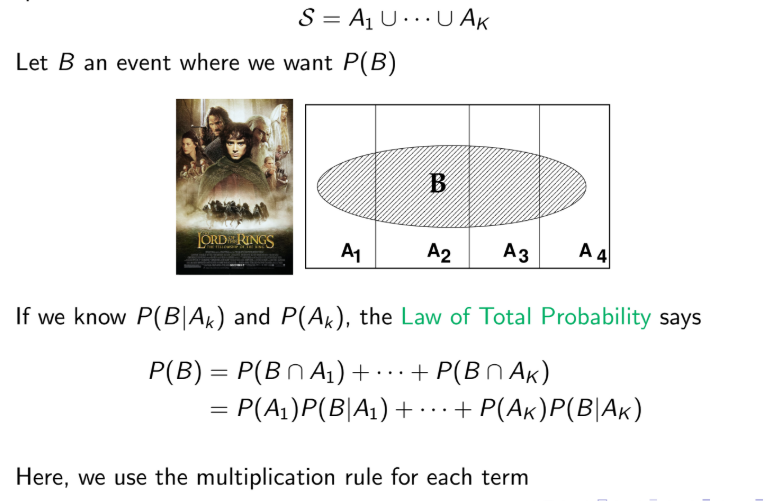
The law of total probability (LOTP)
let the events A1, A2,…AK be disjoint and make up the entire sample space:
Large Hardon Collider
At the CERN Large Hardon Collider (LHC), fundamental particles like the Higgs Boson (HG) can be created. Two primary detectors, ATLAS and CMS, are designed to find the HB
There is another secondary detector, LHCb, that can be used
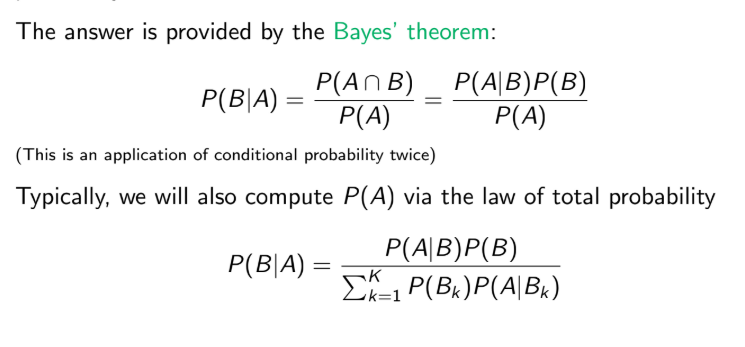
bayes theorem
Consider events A and B. Suppose we know the conditional probability of A given B. Now, we want to know: Given that A has occurred, what is the probability that B occurs? Consider events A and B. Suppose we know the conditional probability of A given B. Now, we want to know: Given that A has occurred, what is the probability that B occurs?
 Note
Note  Flashcards (93)