Edexcel IGCSE Biology; Inheritance
 Call Kai
 Learn
Learn Practice Test
 Spaced Repetition
 Match
Match Flashcards
 Knowt Play
1/93

There's no tags or description
Looks like no tags are added yet.
Name | Mastery | Learn | Test | Matching | Spaced | Call with Kai |
|---|
No analytics yet
Send a link to your students to track their progress
94 Terms
Genome definition
The entire genetic material of an organism
Gene definition
Section of a molecule of DNA that codes for a specific protein
Allele definition
Different versions of the same gene
Where are genes located within a nucleus
Genes arrange along the lengths of a chromosome, found in nucleus
What is a DNA molecule
Two strands coiled to form a double helix, with the strands being linked by a series of paired bases
What is a double helix
Two polynucleotide strands wrapped around each other in a spiral shape
What are the possible DNA bases
Adenine (A)
Thymine (T)
Cytosine (C)
Guanine (G)
What is an RNA molecule and how is it different to DNA
Singled Stranded, Contains Uracil (U) instead of Thymine (T)
What does DNA stand for?
deoxyribonucleic acid
Diploid vs Haploid cells
Diploid cells contain two sets of chromosomes
Haploid cells contain only one set of chromosomes
How many chromosomes do humans have
23 pairs - 46
How many chromosomes do gametes have
23 individual chromosomes
How are nucleotides joined?
Sugar phosphate backbone - phosphate group bonds to sugar in nucleotide above/below
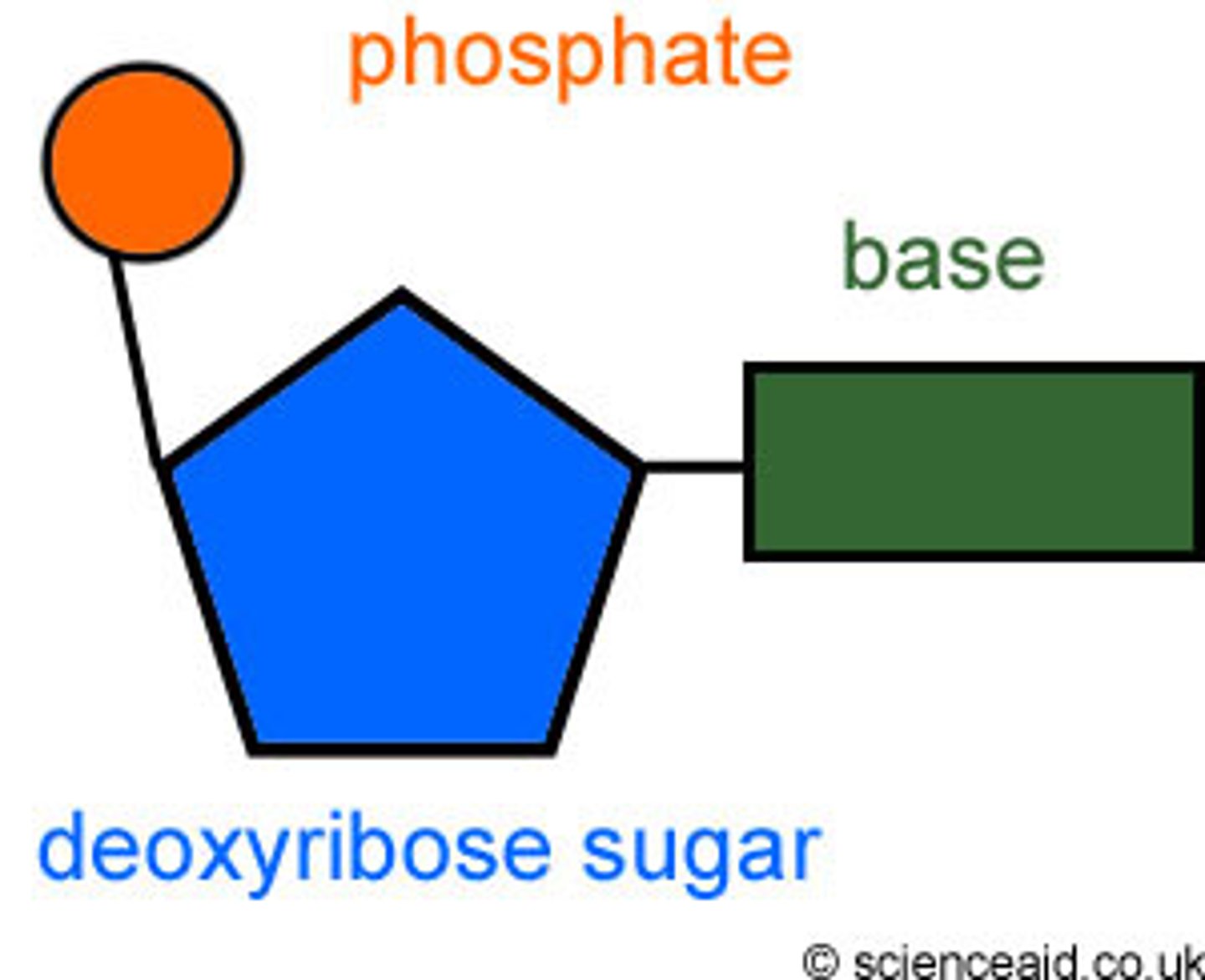
Structure of a nucleotide
phosphate group, sugar, nitrogenous base
What are the complementary base pairs
Adenine and Thymine
Guanine and Cytosine
What is polynucleotide
Contains many nucleotides linked together in a long chain
What is a nucleotide
Monomer - basic repeating unit of DNA
Name for a group of 3 bases for DNA, mRNA, tRNA
Triplet, Codon, Anticodon
Where are proteins synthesised?
Proteins are synthesised in the ribosomes in the cytoplasm
What are the stages of protein synthesis?
1. Transcription
2. Translation
What is the process of transcription and why is it needed?
Once a gene is activated, it must be copied into a form that can leave the nucleus, using mRNA, as DNA is too big to move out.
mRNA is also a sequence of bases, but it is shorter and single-stranded. It uses U instead of T as well.
RNA polymerase is the enzyme that joins together the base sequence to make mRNA.
It binds to a region of non-coding DNA
It then unzips the two DNA strands, and RNA polymerase moves along one of the strands of DNA
It uses the coding DNA in the gene as a template to make the mRNA. Base pairing ensures the mRNA is complementary to the gene
It then moves out of the nucleus and joins with a ribosome in the cytoplasm
What is mRNA and how does it differ from DNA
Messenger RNA:
single stranded nucleic acid
made from ribonucleic acid not deoxyribose
cannot form a double strand
Deoxyribose vs ribose
Sugar in DNA nucleotides
Sugar in RNA nucleotides
What is the problem with amino acids?
There are lots of different combinations for the same amino acids - only the first two bases of the codon affect the amino acid created
How many possible combinations are there of the 3 bases?
64 (4^3)
What does a ribosome look like
Large subunit, small subunit make up te ribosome, with the tRNA going into the large and the mRNA going into the small
What is tRNA?
tRNA is transfer RNA, found as free molecules in the cytoplasm.
It can carry specific amino acids found also in the cytoplasm, with an anticodon that corresponds to a specific codon on the mRNA.
What is the process of transcription?
Once the mRNA is bound to a ribosome, the protein can be assembled.
The order in which amino acids are brought to the ribosome matches the order of the codons in the mRNA
tRNA has a structure called an anticodon, which is complementary to the codon for the amino acid. This ensures amino acids are brought to the ribosome in the correct order.
The amino acids are joined together by the ribosome, which makes a protein.
What joins each amino acid in a protein
Peptide bond
When does mitosis occur?
Growth, repair, cloning and asexual reproduction
What is the diploid and haploid number of chromosomes in human cells?
Diploid - 46; Haploid - 23
What is the definition of mitosis
Nuclear division giving rise to genetically identical cells
What happens before mitosis?
Before mitosis, the cell is in interphase. It gets bigger and makes more organelles and replicates the DNA.
These copies are joined together and known as sister chromatids.
How does fertilisation work
Sperm cell fuses with egg cell in fallopian tube
Sperm forms zygote by passing genetic information to egg
Both gametes must be haploid
Process of meiosis
The cell duplicates its DNA so there’s enough for a new cell. One arm of the X chromosome is an exact copy of the other
In the first division, chromosomes line up in pairs in the centre. One in each pair comes from the mother/father.
The pairs are pulled apart, so each cell only has one copy of each chromosome.
Each new cell will have a mixture of both parents, which is important as it creates genetic variation.
In the Second division, they line up again in the centre. The arms are pulled apart
Four haploid gametes are made. They will each have a single set of chromosomes. They are all genetically different.
What is recombination of the chromosomes in meiosis
also called genetic recombination, is the process that introduces genetic diversity into the gametes during meiosis.
Why is their halving involved in meiosis
Must be halved when gametes are formed
Otherwise there would be double number of chromosomes after they join at fertilisation in zygote
What are homologous chromosomes?
Two genetically similar chromosomes, one from each parent - same genes but could be different versions
Mitosis (Num. daughter cells, Genetic difference, Diploid/Haploid daughter cells, Stages of cell division, Movement at equator)
2, Genetically Identical, Diploid, One stage, Line up along equator
Meiosis (Num. daughter cells, Genetic difference, Diploid/Haploid daughter cells, Stages of cell division, Movement at equator)
4, Genetically different, Haploid, 2 stages, Pair up at equator
What is meiosis used for?
Production of gametes, Increase genetic variation
How does meiosis introduce variation
Forming new combinations of maternal and paternal chromosomes every time gamete is made, so when they fuse randomly at fertilisation offspring will be different
Where does genetic variation come from
Random fusion of gametes at fertilisation creates genetic variation between zygotes
Ways of causing phenotypic variation
Genetic:
Random fusion of gametes at fertilisation creates genetic variation between zygotes
Environmental:
scarring, weight, height (e.g. plant growing to reach more light)
Discontinuous vs continuous variation
discontinuous = characteristics fall into certain groups
with no overlap (e.g. blood group) - determined by genetics only ; will give step-like graph if plotted
continuous = characteristics show a range (e.g. height) - determined by genetic and environmental factors ; will give smooth bell curve if plotted
How is height affected by both genetic and environment
Continuous variation:
Tall parents pass genes for child to be tall
Have genetic potential to be tall
However if diet is poor then they will not grow well
So environment has impact on height
Why is the tRNA anticodon important for its function?
Anticodon is complementary to mRNA codon for an amino acid, pairing ensures amino acids are brought in correct order
Why are nuclear pores necessary for RNA polymerase to carry out its function
RNA polymerase is protein - produced by ribosomes in cytoplasm
Nuclear pores allow it to move from cytoplasm to nucleus to carry out its function
What is non overlapping DNA
• each triplet / codon codes for one amino acid / eq (1)
• codons are discrete / independent of each other / nucleotides /
bases are not shared between codons / eq (1)
• example of triplet reading frames, e.g. CAT TCA / eq
Translation stage
mRNA arrives at) ribosome (1)
• mRNA has codons / is a template (1)
• ribosome moves along mRNA strand (1)
• tRNA brings amino acids (to ribosome) (1)
• anticodon (on tRNA) binds with codon (on mRNA) / tRNA binds
with mRNA (1)
• amino acid chain produced / amino acid joined / polypeptide (1)
Why might mutation not affect phenotype
Protein can be coded with multiple codons
Mutations will not change encoded aminos acid
Means protein won't change
Chromosome definition
Thread-like structures of DNA that carry genetic information in the form of genes, located in the nucleus of cells
Dominant vs recessive
Dominant - always expressed, even if only one is present (CAPITAL)
Recessive - only expressed if dominant allele is absent - so needs two to be expressed (lower case)
Homozygous vs heterozygous
Homozygous - two alleles of gene are the same
Heterozygous - individual has two different alleles - both dominant and recessive
Genotype vs phenotype
Genotype - Combination of alleles that control a characteristic
Phenotype - Observable, physical characteristics of an organisms
Codominant definition
Both of the alleles of a characteristic are expressed in the phenotype - neither are recessive; only n heterzygous
Polygenic inheritance vs monohybrid inheritance
Polygenic - Characteristics are controlled by more than one gene - interaction of multiple
Monohybrid - controlled by single gene
How to draw a Punnett Square
For monohybrid inheritance
Show genotype on top and left for each individual
Go inwards one, separate into separate alleles
Complete 4 squares, combining each alleles with one from the other
Write the genotypes created, the associated phenotype, the ratio, and therefore the probability
What does pure breeding mean
An individual has homozygous pair of alleles for that characteristic
What is a family pedigree
Trace patterns of inheritance of specific characteristic through generations;
Square is male, circle is female
Horizontal lines show male and female have produced children
What are the sex chromosomes
Sex is determined by entire chromosome pair
XX- female
XY- male - only father can pass on Y gene
Mutation definition
Random changes in the sequence of DNA bases in a gene or chromosome, leading to genetic variation
How to increase rate that mutations occur
Factors known as mutagens - environmental factors
Ionising radiation like X-Rays
Chemical Mutations, like in cigarette smoke
Increase rate of mutations increases likelihood of cells becoming cancerous
What is a silent mutation
alters a base but does not change the amino acid
Frame shift
genetic mutation that shifts the "reading" frame of the genetic message by inserting or deleting a nucleotide;
Types of genetic mutation
Substitution - base in DNA sequence randomly swapped for a different base, only changes amino acid for group of thee baes where mutation occurs - no knock on
Frame shift mutations:
Insertion - New base randomly inserted into DNA sequences
Deletion - base is randomly deleted from sequence
Consequences of a mutation
Most mutations have no effect on phenotype
Some significantly alter protein coded, affecting ability to perform function - e.g. if shape of active site changes, no longer form enzyme-substrate complex
Some cause development of alleles, new phenotypes
Some cause survival advantage
Sickle cell anemia
Gene mutation changes haemoglobin , so RBCs become stiff and sickle shaped when they release O2
Get stuck in narrow blood vessels, blocking flow
May cause stroke, blindness, damage to lungs kidney or heart
Darwin's theory of evolution
Change in inherited characteristics and frequency of phenotype of population over time through process of natural selection
Ones most suited to environment have higher chance of survival and reproduction
So characteristics passed to offspring at higher rate than those less suited
Beneficial characteristics become more common in population, species changes
This is 'survival of the fittest'
Evolution definition
the change in the frequency of a phenotype in a population over many generations
Example of Darwins Theory of Evolution
Black peppered moths were originally lighter coloured
Pollution means bark of trees is darker, dark moths can camouflage
So get darker over time
Stages of selective breeding in animals
Humans select individuals with desired characteristics and breed together
From offspring select those with best characteristics, breed together
Repeat generation after generation, selecting only individuals with desired characteristics for breeding
Eventually so little variation all offspring will have desired characteristics
Selective breeding definition
Selecting and breeding parent organisms to pass on specific traits to offspring
Ethical considerations of selective breeding
Young without desired may be put down
Breeding can be encouraged naturally by adding hormones
Or artificially - artificial insemination
Could cause black market
Selective breeding in plants
Select individuals with desired characteristics, remove stamen and stigma of rest
Using brush, transfer pollen from stamen of one desired to stigma of other
Grow seeds, select individuals with best
Repeat for many generations
Eventually little variation
What are antibiotics
Chemical substances made by certain fungi or bacteria that affect the working of bacterial cells, either by disrupting their structure or function or by preventing them from reproducing
How is antibiotic resistance caused?
Bacteria have random mutations in DNA
May give resistance to antibiotic
Therefore more adapted to environment, all else with be killed when in presence of antibiotic
Survive more, reproduce more
Pass on allele more
Repeated every generation
Proportion of bacteria with resistant allele increases until most have it
Preventing antibiotic resistance
Avoid overuse - not in non-serious infection
Not for viral infections
Finish whole course so all are killed, none are left to mutate
Reduced in industries like agriculture
Reducing spread of resistant strains
Good hygiene - handwashing, hand sanitisers
Isolation of infected patients to prevent spread of resistant strains
Why do antibiotics not work on viruses?
Antibiotics work by disrupting cell functions like respiration
However viruses do not carry out cell function or have cell walls, cell membranes or cell organelles
Why does deletion change protein produced but substitution does not
Substitution may just change final base - three bases all code for same amino acid - degeneracy/redundancy of DNA
However deletion causes frame shift mutation - knock on effect
Writing frame for natural selection
VMASRA
Variation in a species due to random genetic mutation
A - gives advantage to species
S - Survive more
R - So reproduce more
A - Advantageous Alleles are passed down to the next generation, repeated over many generations
Then mention the increase in number and increase in frequency/proportion with allele
Why would the predicted ratio of offspring not be obtained
Same size too small (not enough crosses)
Random fusion of gametes at fertilisation
Some may be more likely to die
Mutations may have occured
How to ensure flowers only self pollinate
Enclose stamen and stigma in a bag/isolate plants, pollinate by hand with a brush; prevent cross pollination
Differences between sexual and asexual reproduction
Sexual requires two gametes
Sexual has genetic variation
Sexual involves fertilisation
Sexual is slower
Difference between dominant allele and recessive allele (3)
Dominant is always expressed, expressed in heterozygous but recessive is not, recessive is only expressed if homozygous recessive - in absence of dominant
How to tell if an organism have a characteristics that isn't immediately obvious
Look at family history
Genetic Test
Look for combination of symptoms
How can family pedigree show recessive allele is present
Condition present in offspring but not parents; skips generations; carriers present
Differences between selective beeding and natural selection
Selective breeding is:
Faster
Done by humans
Characteristic may not even be advatangeous or affect survival
Why might mutation have little effect on phenotype
• change in base may code for same amino acid (1)
• amino acid may not be involved in active site (1)
• enzyme still made/still functions/equivalent (1)
• could be recessive allele (1)
• so not expressed in phenotype (1)
How does mutation affect functioning of enzyme
• change in the order of bases/equivalent (1)
• leads to different codon (1)
• different amino acid in protein (1)
• different-shaped enzyme/change to active site/enzyme not made/equivalent (1)
Natural selection definition
the process whereby organisms better adapted to their environment tend to survive and produce more offspring
Why might offspring not have desired characteristics
Recessive alleles also contribute to genotype and therefore phenotype
Random fusion of gametes at fertilisation
Mutations
Genes are randomly selected
How to selectively breed fish for fast growth
Select fish that you can see are growing quickly - have desired characteristic
Breed them together, repeat over several generations
Alleles for fast growth are passed on

