4.4 Genetic diversity and adaptation
 Studied by 1 person
 Call with Kai
 Learn
Learn Practice Test
 Spaced Repetition
 Match
Match Flashcards
 Knowt Play
1/20

There's no tags or description
Looks like no tags are added yet.
Name | Mastery | Learn | Test | Matching | Spaced | Call with Kai |
|---|
No analytics yet
Send a link to your students to track their progress
21 Terms
What is genetic diversity?
Number of different alleles of genes in a population
What are alleles and how do they arise?
● Variations of a particular gene (same locus) → different DNA base sequence
● Arise by mutation
What is a population?
● A group of organisms of the same species in a particular space at a particular time
● That can (potentially) interbreed (to produce fertile offspring)
Explain the importance of genetic diversity
● Enables natural selection to occur
● As in certain environments, a new allele of a gene might benefit its possessor
● By resulting in a change in the polypeptide (protein) coded for that positively changes its properties
● Giving possessor a selective advantage (increased chances of survival and reproductive success)
What is evolution?
● Change in allele frequency (how common an allele is) over many generations in a population
● Occurring through the process of natural selection
Explain the principles of natural selection in the evolution of populations
1. Mutation
Random gene mutations can result in [named] new alleles of a gene
2. Advantage
In certain [named] environments, the new allele might benefit its possessor [explain why] → organism has a selective advantage
3. Reproduction
Possessors are more likely to survive and have increased reproductive success
4. Inheritance
Advantageous allele is inherited by members of the next generation (offspring)
5. Allele frequency
Over many generations, [named] allele increases in frequency in the population
Describe 3 types of adaptations
Natural selection results in species that are better adapted to their environment:
● Anatomical - structural / physical features that increase chance of survival
● Physiological - processes / chemical reactions that increase chance of survival
● Behavioural - ways in which an organism acts that increase chance of survival
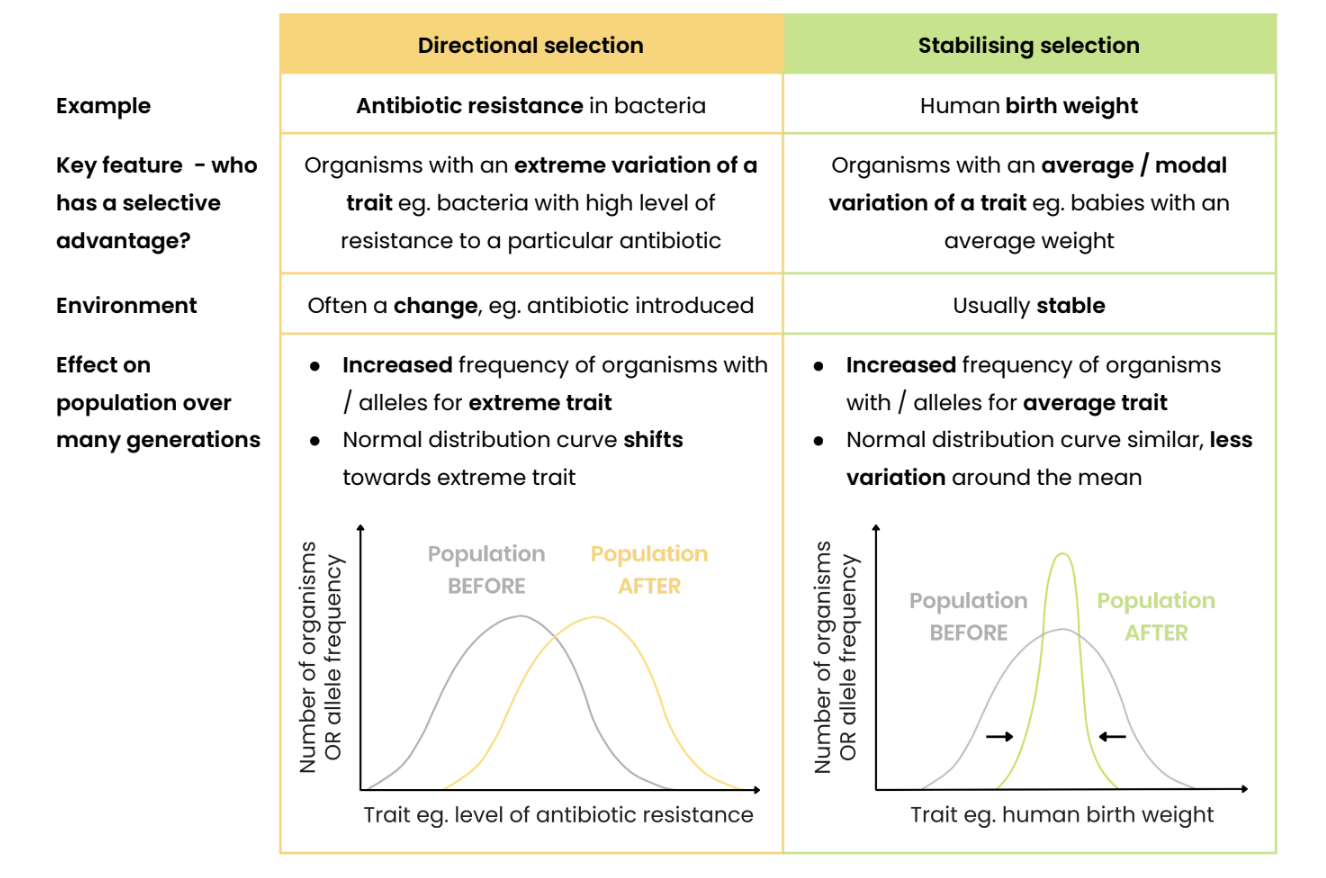
Explain two types of selection, with examples
Required practical 6
Use of aseptic techniques to investigate the effect of antimicrobial substances on microbial growth.
Explain examples of aseptic techniques that could be used
● Wash hands with soap / disinfect surfaces → kill microbes / prevent contamination
● Sterilise pipette / spreader / boil agar growth medium → kill microbes / prevent contamination
● Flame neck of bottle of bacteria → kill microbes / prevent contamination
● Bunsen burner close → upward current of air draws air-borne microbes away to prevent contamination
● Lift lid of petri dish slightly / minimise opening → prevent entry of microbes / contamination
Describe a method to investigate the effect of antimicrobial substances (eg. antibiotics, disinfectants, antiseptics) on microbial growth
1. Prepare area using aseptic techniques (as above)
2. Use a sterile pipette to transfer bacteria from broth to agar plate using aseptic techniques (as above)
3. Use a sterile spreader to evenly spread bacteria over agar plate
4. Use sterile forceps to place same size discs that have been soaked in different types / concentrations of
antimicrobials for same length of time, onto agar plate (at equal distances)
5. Lightly tape lid onto plate (not fully sealed), invert and incubate at 25
oC for 48 hours
6. Measure diameter of inhibition zone around each disc and calculate area using πr²
Explain why it is important to maintain a pure culture of bacteria. (1)
● Bacteria may outcompete bacteria being investigated
● Or could be harmful to humans / pathogenic
Explain why the lid is held with 2 pieces of tape and not sealed completely. (2)
● Allows oxygen in preventing growth of anaerobic bacteria
● More likely to be pathogenic / harmful to humans
Explain why a paper disc with water / no antimicrobial agent is used. (2)
● Act as a control
● Ensuring antimicrobial prevented growth, not paper disc
Explain why petri dishes are incubated upside down. (1)
● Condensation drips onto lid rather than surface of agar
Explain how zones of inhibitions can be measured if irregular. (1)
● Repeat readings in different positions, calculate a mean
Explain why a higher antimicrobial concentration isn’t used. (1)
● More bacteria killed so clear zones may overlap
Explain why bacteria should be incubated at 25oC or less in a school laboratory. (1)
● Below human body temp to prevent growth of pathogens
Explain the presence and absence of clear zones
1. Clear zones → antimicrobial diffuses out of disc into agar, killing / inhibiting growth of bacteria
○ Larger clear zones → more bacteria killed → more effective antimicrobial
2. No clear zones → if antibiotic used, bacteria may be resistant or antibiotic may not be effective against that specific bacteria
Describe how data about the effect of antimicrobial substances can be presented as a graph
● Categorical data → bar chart, eg.
○ X axis type of antimicrobial
○ Y axis area of zone of inhibition / mm3
● Continuous data → line graph joined by a line of best fit, eg.
○ X axis concentration of antibiotic / μgmL^-1
○ Y axis area of zone of inhibition / mm3
 Note
Note  Flashcards (20)