Unit 6: Fiscal and Monetary Policy
 Studied by 1 person
 Call Kai
 Learn
Learn Practice Test
 Spaced Repetition
 Match
Match Flashcards
 Knowt Play
1/78

Earn XP
Description and Tags
Merged flashcards from several presentations of Unit 6 in an Economics class.
Name | Mastery | Learn | Test | Matching | Spaced | Call with Kai |
|---|
No analytics yet
Send a link to your students to track their progress
79 Terms

AD-AS model
A model that helps visualize the entire economy’s behavior and effects of potential governmental intervention based on aggregate demand and aggregate supply in an economy
Where the two curves meet determine real GDP, average price levels, and current business cycle status

Aggregate demand (AD)
The total amount of spending on goods and services in the entire economy
Fiscal policy
Policies developed by a government relating to taxes and spending
Monetary policy
Policies developed by a government relating to interest rates and the money supply

Aggregate supply (AS)
The aggregate quantity of output supplied to the economy, modeled through a curve showing its relationship to the aggregate price level

Short-run aggregate supply (SRAS)
An upward-sloping curve showing output changes with price levels in the short run

Short-run aggregate supply shifts (SRAS shifts)
Created by input costs, technology, productivity, and supply shocks relating to a company’s total production of supply

Long-run aggregate supply (LRAS)
A vertical line representing the economy’s maximum total potential output, fixed by long-term factors like labor, capital, and technology and not price levels

Long-run equilibrium
The state where the economy’s aggregate demand, short-run aggreate supply, and long-run aggregate supply curves all intersect at a single point — indicating that the economy is at maximum potential and demand is being adequately fulfilled

Potential output
Full employment and output where AD, SRAS, and LRAS all intersect
Output gap
Any difference between actual aggregate output and potential output

Recessionary gap
Occurs when aggregate output falls below potential output

Inflationary gap
Occurs when aggregate output rises above potential output
Taxes
How federal, state, and local governments primarily raise money to pay for schools, roads, and national programs
Raises or lowers aggregate demand as part of the government’s fiscal policy for cooling or growth
Government revenue
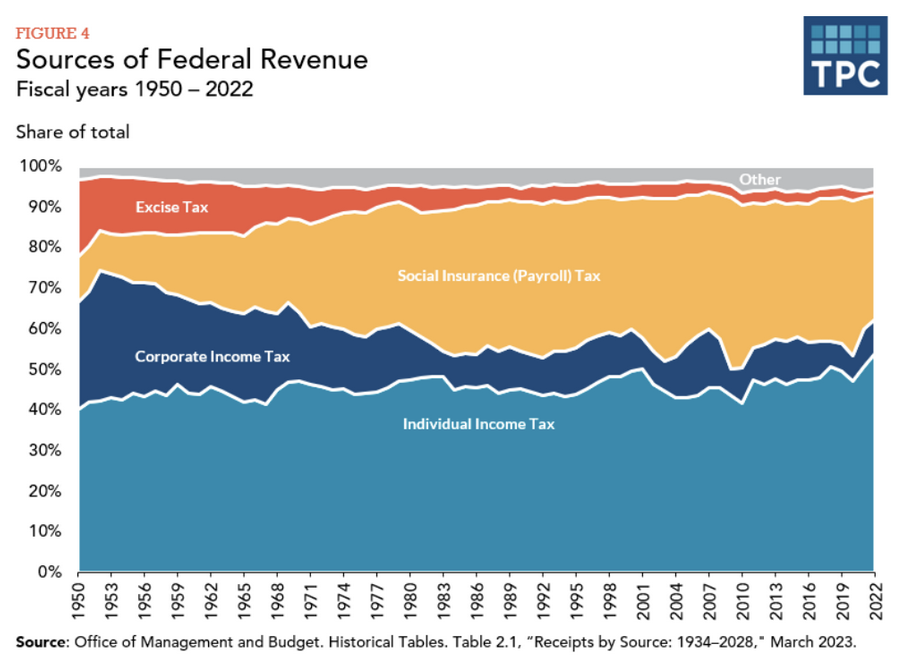
Money the government receives from taxes and other sources
About 84% of this comes from individual income taxes and payroll taxes for Social Security and Medicare
About 11% of this comes from corporate income taxes
The remaining 5% comes from excise taxes, tariffs, fees, and other sources
Congress
The body of government given the power to “lay and collect taxes” according to Article I, Section 8 of the Constitution for:
The payment of debt
The common defense
General welfare
Cannot levy taxes on religious services, exports, or polls, as they were used to restrict voting in the past
Progressive tax
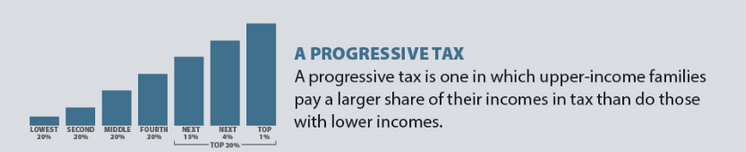
A tax structure that makes a person’s effective tax rate rise with their income level, as seen in the federal income tax
Serves as an automatic stabilizer to reduce tax burdens on the low income while increasing taxes on the higher income

Regressive tax
A tax structure that makes a person’s effective tax rate fall with their income level, as seen in sales taxes
Higher income households spend a lower portion of their incomes on taxable goods and services

Proportional tax
A tax structure that makes a person’s tax rate the same across all income levels with minimal deductions or exemptions
Tax base
The income, property, good, or service that is subject to a tax; seen in the forms of personal earnings, company profits, real estate, and goods and services sold
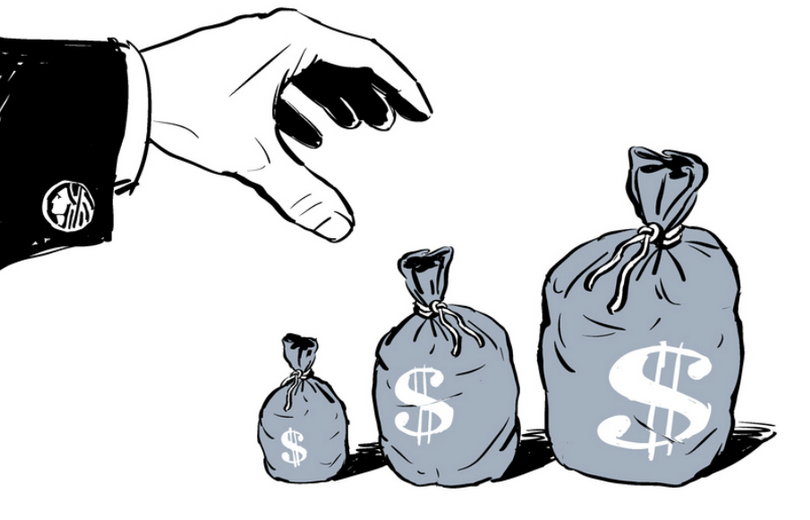
Pay as you earn
A tax collection system where money is withheld from a paycheck throughout the year by employers to avoid a large tax bill during filing season
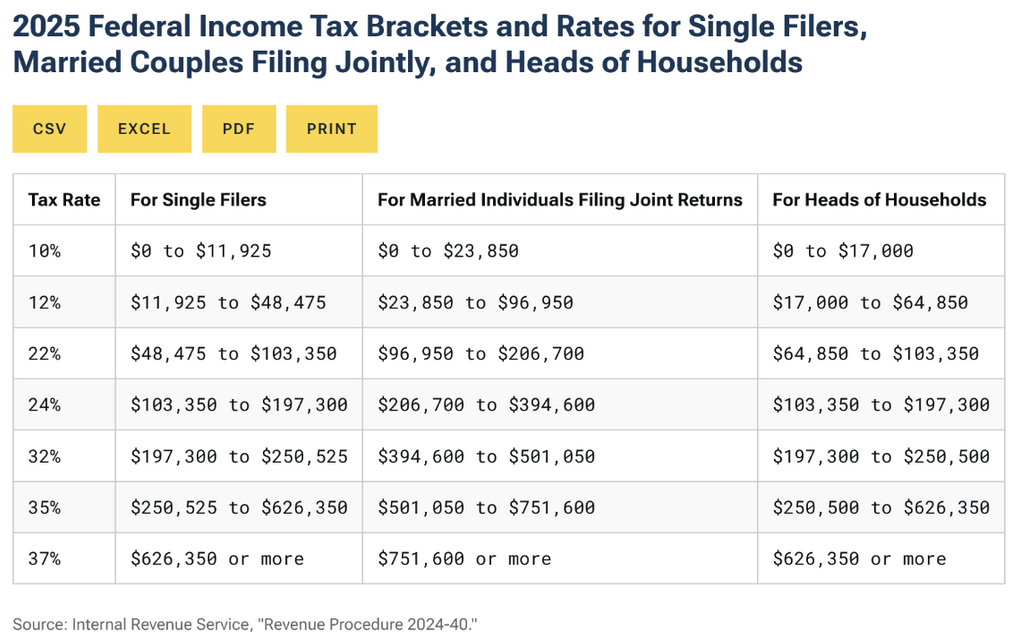
Taxable income
The income one earns (minus exemptions and deductions) that can be taxed
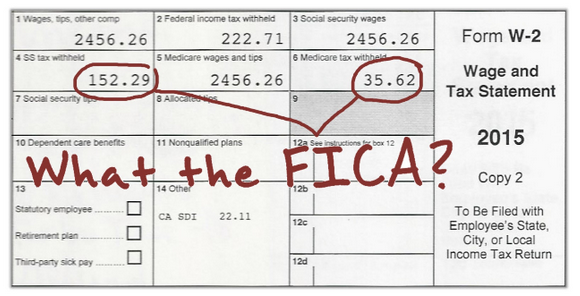
Federal Insurance Contributions Act (FICA)
Act that funds Social Security and Medicare through payroll withholdings and employer contributions
Corporate income tax
A progressive tax paid on corporate profits
Excise tax
A regressive tax on specific items, such as gasoline, cigarettes, and alcohol
Estate tax
A tax on the total value of an estate that changes year-by-year
In 2025, this applied to any estate worth over $13.99 million
Tariffs
Taxes on imported goods
Once one of the most important sources of federal revenue; today, they represent just a tiny share
Intended to protect American industries with better trade deals, lowered trade deficits, and increased government revenue
State revenue
Mostly in the form of:
Personal income taxes
Sales taxes
Excise taxes
Corporate income taxes
Charges (university tuition, tolls, park fees)
Federal funds (for healthcare and low-income programs; one-third of total revenue in many)
Funds are often passed on to lower levels
Local revenue
Revenue that goes to counties, cities, towns, and school and special districts for schools, emergency services, libraries, parks, and utilities in the form of:
Property taxes (largest contributor)
Sales taxes
Income taxes
Fees for utilities, land, and public resources
Intergovernmental transfers
Grant
A portion of money set aside to another entity for a designated program
The federal government offers these to states and localities for healthcare, income support, transportation, and education
Fiscal policy
Policies the government adopts to speed up or slow down economic growth for stable aggregate supply and aggregate demand
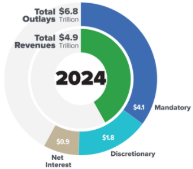
Government revenue
Funds that flow into the government from personal income, social insurance, and corporate profit taxes
Education and defense
The largest purchases of the United States using tax revenue
Medicare and Social Security
The largest transfers of the United States using tax revenue
GDP
The sum total of net exports, consumer spending, government spending, and investment spending
Government spending
Spending performed by the government as it purchases goods and services
Consumer spending
Spending performed by consumers
Can be influenced by the government through effects on disposable income with taxes and government transfers
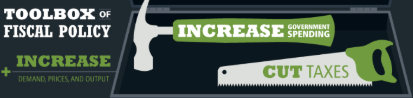
Expansionary fiscal policy
Fiscal policy that increases aggregate demand, decreasing a recessionary gap to shift aggregate demand rightward for a restoration to LRAS
Seen through:
Increasing government spending
Reducing taxes
Increasing government transfers
These all indirectly boost consumer, investment, and government spending
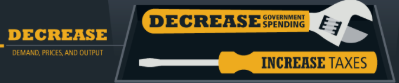
Contractionary fiscal policy
Fiscal policy that reduces aggregate demand, decreasing an inflationary gap to shift aggregate demand leftward for a restoration to LRAS
Seen through:
Reducing government spending
Increasing taxes
Reducing government transfers
These all indirectly lower consumer, investment, and government spending
Discretionary fiscal policy
Fiscal policy that is the result of deliberate actions by policy makers, which can modify taxes or legislation to shift AD to the left or the right
Often used sparingly due to the problems associated with time lags
Time lag
The time between an incident and the adoption of discretionary fiscal policy, caused by:
Delays in the realization of an output gap
The time used to agree on an expansionary or contractionary plan
The time taken to adjust its spending
This can result in a significant delay, potentially even long enough for a market self-correction
Automatic stabilizers
Government spending and taxation rules that cause fiscal policy to be automatically expansionary or contractionary when the economy contracts or expands
Progressive tax policies are an example of this, where lowered tax rates and aid programs apply to the lower income
These can allow for aggregate demand to shift according to this increased or reduced spending
Classical economics
School of thought based on the idea that free markets regulate themselves
Believes that struggling economies can recover on their own
Does not account for the time needed to return to equilibrium
Challenged by the Great Depression with inadequate self-regulation, high unemployment, and immense bank failures

Keynesian economics
School of thought that uses demand-side theory as the basis for encouraging governmental action to help the economy
Developed by John Maynard Keynes, focusing on the economy as a whole with governmental responsibility to boost demand
Drastically changed the role of government in the United States’ free enterprise system, used to fight periods of recession and inflation for full productive economic capacity

John Maynard Keynes
British economist that developed Keynesian economics, promoting more governmental intervention

Multiplier effect
A concept in Keynesian economics that refers to the idea that every one-dollar change in fiscal policy creates a change greater than one dollar in the national income, multiplying the effects of changes in fiscal policy

Spending multiplier
Aspect of the mutiplier effect that demonstrates how governmental purchases of goods and services boost GDP both directly and indirectly
Seen through defense spending with contractors spending money that flows throughout the economy
Supply-side economics
School of thought based on the idea that the supply of goods drives the economy
Taxes thus have a strong negative effect on economic output

Laffer Curve
A graph that illustrates the effects of taxes on revenue, demonstrating how a moderate optimal tax rate can produce more revenue than a lower or higher tax

Budget gap
Occurs when the government spends more or less than it earns in the budget
Budget surplus
Occurs in any year when revenues exceed expenditures, with more money going into the Treasury than coming out of it
Budget deficit
Occurs in any year when expenses exceed expenditures, with more money coming out of the Treasury than going into it
Often a common characteristic of the economy in recent decades
Can be dealt with through money creation for small amounts and debt through bonds for larger amounts
Savings bond
A bond that allows people to loan the government small amounts of money, and in return, they earn interest on the bonds for up to 30 years
Treasury bills
Short-term bonds that have maturity dates of 26 weeks or less
Treasury notes
Bonds that have maturity dates of 2 to 10 years
Treasury bonds
Bonds that have maturity dates of 30 years after issue

National debt
The total amount of money the federal government owes to bondholders
Increases every year there is a budget deficit and the federal government borrows money to cover it
Best viewed as a percentage of GDP over time due to the large amount
Concerns have been raised over the goverment’s large interest payments and foreign involvement
National deficit
The amount of money the government borrows for one fiscal year

Crowding-out effect
Occurs with a higher national debt and reduced funds available for businesses as funds are used to pay for interest
Crowds out private firms that would have borrowed these funds for investment spending, potentially reducing economic growth
Gramm-Rudman-Hollings Act (1985)
An act that created automatic across-the-board cuts in expenditures if the deficit exceeded a certain amount
While it did exempt many programs, the Supreme Court ruled that some parts of the Act were unconstitutional
Further revisions led to a shifted focus towards spending control, not significantly reducing the national debt

Monetary policy
The actions of the Federal Reserve to manage the money supply and credit conditions to achieve sustainable economic growth
This affects interest rates (the cost of borrowing money), which in turn can affect the level of spending and investment in the economy
Must be carefully timed and planned for steady and sustainable pacing
Dual Mandate
The two duties of the Federal Reserve to promote maximum employment and price stability
Maximum employment
The highest level of employment that the economy can sustain while maintaining a stable inflation rate (generally considered to be 2%)
Price stability
A low and stable rate of inflation maintained over an extended period of time

Federal Open Market Committee (FOMC)
The group within the Federal Reserve System that conducts monetary policy
5 Reserve Bank Presidents and 7 Governors have voting rights while the rest are simply part of the committee
Meets 8 times a year, 2 days at a time to assess appropriate monetary policy decisions
Their set target rate goes on to affect the market, business, employment, and inflation later on
Reserve balance accounts
Where banks can hold cash at the Federal Reserve
These are used for loans to other banks in a federal funds transaction
Federal funds transaction
The transfer of funds from one bank’s reserve account to another bank’s reserve account

Federal funds rate (FFR)
The interest rate agreed upon in a federal funds transaction between two banks
Set by the Federal Reserve through a target level achieved with open market operations
Helps influence rates in the economy as well as business and consumer decisions
Required reserve
The amount of money banks are required to keep in their deposits
Lowering of this can increase the money supply and aid high unemployment
Raising of this can reduce lending and aid high inflation
Not often adjusted compared to other methods of administering monetary policy
Discount rate
The interest rate the Federal Reserve charges on loans to financial institutions
Primarily used to ensure sufficient funds are available in the economy
Set above the Federal Funds Rate
Prime rate
The rate of interest that banks charge on short-term loans to their best customers
This is affected by the Federal Funds and discount rates

Open market operations
The buying and selling of government securities in order to alter the supply of money through transactions
Is the most important and most often used tool employed by the Federal Reserve to implement monetary policy
Easy money policy
Policy that increases the money supply with lower interest rates to encourage investment spending
Tight money policy
Policy that decreases the money supply with higher interest rates, lowering investment spending to avoid high inflation
Inside lag
The time it takes to identify and implement a policy
More severe for fiscal policy because it includes changes in taxes and spending, as monetary policy does not have to go through Congress and the President
Outside lag
The time it takes for a policy to have an effect
More severe for monetary policy because it primarily affects business investment plans, which may not have a full effect on spending for several years
Keynesian economics
An economic school of thought that emphasizes fiscal policy over monetary policy, smoothing out the business cycle with government spending
Monetarism
An economic school of thought established by Milton Friedman that believes that the money supply is the most important factor in macroeconomics
Classical economics
An economic school of thought that believes in self-correction, recommending against new policies and arguing that governmental intervention disrupts the proper functioning of a free-market economy
 Note
Note  Flashcards (66)