Density and pressure (4.3)
 Studied by 0 people
 Call Kai
 Learn
Learn Practice Test
 Spaced Repetition
 Match
Match Flashcards
 Knowt Play
1/7

There's no tags or description
Looks like no tags are added yet.
Name | Mastery | Learn | Test | Matching | Spaced | Call with Kai |
|---|
No study sessions yet.
8 Terms
What is density?
Density - mass per unit volume of an object
ρ = m/v
Where ρ is density in Kgm-3
Where m is mass in Kg
Where v is volume is m3
What is pressure?
Pressure - force per unit area
p = F/A
Where P is pressure in Nm-2 / Pa
Where F is force in N
Where A is area in m2
Thus if force is spread over a larger area there will be a lower pressure
What is hydrostatic pressure?
Hydrostatic pressure - the pressure at any given point within a fluid, that is exerted by the weight of the fluid above that point
If a fluid is at rest then all points within it are in equilibrium and the pressure acts in all directions at each point
What is the equation for hydrostatic pressure and how is it derived?
Derivation
The weight of the fluid above the object with area A, can be given as:
W = mg
Using the density equation, mass can be found:
ρ = m/v
m = ρv = ρAh - where h is the depth of the object under the surface of the fluid
Thus:
W = ρAhg
Thus the pressure can be given as:
p = F/A
p = ρAhg/A = ρhg
Within the cube there is a difference in pressure between the top and bottom surfaces:
∆p = ρ∆hg
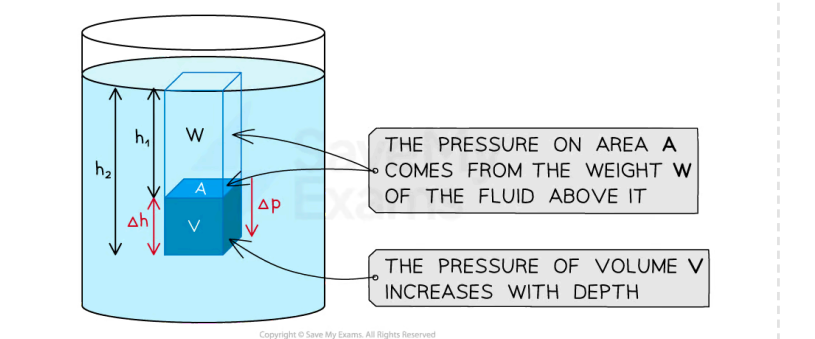
Equation
∆p = ρ∆hg
Where ∆p is the change in pressure in Pa
Where ρ is the density of the fluid in Kgm-3
Where ∆h is the change in height in m
Where g is the gravitational field strength in NKg-1
What is a u-tube manometer?
U-tube manometer - instrument to measure density and pressure of two liquids
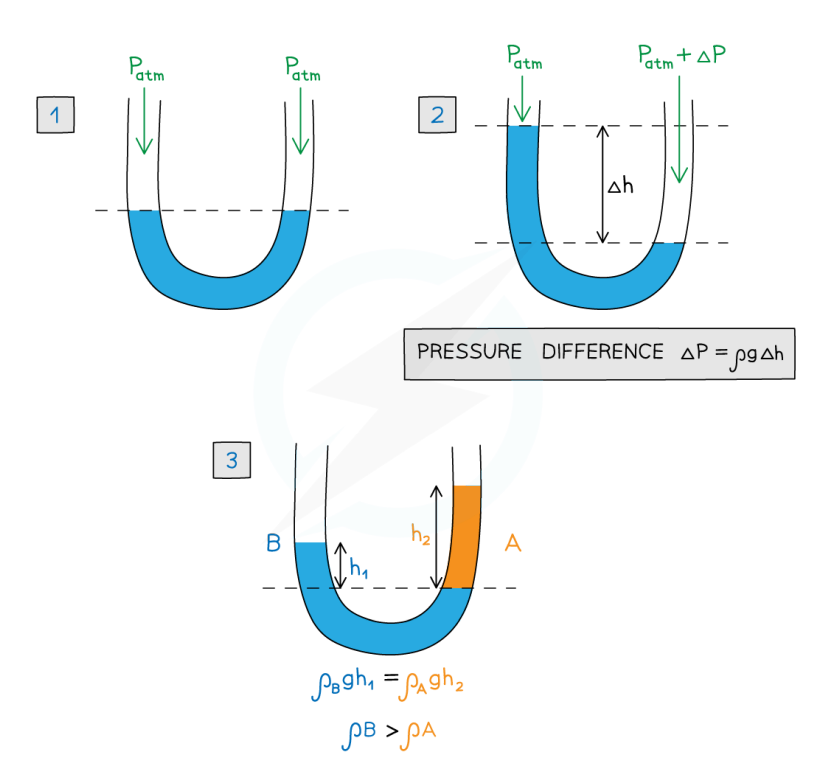
1 - the level is equal because the atmospheric is the same
2 - the pressure rose on one side (someone blowing into the tube), forcing the liquid on that side down and on the other up
3 - now it has two different liquids, with B being more dense but the pressure is still the same
What is upthrust?
Upthrust - the resultant force on an object submerged in a fluid due to the pressure difference between the top and bottom surfa
What is Archimedes’ principle?
Archimedes’ principle - when an object is totally or partially immersed in fluid at rest, it has an upthrust equal to the weight of the fluid displaced by the object
So when object float the upthrust equals the weight of the object
How can upthrust be calculated?
U = ρvg
Where U is upthrust in N
Where ρ is density in Kgm-3
Where v is volume in m3
Where g is gravitational field strength in NKg-1
 Note
Note  Flashcards (38)