Lecture 9-15: CLL Exam2
 Call Kai
 Learn
Learn Practice Test
 Spaced Repetition
 Match
Match Flashcards
 Knowt Play
1/164

There's no tags or description
Looks like no tags are added yet.
Name | Mastery | Learn | Test | Matching | Spaced | Call with Kai |
|---|
No analytics yet
Send a link to your students to track their progress
165 Terms
after the chaos of the middle of the 3rd century AD (200s)
diocletian and eastern general began to bring order
diocletian divided the empire
west: augustus, caesar
south: augustus, caesar
rule of 4
tetarchy
diocletain retired and the
tetcharchy collapsed into civil war
who won the civil war after diocletian retired
constantine (I), who moved the captial eastwards to byzantium (constantinople)
byzantium will become
byzantine empore and will outlast western rome by 1000 years (following to ottoman turks in 1452AD)
what happened to the west?
gradual germanification- the western world becomes a series of gernamic kindgoms
this could sometimes mean
invasion, but mostly a slow process of assimilation (germans become roman)
rome has originally tried conquest, but past 9AD
the defeat from a large roman army, marked off roman territory from german w the limes germanicus w many miles of boarder defenses and watch towers
but had a porus boarder
traders crossed it
rome recruited soldiers across it
gradually, germans filtered in and became
romanized
a perfect picture of assimilation (circa 500AD)
medallion of the theodoric but also theuda reiks
theo - god doric- gift theuda - of the people reiks - ruler
in gothic (germanic languge)
theodoric was married to
audofueda (siser of the frankish (gernmanic) king to the north clovis
clovis
founder of the merovingian kingdom (names for maybe mythological meroveck)
stability in germanic kingdoms after marriage
after marriage
because the merovinsion kingdom so big,
king has an assistant; the “mayor of the palace”
meaniwhile in 711AD
invaders from north africa began to conquer spain (moors)
732AD
in central France and driven back by the frankish mayor of the palace, charles “martel” (chuck the hammer) at politer / tours
but charles son, pepin, had plains to become a new king w the blessing of pope zachary,
he overthrew childeric II to make himself ruler and the founder of a new dynasty-carolingion - after his son charlemange - carolus magnus
charlemange ruled over huge kingdom - the pope on xmas day 800AD even crowed him
“emperor of the romans”
“emperor of the romans” → but this fell apart out the time of his 3 grandsons →
who split his kingdom into 3rds (843AD - treaty of verdon)
meanwhile, in what had been roman britain,
more germans!
brisitsh towns w/ chester or ester in name =
old roman garrisons from castra = “military camp”
romans occupied britain from the 1st circa AD to the very beginning of the
5th century, then troops withdrawn + britain suffered germanic invasion - hiring other germans to defend them - who then become colonists
by 950
scandinavian people were appearing in britain and europe as: raiders, traders, colonists
western france had so many of these northman that the area became known as
normandy (norse man land), and their ruler hrolfr became a french duke, rollo
anglo-saxon england now rules by a single king
edward the confessor
in edward the confessor death, he had a problem with
succession
who were edward the confessor possible successors?
a. harold godwinson (anglo saxon noble)
b. william duke of normondy
harold becomes kind and is attacked from 2 directions
vikings from north
normans from south
defeats vikings but is killed in hastings in
oct 1066, fighting norms
williams then makes himself
king
william gives land to his
chief warriors (barons)
these barons spread
across england and build early castles (motte and bailey)
williams govt uses anglo-saxon
tax records to begin controlling england (“doomsday book”)
1066
narmeans begin to conquer england led by william, duke of normandy
normandy =
norse = viking
now for awhile…
armored, mounted men will rule battlefield
william gave land to
chief followers (the barons)
the barons spread
across england building wooden forts
what were the wooden forts called?
motte and bailey
as well, the normans used anglo-saxon tax records to
develop their own tax system called the Domesday Book
the feudal system
king
nobles
knights
everyone else
serfs
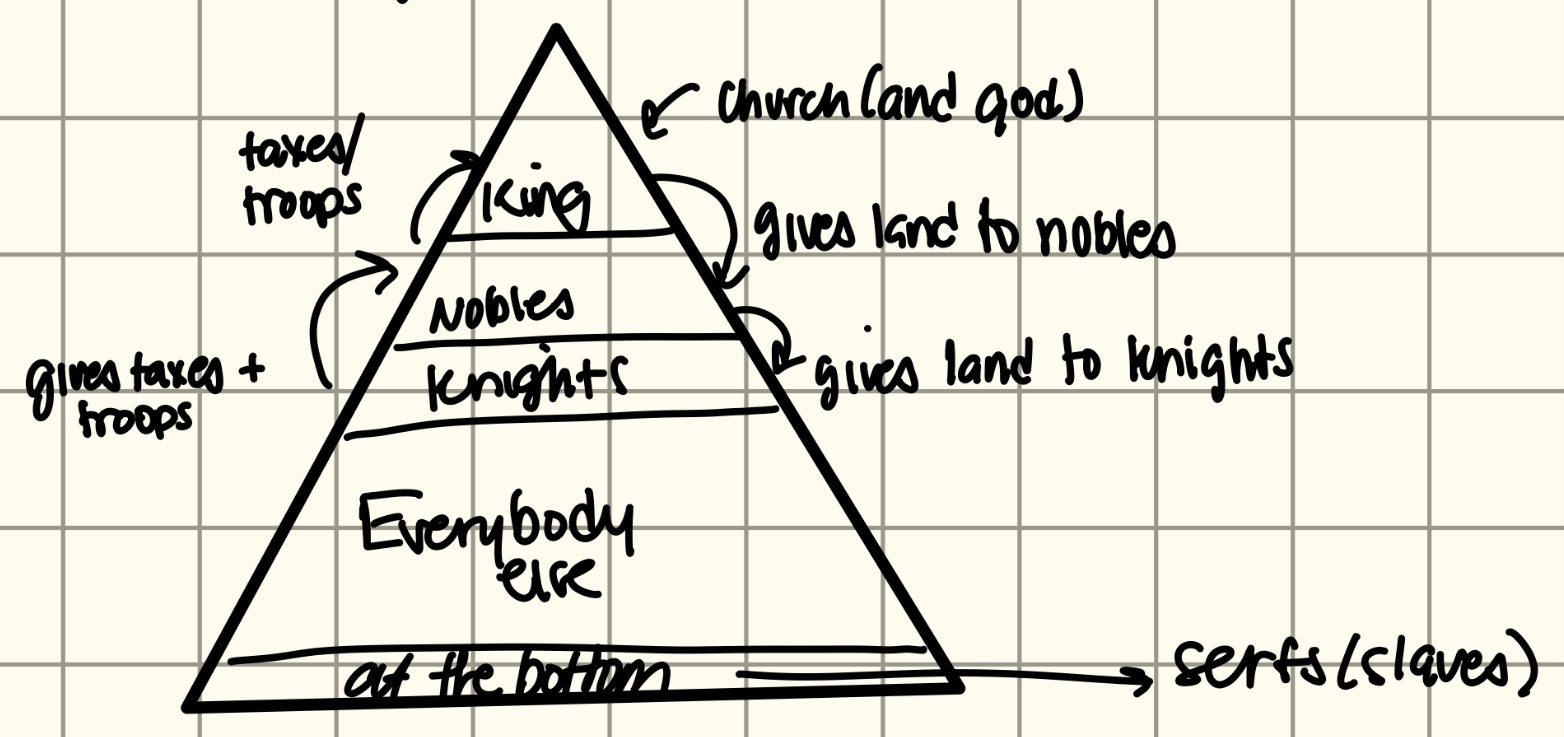
at the base of the feudal system, land equals
wealth and power
the lowest land-holding =
manor→ self sustaining community
3 lower social classes
freemen - own land, pay taxes on it
peasants - no land but free
serfs - slaves (owned)
but the role of armored men or horseback will begin to change
a. fewer battles
b. more sieges
gradually, mottle and baileys converted to
stone castles (only to be captured by sieges)
siege methods
a. surrounding and starve out
b. assault
ladders (escalade)
seige towers
battering rams
store throwers
a. small (mangonel)
b. large (trebucket)
undermining
so infantry + engineering + artillery -
men become more important than knights
besides sieges, another reason for fewer battles
knight expensive and require many years of training
ages for knights
a. page (at 7)
b. squire (at 14)
c. knight (maybe at 21)
knights also
held the social fabric together
anti knight weapons began to appear
longbows
crossbows
pikes
from 1337-1453 england fought
an on and off war to conquer france (100 year war)
battle few - 3 big ones won by the english - in partby their missile troops w longbows
crecy 1346
poitiers 1356
agincourt 1415
long bows could fire 10 arrows per minute
showering attackers and their horses
knights will begin to become only 1 weapon _______ _____ and __________ instead of dominating battlefields
heavy cavalry
gendarmes
during this era, we’ll see
a. more training
b. more organization
c. knights becoming heavy cav
d. gunpower
late medieval period
a. more sieges fewer battles
b. more middle troops caused that change to knights
gunpowder
a. discovered by the chinese (?)
b. first known mention in europe, 1242, friar roger-bacon
c. first known depiction of gunpowder weapon - 1327
for sieges you’ve got:
a. big arrow throwers (ballista)
b. smaller stone throwers (mangonel)
c. bigger stone throwers (trebuchet)
combined older weapons and new?
proof of the new weapons
use of bombards (early cannon) at seige of constantinope (1453AD)
constantinople depended by a moat and a double wall
only in its 1000yr history, captured once - so how to break in?
bombards made in 2 ways
like a barrel - long pieces of iron clamped together → iron
cast like a bell → bronze
if you can make big guns → could make
smaller guns for use on battlefields
even smaller to be used by infantry (hand cannons, had gonnes)
but you’ve got long bows + cross bows, who needs a handgonne?
long bows take years of training and muscle conditioning
cross bows increasingly heavy, slow load, expensive
whereas a handgonnes
a. takes virtually no time to learn how to use
b. simple and light
c. cheap
an ancient weapong makes a comeback
the long pike (sarissa)
pole arms had been developed by the swiss
who were making and first used in mass attacks, but then they switches to long pikes and learned to drill
the swiss learned to fight in pike blocks/ squares and w
missile troops at the edges
the swiss became mercenaries:
renting out pike blocks and because of demand, immitation swiss (landokneukre - appeared)
now armies had
a. artillery
b. pikeman w/ missile troops
c. heavy cav. (gendames)
d. light cav (scouting and skirmishing) (stradites/jineies)
renaissance army
a. pikemen
b. missile troops
c. sword + bucklermen
d. gendarmes
e. light cav. (jinette, stadiotes)
f. artillery
(big change from hoplites w/ hoplites, slingers, archers)
another change will be economic
later middle ages brings increasingly stability
trade begins to develop/grow once more - and from it new wealth
1. merchants
2. manufacturers
manufactures formed guides = early trade unions which oversaw:
a. training
b. quality
c. prices
some towns (especially northern Italy) became so prosperous that
a. merchants and guilds ran them
b. they became independent of local feudal lords
england’s went a step farther - devising a representative body- parliament
a. lords (wealthy land-owners)
b. commons (merchants/guilds)
another change - fortifications
a. motte and bailey
b. stone castle
c. but tall, thin castle walls vulnerable to artillery
Italian renaissance engineers, began creating new defenses
a. low
b. earth-bound
angle bastions added to walls to
allow for crossfire
another change - military formations
a. orginally a pike block/square
b. now this will become a tercio
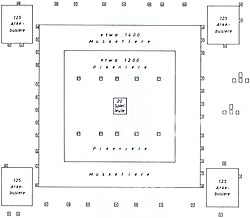
tercio - advantages
a. the look
b. protection of pikes by missiles
c. weight
tercio has:
a. pikeman
b. sword + buckermen
c. missile troops
main missile weapons =
the matchlock
spain, through its american conquests became dominant and wealth and so
their formation the tercio - became everyone’s formation for a little while
tercios are also:
a. slow and clumsy
b. masked ½ of its gunfire
from 1568-1648 (80 years war) the dutch struggled
to escape spanish control but always out spent and out numbered
a dutch general and noble maurice of nassua, invented new dutch formations to counter this
a. read ancient classics - used the roman triples acies
b. changed infantry lines to M P M so that firepower could be used (“the dutch system” allowed for greater flexibility as well)
1600, maurice defeated the spanish at nitewport and generals began
to see this as an alternate method of combat
In this lecture, we’re going to back up just a little, from the time of the ENGLISH CIVIL WAR, in which King CHARLES I (1600-1649)
so antagonized many of his people, represented in part by the House of Commons, that he brought on a civil war
this civil war lasted from
1642 to 1651: continuing even after the king had been tried by Parliament for treason and executed in January, 1649, an act which shocked people all over Europe—especially other monarchs.
1517, when a German priest, Father MARTIN LUTHER (1483-1546),
sent a list of points to the local archbishop which argued that the Church was misbehaving by selling a kind of pardon, called an INDULGENCE. He may also have nailed a copy of that list onto a local church door, thus publishing them.
Needless to say, this was not well received by the archbishop and by his superiors and was, instead, the beginning of a great struggle, which ended with Luther forced out of the Church.
In turn, along with others who shared his beliefs, he set in motion a movement of protest which ended in a new form of Christianity, called PROTESTANTISM, as well as the foundation of a new church, named LUTHERAN, after him.
The beliefs of this new church included the idea that people were so responsible for their own souls that they should read the Christian Bible for themselves. The Church had resisted this for a long time, maintaining the Bible in Latin, which could only be read by a few educated people, mostly churchmen. Luther responded by translating the Bible into German.
Mechanical printing was still relatively new at this time, having been invented in the 1450s (right at the time the Hundred Years War was ending),
but luther used it to publish one part of the bible, the new testament, in 1552, and both that and the old testament in 1534
this spirit of criticism and resistance was in the Europeans air at this time and a French lawyer, named jean calvin (1509-1564)
became so involved that he was forced to flee france for switlerland, where he was instrumental in the foundation of another named of Protestantism, named after him Calvinism
these two branches spread rapidly, but unevenly,
across northern and parts of western europe
england would join this movement, not for religious reasons, but for dynastic ones
henry VIII (1491-1547), whose father, henry VII (1457-1509), had seized the throne of england after the battle of Bosworth in 1485, was worried about family succession
his wife, catherine of aragon (daughter of isabella and ferdinand of spain, had produced a daughter, but no sons
and henry wanted boys to succeed him
He was having an affair with one of his wife’s ladies-in-waiting, Anne Boleyn, who was pregnant, so he must have been feeling hopeful, as well as pressured.
He applied to the Pope, Clement VII, for a divorce (extremely rare in those days), but Catherine was the aunt of the most powerful man in central Europe, the Holy Roman Emperor, Charles V, so the Pope put him off.

