L3: Adaptive Immunity and B cells
 Studied by 2 people
 Call Kai
 Learn
Learn Practice Test
 Spaced Repetition
 Match
Match Flashcards
 Knowt Play
1/41

There's no tags or description
Looks like no tags are added yet.
Name | Mastery | Learn | Test | Matching | Spaced | Call with Kai |
|---|
No analytics yet
Send a link to your students to track their progress
42 Terms
Adaptive Immunity
slower, antigen specific - specific for a certain disease
What are the features of adaptive immunity?
Specificity, Versatility, Memory, Tolerance
Specificity
activated by and responds to a specific antigen
Versatility
ready to confront any antigen at anytime
Memory
“remembers” any antigen it has encountered
Tolerance
responds to foreign substances but ignores normal tissues
How is specificity achieved?
Both B and T cells have receptors that recognize specific shapes
How is versatility achieved?
Different B and T cells have different receptors
How is memory achieved?
Some activated B and T cells are long lasting
How is tolerance achieved?
B and T cells with receptors that recognize self are deleted or not activated
(1) Specificity & (2) versatility of B and T cell receptors
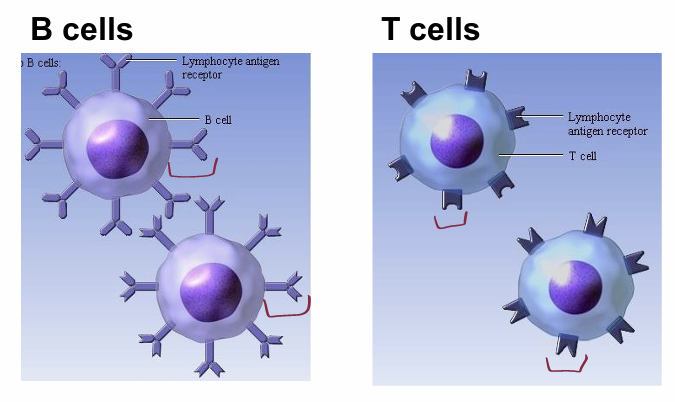
Antibody
Immunoglobulin
a Y-shaped protein made by the immune system (specifically plasma cells) to identify and neutralize foreign invaders like bacteria, viruses, and toxins (antigens)
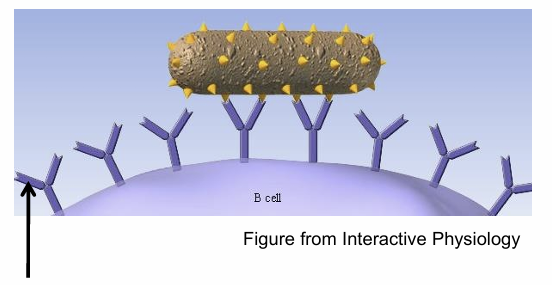
B cell receptors bind to _______ ______
extracellular antigens
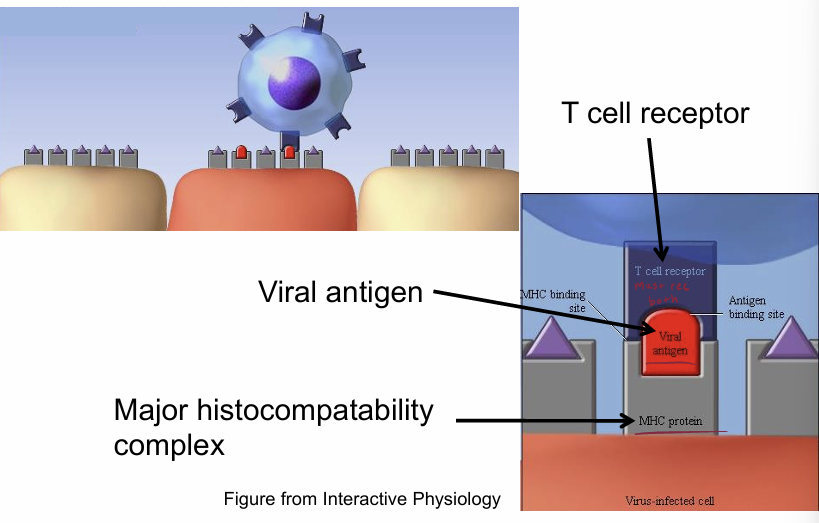
T cell receptors bind to ________
antigens displayed on the surface of cells
(macrophages, tissue cells, etc)
T and B cells circulate throughout the body _____ __ _____
searching for antigen
Where are antigens encountered?
secondary lymphoid tissues - lymph nodes or spleen
Clonal selection, expansion and memory
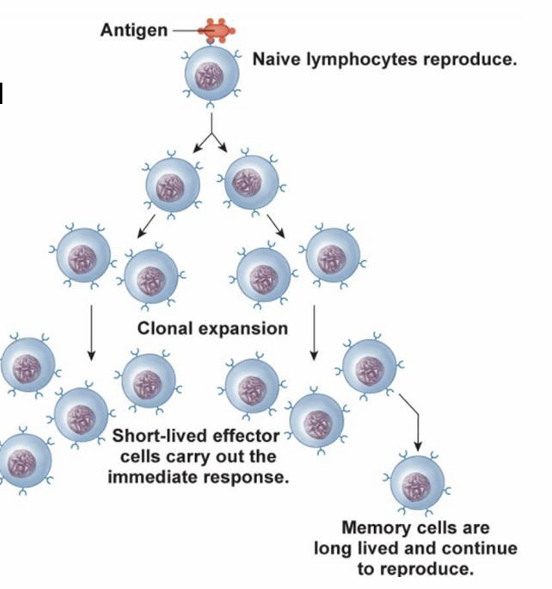
Primary and Secondary Immune Responses i.e. (3) Memory
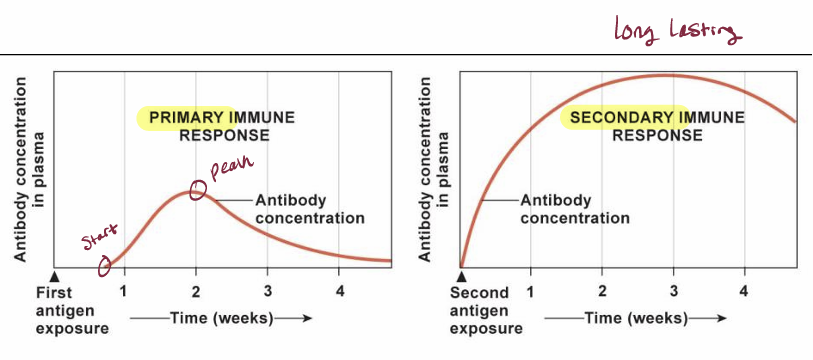
B and T lymphocytes originate in the bone marrow Need to be educated i.e. (4) Tolerance
Need mechanism to eliminate the ones that have the potential to attack our own body strongly
T cells undergo positive and negative selection in the _____
thymus
B cells undergo positive and negative selection in the
Bone marrow
negative selection
if there are B or T cell receptors that recognize self proteins — those are deleted
Positive selection in T cells
seeing MHC molecules
Antibody structure
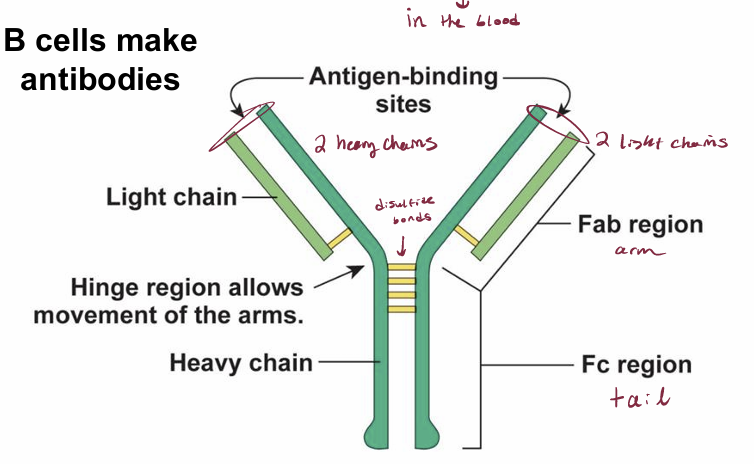
B cells make ______
antibodies
Every human has between __________
107 and 109 different shaped Fabs
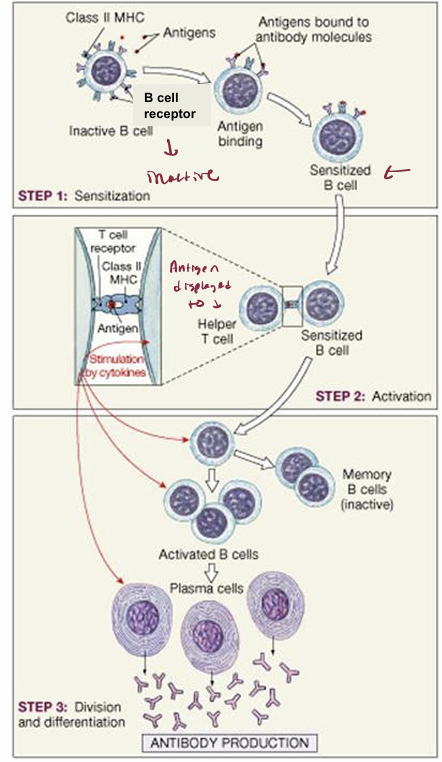
How are B cells activated?
1. Antigen binds to specific B cell via B cell receptors
2. Antigen is internalized, digested and combined with MHC and then transported to cell surface
Specific helper T cell recognizes antigen and MHC becomes activated and secretes cytokines
Activated B cell divides. Some daughter cells become plasma cells and secrete antibodies, others become memory B cells
Antibody Functions
Antigen clumping
Inactivation of bacterial toxins
Act as opsonins to tag antigens for phagocytosis
Trigger degranulation
Activate Complement
Activate B lymphocytes
Inactivation of bacterial toxins
prevents toxin from binding to a cell
Antigen clumping
creates bigger structure so it is more likely to be engulfed by phagocytes
Classes of antibodies
IgG, IgM, IgA, IgE, IgD
IgG
Most common type of circulating antibody - Transferred across the placenta from mother to baby
IgM
First type of antibody to be secreted in response to a new antigen
• Good at causing antigen clumping and activating complement
IgA
Crosses epithelial cells. Protects epithelial surfaces and present in breast milk
IgE
Fights parasites. Eosinophils have receptors for the IgE. Release histamine. Associated with allergic reactions
IgD
Are the B cell receptors on the surface of B cells
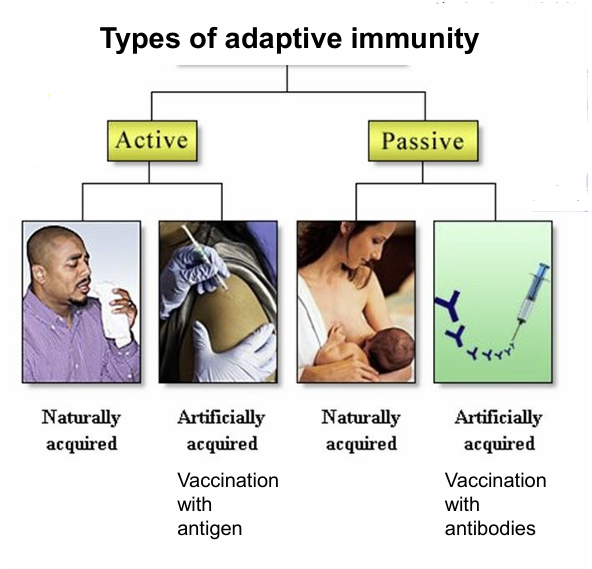
Types of adaptive immunity
Active and Passive
Active Adaptive Immunity
Exposure to a pathogen. Long lasting generates memory B and T cells
Passive Adaptive Immunity
Transfer of Ab from another organism. Lasts about 3 months because Ab degraded
Types of adaptive immunity diagram
Coordination of innate and specific immune system: response to extracellular bacteria
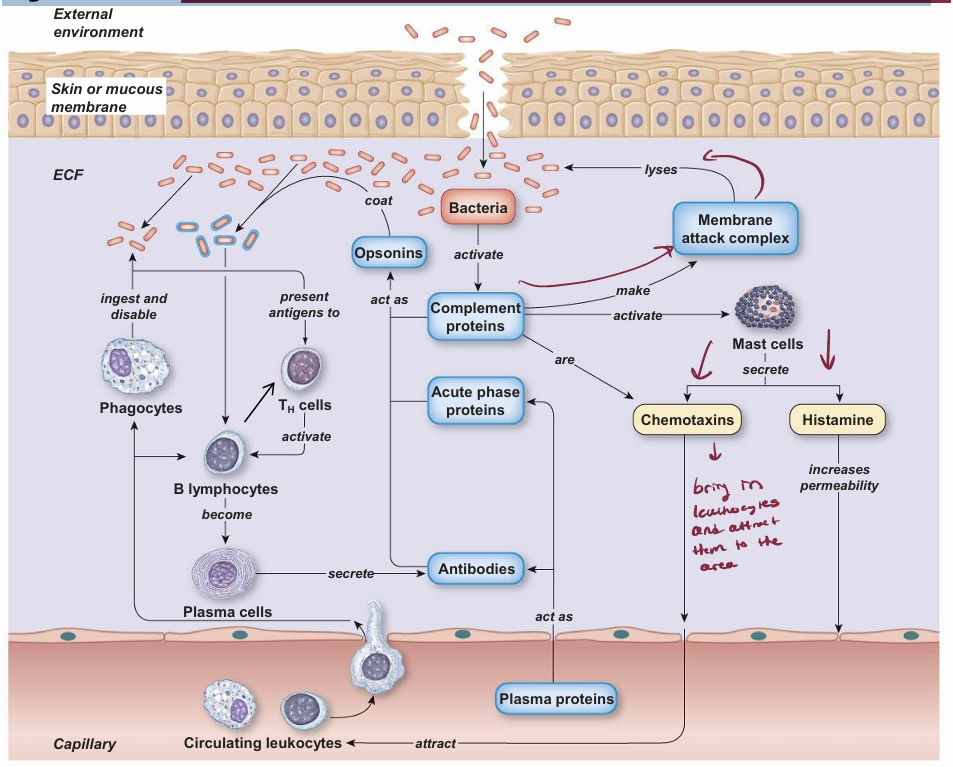
Summary
Features of adaptive immunity: Specific, versatile, has memory, tolerant to self
Features achieved by T and B cells having different receptors with different specificities, the generation of memory cells and deletion or inactivation of T and B cells that react to self
B cells are activated through binding to antigen to B cell receptors, presentation on MHC class II, activation of specific helper T cells, generation of plasma cells that secrete Ab
Antibodies protect us by binding to antigen blocking the action of the antigen and further activating the immune system
 Note
Note  Flashcards (53)