BSCI201: LEx4
 Studied by 13 people
 Call Kai
 Learn
Learn Practice Test
 Spaced Repetition
 Match
Match Flashcards
 Knowt Play
1/155

Earn XP
Description and Tags
Goytia | Only on Endocrine and Sensory System
Name | Mastery | Learn | Test | Matching | Spaced |
|---|
No study sessions yet.
156 Terms
How do sensory systems function?
By the process called transduction, which is the detection of stimuli and transforming the signal into an electrical message that is sent to the central nervous system (CNS).
What receptor detects light energy?
photoreceptors
Where is the location of photoreceptors?
Retina (vision)
What is the signal transduction of photoreceptors?
Light → chemical → electrical
What receptors detects mechanical forces (touch, pressure, stretch, vibration)?
Mechanoreceptors
Where are the locations of mechanoreceptors?
hair cells in ear (hearing) and pacinian corpuscles (touch)
What is the signal transduction of mechanoreceptors?
mechanical → electrical
What receptors detect chemicals in solution (odorants/tastants)?
Chemoreceptors
What are the locations of chemoreceptors?
olfactory cells (smell) and gustatory cells (taste)
What is the signal transduction of chemoreceptors?
chemical → electrical
What are some other receptors?
thermoreceptors, osmoreceptors, and noiceptors
What are the receptor cells for olfaction?
olfactory receptor cells
What is the requirement for olfaction to occur?
odorants must be dissolved in mucus
What are the key structures for olfaction?
olfactory epithelium, olfactory gland (produces mucus)
What is the transduction of olfaction?
odorants bind to G-protein coupled chemoreceptors
What is the pathway to CNS for olfaction?
Olfactory tract goes straight to the cerebral cortex (limbic system), bypassing the thalamus
What can replace olfactory receptor cells and gustatory cells?
differentiated basal cells
What is the receptor cells for gustation? Where are they found?
gustatory cells in taste buds
What is the requirement for gustation to occur?
tastants must be dissolved in saliva
What is the key structures for gustation?
taste buds located on lingual papillae (except filiform papillae, which lacks taste buds)
What is the transduction for gustation?
Salty/Sour (ions: Na+, H+) pass through ion channels. Sweet/Bitter/Umami bind to G-protein coupled chemoreceptors.
What is the pathway to CNS for gustation?
Pathway goes through the thalamus
How are olfactory and gustation connected?
The appreciation of flavor 80% dependent on the sense of smell - why food taste bland when sense of smell is impaired.
When sound waves enter the external auditory canal what does it do?
vibrates the tympanic membrane
What does the vibration do when it hits the tympanic membrane?
The vibration is amplified across the three ossicles (Malleus → Incus → Stapes)
When the vibration reaches the stapes, what does it do?
stapes pushes on the oval window, creating pressure waves in the perilymph found in scala vesticuli
After the waves reach the scala vestibuli, where does it move to?
moves through the cochlea to the endolymph in the cochlear duct
When the ear converts vibrations into fluid vibrations, what does it activate?
organ of Corti and are perceived as sounds
As fluid waves travel, what moves at a specific location that corresponds to the frequency of the sound?
basilar membrane
After the basilar membrane, what relative motion does it hit? What does that do?
tectorial membrane, bends the stereocilia of the hair cells
The endolymph is rich in K+, why is that important for the bending of stereocilia?
bending of stereocilia mechanically opens ion channels, causing K+ to enter the hair cell, which causes depolarization (EPSP).
Depolarization opens what in the ear?
Depolarization opens voltage-gated Ca2+ channels, leading to neurotransmitter release onto the cochlear nerve - sensing sound!
What senses the head position and motion?
the vesticular apparatus using mechanoreceptor hair cells
Linear acceleration/deceleration (position) are sensed by what?
utricle and saccule (in the vestibule)
What does motion rely on?
heavy otoliths (CaCO3 crystals) in the otolithic membrane
Rotational acceleration/deceleration are sensed by what?
semicircular canals
What does rotation cause?
causes the endolymph inside the canals to flow against and bend the Cupula located in the Ampulla, activating the hair cells
What are the two main types of photoreceptors in the retina?
rods and cones
What do rods sense?
dim light, images of shades of gray
What do cones sense?
bright light, concentrated in the fovea, color vision
What is the fovea centralis?
central region of retina providing color vision
What is the path of light when entering the eye?
Light enters the eye and is refracted (bent) primarily at the cornea and then by the lens
What are problems with refraction?
myopia and hyperopia
What is myopia known as? What is it?
nearsightedness; focal point is in front of the retina with concave lens to decrease curvature
What is hyperopia known as? What is it?
farsightedness; focal point is behind retina with convex lens to increase curvature
Where does light need to reach to present vision?
Light must reach the deepest cellular layer of the retina, where the photoreceptors are located
What is the electrophysiology (signal transmission) when your in the dark (resting state)?
Photoreceptors are depolarized and continuously release glutamate. Glutamate hyperpolarizes bipolar cells, which prevents the depolarization of retinal ganglion cells, meaning no AP is sent.
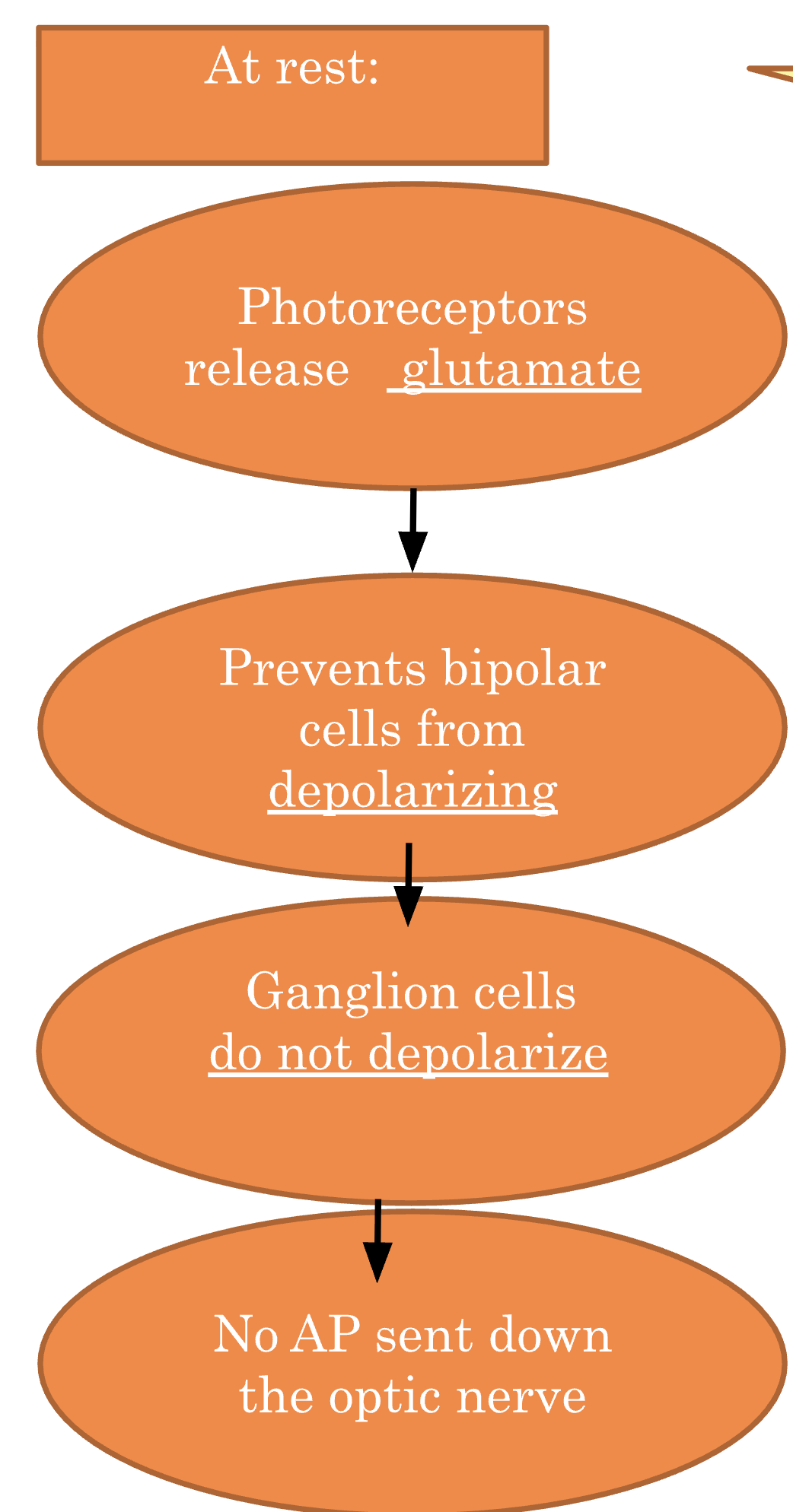
What is the electrophysiology (signal transmission) when your in the light?
Light hyperpolarizes photoreceptor cells. They stop releasing glutamate and bipolar cells are released from inhibition, depolarize, and excite retinal ganglion cells. RGCs generate APs that travel down the optic nerve.
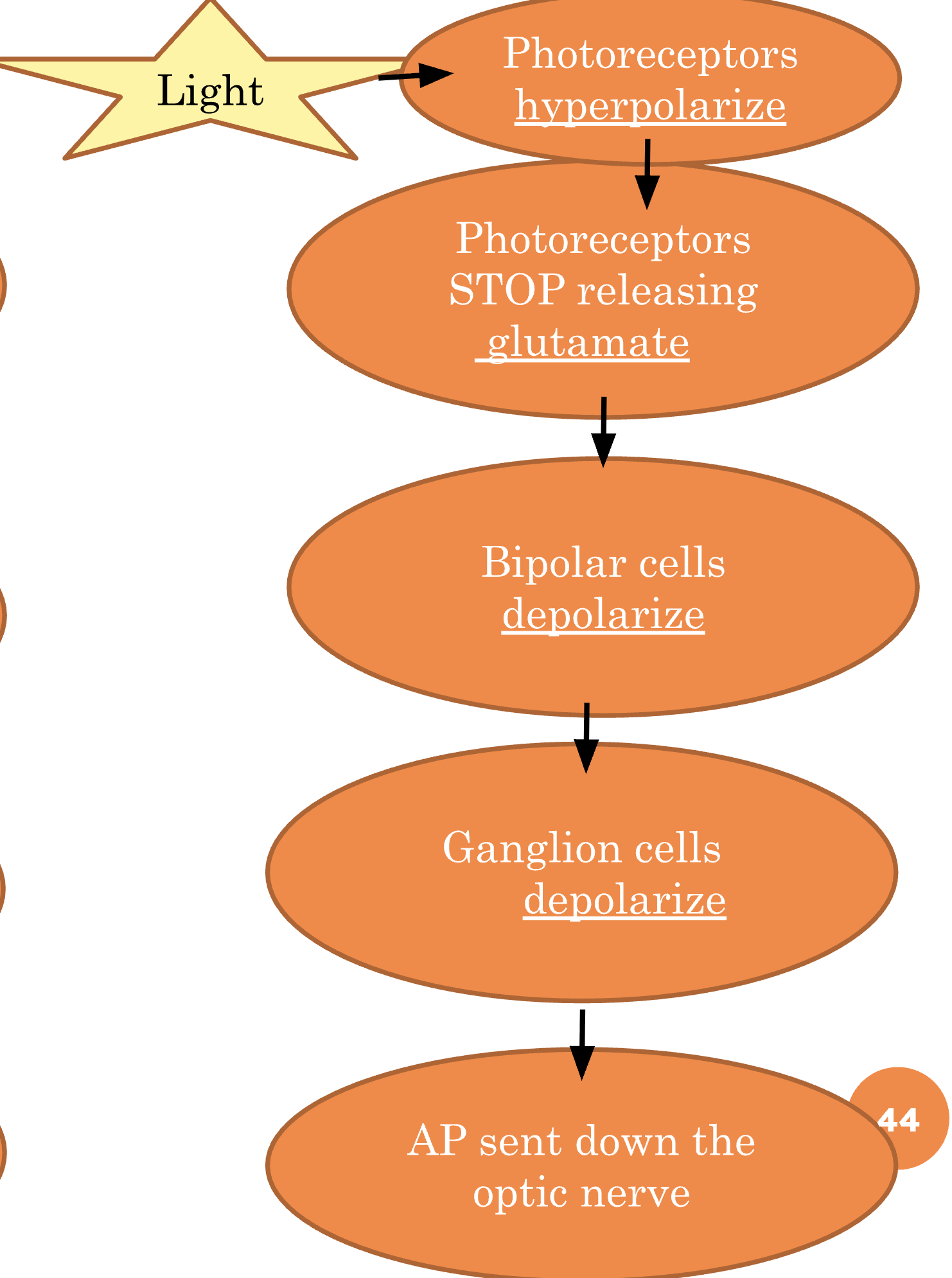
What is the chronology of vision signal?
Light is sensed by photoreceptors
Receptor cells hyperpolarize by closing sodium and calcium channels
The neurotransmitter is not delivered to the bipolar cells
Bipolar cells are depolarized
The neurotransmitter delivers an activating signal to the ganglion cells
What is the visual pathway to cortex?
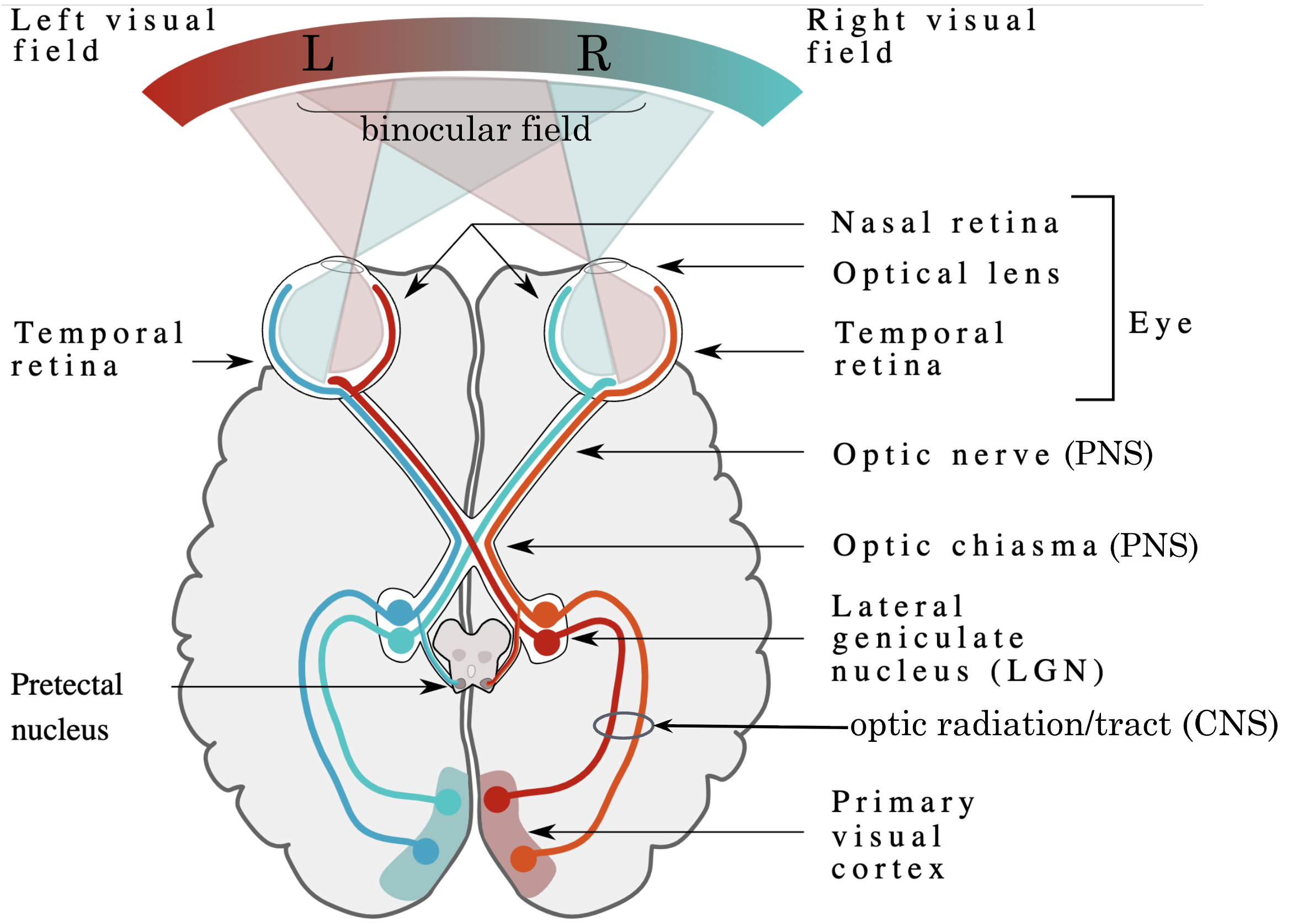
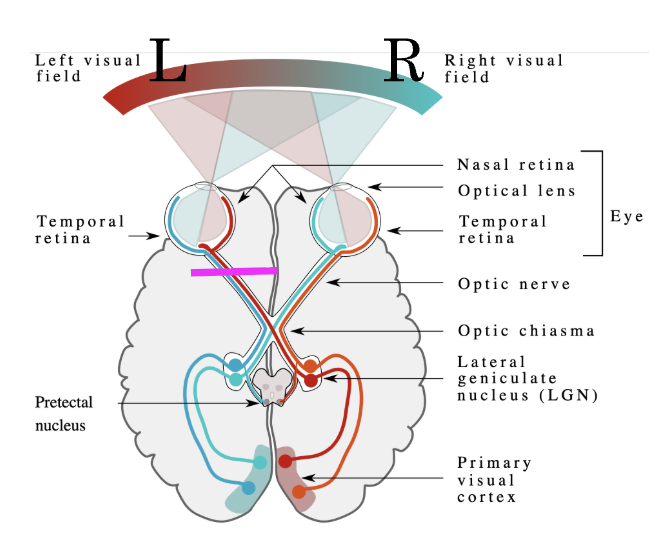
What does the visual deficit (lesion) at the left optic nerve cause?
blindness in the left eye

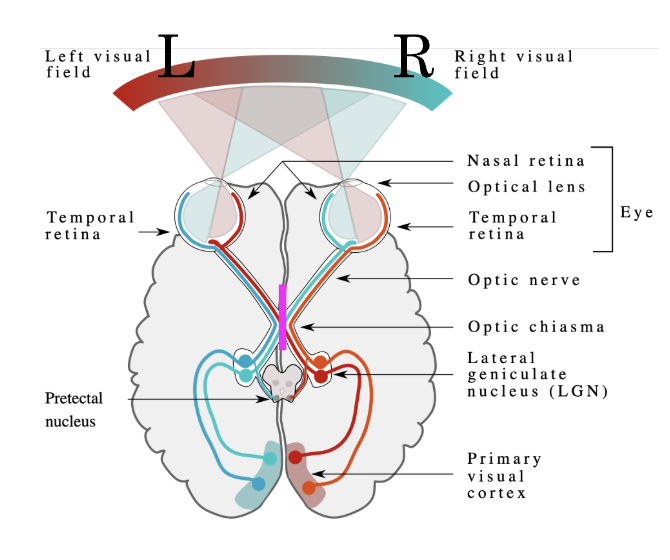
What does the visual deficit (lesion) at the optic chiasma cause?
loss of peripheral vision in both eyes (tunnel vision)

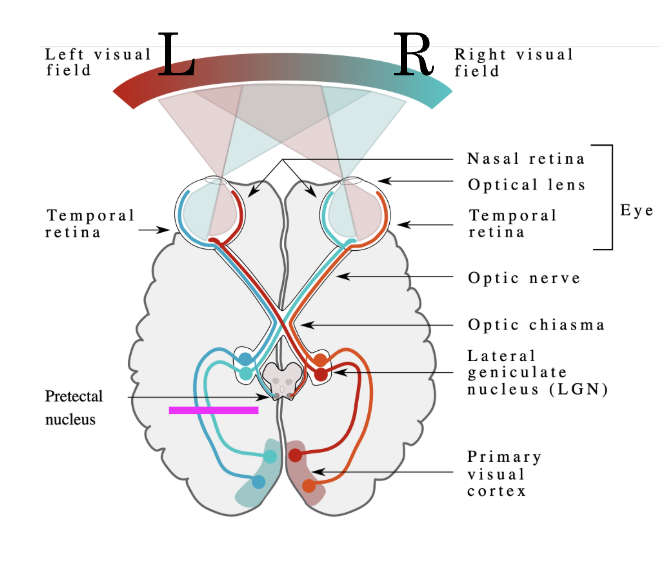
What does the visual deficit (lesion) at the left optic tract/radiations (CNS) cause?
loss of entire right visual field

What is the difference in signaling between the endocrine system and nervous system?
Endocrine system is chemical (hormones) while Nervous system is electrical and chemical
What is the difference in transport between the endocrine system and nervous system?
Endocrine system is bloodstream (long distance) while Nervous system is neurons (short distance)
What is the difference in action between the endocrine system and nervous system?
Endocrine system action takes time, triggers long-lasting actions while Nervous system action is immediate, triggers quick, brief actions.
What is the main function of primary endocrine glands?
Ductless glands; hormone production and secretion directly into the blood (ie. pituitary, adrenal, etc.)
What is the main function of secondary endocrine glands?
have primary functions outside of hormone production but secretes hormones (ie. Heart, kidneys, etc)
What are the two signal chemicals that diffuses to target?
Autocrine and Paracrine
Autocrine signals
Acts on same cell → potentiation
Paracrine signals
Secreted by one cell and diffuse to adjacent cells, ie. neurotransmitters
What is an example of Paracine secretion?
Pancreas secretion of glycotic and lipolytic enzymes to the small intestine
What are the messenger classifications of chemical messengers?
Neurotransmitters, hormones, neurohormones, and cytokines
What system are Neurotransmitters for?
messenger molecule of nervous system
How are neurotransmitters released?
released from neuron by exocytosis
Where do neurotransmitters diffuse through?
diffuses through synaptic cleft to very close target cell
What do neurotransmitters induce?
I/EPSP for long-distance communication (NS)
What are examples of neurotransmitters?
acetylcholine, epinephrine, norepinephrine
What system are hormones for?
messenger molecule of endocrine system
How are hormones expressed?
expressed by endocrine glands
What do target cells of hormones must express?
accessible and functional hormone-specific receptors (cognate receptor)
When are hormones produced?
produced in advance, stored in vesicles for secretion
What system are neurohormones for?
messenger molecule of nervous system
How are neurohormones released?
released from neuron into blood: axosecretory synapse
What are examples of neurohormones?
anti-diuretic hormone and oxytocin
What are cytokines?
peptides or proteins
What released cytokines?
most cell types
How do cytokines get transported?
through blood
What are cytokines involved in?
cell development, proliferation, differentiation and immune response
What do the target cells of cytokines must express?
accessible and functional receptor
Hormones can be chemically classified as…
Biogenic Amines, Peptide, Protein, Glycoprotein, Steroids
Biogenic Amines, Peptide, Protein, Glycoprotein are all…
generally hydrophilic (polar); requires cell surface receptor and are stored in vesicles
Steroids derive from what? What polarity are they?
derive from cholesterol; hydrophobic/lipophilic and diffuse through cell membranes. They are transported in blood by carrier protein
Where is the receptor location(s) of hydrophobic hormone types?
Cytosolic or Nuclear
What is the response speed of hydrophobic hormone types?
Slower
What is the mechanism of hydrophobic hormone types?
regulates gene expression
Where is the receptor location(s) of hydrophilic hormone types?
Cell Membrane
What is the response speed of hydrophilic hormone types?
Faster
What is the mechanism of hydrophilic hormone types?
Activates second messenger systems, leading to signal amplification
What are the receptor properties?
Must be expressed, accessible, and functional
Receptors must exhibit…
saturation, specificity and competition
Agonism
Binds to the receptor and mimics the normal response
Inverse Agonism
A hormone (ligand) that binds to the same receptor, and imposes the inverse effect of the agonist
Additive/Cooperative
Effects of two hormones favor each other and sum
Antagomism
Binds to the receptor, blocking the cognate hormone and producing no response
Synergism
Two hormones together produce an effect that exceeds the sum of their individual effect
Permissiveness
One hormone is required for another to exert its full effects
What is an example of permissiveness?
Estrogen causes expression of oxytocin receptors and oxytocin induces expression of prostaglandins (PG) which induces expression of oxytocin
Receptor agonist
chemicals that bind to a receptor mimicking normal response
Receptor antagonists
chemicals that bind to a receptor producing no response
 Note
Note  Flashcards (30)