Ch 19: Learning and Memory Molecular Mechanisms I
 Studied by 0 people
 Call Kai
 Learn
Learn Practice Test
 Spaced Repetition
 Match
Match Flashcards
 Knowt Play
1/53

There's no tags or description
Looks like no tags are added yet.
Name | Mastery | Learn | Test | Matching | Spaced | Call with Kai |
|---|
No analytics yet
Send a link to your students to track their progress
54 Terms
Our brains are (more/less) plastic in children than adults
More
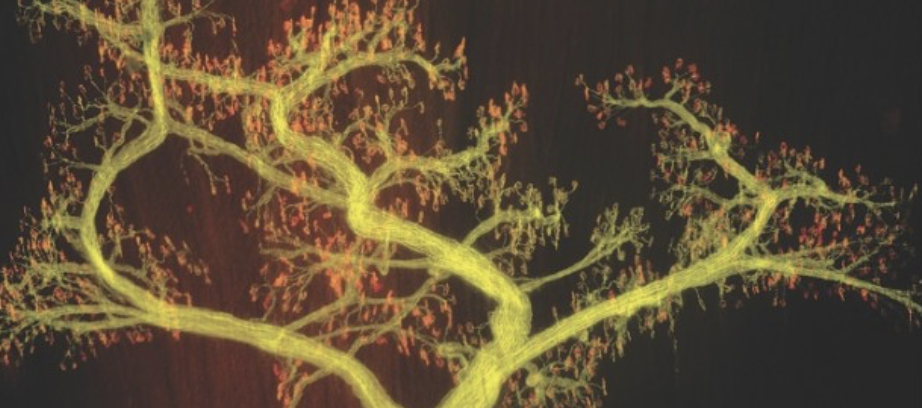
The red part of this image shows single synapses, the number of red connections with muscle (increase/decrease) with age
Decrease
Hebb believed memory results from _____ _____.
Synaptic modifications
What do adult memory formation and brain development have in common?
Both use activity-dependent synaptic plasticity to strengthen or weaken connections
What are the 4 stages of memory acquisition?
Encoding
Storage
Retrieval
Reconsolidaton
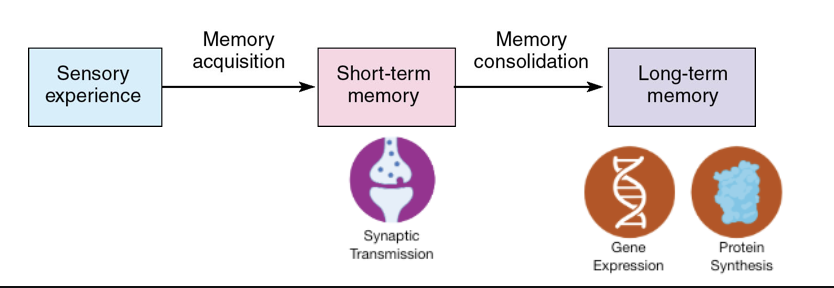
Encoding a memory includes _____ and _____
Acquisition and consolidation
What happens in the acquisition of a short term memory (aka learning)?
Incoming sensory information causes temporary physical changes in neural circuits (e.g., brief shifts in neurotransmitter release or receptor sensitivity)
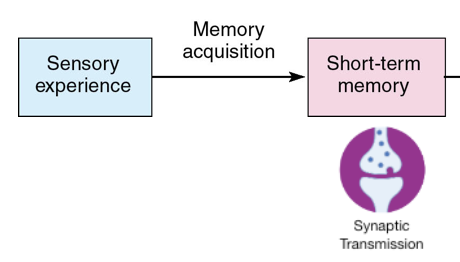
How does STM modify communication between neurons?
STM forms through short-lasting changes in synaptic transmission, such as small increases or decreases in synaptic strength
What happens to STM if it isn’t consolidated?
STM can survive distraction for a short time but will fade unless stabilized into long-term memory through consolidation.
Do all neurons participate in memory?
Yes, every neuron undergoes activity dependent plasticity & forms memory traces
What does consolidation require? (2)
Gene expression & protein synthesis
Describe Hebb’s networks & memory engrams
Collection of distributed neurons in the cortex & hippocampus that encode a memory
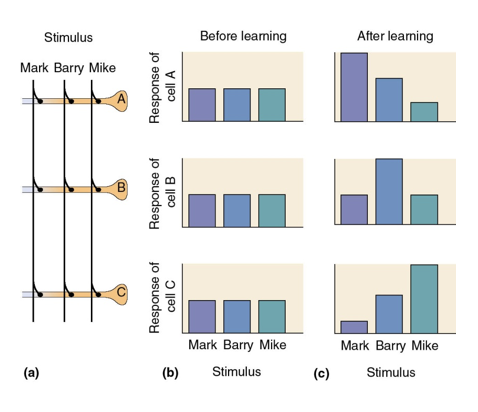
Explain what is happening in this image
Neurons (A,B,C) respond to faces the first time seeing them the exact same. After many months the neurons show selectivity for different faces (A for Mark, B for Barry, and C for Mike)
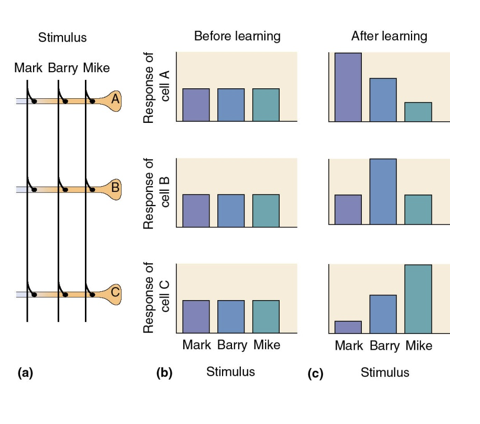
With neuron selectivity in mind, does neuron A respond only to Mark’s face?
No, all neurons respond to Mark’s face just in varying degrees.
Why is memory distributed among different neurons (memory engram)?
If one neuron died, a whole memory would die with it. Distribution allows us to keep memories even if a neuron dies.
Where has LTP been the most researched?
The hippocampus
What is LTP?
Long term potentiation: long lasting increase in the strength of a synapse based on recent patterns of neuronal activity
Why is the hippocampus the most researched for LTP? (3)
Easy to dissect out simplified circuit
Can be kept alive w/ ASCF then sliced for electrophysiology
Has a known role in learning & memory (HM, rodent studies)
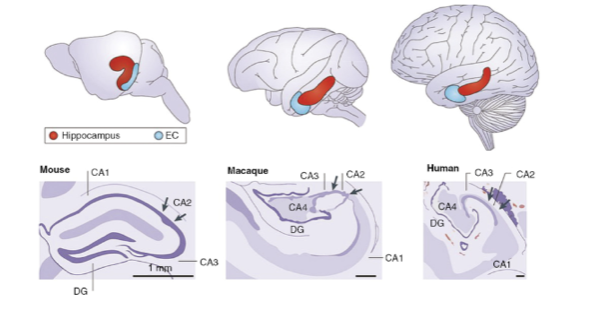
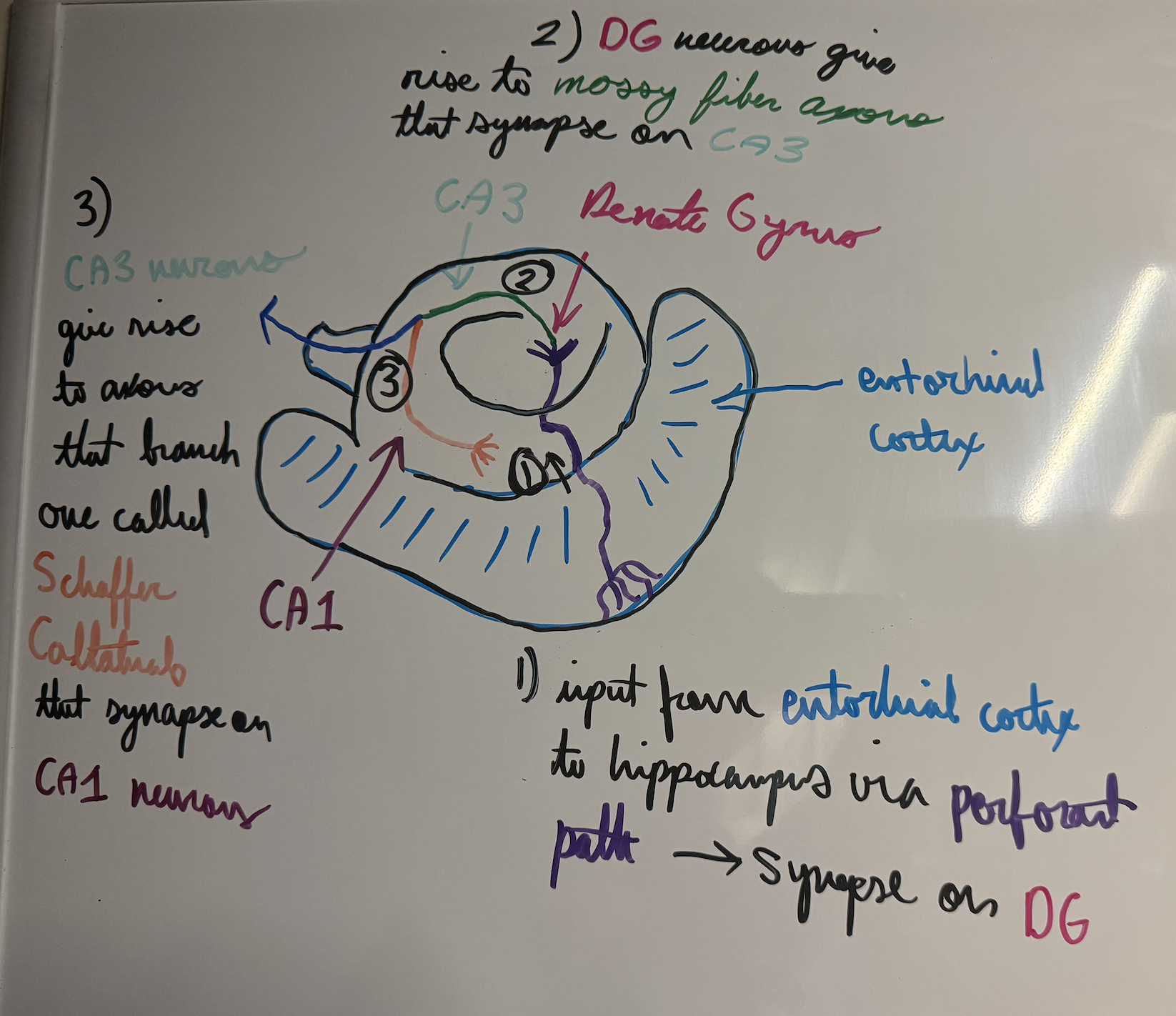
Summarize the steps of the tri-synaptic circuitry
Input to hippocampus from entorhinal cortex via bundle of axons call perforant path → synapse on DG neurons
DG neurons give rise to mossy fiber axons that synapse on CA3 neurons
CA3 neurons give rise to axons that branch, one branch called the Schaffer collaterals and form synapses on CA1 neurons
What is tetanus (not lockjaw syndrome…the neuroscience tetanus)
Burst of high frequency stimulation (100/sec)
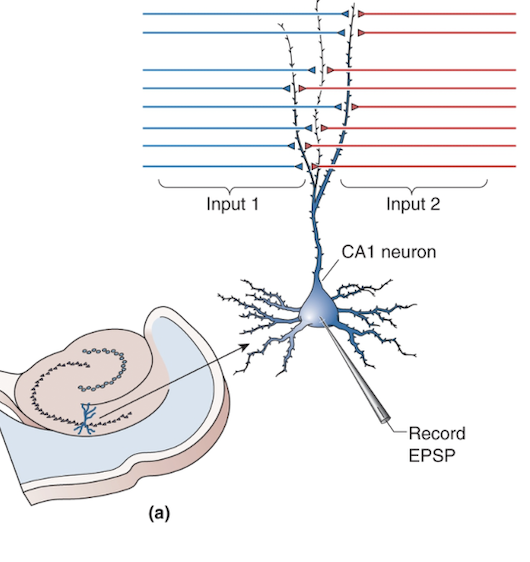
Tetanus stimulation of presynaptic neurons within Schaffer collateral synapse (CA3 → CA1) causes what to happen? (2)
LTP are induced
Postsynaptic EPSPs are much greater than during baseline period
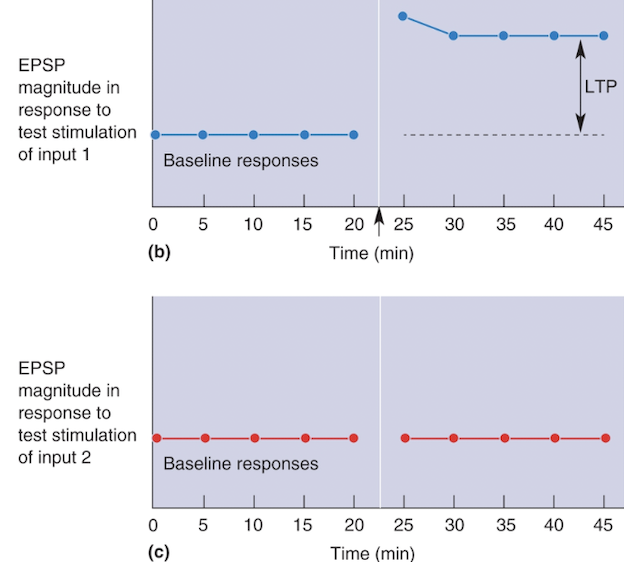
Most _____ and _____ synapses can support LTP
Excitatory & inhibitory
What is input specificity in LTP?
Only the active synapses undergo LTP: if a synapse does not receive tetanus it shows no LTP → only the synapse that is strongly activated becomes strengthened
What is required for an LTP to happen?
Synapses be active at the same time that the postsynaptic CA1 neuron is strongly depolarized
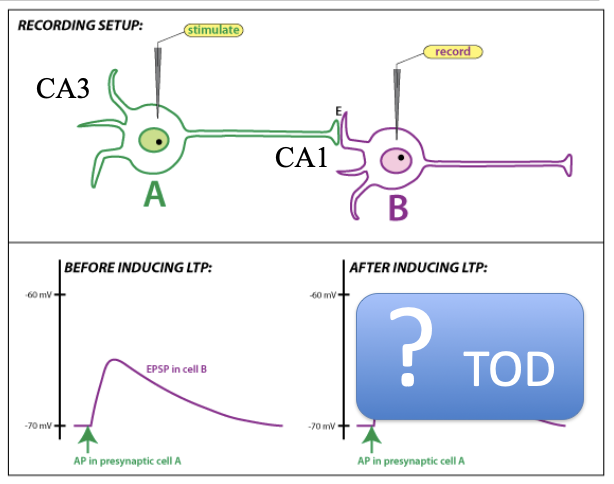
How does depolarization of the baseline change after LTP is introduced? How does EPSPs change?
After LTP, the same baseline stimulation now produces a larger EPSP. The synapse has been strengthened, so the postsynaptic neuron depolarizes more even though the input intensity hasn’t changed.
What is cooperativity?
Multiple weak inputs must fire together to reach the threshold for inducing LTP in a postsynaptic neuron
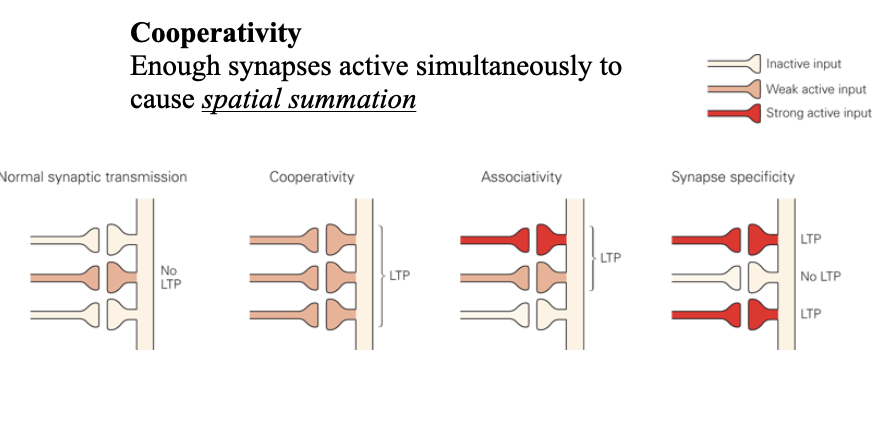
Which synapses are potentiated during cooperativity-induced LTP?
Only the active synapses that contributed to postsynaptic firing are potentiated
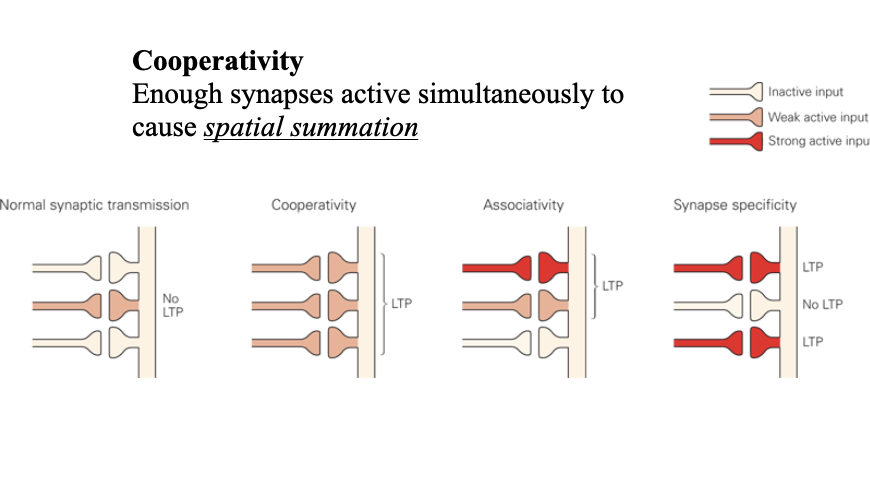
How does cooperativity in LTP create associations between stimuli? (explain using the three input example in textbook)
After LTP, either input I or input II alone can trigger postsynaptic firing, forming an association between them. Input III, which was inactive, remains unassociated.
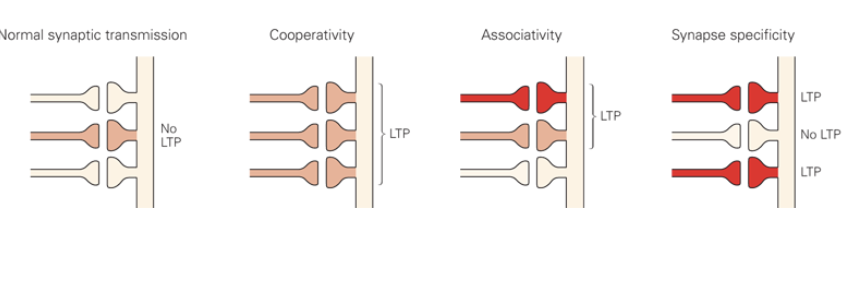
Give an example of associative learning using hippocampal cooperativity.
The sight of a duck (input I) and the quack of a duck (input II) often occur together → LTP at their synapses associates the two. A dog bark (input III) is never paired, so it is not associated.
LTP induction requires _____ and _____ receptors
AMPA and NMDA
 Note
Note  Flashcards (150)