E2: Complete
 Call Kai
 Learn
Learn Practice Test
 Spaced Repetition
 Match
Match Flashcards
 Knowt Play
1/315

There's no tags or description
Looks like no tags are added yet.
Name | Mastery | Learn | Test | Matching | Spaced | Call with Kai |
|---|
No analytics yet
Send a link to your students to track their progress
316 Terms
Glycolysis
what is it? where does it happen? does it require O2
main catabolic pathway found in the cytoplasm, since its in the cytoplasm it does NOT require oxygen
What is substrate level phosphyrolation?
enzyme binds to phosphorylated substrate, then breaks the phosphate from the substrate and phosphorylates ADP into ATP (ADP+P)
Aerobic glycolysis process per once glucose molecule
ATP used
Substrate level phosphorylation (ATP direct)
NADH net
FADH2 net
Oxidative phosphorylation (ATP indirect)
ATP total
ATP net
CO2 net
1 glucose + 2 ATP → (10 reactions) → 2 pyruvate + 4 ATP + 2 NADH
2
4
2
0
6
10
8
0
Aerobic glycolysis per one 3C molecule
ATP used
Substrate level phosphorylation (ATP direct)
NADH net
FADH2 net
Oxidative phosphorylation (ATP indirect)
ATP total
ATP net
CO2 net
1
2
1
0
3
5
4
0
What determines pyruvates fate?
single or separate?
Pyruvate can go through fermentation or activation, and its determined by the mass action.
Both can happen at the same time, if there is more O2 available pyruvate goes more into pyruvate activation. If there is less O2, pyruvate mostly goes into fermentation
Even during high levels of oxygen what can happen?
pyruvate can “run” into the enzyme that makes lactate
What is anaerobic glycolysis/fermentation?
production rate?
The only metabolic pathway that can occur without O2, and takes place in the cytosol
Produces a small but rapid yield of ATP in low O2 levels
Why is it referred to fermentation
because it is analogous to making alcohol in yeast, the difference in humans is the difference in enzymes (lactate dehydrogenase vs. alcohol dehydrogenase)
anaerobic glycolysis/fermentation
Substrate
Fate of NADH
Product
Yield
Substrate: 1 glucose + 2ATP
Fate of NADH: (2) NADH snaps its high-yielding electrons onto pyruvate to form (lactic acid first) lactate. It’s oxidized back into NAD+ and returns to glycolysis.
Product: 2 lactate, 4 total ATP
What is the goal of NADH in fermentation?
The goal is to keep regenerating NADH to NAD+ back to glycolysis, to keep making a small but rapid yield of 4 ATP
anaerobic glycolysis/fermentation
ATP used
Substrate level phosphorylation (ATP direct)
NADH net
FADH2 net
Oxidative phosphorylation (ATP indirect)
ATP total
ATP net
CO2 net
2 ATP invested to start anaerobic glycolysis
4 ATP directly produced within the metabolic pathway
0 NADH net: the NADH made is needed to convert pyruvate into lactate; its used and becomes NAD+
0: none
0 ATP indirect: no NADH or FADH
4 ATP total: total amount of ATP produced
2 ATP net: (Total ATP-Used ATP)
0 CO2 net: no change in the number of carbon atoms
Define: Gluconeogenesis
making glucose from non glucose precursors (3C)
Gluconeogenesis: How can lactate be converted back into glucose?
what type of process is this?
lactate is transferred to the liver and is converted into glucose by reversing the reaction of glycolysis
endergonic process because 4 ATP are invested to make 2 ATP (net loss of 2 ATP per glucose molecule)
Lactate: What does new evidence suggests about lactate and muscle soreness?
there is ample evidence that lactate is NOT the major cause of muscle soreness, but rather its production is temporarily related due to the drop in pH.
Evidence indicates that microtrauma to muscles are the major cause for muscle soreness
The production of lactate is based on the mass action. Meaning?
its not a purely anaerobic process, but actually depends on how much NADH is available to the cell
so as more glucose is broken down, there is a greater amount of pyruvate, which makes more lactate, even when there is plenty of oxygen available
everyone has low levels of lactate in the blood
What is the difference between the product of anaerobic glycolysis and glycolysis (aerobic)
ana: lactate
aer: pyruvate
What is the importance of the mitochondrial shuttle system?
NADH produced in the cytosol during glycolysis need to be shuttled into the mitochondria to the ETC in order to get usable energy from it in the form of ATP
How is the energy of cytosolic NADH shuttled?
additionally?
because NADH is a nucleotide (large and polar), the energy (electrons) are transferred to another molecule that can cross the mitochondrial membrane (shuttle)
additionally NAD+ needs to be regenerated in the cytosol so that glycolysis can continue
What are two types of shuttles? What organs are they specific to?
malate aspartate shuttle, heart and liver
glycerol phosphate shuttle, skeletal muscle
Malate-aspartate shuttle
organ
how does it work?
for heart and liver
1) NADH donates its electrons to malate and is oxidized back into NAD+ in the cytosol
2) malate crosses BOTH membranes of the mitochondria → into the matrix, where NAD+ is present
3) NAD+ will accept electrons from malate and reduce to NADH
4) malate exits the mitochondria as aspartate
5) the cycle continues
Malate-aspartate shuttle
is there any energy loss?
whats a limitation of this shuttle?
Since the energy from NADH in the cytosol was shuttled to a NAD+ in the matrix of the mitochondria, the energy yield is the same
The malate-aspartate shuttle is a passive transport mechanism, NADH (electrons specifically?) only enters the mitochondria down its concentration gradient, so it can be slow
Complete oxidation of glucose: Malate-aspartate shuttle
ATP used
Substrate level phosphorylation (ATP direct)
NADH net
FADH2 net
Oxidative phosphorylation (ATP indirect)
ATP total
ATP net
CO2 net
Take note of: Total ATP = 40; Net ATP = 38
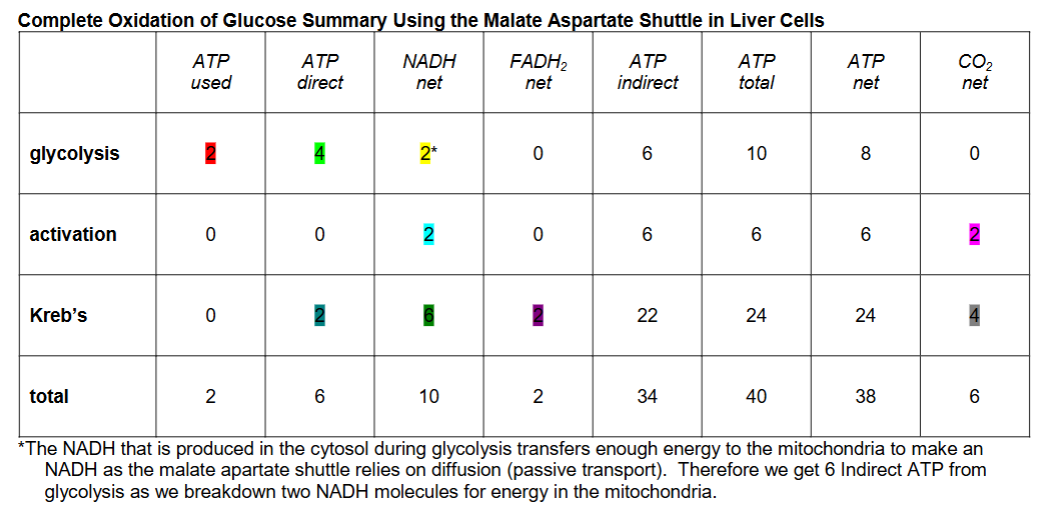
One pyruvate: Malate-aspartate shuttle
ATP used
Substrate level phosphorylation (ATP direct)
NADH net
FADH2 net
Oxidative phosphorylation (ATP indirect)
ATP total
ATP net
CO2 net
1
3
5
1
17
20
38
6
Glycerol phosphate shuttle
organ
how does it work?
for skeletal muscles
1) NADH donates e- to glycerol phosphate
reduced to NAD+, returns to cytosol
2) glycerol phosphate crosses only the FIRST membrane (outer mitochondrial), entering the INTERMEMBRANE SPACE
3) glycerol phosphate in intermembrane space gives e- to FAD, forming FADH2
4) FADH2 brings electrons to 2nd protein of ETC
Glycerol phosphate shuttle
is there any energy loss?
benefit of shuttle? importance?
The e- transferred from NADH to FADH2 yield an energy loss of 1 ATP
the “loss” is used to power the movement of electrons across the mitochondria. Important reaction in highly metabolic tissues that require energy immediately
Complete oxidation of glucose: Glycerol-phosphate shuttle
ATP used
Substrate level phosphorylation (ATP direct)
NADH net
FADH2 net
Oxidative phosphorylation (ATP indirect)
ATP total
ATP net
CO2 net
Take note of: ATP total = 38; ATP net = 36
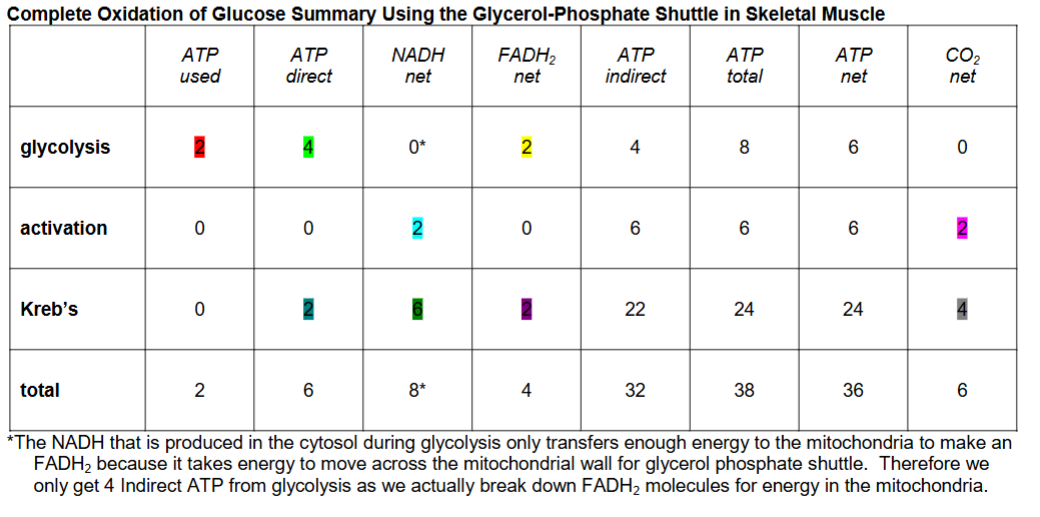
One pyruvate : Glycerol-phosphate shuttle
ATP used
Substrate level phosphorylation (ATP direct)
NADH net
FADH2 net
Oxidative phosphorylation (ATP indirect)
ATP total
ATP net
CO2 net
1
3
4
2
16
19
18
3
What is the creatine phosphate shuttle used for?
problem arises where ATP is a nucleotide mainly produced in the mitochondria, and energy is primarily needed for other parts of the cell
Creatine phosphate: Steps
1) ATP transfers energy in the form of a phosphate (Pi) molecule to a creatine molecule
a) ADP is formed from ATP as its phosphate us transferred to creatine to form creatine phosphate
2) Creatine phosphate can move across the mitochondrial membrane, where it transfers back phosphate to ADP to form ATP
3) Creatine can freely diffuse back into the mitochondria and continue the cycle
What happens, what are the four pathways?
the products of glycolysis can enter the mitochondria and produce nearly 20x the amount of energy in the presence of O2
glycolysis → pyruvate activation → krebs cycle → and ETC
Summary for aerobic respiration in the complete oxidation of glucose
1 glucose + 2ATP+ 6O2 → 38-40 ATP + 6CO2 + 6 H2O
Aerobic glycolysis
same steps as anaerobic glycolysis, what are two distinctions?
1) in the presence of O2 pyruvate can be activated and enter the mitochondria
2) energy from NADH can be gained and is not needed for the conversion of pyruvate to lactate
1 glucose + 2 ATP + 2NAD+ → 2 pyruvate, 2 NADH, 4 ATP
What happens in pyruvate activation?
pyruvate is transported from the cytosol into the mitochondria and goes through reactivation
Pyruvate activation steps for 1 pyruvate molecule
1) one carbon bond broken and released as CO2
2) since bonds are getting broken we harvest some high energy electrons into NAD+ which becomes NADH
3) attach coenzyme A to acetyl to form: acetyl CoA
Pyruvate Activation (one glucose molecule)
ATP used
Substrate level phosphorylation (ATP direct)
NADH net
FADH2 net
Oxidative phosphorylation (ATP indirect)
ATP total
ATP net
CO2 net
0 ATP used
0 Substrate level phosphorylation (ATP direct)
2 NADH net
0 FADH2 net
6 Oxidative phosphorylation (ATP indirect)
6 ATP total
6 ATP net
2 CO2 net: 2 net carbons lost and come off as CO2
2 pyruvate +2 NAD+ 2 O2 = 2 acetylCoA + 2 NADH + 2 CO2
Pyruvate Activation (one pyruvate molecule)
ATP used
Substrate level phosphorylation (ATP direct)
NADH net
FADH2 net
Oxidative phosphorylation (ATP indirect)
ATP total
ATP net
CO2 net
0
0
1
0
3
3
3
1
1 pyruvate +1 NAD+ 1 O2 = 1 acetyl + 1 NADH + 1 CO2
Pyruvate Activation
substrate
product
Krebs Cycle (Citric Acid Cycle ,Tricarboxylic Acid Cycle, TCA)
yields most?
also important?
yields much of the energy that we will gain from the breakdown of carbohydrates
also important in terms of using both fat and protein as energy as each has the potential to enter the Krebs's cycle at some point (many that have been converted in acetyl CoA)
Krebs’s Cycle
What are the steps?
1) acetyl CoA (2C) joins with oxaloacetate (OAA) (4C) to form citric acid
2) once citric acid is formed, it goes through a series of enzymatic steps where it releases energy as it is broken down
3) once acetyl CoA is completely broken down we end back with OAA
1 turn per acetyl CoA (2 turns per glucose)
as long as we keep putting acetyl CoA into the cycle, it keeps going
Krebs’s Cycle - Per one glucose (2 turns of the cycle)
ATP used
Substrate level phosphorylation (ATP direct)
NADH net
FADH2 net
Oxidative phosphorylation (ATP indirect)
ATP total
ATP net
CO2 net
0 ATP used
2 Substrate level phosphorylation (ATP direct): 2 turns per glucose molecule
6 NADH net: 3 NADH in each cycle
2 FADH2 net: 1 FADH in each cycle
22 Oxidative phosphorylation (ATP indirect)
24 ATP total
24 ATP net
4 CO2 net
2 Acetyl CoA + 2 OAA + 6 NAD + 2 FAD + 2 ADP + 2Pi + 4 O2 = 2 OAA + 6 NADH + 2 FADH2 + 2 ATP + 4CO2
Krebs’s Cycle - Per one pyruvate (1 turn of the cycle)
ATP used
Substrate level phosphorylation (ATP direct)
NADH net
FADH2 net
Oxidative phosphorylation (ATP indirect)
ATP total
ATP net
CO2 net
0
1
3
1
11
12
12
2
1 Acetyl CoA + 1 OAA + 3 NAD+ + 1 FAD + 1 ADP + 1Pi + 2 O2 = 1 OAA + 3 NADH + 1 FADH2 + 1 ATP + 2CO2
Electron transport chain
location
what happens?
In the mitochondria (intermembrane space)
where the energy carried by NADH and FADH2 in the form of electrons and hydrogen ions can be changed in usable energy in the form of ATP
ETC: Process
H+ are moved
e- are moved
H+ are moved across the mitochondrial membrane
e- are moved through a series of enzymes to make energy and combine with oxygen from respiration to form water
permits the controlled release of free energy to drive the synthesis of ATP
2H+ + 2e- + ½ O2 → H2O + energy
2H+ + 2e- + ½ O2 → H2O + energy
2 hydrogens ions, two electrons, and an oxygen molecule react to form as a product water with energy released in an exothermic reaction. The energy released is coupled with the formation of 3 ATP molecules per NADH and 2 ATP molecules per FADH2
ETC: steps
1) (5) Cytokine proteins are embedded in the intermembrane space, high energy electrons from NADH are given to the first protein and FADH 2 to the second protein
2) The proteins use the energy of e- to move H+ from low concentration in the matrix to high in the intermembrane, building the H+ gradient
as the e- from NADH and FADH are given they are oxidized back to NAD+ and FAD (return to glycolysis, activation, or krebs)
as the proteins “throw” the e- its a cycle of oxidation and reduction
3) Now that the high e- electrons were used to make the gradient (potential energy), the low energy (2) e- is accepted by oxygen to form warm (and 2H)
4) ATP synthase
there is now a high concentration of H+ in the intermembrane space that want to go down their gradient into the lumen; to do so they are assisted by ATP synthase
ATP synthase allows H+ to run down their gradient (potential energy created). As H+ goes down the gradient, it begins to spin ATP synthase, and ATP synthase uses the kinetic energy of spinning to phosphorylate ADP (ADP+Pi), making ATP
Chemiosmosis
the movement of H+ (proton) across a semipermeable membrane down its electrochemical gradient to make ATP via ATP synthase
How much does NADH yield? FADH2?
1 NADH = 3 ATP
1 FADH = 2 ATP
What is nicotinamide adenine dinucleotide?
NAD+ is a coenzyme found in all living cells
What does NAD+ do in metabolism?
carries electrons from one reaction to another
What two forms can NAD+ be found in cells?
OIL RIG
As NAD+ acts as an oxidizing agent because it accepts electrons from other molecules it becomes reduced.
the reduced state carries the electrons known as NADH
How is the NADH converted into usable energy?
how much does it yield?
converted into ATP in the mitochondria by the electron transport chain ETC
1NADH = 3 ATP
What is Flavin adenine dinucleotide?
what does it carry?
yield
FAD
also carries electrons
when reduced = FADH2
1FADH2 = 2 ATP
Why are NADH and FADH2 used?
used to capture energy released by bonds that will later be converted into ATP so there is no loss of energy
Energy equivalence for various molecules
break a small bond - capture directly as ATP = 1 ATP
break a medium bond - capture directly as FADH2 = 2 ATP
break a large bond - capture directly as NADH = 3ATP
How is the catabolism of carbs done?
through the harvesting of the oxidation of glucose
What is the net gain of ATP of glucose? k/cal? efficiency?
where does the remaining energy go? what is related to this?
Glucose net gain is 36-38 ATP, which is only about 262.8 - 277.4 kcal, making it 38-40% efficient
60% or remaining energy is released as heat; we heat up when we exercise due to this
Aerobic metabolism of lipids
where do the products enter? what is required?
products of lipolysis can enter the mitochondria and produce large amounts of energy. only happens in the presence of oxygen (only broken down by oxidative phosphorylation)
Aerobic metabolism of lipids
pathway
1) lipolysis
2) beta oxidation
3) krebs
4) ETC
Lipid Catabolism
1) location, enzyme, what do products join
occurs in the cytosol
enzyme lipase takes triglycerides and undergoes lipolysis, cutting fatty acids from glycerol
glycerol (3C) joins glycolysis, makes ~20 ATP
fatty acids undergo beta oxidation
Lipid catabolism
2) Beta oxidation
cuts, forms, joins
in beta oxidation an enzymes cuts at the beta bond, forming a 2 carbon unit, this can enter the Krebs cycle as acetyl CoA
each fatty acid has 20-30 C; 10-15 acetyl CoA can be made (x3)
Lipid catabolism
3 + 4) krebs cycle and oxidative phosphorylation (ETC)
what is the yield?
Nat ATP yield is 400 - 500 ATP per triglyceride
Protein Catabolism
When are proteins used as an energy source?
example
what is the first source
proteins are only broken down for energy under extreme metabolic conditions
ex) person on low calorie/carbohydrate diet that cannot provide adequate carbohydrate fuel (glucose), if there is no available source of glucose from the diet, the body manufactures it through gluconeogenesis
most readily source of amino acids is the protein that makes up skeletal muscles
Aerobic respiration of proteins can be broken down into four - five sequential steps, depending on the substrate
1) proteolysis
2) gluconeogenesis (glycolysis), ketogenesis (krebs first)
3) glycolysis and activation of pyruvate
4) krebs cycle
5) ETC
Protein Catabolism: Steps
1) proteolysis
“breaking down proteins”
protases enzyme breaks down peptide bonds though hydrolysis, releasing single amino acids
Protein Catabolism: Steps
2) Deamination
“cutting amine group from amino acid”
NH3 forms ammonia NH4+, the liver takes it and converts it into urea; urea will be excreted in the urine
deamination forms an organic keto acid, which varies in carbons
Protein Catabolism: Steps
3) energy production
glucogenic amino acids (3C) are converted into glucose (gluconeogenesis) which can then enter glycolysis and follow that pathway through their complete oxidation
ketogenic amino acids (2C) are converted in acetyl CoA, which can enter the krebs cycle and follow that pathway through their complete oxidation
Protein catabolism: yield
ketogenic: 12 ATP
glucogenic: 15 ATP
Order of energy
1) ATP
2) Creatine phosphate
3) glucose
4) glycogen
5) lipids
6) proteins
What are the energy sources for the cell?
High energy carriers
1) ATP
2) Creatine phosphate
3) Anaerobic metabolism (with simple sugars)
4) Aerobic metabolism (with complex carbohydrates (glycogen) / lipids (triglycerides)
1) ATP
the cell uses the supply of ATP itself to meet its initial metabolic needs
the body stores little ATP, and is cycled through ADP
only store enough ATP for a few seconds of exercise
2) Creatine phosphate
once sparse ATP has been used, we can transfer phosphate molecules from creatine phosphate to ADP to reform ATP (through creatine phosphate shuttle)
few more seconds of energy ~10 seconds
3) Anaerobic metabolism
simple sugars
from simple sugars we get 4kcal/g, and have about 500g inside us for simple sugars
have the capacity to continue without oxygen for a limited amount of time, inefficient method as we only produce 2 ATP per glucose
can only use carbohydrate for energy anaerobically and lasts 30-60 seconds
4) Aerobic metabolism
nearly unlimited capacity to undergo; can use a variety of fuel sources to generate ATP (carbs, fats, proteins) in the presence of O2
Can provide energy for long period of time (hours)
4) Aerobic metabolism
glycogen
4000kcal stored in glycogen
3000 kcal in liver
1000 kcal in muscle
3 hours of exercise
4) Aerobic metabolism
lipids
9kcal/g
calorically dense because carbons are more reduced
10,000 kcal stored as fat
enough to run 100 miles or sleep for months
The human body is composed of ~75 trillion cells
what are they trying to do? how?
about 60-70 trillion cells trying to live as a single organism
to do so they must effectively communicate to coordinate function and maintain homeostasis
What are the three main ways of cell-to-cell communication?
1) direct cytoplasmic transfer: contact depended on direct transfer via gap junctions/connexons
2) local communication: through chemicals, NT, and graded potential vis DIFFUSION
3) Local distance signaling: chemicals vis hormones and electrical signals via neurons
1) direct cytoplasmic transfer
what is it? what moves?
characteristic of channel
Two cells directly communicating, done with protein channels (gap junctions/connexons). Since it is a channel, small molecules (ions) move through them.
Channels are selective and are regulated by gates (typically single)
1) direct cytoplasmic transfer: Intercalated discs
Intercalated discs are specialized gap junctions connecting cardiomyocytes, ensuring they function as a single unit. They enable synchronized contraction by anchoring cells together structurally and providing rapid electrical communication. The gap junctions allow ions to move rapidly between cardiomyocytes, propagating action potentials instantly throughout the heart muscle, ensure that it contracts in a synchronized and efficient wave
2) Local communication
what does it depend on
what are some examples?
depends on the DIFFUSION of chemical signals
autocrines, paracrines, neurotransmitter, and graded potentials
Local communication: Autocrine
chemicals secreted by the cell that binds to the receptors of the cell it self (acts on self)
Local communication: Paracrine
Chemicals secreted by one cell and diffuse to neighboring cells, binding onto receptors and acting on them
Local communication: Neurotransmitters
released at the synapses and diffuses to neighboring cells, binding onto receptors and acting on them
local communication depends on the diffusion of NT across the synaptic cleft
Local communication: Graded potentials
localized electrical event that decays with time and distance
local communication from dendrites because as ions enter the cell they diffuse to the axon hillock, but decay with time and distance
Long distance communication:
what are the two types?
Neural, humoral, and neurohormones
Long distance communication: Humoral
endocrine cell secretes hormones that travel in blood to distant target cell that has receptors
all cells are exposed to the hormone but ONLY the TARGET cell is affected
Long distance communication: Neural
neurons transmit electrical signals down (long) axons
Long distance communication: Neurohormones
example
release “NT” that is carried by blood to target cells
hormones are produced by the hypothalamus and released through neurons in the posterior pituitary as vesicles filled with oxytocin/antidiuretic
All types of communication or interconnected, explain
long distance communication can lead to local communication, and local communication can lead to long distance communication
it does not have to be just one type
Each type of signal may cause another type of signal?
explain
what organ exhibits all?
one organ can doo call communication and one communication can lead to the next in order to synchronize function
heart exhibits all
Heart exhibits all types of communication
Local
Direct cytoplasmic
Long
SA node generates local graded potentials → local graded potentials can cause cardiac AP → AP is passed between cells via gap junctions (direct)
Heart responds to different autocrines and paracrines like histamine
Heart makes and responds to hormones
Responds to PSNS/SNS fibers
long distance communication releasing NT, being local communication binding to the receptors, then generating IPSP or EPSP on the heart muscle
What are signal pathways?
why? response?
pathways in which cells signal or communicate with other cells. Cells need to communicate in order to coordinate action.
Only cells with corresponding receptors responds, and the receptor determines the effect
Intracellular signals must cross the CM
Lipophilic signals
can they diffuse? location of receptors?
Lipophilic signals, are lipophilic molecules (mainly steroids), meaning they can diffuse across the cell membrane or the nuclear envelope
Receptors are inside the cytoplasm or the nucleus
Intracellular signals must cross the CM
Lipophilic signals
Result? Speed?
Cytosolic/Nuclear receptors: as a result, especially the ones that go into the nucleus results in protein production, a change in gene expression
these signals are slow in production due to the long process of protein production
Intracellular signals must cross the CM
Lipophobic signals
can they diffuse? location of receptors?
membrane impermeable, typically protein or amino acid signals
receptors are found on the cell membrane (extracellular) and the signal is transduced into the cell via secondary messengers and has a rapid response time
What is a secondary messenger?
molecule activated inside the cell which activates enzymatic cascade of intracellular activities very fast
Lipophilic molecules and Secondary Messenger
steps
1) First messenger is the hormone itself, extracellular signal molecules
2) First messenger binds onto the receptor protein, and the signal is transduced
3) G protein-coupled receptors are activated by the primary messenger by changing their conformation. A G protein stimulates enzymes inside the cell that will activate the secondary messenger
3) results in the activation of many secondary messengers (cAMP/ Ca2+) for each signaling molecule (amplifies)
5) The secondary messenger usually activates an enzymatic cascade of intracellular activities very fast
Primary and Secondary messenger example
GP that leads to an AP is the signal to the cell (primary messenger). The release of Ca2+ from AP traveling down and exciting DHP receptors opening the doors on the sarcoplasmic reticulum, leads to following events (muscle contraction)
Extracellular receptors properties
what are some ligand sub-types within?
specificity
agonist
competition
antagonist
saturation

