Gereffi - The Global Economy Organization, Governance, and Development
- At the macro level are international organizations and regimes that establish rules and norms for the global community
- At the meso level, the key building blocks for the global economy are countries and firms
- At a micro level, there is a growing literature on the resistance to globalization by consumer groups, activists, and transnational social movements
How New is the Global Economy
- Internationalization, which involves the mere extension or geographic spread of economic activities across national boundaries
- One of the key actors that distinguish the global economy of the latter half of the twentieth century from its predecessors is the transnational corporation
- Origins of a global economy can be traced back to the expansion of long-distance trade during the period of 1450–1640
- The foundations of the contemporary economic order were established in the late 1940s by the system of financial and trade institutions that were set up at an international conference in Bretton Woods
- Bretton Woods became a dollar system because the United States was the leading economy and the only major creditor nation
Distinctive Features of the Contemporary Global Economy, 1960s to the Present
- Growth in international trade, investment, and financial flows is one side of the story
- The dramatic expansion of production capabilities reflected in global outsourcing across a wide range of industries does not necessarily increase levels of development or reduce poverty in the exporting nations
The Reorganization of Production and Trade in the Global Economy
The Role of Transnational Corporations
- Transnational corporations have become the primary movers and shakers of the global economy because they have the power to coordinate and control supply chain operations in more than one country, even if they do not own them
- TNCs had the power, the resources, and the global reach to thwart the territorially based objectives of national governments in both developed and developing countries
- Many TNCs are bigger than countries
- The concentrated power of vertically integrated, industrial TNCs has been diminishing for the past couple of decades as a result of the tendency toward both the geographic and the organizational out-sourcing of production
The Emergence of International Trade and Production Networks
- The most common causes usually given to explain expanding world trade are technological (improvements in transportation and communication technologies) and political
- 3 new aspects of modern world trade:
- The rise of intra-industry and intra-product trade in intermediate inputs
- The ability of producers to “slice up the value chain” by breaking a production process into many geo-graphically separated steps
- The emergence of a global production networks framework that highlights how these shifts have altered governance structures and the distribution of gains in the global economy
Intra-industry Trade in Parts and Components
- Fragmentation describes the international division of labour that allows producers located in different countries and often with different ownership labour structures to form cross-border production networks for parts and components
Slicing Up the Value Chain
- The power of value-chain or industry analysis as a basis for formulating global strategies that can integrate comparative (location-specific) advantage and competitive (firm-specific) advantage
- Remarkable growth of manufactured exports from low-wage to high-wage nations in the past several decades
Production Networks in the Global Economy
- Supply chains
- International production networks
- Global commodity chains
- French “filière” approach
- Global value chains
Governance in the Global Economy: Institutional and Organizational Perspectives
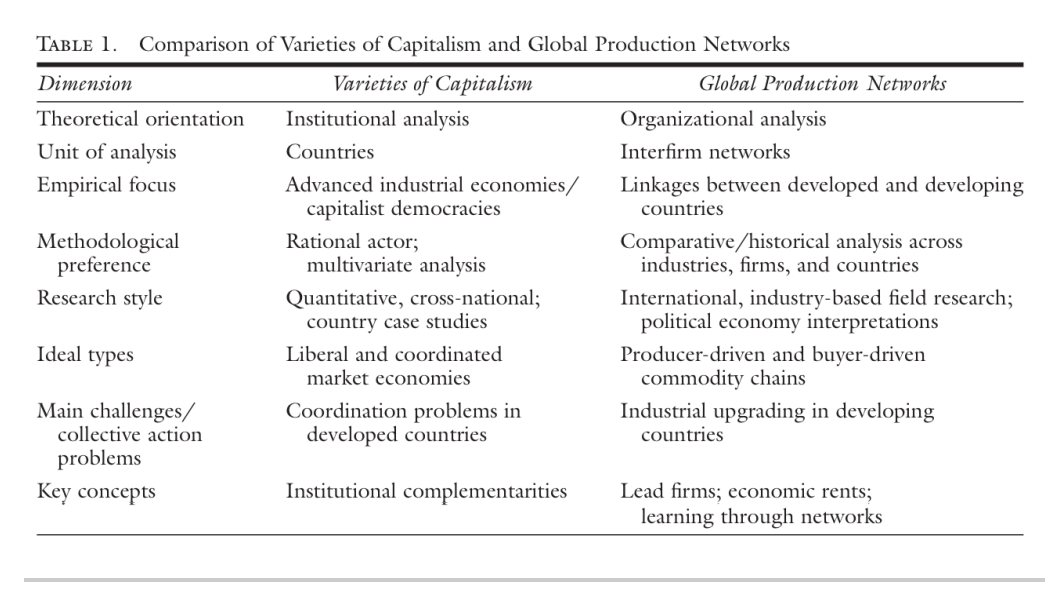
- Business groups: a collection of firms bound together in persistent formal or informal ways, are a pervasive phenomenon in Asia, Europe, Latin America, and elsewhere
- Business groups play a role in the global economy through their impact on national market structures and on product variety and product quality in international trade
Industrial Upgrading and Global Production Networks
- Industrial upgrading: the process by which economic actors move from low-value to relatively high-value activities in global production networks
- Expanding set of capabilities that developing countries must attain in pursuing an upgrading trajectory in diverse industries
- Apparel
- Electronics
- Fresh Vegetables
The Globalization Backlash: Dilemmas of Governance and Development
- Many people sense that globalization means greater vulnerability to unfamiliar and unpredictable forces that can bring economic instability and social dislocation, as well as a flattening of culture
- Purported benefits of globalization are distributed highly unequally
- Transnational corporations are being pressured to comply with a broad range of social objectives in multistakeholder institutions of private governance that can have an impact on public policies in the developed as well as the developing world