L1: The cytoskeleton as a dynamic system

0.0(0)
studied byStudied by 0 people
0.0(0)
call with kaiCall with Kai
learnLearn
examPractice Test
spaced repetitionSpaced Repetition
heart puzzleMatch
flashcardsFlashcards
GameKnowt Play
Card Sorting

1/50

encourage image

There's no tags or description

Looks like no tags are added yet.

Study Analytics
Name
Mastery
Learn
Test
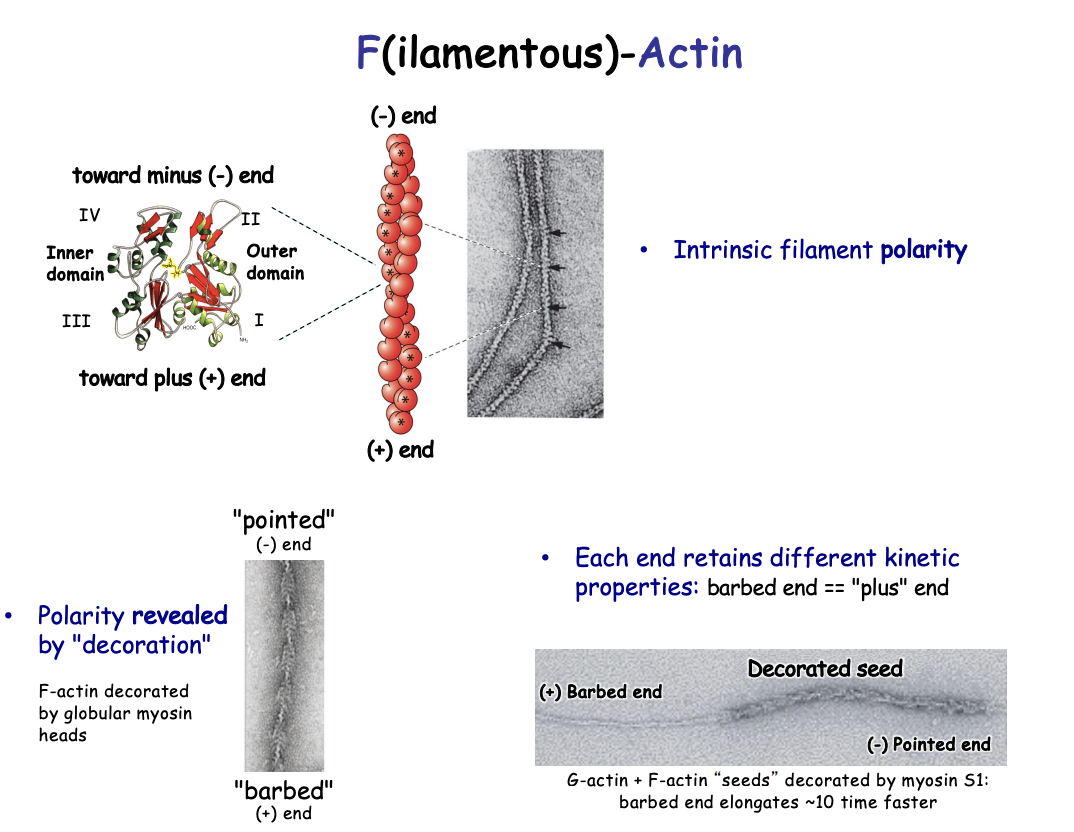
Matching
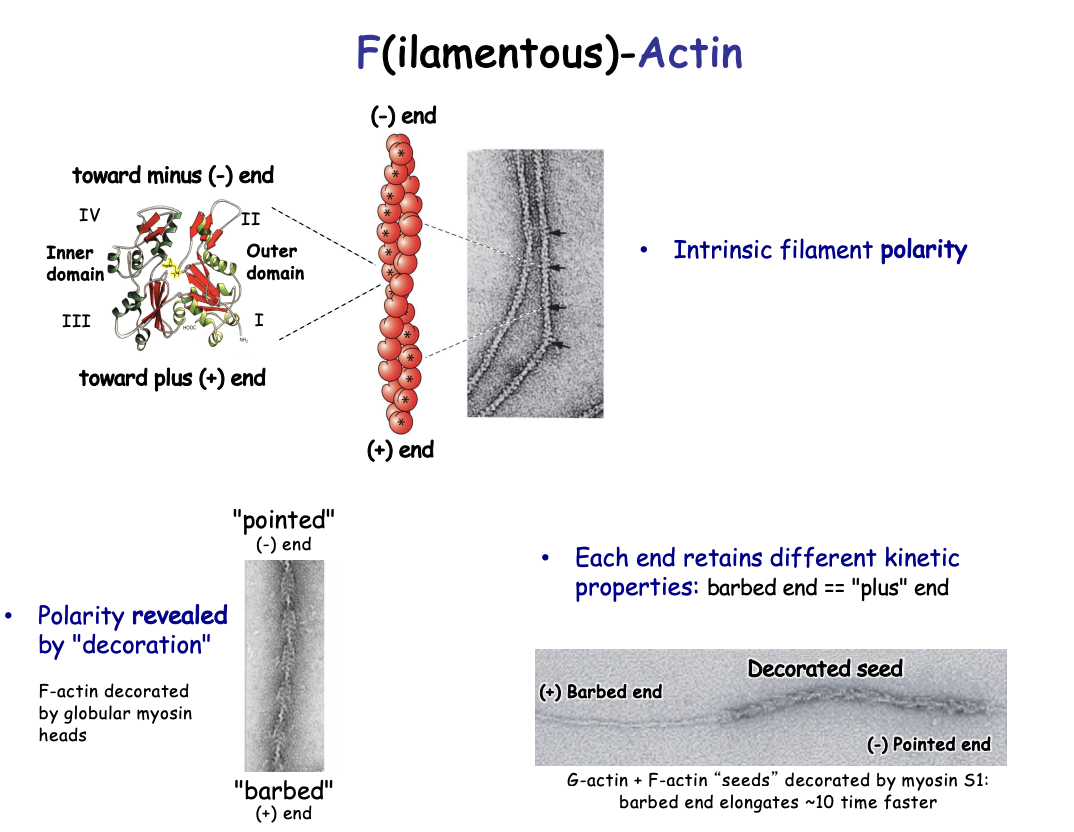
Spaced
Call with Kai

No study sessions yet.

51 Terms

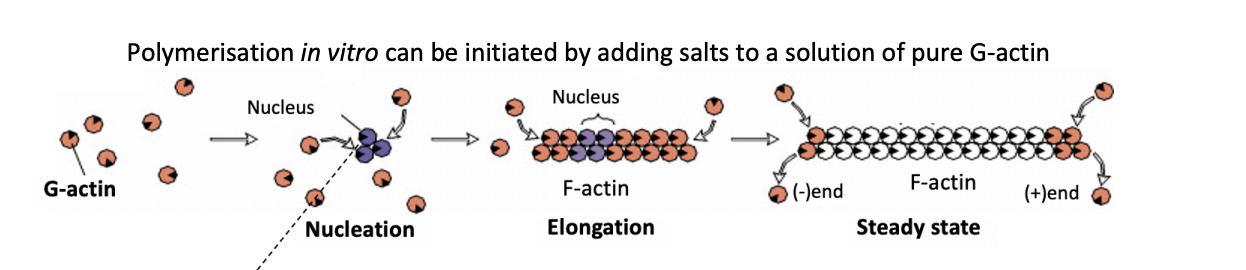
1
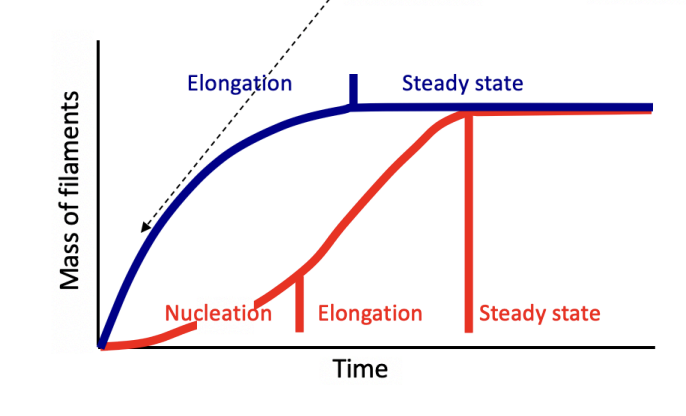
New cards

What is the cytoskeleton

  • system of protein filaments found in all eukaryotic cells

2
New cards

What fundamental cellular functions does it perform

  1. maintenance of cell shape

  2. locomotion

  3. intracellular trafficking that organises the cells’ contents

  4. Rearrange components of cell in space and time

3
New cards

How do the compoentns of the cytoskeleton perform these functions

  • organised into higher order strucutures

4
New cards

What processes can these higher order structures support examples

  1. cell migration in developing embryo or adult

  2. spread of cancer cells

  3. swimming of sperm

  4. muscle contraction

  5. meiotic and mitotic divisions

    • cell cycle divisions every ten minutes

      • segregating chromosomes

      • contractile ring for cell division

  6. Organelle partition

  7. establishment of polarity and asymmetrical positioning of cell determinants for alternative developmental fates

i.e not just in muscle cells→ also in all cells
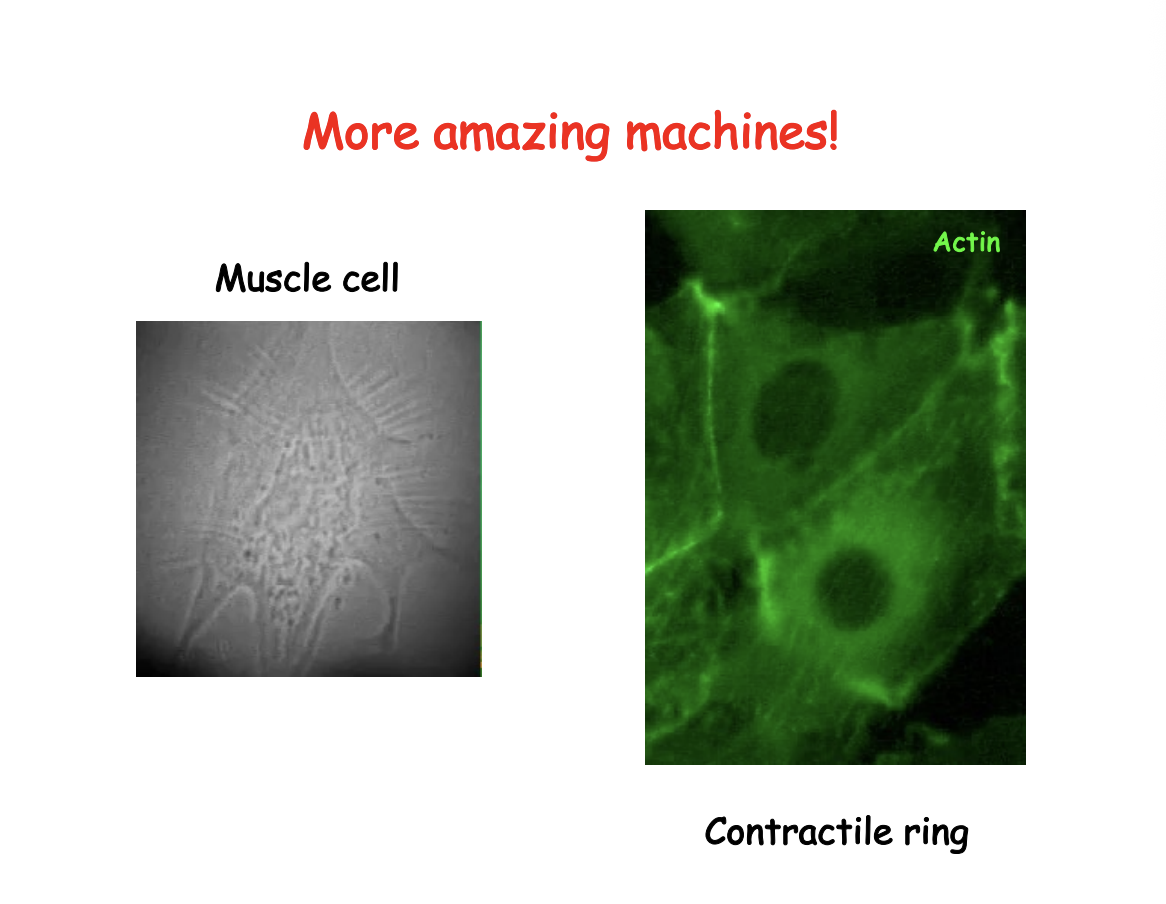
<ol><li><p>cell migration in developing embryo or adult</p></li><li><p>spread of cancer cells</p></li><li><p>swimming of sperm</p></li><li><p>muscle contraction</p></li><li><p>meiotic and mitotic divisions</p><ul><li><p>cell cycle divisions every ten minutes</p><ul><li><p>segregating chromosomes</p></li><li><p>contractile ring for cell division</p></li></ul></li></ul></li><li><p>Organelle partition</p></li><li><p>establishment of polarity and asymmetrical positioning of cell determinants for <strong>alternative</strong> <strong>developmental fates</strong></p></li></ol><p><em>i.e not just in muscle cells→ also in all cells</em></p>
5
New cards

Example of where it is used for transport and motility

  1. Intracellular→ axonal transport

  2. Change in cell shape movement → granulocyte in blood vessel for healing wound

  3. Dorsal closure in development→ actin creates a zipper that closes the gap
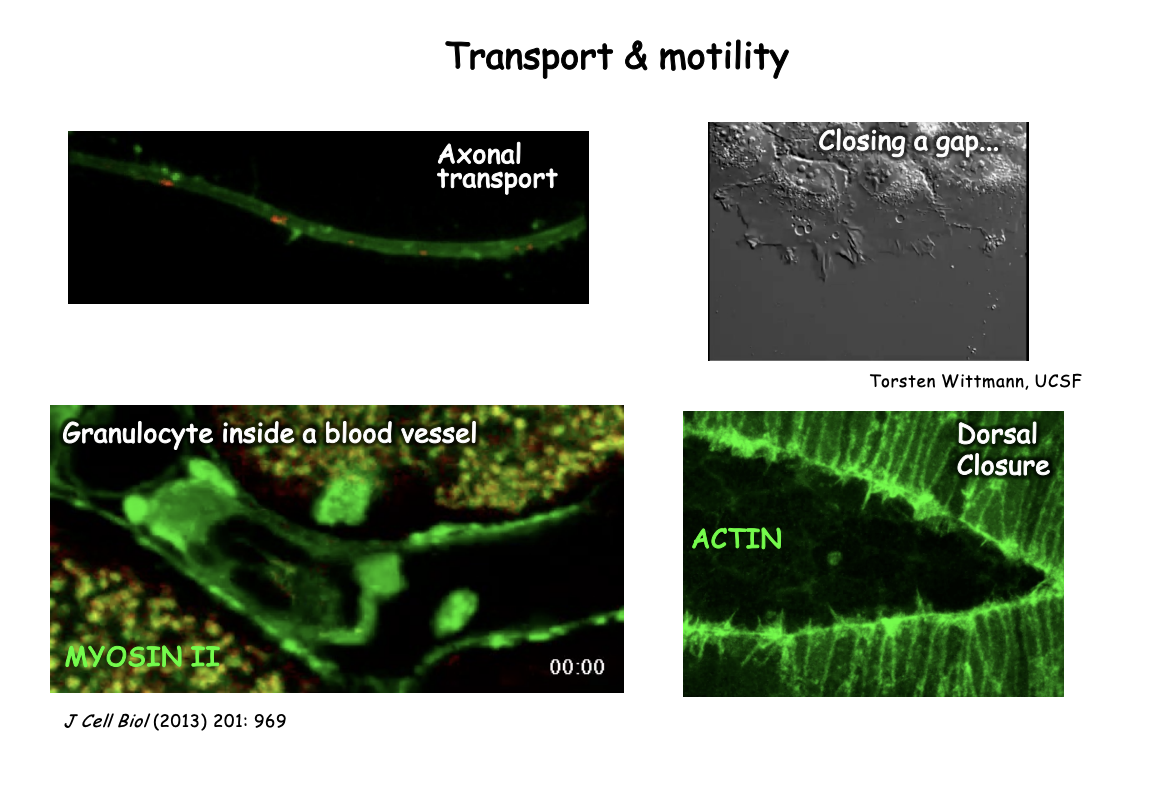
<ol><li><p>Intracellular→ axonal transport</p></li><li><p>Change in cell shape movement → granulocyte in blood vessel for healing wound</p></li><li><p>Dorsal closure in development→ actin creates a zipper that closes the gap</p></li></ol><p></p>
6
New cards

Examples of other motile strucutures

  1. Swimming→ flagellum

  2. Beating→ cilia

  3. Listeria→ invading cell must hijack the cytoskeleton system to propel themselves
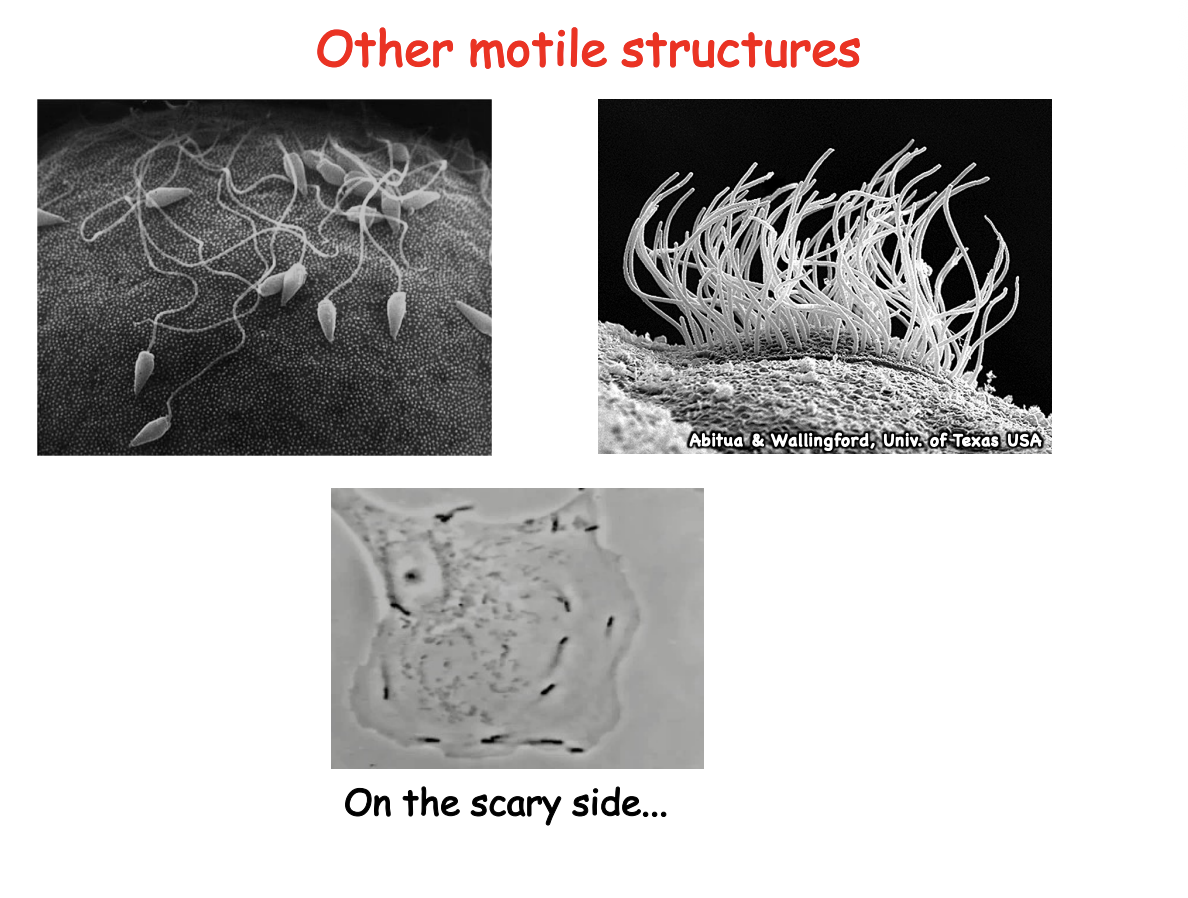
<ol><li><p>Swimming→ flagellum </p></li><li><p>Beating→ cilia</p></li><li><p>Listeria→ invading cell must hijack the cytoskeleton system to propel themselves</p></li></ol><p></p>
7
New cards

What features of the cytoskeleton allow it to have so many functions

  1. Built from small diffusible subunits

  2. Subunits held together mainly by non-covalent interactions→ makes them really strong

  3. Accessory proteins modulate the spatial distribution and dynamic behaviour of cytoskeletal systems and provide an interface with diverse signalling pathways

  4. Cytoskeletal structures ca be highly dynamic and may undergo rapid remodelling

8
New cards

How are cytoskeltal strucutres highly dynamic

  • under the control of accessory proteins

  • undergo continuous turnover in cells

  • small subunits can then diffuse and become reorganised into strucutre to match requirments of the cell

9
New cards

When do these rearrangements occur

Abruptly in response to

  • intracellular cues

or

  • Extracellular signals

10
New cards

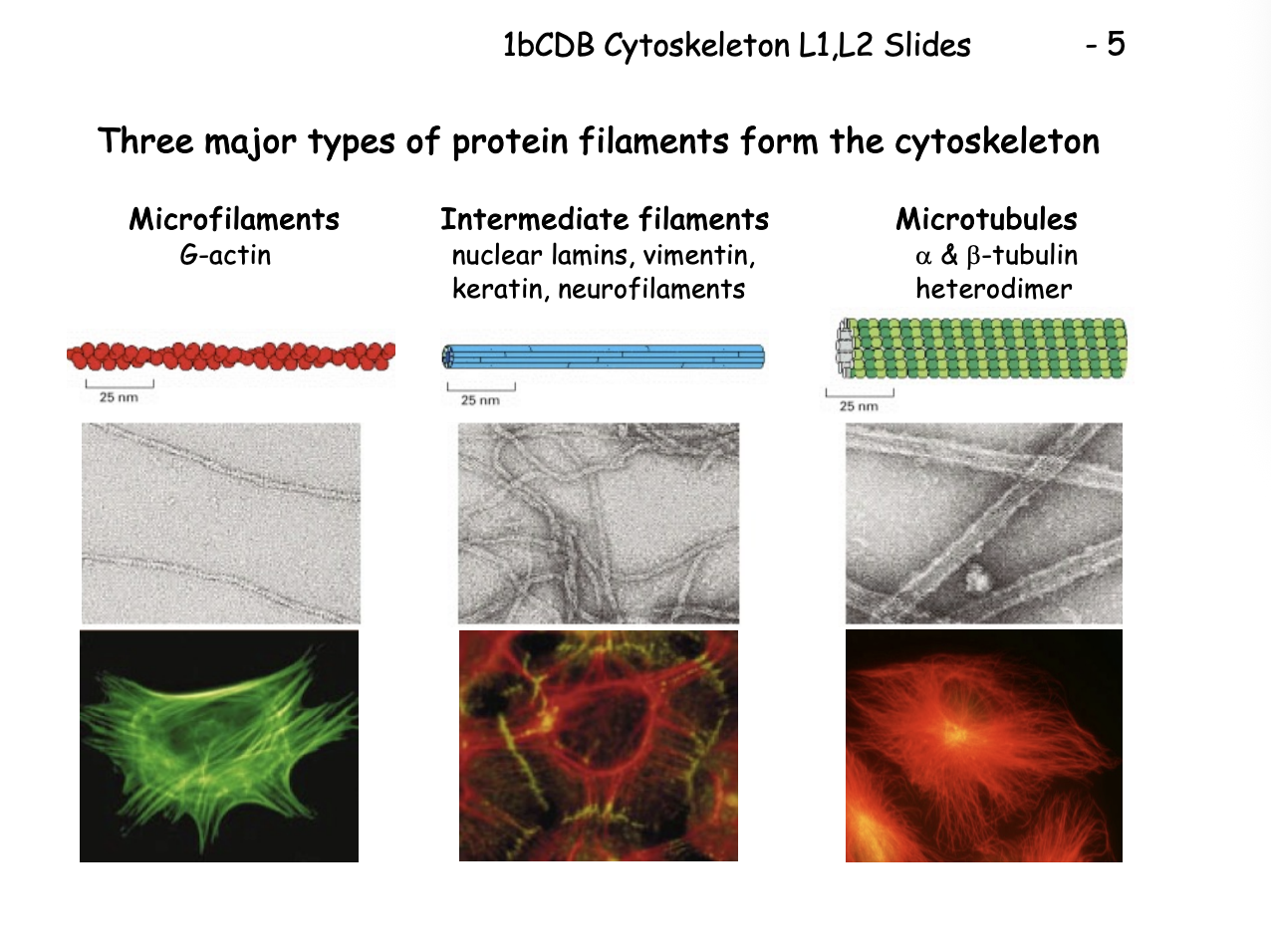
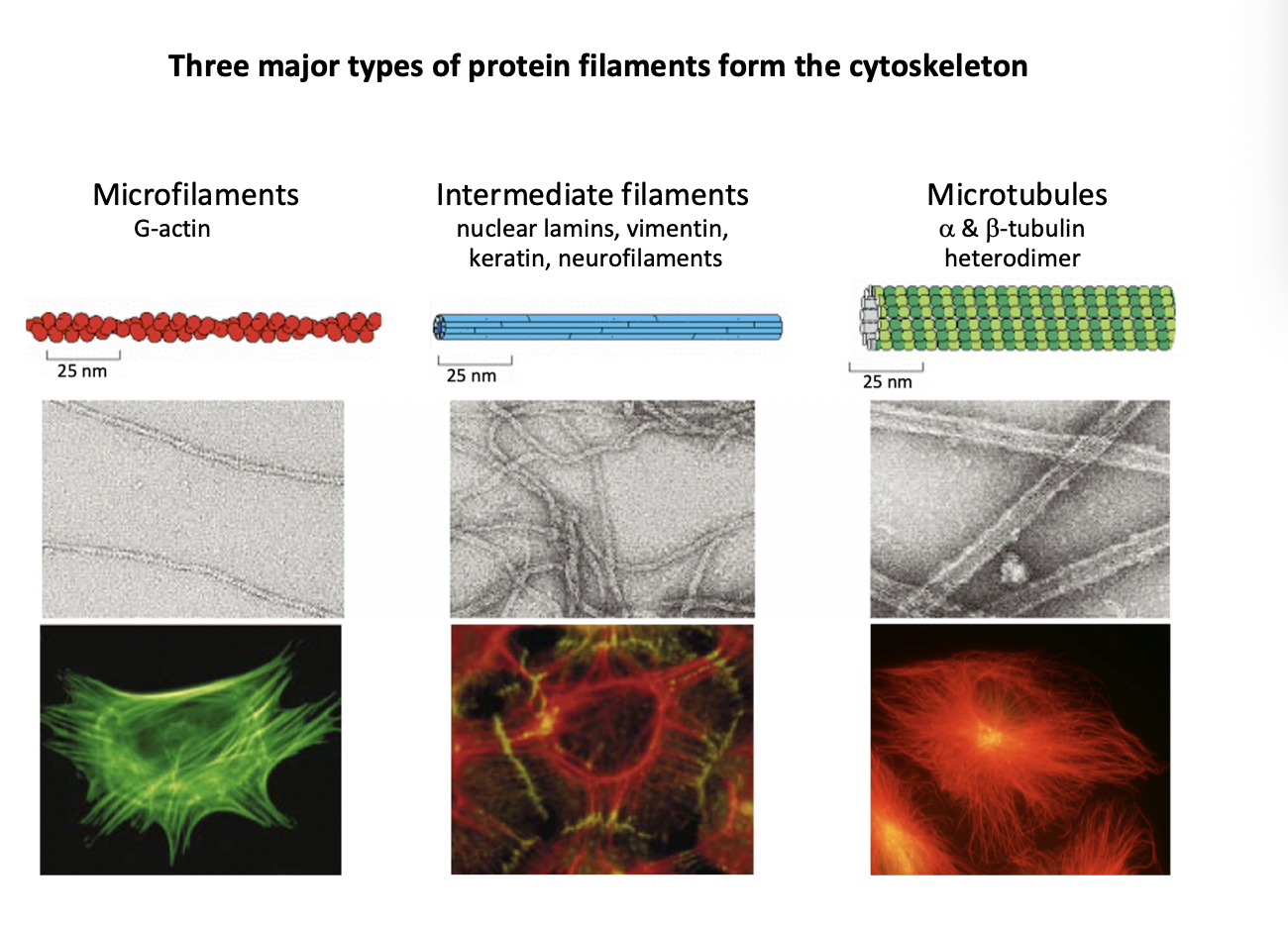
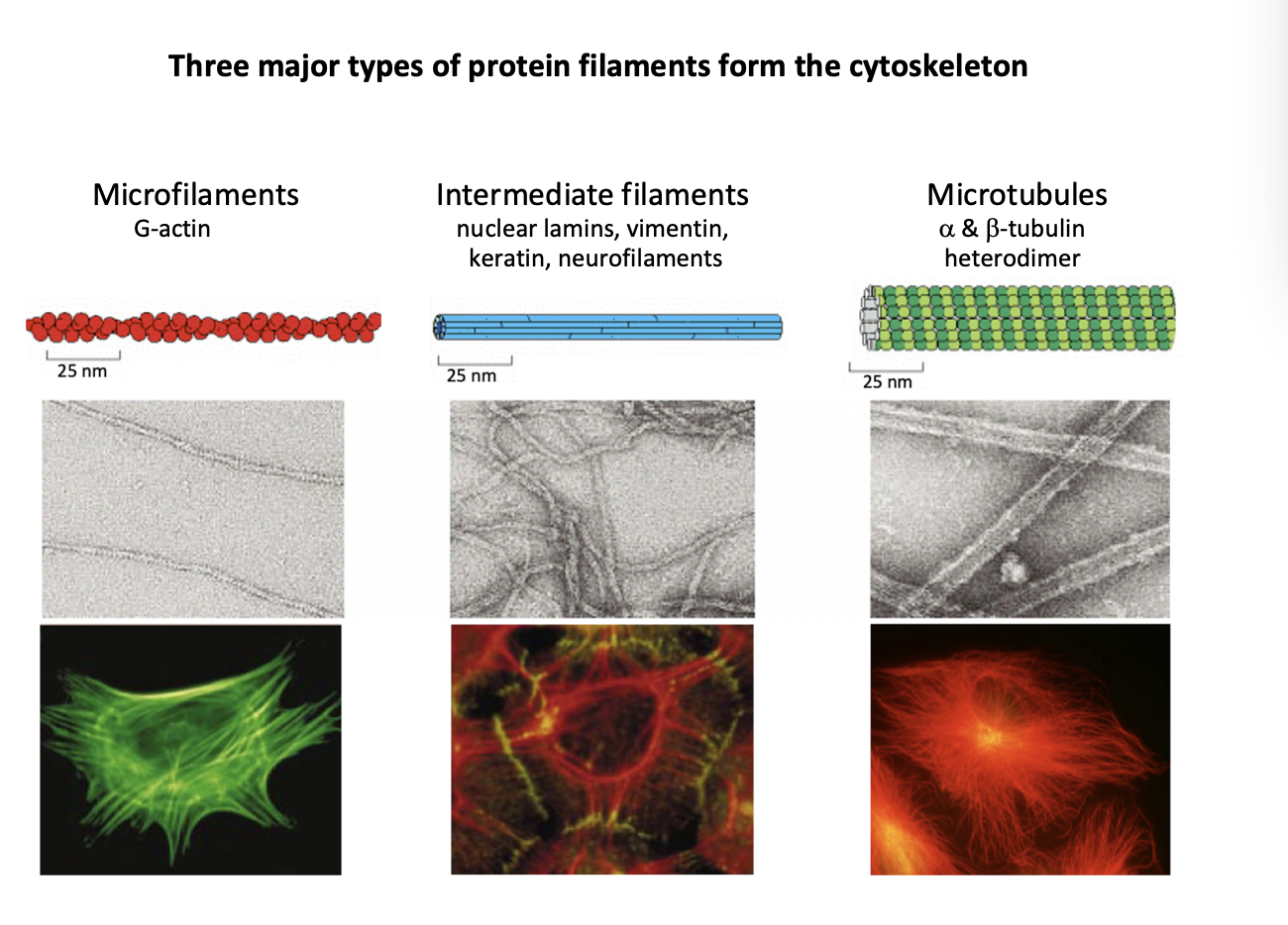
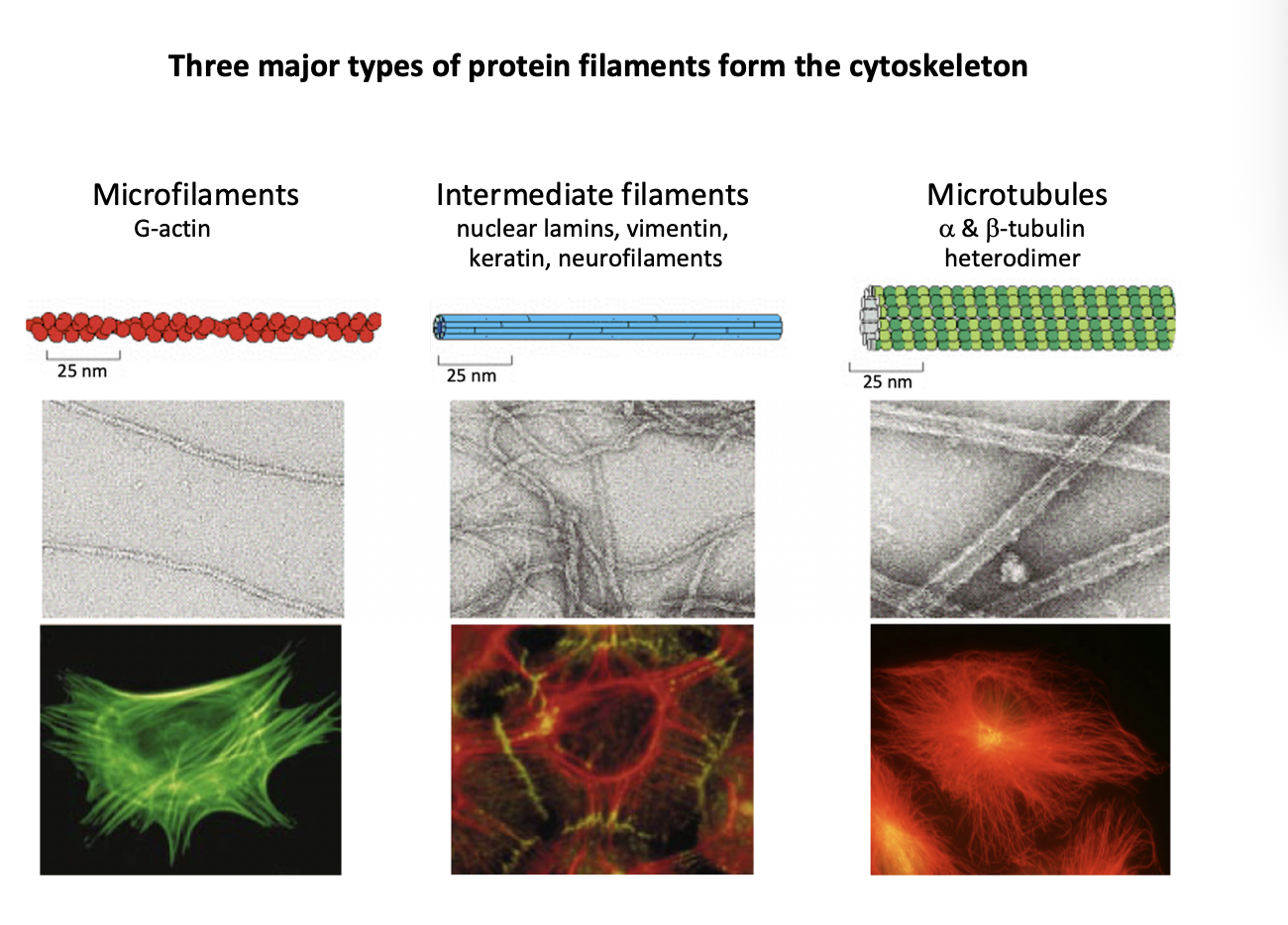
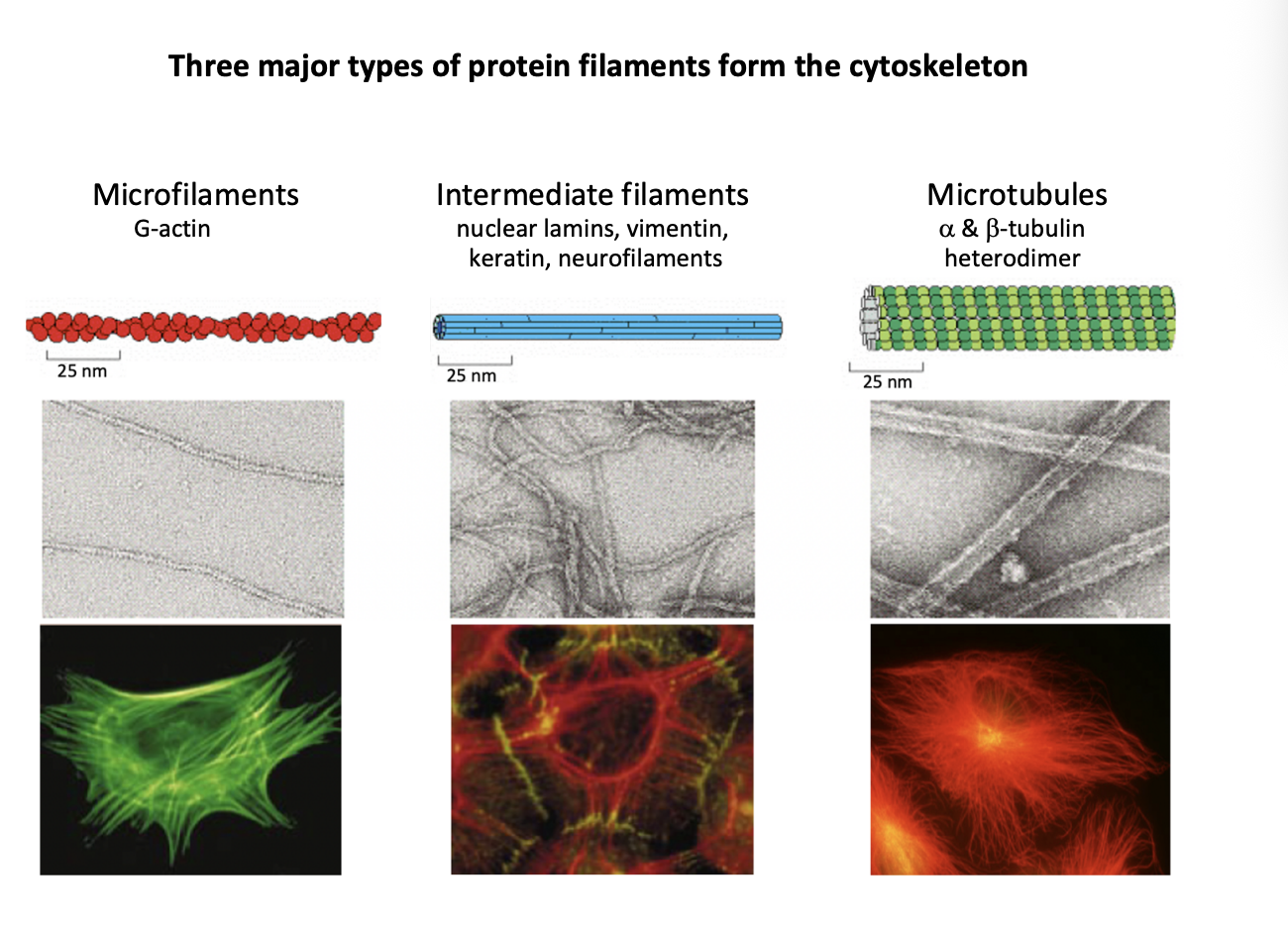
Three major types of protein filaments from the cytoskeleton and rough diameters

  1. Microfilaments (MFs)

    • G actin

    • 7nm

  2. Intermediate filaments (IFs)

    • Repetitive subunits of different proteins

      • neulcear lamins, vimentin, keratin, neurofilaments

    • 10nm

  3. Microtubules (MTs)

    • Alpha and beta tubulin heterodimer

    • makes walls and hollow cylinder

    • 25nm

<ol><li><p>Microfilaments (MFs)</p><ul><li><p>G actin</p></li><li><p>7nm</p></li></ul></li><li><p>Intermediate filaments (IFs) </p><ul><li><p>Repetitive subunits of different proteins</p><ul><li><p>neulcear lamins, vimentin, keratin, neurofilaments</p></li></ul></li><li><p>10nm</p></li></ul></li><li><p>Microtubules (MTs)</p><ul><li><p>Alpha and beta tubulin heterodimer</p></li><li><p>makes walls and hollow cylinder</p></li><li><p>25nm</p></li></ul></li></ol><p></p>
11
New cards
  1. Microfilaments

  • actin monomers

  • in all eukaroytic cells

Functions:

  1. form cell cortex→ underneath cytoplasmic membrane network

  2. Filaments bundle to form chracteristic cell protrusions

    • Microvilli→ e.g intestine

    • Sterocilia→ e.g inner ear

    • filopodia or lamellipodia in crawling cells

  3. Intracellular transport

    • provide tracks

  4. Contractile strucutres

    • stress fibres

    • myofibrils in muscle cells

  5. Cytokinesis

    • actomyosin ring

<ul><li><p><strong>actin</strong> monomers</p></li><li><p>in all eukaroytic cells</p></li></ul><p>Functions:</p><ol><li><p>form cell cortex→ underneath cytoplasmic membrane network </p></li><li><p>Filaments bundle to form chracteristic cell protrusions</p><ul><li><p><strong>Microvilli→ e.g intestine</strong></p></li><li><p><strong>Sterocilia→ e.g inner ear</strong></p></li><li><p><strong>filopodia or lamellipodia in crawling cells</strong></p></li></ul></li><li><p>Intracellular transport</p><ul><li><p>provide tracks </p></li></ul></li><li><p>Contractile strucutres</p><ul><li><p>stress fibres</p></li><li><p>myofibrils in muscle cells</p></li></ul></li><li><p>Cytokinesis</p><ul><li><p>actomyosin ring</p></li></ul></li></ol><p></p><p></p>
12
New cards

Role of nuclear actin?

  • remain more mysterious

<ul><li><p>remain more mysterious</p></li></ul><p></p>
13
New cards

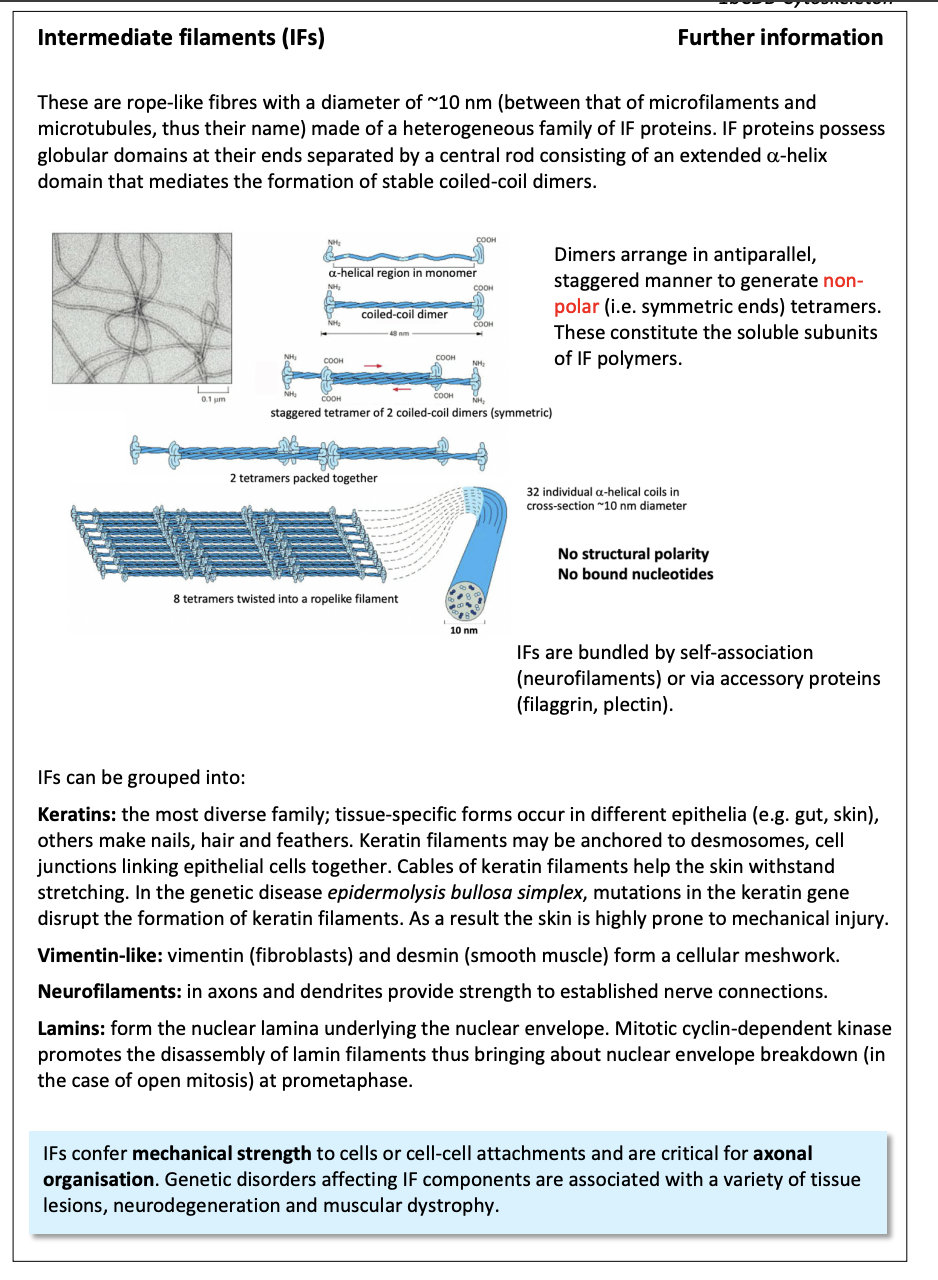
2 . Intermediate filaments

  • more restricted distribution

  • strong polymers with common overall ‘rope-like’ strucutre

  • contribute to the remarkable strength of tissues

    • e.g skin and muscle

    • withstand stretching

  • Full development of neurons

<ul><li><p>more restricted distribution</p></li><li><p>strong polymers with common overall ‘rope-like’ strucutre</p></li><li><p>contribute to the remarkable <strong>strength</strong> of tissues</p><ul><li><p><strong>e.g skin and muscle</strong></p></li><li><p>withstand stretching</p></li></ul></li><li><p>Full development of neurons</p></li></ul><p></p>
14
New cards
  1. intermediate filaments

  • further info

<ul><li><p>further info</p></li></ul><p></p>
15
New cards
  1. Microtubules (MTs)

  • hollow cylinder of heterodimeric subunits

    • a/b-tubulin

Functions:

  1. Form tracks for vesicular and organelle traport

    • e.g axonal transport

  2. Compartmentalisation of Golgi and ER within the cell

  3. Mitotsis> rearrange mitotic apparatus

<ul><li><p>hollow cylinder of heterodimeric subunits </p><ul><li><p>a/b-tubulin</p></li></ul></li></ul><p>Functions:</p><ol><li><p>Form tracks for vesicular and organelle traport</p><ul><li><p><strong>e.g axonal transport</strong></p></li></ul></li><li><p>Compartmentalisation of Golgi and ER within the cell</p></li><li><p>Mitotsis&gt; rearrange mitotic apparatus</p></li></ol><p></p>
16
New cards

In order to understand MFs and MTs→ must explore

  1. Structure

  2. Filament nucleation

  3. Organisation

  4. Dynamic beahviour

  5. Functional integration→ mitosis and cell division (case study)

17
New cards

Microfilaments: Actin

  • in all euakroytic cells

  • most abundant cellular protein

    • 10% muscle cells

    • 1-5% non-muslce cells

18
New cards

Main roles in cell

  1. cell motility

  2. Cell polarity

  3. Cell shape

19
New cards

Great range of roles it has

  1. Endocytosis and intracellular trafficking

  2. Contractility

  3. Surface protrustion and adhesion

  4. Mitotic spindle orientation

  5. Cytokinesis

  6. Cell division patterning

  7. Embryonic development

  8. Whole cell motility

  9. Elongation of nerve axons

  10. Defence against infection

  11. Wound healing

  12. Metastasis

20
New cards

How is it able to do these roles

  • structrual and dynamic properties

  • cycles of polymerization and disassembly

    • between globular and filamentous forms

    • constantly remodelling

    • used for force-generating system

21
New cards

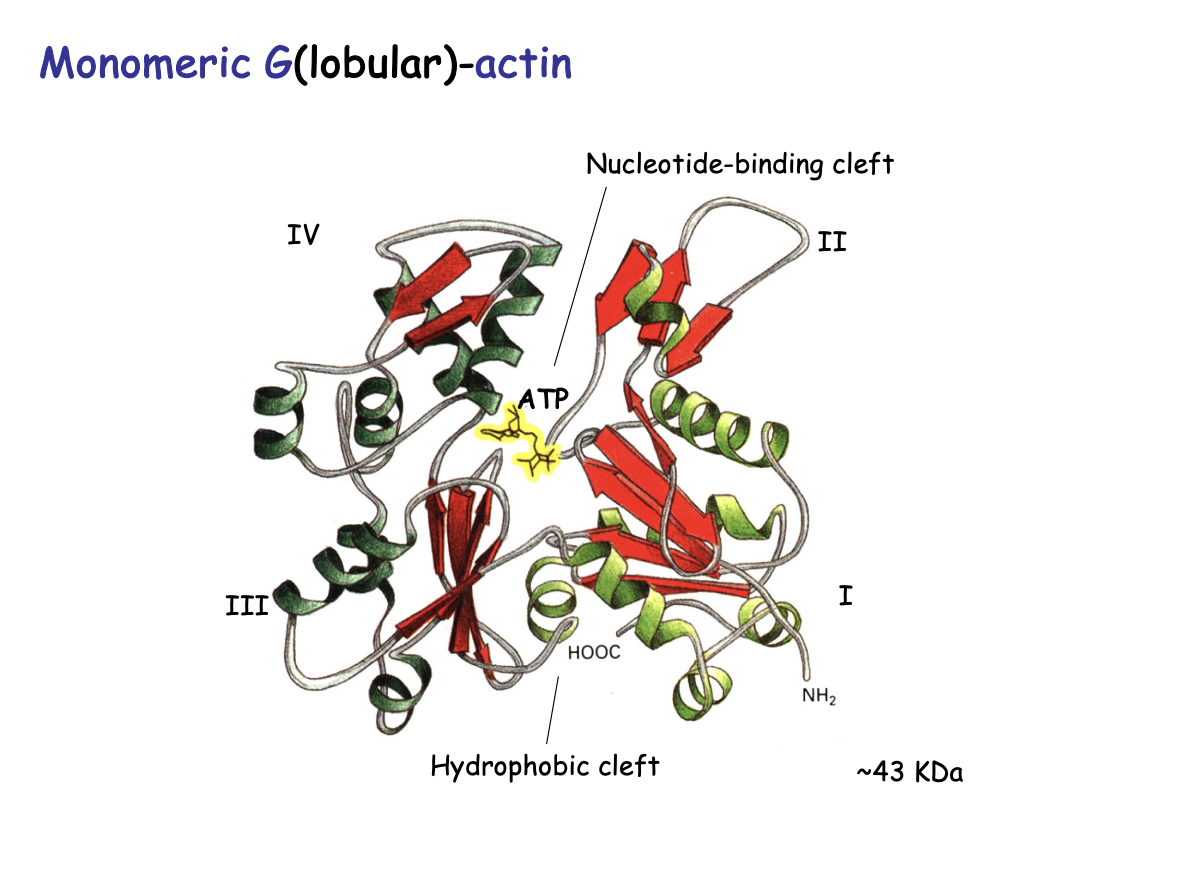
Actin monomers strucutre

Globular (G) Actin:

  • bi-lobe (two distinct lobes)

  • separated by a deep hydrohobic cleft

    • binds ATP or ADP

  • ATPase activity

  • 43kDa

<p><strong>Globular (G) Actin</strong>:</p><ul><li><p>bi-lobe (two distinct lobes)</p></li><li><p>separated by a deep hydrohobic cleft</p><ul><li><p>binds ATP or ADP</p></li></ul></li><li><p>ATPase activity</p></li><li><p>43kDa</p></li></ul><p></p>
22
New cards

Polymerised actin

Filament (F) actin

  • Flexible

  • 7nm diameter

  • double helix

  • non covalent bonds→ strong

  • Same orientation/polarity→subunits pointed in the same direction
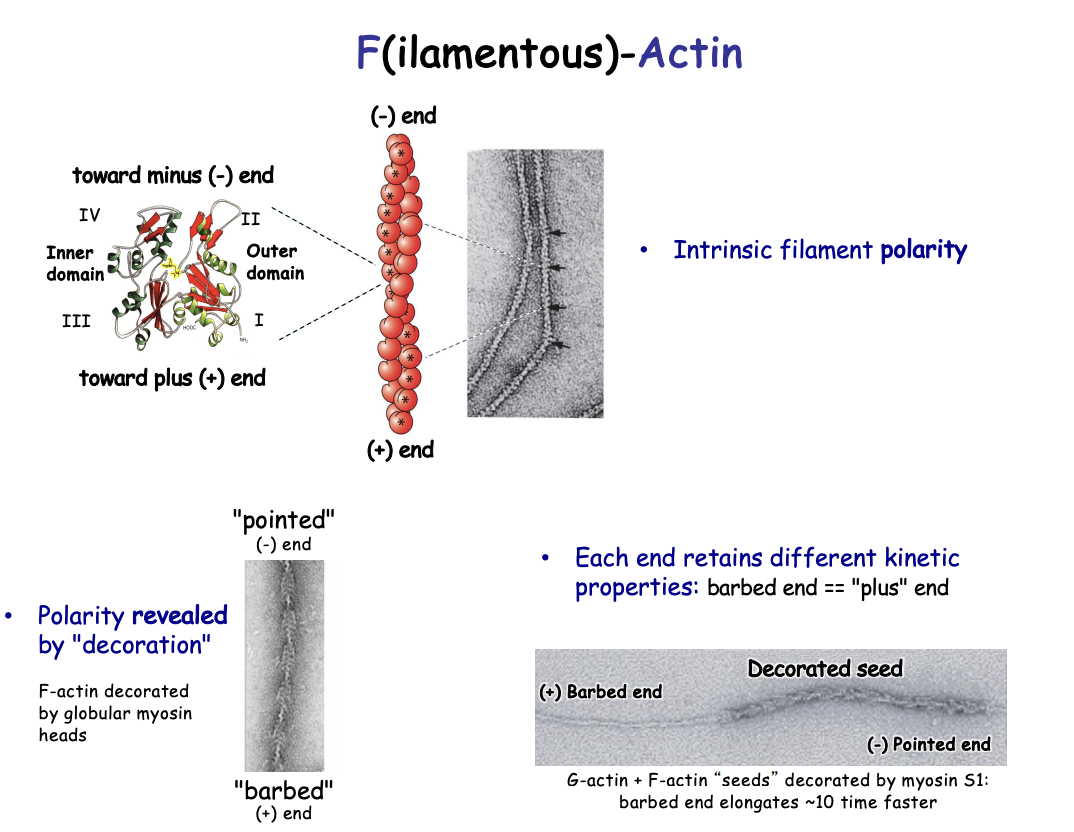
<p><strong>Filament (F) actin</strong></p><ul><li><p>Flexible </p></li><li><p>7nm diameter</p></li><li><p>double helix</p></li><li><p>non covalent bonds→ strong</p></li><li><p><strong>Same orientation/polarity→</strong>subunits pointed in the same direction</p></li></ul><p></p>
23
New cards

How was polarity investigated/shown

Decoration Experiments

  • add proteolytic S1 fragment to microfilaments in vitro (myosin globular heads)

  • i.e F actin decorated with globular muosin heads

results:

  • revered a ‘barbed’ or ‘pointed’ ends

  • with polarity→ all point in same direction
<p><strong>Decoration Experiments</strong></p><ul><li><p>add proteolytic S1 fragment to microfilaments in vitro (myosin globular heads)</p></li><li><p>i.e F actin decorated with globular muosin heads</p></li></ul><p>results:</p><ul><li><p>revered a ‘barbed’ or ‘pointed’ ends</p></li><li><p>with polarity→ all point in same direction</p></li></ul><p></p>
24
New cards

Investigating the different dynamics of each head

Procedure:

  • G actin and F actin seeds decorated by myosin S1

  • shows the barbed end elongates 10 x faster

Different end retains different kinetics:

  • Plus end (+)→ fast-growing barbed end

  • Minus end (-)→ less dynamic pointed end
<p>Procedure:</p><ul><li><p>G actin and F actin seeds decorated by myosin S1</p></li><li><p>shows the barbed end elongates 10 x faster</p></li></ul><p><strong>Different end retains different kinetics:</strong></p><ul><li><p>Plus end (+)→ fast-growing barbed end</p></li><li><p>Minus end (-)→ less dynamic pointed end</p></li></ul><p></p>
25
New cards

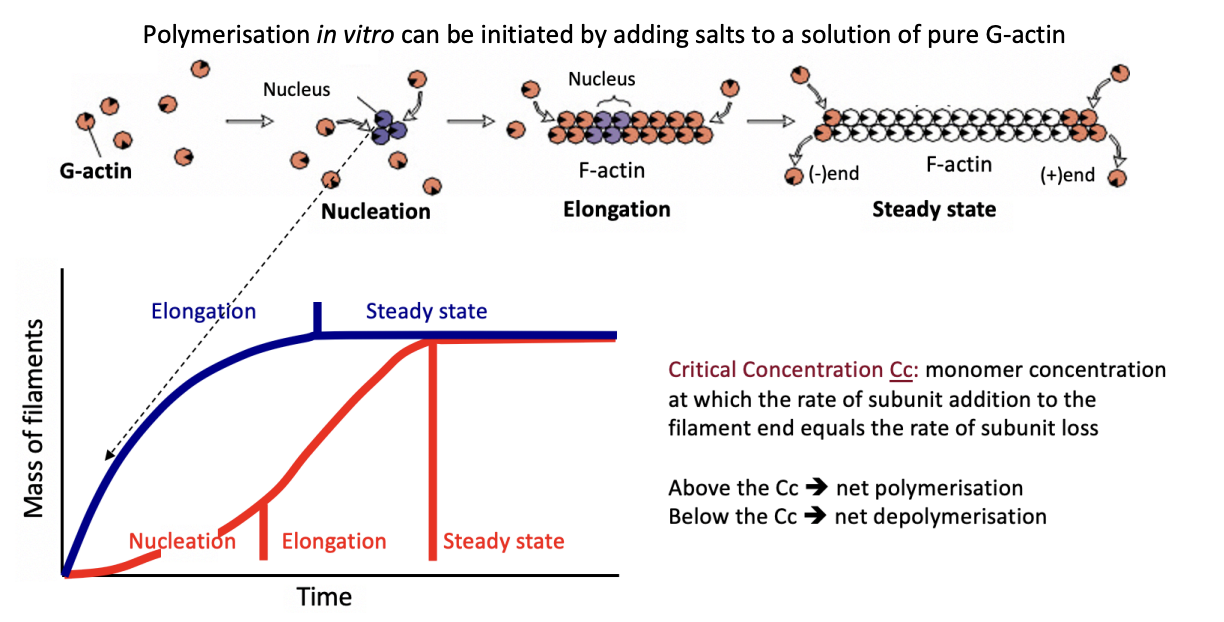
Polymerisation of actin

knowt flashcard image
26
New cards

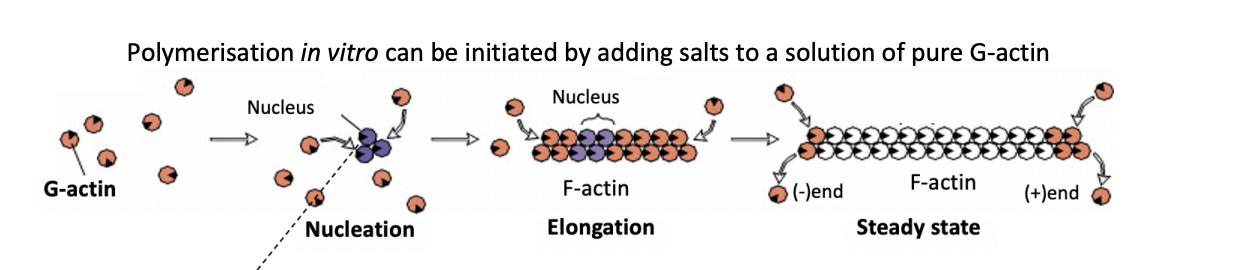
How can polymerisation in vitro be initiated

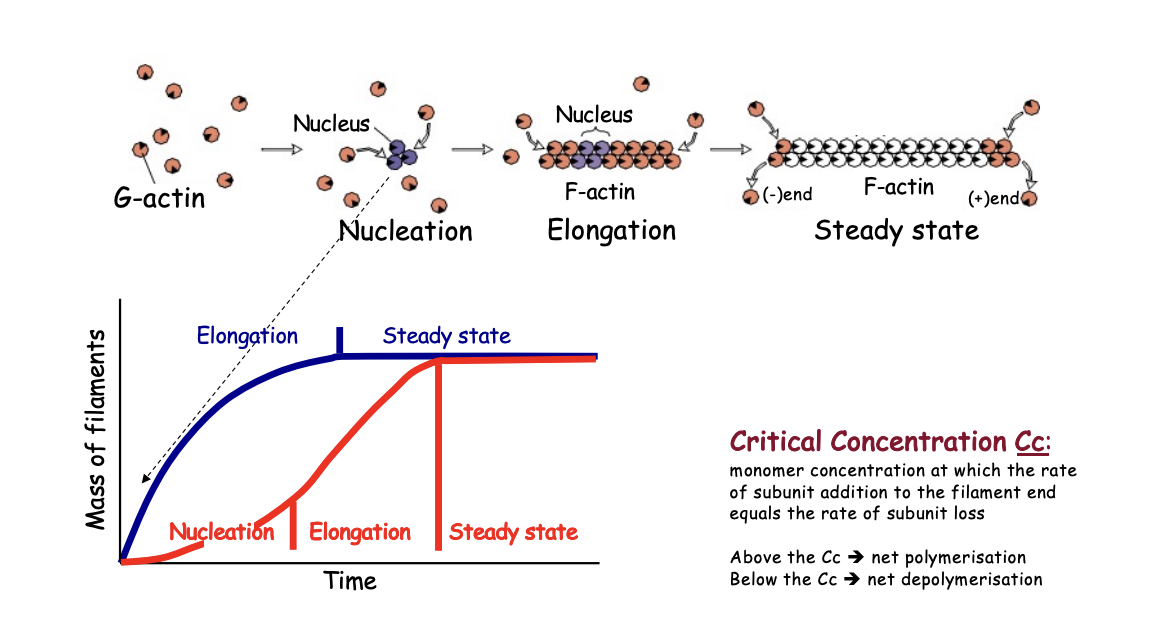
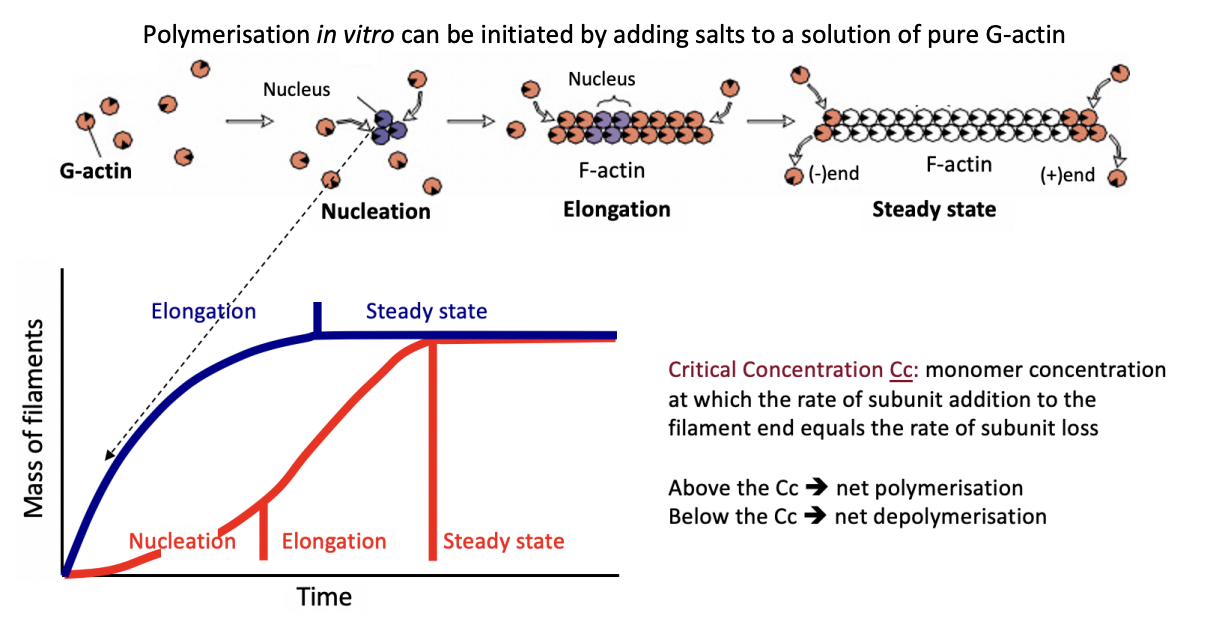
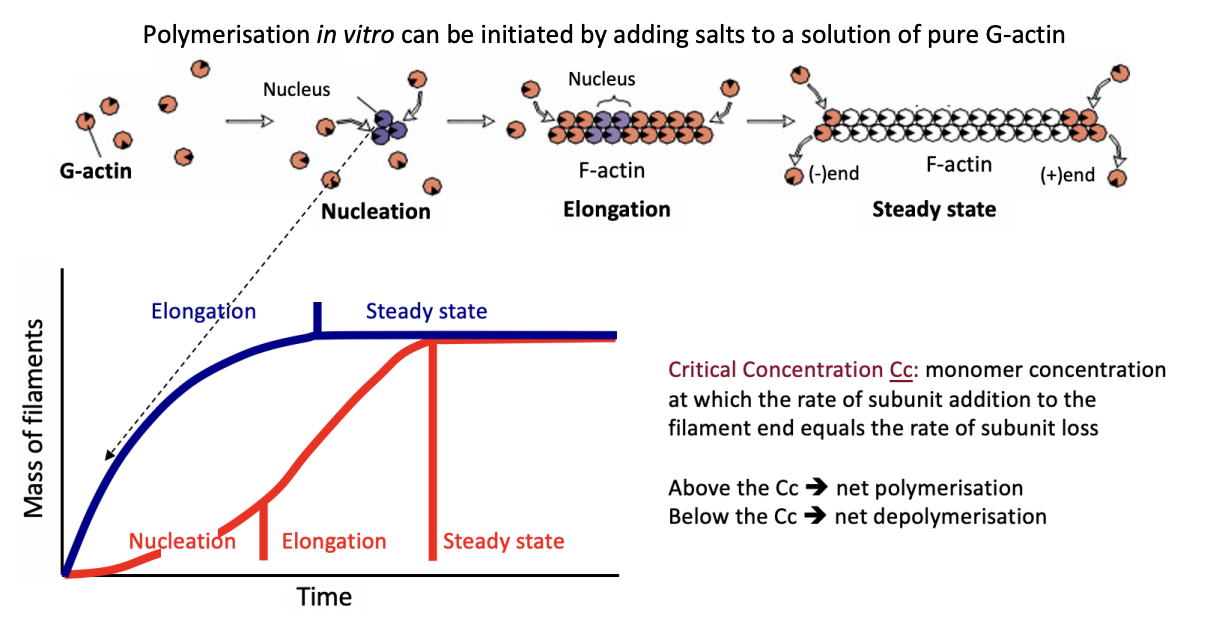
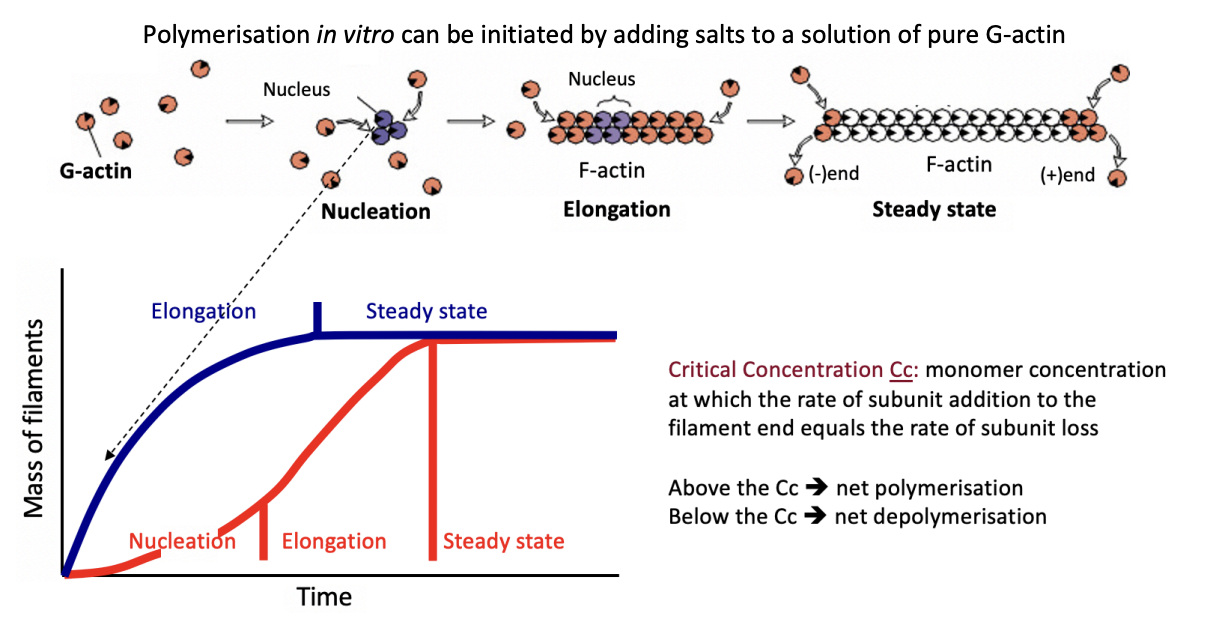
  • adding salts to a solution of pure G-actin
<ul><li><p>adding salts to a solution of pure G-actin</p></li></ul><p></p>
27
New cards

What is the rate limiting step in actin polymerisation

Nucleation

  • initial formation of oligomers with few subunits

  • energetically unfavourable

<p><strong>Nucleation</strong></p><ul><li><p>initial formation of oligomers with few subunits</p></li><li><p>energetically <strong>unfavourable</strong></p></li></ul><p></p>
28
New cards

Evidence that the RLS is nucleation→ Actin polymerisation kinetics if add stablilised oligomers to the reacation→ blue line

  • suppresses the lag

<ul><li><p>suppresses the lag</p></li></ul><p></p>
29
New cards

Actin polymerisation kinetics (red line)

  1. Nucleation

  2. Elongation

  3. Steady state

    • As filaments elongate, the concentration of free monomers of free monomers falls until critical concentration (Cc)
<ol><li><p>Nucleation</p></li><li><p>Elongation</p></li><li><p>Steady state</p><ul><li><p>As filaments elongate, the concentration of free monomers of free monomers falls until <strong>critical concentration (Cc)</strong></p></li></ul></li></ol><p></p>
30
New cards

What happens at the critical concentration (Cc)

  • actin subunits add to or leave the filament at the same rate
<ul><li><p>actin subunits add to or leave the filament <strong>at the same rate</strong></p></li></ul><p></p>
31
New cards

What happens below Cc

  • no new filaments form

  • any present→ depolymerise

  • net depolymisation

<ul><li><p>no new filaments form </p></li><li><p>any present→ depolymerise</p></li><li><p><strong>net depolymisation</strong></p></li></ul><p></p>
32
New cards

What happens above

  • Net polymerisation

<ul><li><p>Net polymerisation</p></li></ul><p></p>
33
New cards

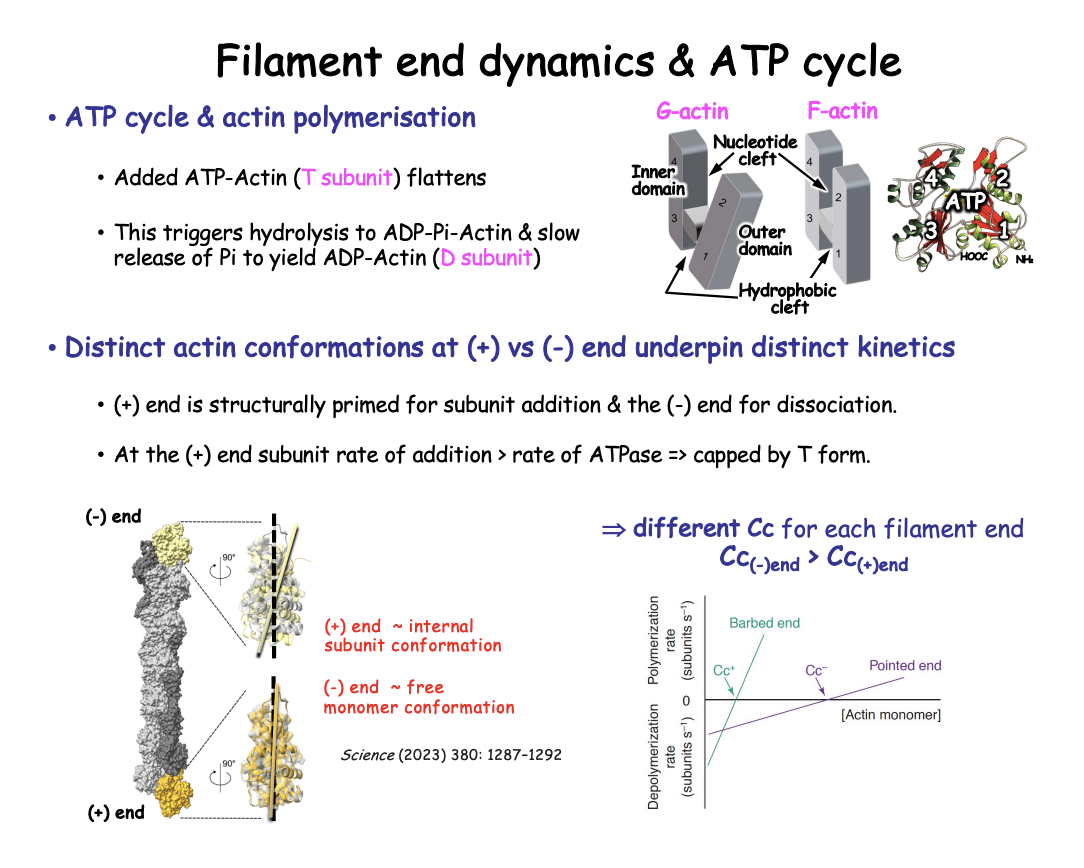
Filament end dynamics and ATP cycle

  1. incoming monomer→ ATP-boud actin monomers (T form)

    • Preferentially incorporated

    • Domains are twisted

  2. Newly polymerised→ 20 degree scissor like rotation

    • Flat conformation on outer domain

    • (the one facing outwards in the helical filament)

  3. Rotation enhances ATP hydrolysis to ADP-Pi-ACtin

  4. Slow release of Pi

  5. Yields ADP-actin→ D form

This process explains why there are two different properties of the two ends
<ol><li><p><strong>incoming monomer</strong>→ ATP-boud actin monomers (<strong>T form</strong>) </p><ul><li><p>Preferentially incorporated</p></li><li><p>Domains are <strong>twisted</strong></p></li></ul></li><li><p><strong>Newly polymerised</strong>→ 20 degree scissor like rotation</p><ul><li><p> <strong>Flat conformation</strong> on outer domain</p></li><li><p>(the one facing outwards in the helical filament)</p></li></ul></li><li><p>Rotation enhances <strong>ATP</strong> hydrolysis to ADP-Pi-ACtin</p></li><li><p>Slow release of Pi </p></li><li><p>Yields ADP-actin→ <strong>D form</strong></p></li></ol><p></p><p><em>This process explains why there are two different properties of the two ends</em></p>
34
New cards

Distinct actin conformations at (+) vs (-) end

Plus (+)

  • retains flat conformation

  • typical of internal subunits

  • → therefore: Favours subunit addition

    • Rate of addition of ATP-actin is > Rate of conversion to D form

    • so + end retains T subunit form

Minus (-)

  • twisted

  • monomer-like conformation

  • Therefore: primed for subunit dissociation

    • disfavours incorporation of new subunits

    • contains the D form

35
New cards

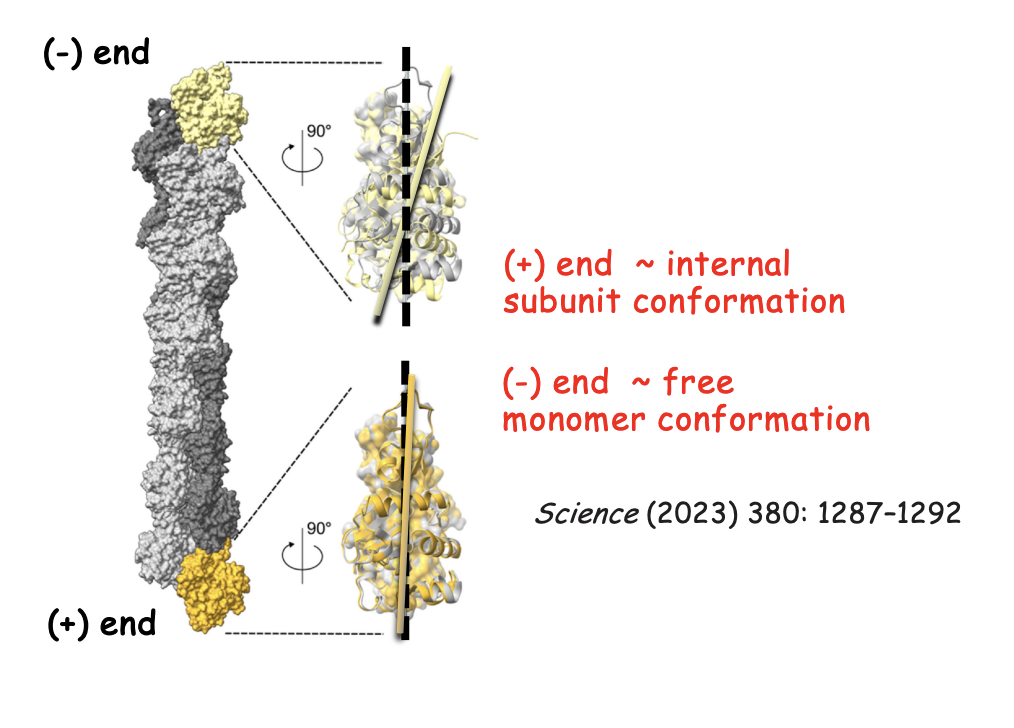
This has been revealed with what

Cryo-electron microscopy (Cryo-EM) high resolution

Right side→ + and - ends with internal F-actin subunit

  • structures aligned by their inner domains (surface representation)

  • showing relative rotation of outer domains (ribbon representation)

  1. Top→ - end→ Black dotted line→ axis of outerdomain in internal subunit→ Shows twisted (monomer like)

  2. Bottom→ + end→ Flat conformation→ (polymerised conformation)
<p><strong>Cryo-electron microscopy (Cryo-EM) </strong>high resolution</p><p>Right side→ + and - ends with internal F-actin subunit</p><ul><li><p>structures aligned by their inner domains (surface representation) </p></li><li><p>showing relative rotation of outer domains (ribbon representation)</p></li></ul><ol><li><p>Top→ - end<strong>→ Black dotted line→ axis of outerdomain in internal subunit→</strong> Shows twisted (monomer like)</p></li><li><p>Bottom→ + end→ <strong>Flat </strong> conformation→ (polymerised conformation)</p></li></ol><p></p>
36
New cards

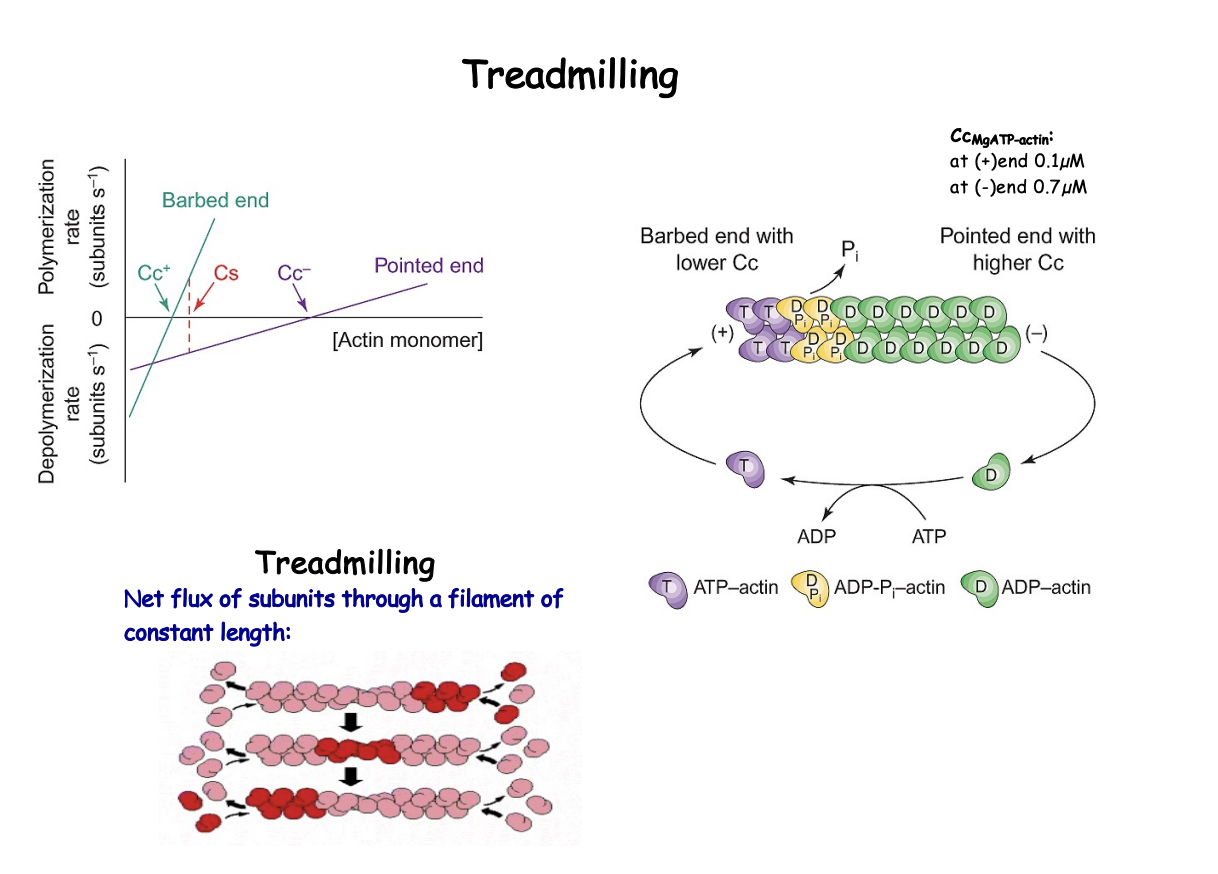
Each end has a different Critical concentration (Cc)

Cc pointed (-) end > Cc barbed (+) end

  • So for there to be a steady state→ needs to be more monomers around for the - end because this end is prone to depolymerisation
<p><strong>Cc pointed (-) end &gt; Cc barbed (+) end</strong></p><ul><li><p>So for there to be a steady state→ needs to be more monomers around for the - end because this end is prone to depolymerisation</p></li></ul><p></p>
37
New cards

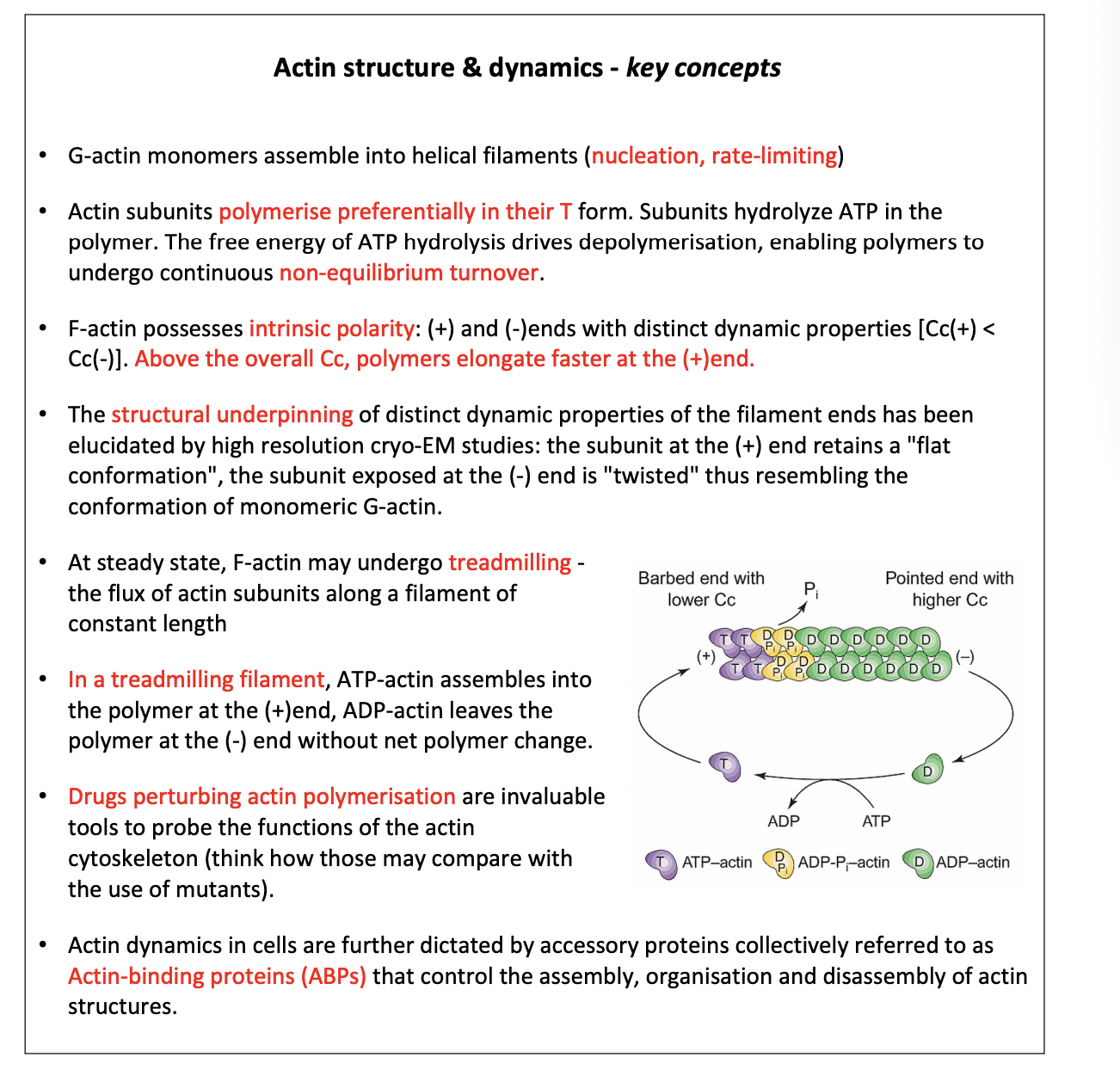
What is treadmilling

net flow of actin subunits through a filament of constant length

  • seems static but is continuously breaking down and building up

Contains:

  • ATP-bound subunits at the + end

  • ADP bound subunits at the - end

38
New cards

When does treadmilling happen

  • At a set concentration of G actin intermediate bewteen the Cc + and Cc-

  • F and G actin are at steady state (see graph)

    • filament length and the concentration of monomeric actin (Cs) will not change over time

  • Rate of loss of molecules at pointed end BALANCES addition at the barbed end

39
New cards

Treadmilling is done due to

  1. ATP hydrloysis and distinct dynamics of the two ends

  2. Helped by existence multiple polymer conformation

  3. Actin-binding proteins

40
New cards

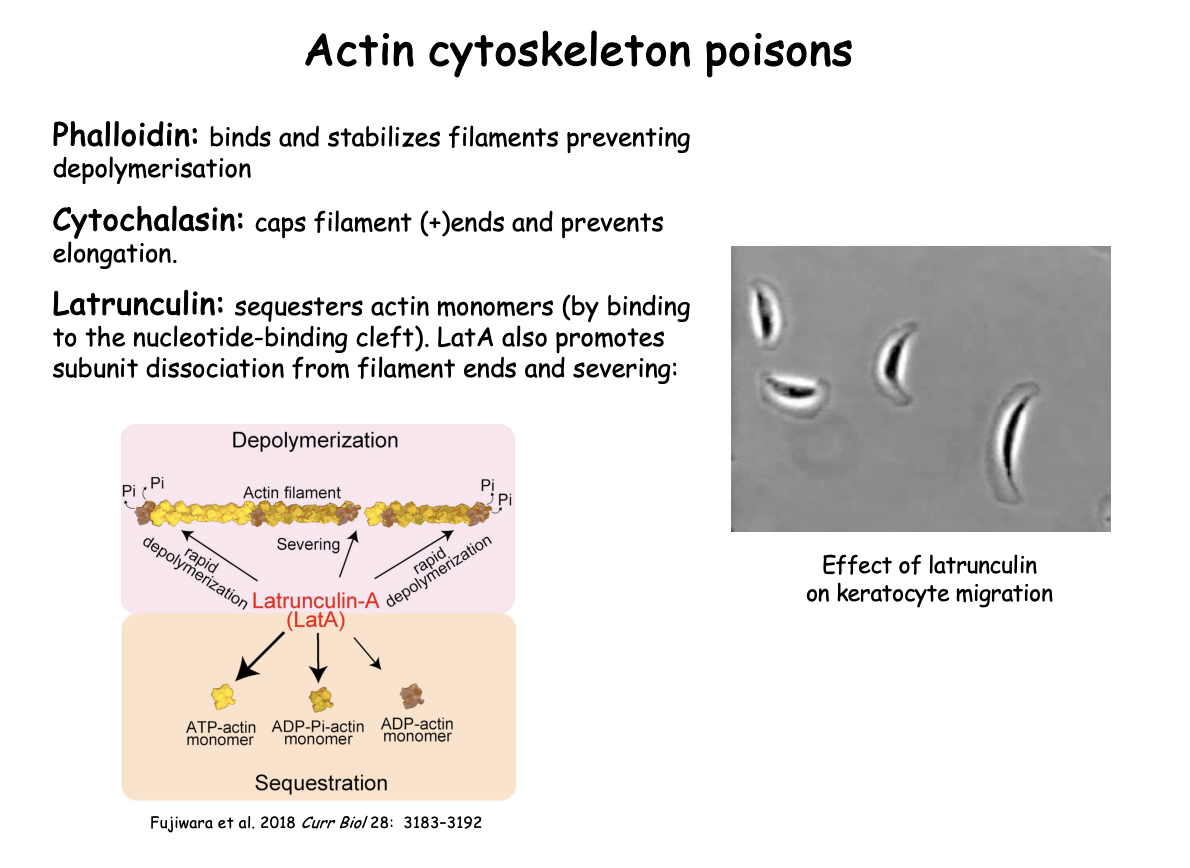
What types of actin poisons have been used to study dynamics?

  1. Phalloidin→ binds and stabilizes preventing depolymerisation

  2. Cytochalasin→ caps filament (+) ends and prevents elongation

  3. Latrunculin

    • Binds to nucleotide binding cleft

    • sequesters actin monomers

    • Also→ LatA promotes subunit dissociation from filament ends and severing
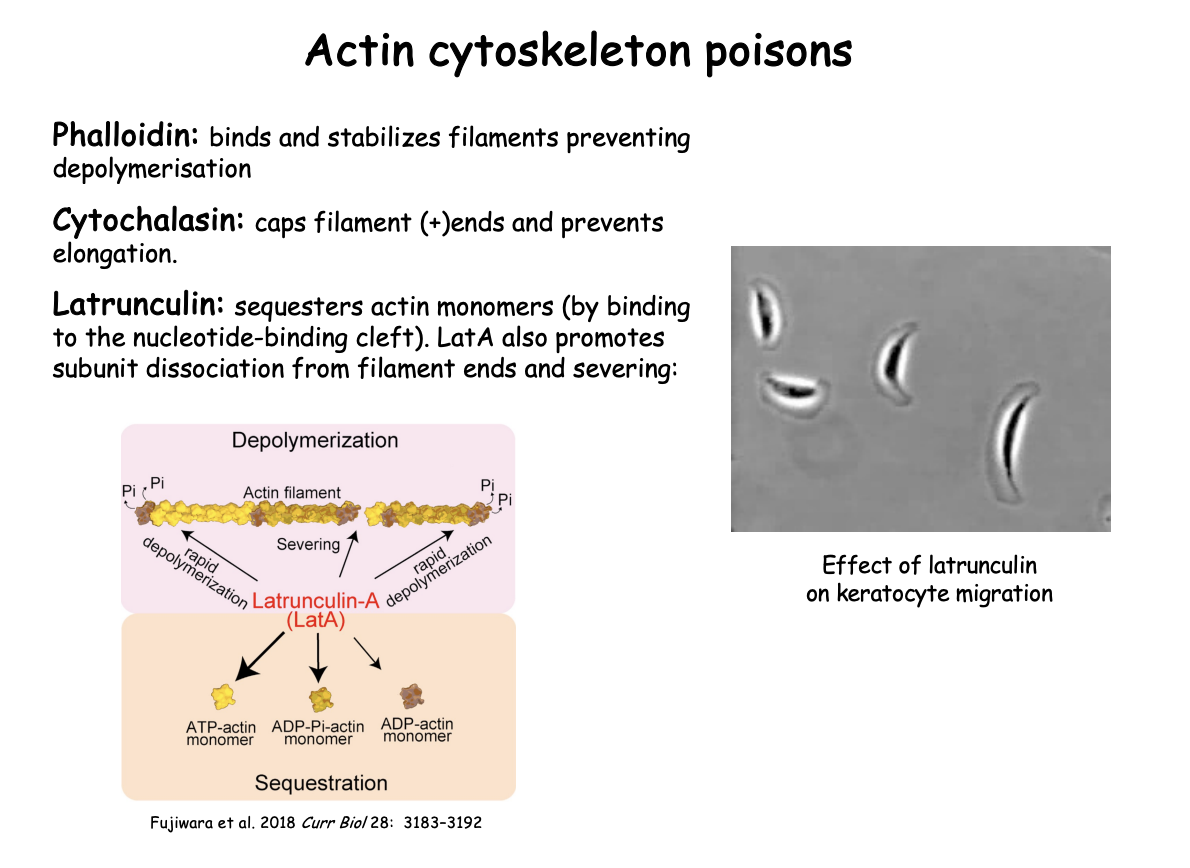
<ol><li><p><strong>Phalloidin</strong>→ binds and stabilizes preventing depolymerisation</p></li><li><p><strong>Cytochalasin</strong>→ caps filament (+) ends and prevents elongation</p></li><li><p><strong>Latrunculin</strong>→ </p><ul><li><p>Binds to nucleotide binding cleft</p></li><li><p>sequesters actin monomers</p></li><li><p><strong>Also</strong>→ LatA promotes subunit dissociation from filament ends and severing</p></li></ul></li></ol><p></p>
41
New cards
  1. Phalloidin

  • Bicyclic heptapeptide from mushroom→ Amanita phalloids

What is does

  • Stabilizes F-actin

  • prevents depolymerisation

  • shows that if stabilised→ there will not be enough MFs to continue to live

Use

  • Rhodamine-conjugated phalloidin

    • high selectivity

  • Used for reagent to speciffically stain and visualise F-actin

  • for fluoresence microscopy

42
New cards
  1. Cytochalasin

  • fungal alkaloid

What it does

  • caps filament + ends

  • prevents elongation

  • But as Cc- is higher than Cc+→ blocking + end leads to depolymerisation of the filament

43
New cards
  1. Latrunculin and what it demonstrates

  • from certain sponges

what it does

  • sequesters actin monomers and prevents polymerisation into filaments

  • LatA→promotes subunit dissociation from filament ends and severing

Effect on keratocyte migration demonstrates:

  • requirement for actin polymerisation in generating protrusion at the leading edge and associated movement

  • i.e shows essential for movement

<ul><li><p>from certain sponges</p></li></ul><p>what it does</p><ul><li><p>sequesters actin monomers and prevents polymerisation into filaments</p></li></ul><ul><li><p><strong>LatA</strong>→promotes subunit dissociation from filament ends and severing</p></li></ul><p>Effect on keratocyte migration demonstrates:</p><ul><li><p>requirement for actin polymerisation in generating protrusion at the <strong>leading edge and associated movement</strong></p></li><li><p><strong>i.e shows essential for movement</strong></p></li></ul><p></p>
44
New cards

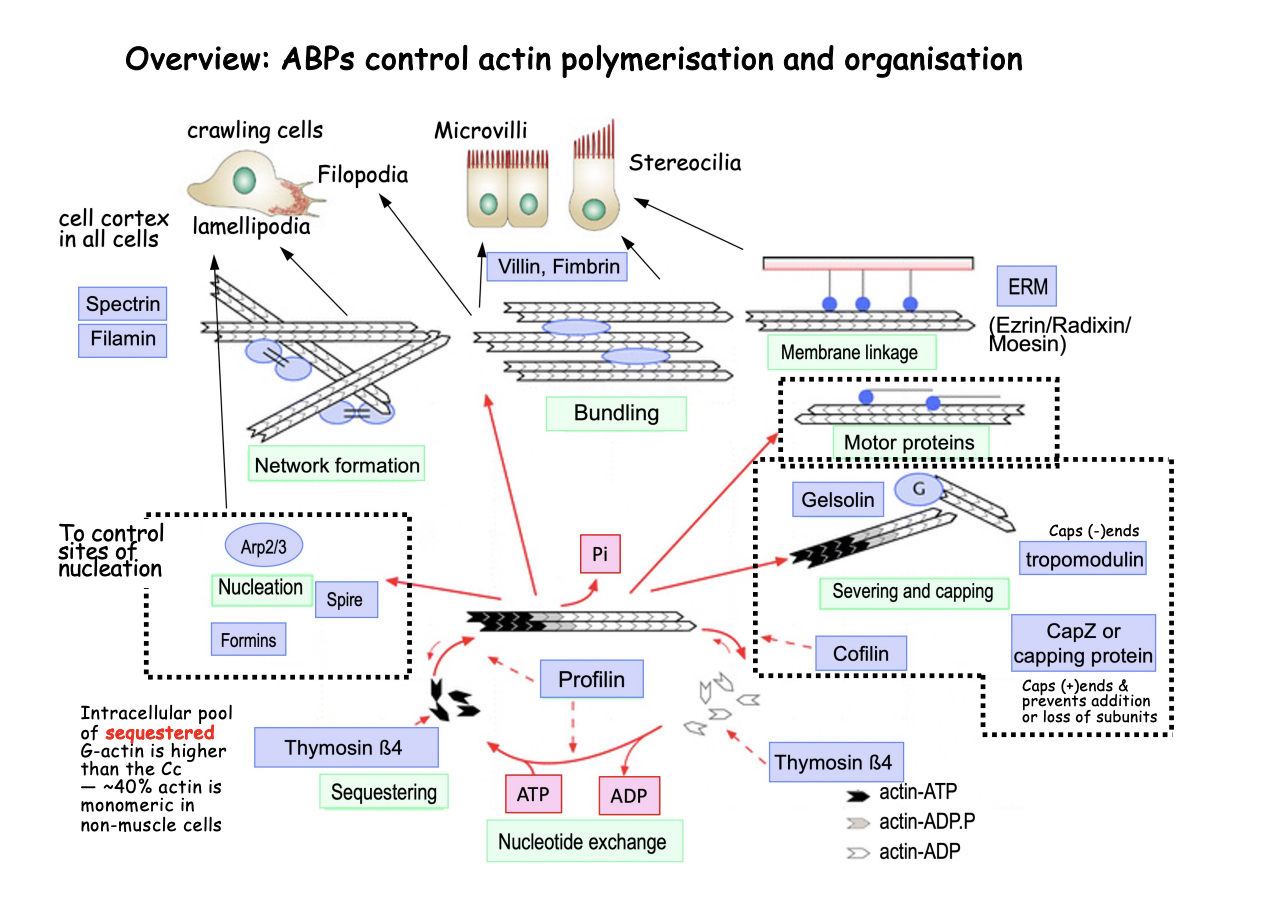
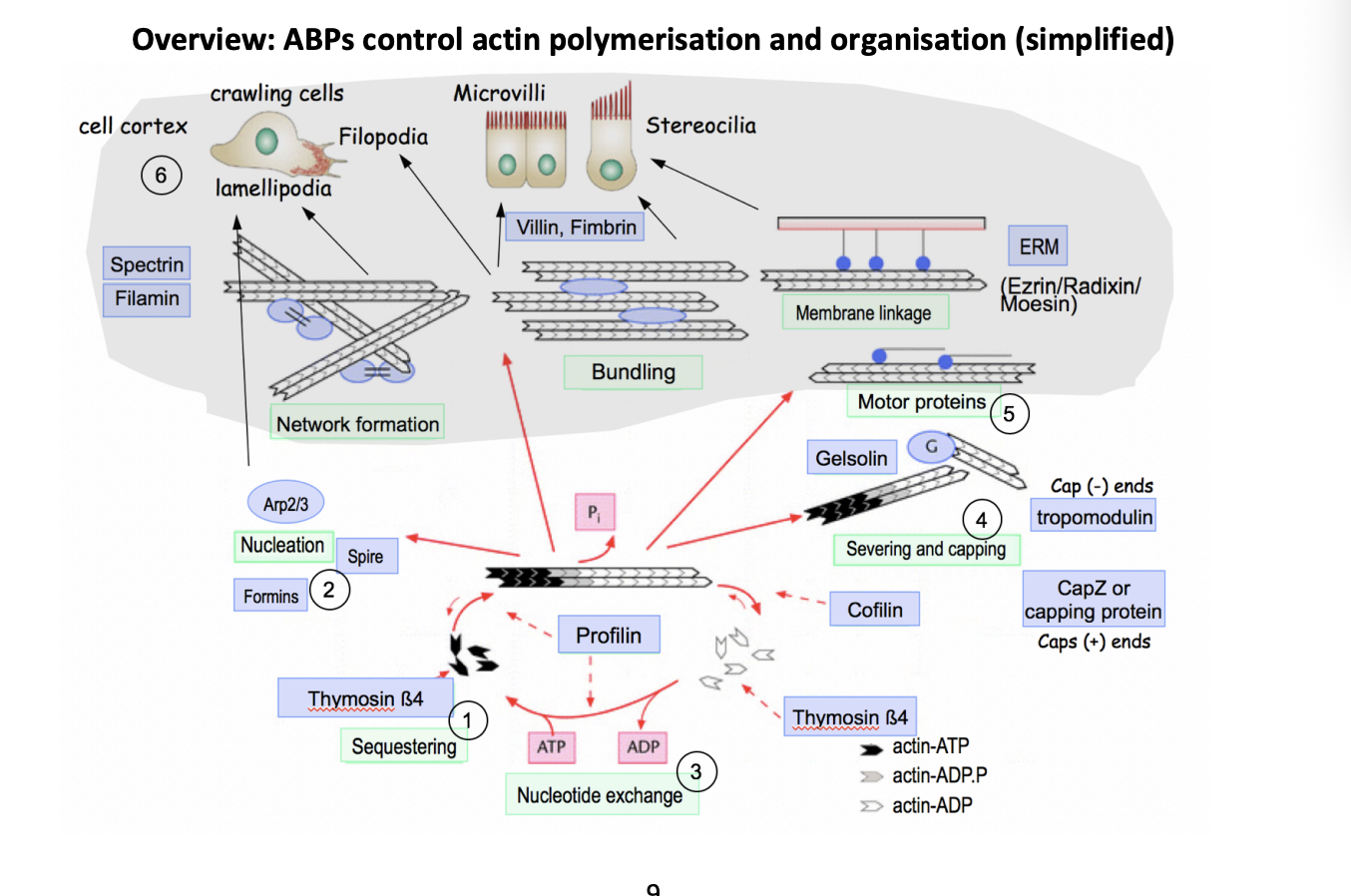
Overview of how Actin Binding proteins (ABP) control actin polymerisation and organisation

  1. Help general actin polymerisation cycle

But also help organise into different structures for different functions

  1. Organisation of the cell cortex

    1. Network formation

    2. Bundling

    3. Membrane linkage

  2. Motor proteins

<ol><li><p>Help general actin polymerisation cycle</p></li></ol><p>But also help organise into different structures for different functions</p><ol start="2"><li><p>Organisation of the cell cortex</p><ol><li><p>Network formation</p></li><li><p>Bundling</p></li><li><p>Membrane linkage</p></li></ol></li><li><p>Motor proteins</p></li></ol><p></p>
45
New cards
  1. Help in general actin polymerisation cycle

  1. Sequestering→ e.g thymosin beta4

    • 40% of all monomeric actin is in a pool

    • but this is higher than the critical concentration→ so why doesn’t it cause polymerisation?

    • ABP sequester the G actin into a pool

  2. Nucleation→ e.g Formins, Spire and Arp2/3

    • used to control the generation of new actin filaments spatially and temporally

  3. Nucleotide exchange→ e.g profilin

    • Promodes ADP/ATP exchange and delivers ATP-actin for polymerisation

  4. Severing and capping→ e.g Gelsolin, CapZ or capping protines, Topomodulin

    • limits elongation as the cap of the + end

    • or causes filament fragmentsation

<ol><li><p><strong>Sequestering</strong>→ e.g thymosin beta4</p><ul><li><p>40% of all monomeric actin is in a pool</p></li><li><p>but this is higher than the critical concentration→ so why doesn’t it cause polymerisation?</p></li><li><p>ABP sequester the G actin into a pool</p></li></ul></li><li><p><strong>Nucleation</strong>→ e.g Formins, Spire and Arp2/3</p><ul><li><p>used to control the generation of new actin filaments spatially and temporally</p></li></ul></li><li><p><strong>Nucleotide exchange→ </strong>e.g profilin</p><ul><li><p>Promodes ADP/ATP exchange and delivers ATP-actin for polymerisation</p></li></ul></li><li><p><strong>Severing and capping</strong>→ e.g Gelsolin, CapZ or capping protines, Topomodulin</p><ul><li><p>limits elongation as the cap of the + end </p></li><li><p>or causes filament fragmentsation</p></li></ul></li></ol><p></p>
46
New cards

Why need sequestering

  • ensures that it causes rapidly changes in polymerisation

  • no need to wait for it to be produced

  • stops under signals?

47
New cards

How ABP are used for more specialised functions

  1. Motor proteins→ e.g myosins

    • Actin-dependent motor proteins

    • powered by ATP hydrolysis

    • move along actin tracks and transport cargo or mediate contractility by sliding antiparallel filaments with respect to each other

  2. Organisation of the cell cortex

48
New cards

Way the cell cortex can be organised

  1. Network formation→ spectrin, filamin

    • Crosslinking proteins→ loose network

  2. Bundling→ Villin, Fimbrin

    • bundling proteins→ tight bundle

  3. Membrane linkage→ ERM (Ezrin/Radixin/ Moesin)

    • anchor filaments to membranes

49
New cards

Combinations of these ABPs can form higher order actin strucutres, imparting overall shape and function

  1. Lamellipodia and filopodia→ drive cell crawling

    • dynamic membrane protrusions at the leading edge

  2. Tight actin bundles support persistent strucures:

    • Microvilli→ brush boarder to maximise SA

    • Sterocilia→ transudce sound by mechanical displacement in hair cells
<ol><li><p><strong>Lamellipodia and filopodia</strong>→ drive cell crawling</p><ul><li><p>dynamic membrane protrusions at the leading edge</p></li></ul></li><li><p>Tight actin bundles support persistent strucures:</p><ul><li><p><strong>Microvilli</strong>→ brush boarder to maximise SA</p></li><li><p><strong>Sterocilia</strong>→ transudce sound by mechanical displacement in hair cells</p></li></ul></li></ol><p></p>
50
New cards

Summary

knowt flashcard image
51
New cards

Explore top flashcards

SS100 Spring Exam 23
Updated 988d ago
flashcards Flashcards (234)
APUSH Unit 2
Updated 862d ago
flashcards Flashcards (135)
kafli 6 og 7
Updated 1005d ago
flashcards Flashcards (88)
root examples 2
Updated 1021d ago
flashcards Flashcards (31)
Troika - Chapter 8
Updated 1205d ago
flashcards Flashcards (88)
Spanish Vocab 1.1
Updated 864d ago
flashcards Flashcards (30)
Reproductive Systems
Updated 984d ago
flashcards Flashcards (55)
SS100 Spring Exam 23
Updated 988d ago
flashcards Flashcards (234)
APUSH Unit 2
Updated 862d ago
flashcards Flashcards (135)
kafli 6 og 7
Updated 1005d ago
flashcards Flashcards (88)
root examples 2
Updated 1021d ago
flashcards Flashcards (31)
Troika - Chapter 8
Updated 1205d ago
flashcards Flashcards (88)
Spanish Vocab 1.1
Updated 864d ago
flashcards Flashcards (30)
Reproductive Systems
Updated 984d ago
flashcards Flashcards (55)