UNIT 7 - Evolution
 Call Kai
 Learn
Learn Practice Test
 Spaced Repetition
 Match
Match Flashcards
 Knowt Play
1/37

Earn XP
Description and Tags
CHAPTERS 22, 23 & 24
Name | Mastery | Learn | Test | Matching | Spaced | Call with Kai |
|---|
No analytics yet
Send a link to your students to track their progress
38 Terms
Evolution
A change in the genetic composition of a population from generation to generation as they adapt to their environment.
People & Ideas about evolution throughout the years
Aristotle (384-322 BCE): Viewed species as fixed (unchanging) and concluded that life-forms could be arranged on a ladder of increasing complexity (scala naturae).
Old Testament account of creation (Creationism): Earth is 6000~ years old. Species were individually designed by God and therefore perfect.
Carolus Linnaeus (1707-1778): Believed that the “creator” had designed each species for a particular purpose since they were well suited in their environment.
Developed the two-part format for naming species (binomial nomenclature) and used a nested classification system (taxonomy), grouping similar species into increasingly inclusive categories (based on anatomy and morphology rather than evolutionary relationships which Darwin argued for a century later.)
Georges Cuvier (1769-1832) stated that each boundary between strata was represented by an event such as flood that killed many species and then was later repopulated by different species immigrating from other areas.
James Hutton (1726-1797): Proposed that Earth’s geologic features could be explained by gradual mechanisms.
Charles Lyell: Incorporated Hutton’s thinking into his proposal that the same geological processes are operating today as in the past, and at the same rate (therefore earth is older than we thought).
Darwin agreed that if geological change results from slow, continuous actions rather than from sudden events, then perhaps slow and subtle processes could produce substantial biological change.
Lamarck published his hypothesis in 1809 with two principles. Use and disuse: The idea that parts of the body that are used extensively become larger and stronger, while those that are not used deteriorate.
Use and disuse: The idea that parts of the body that are used extensively become larger and stronger, while those that are not used deteriorate.
Inheritance of acquired characteristics: An organism could pass these modifications to its offspring (this is not true as only chromosomes found in the gametes are passed down to offspring.)
He also thought evolution happens because organisms have an innate drive to become more complex.
In 1859 Charles Darwin published On the Origin of Species by Means of Natural Selection.
Fossils & How it relates to evolution
Fossils: The remains or traces of organisms from the past.
Found in sedimentary rocks formed from sand and mud that settle to the bottom of seas, lakes, and swamps.
Strata: Super imposed layers of rock that form when new layers of sediment cover older ones and compress them.
The fossils in a particular stratum provide a glimpse of some of the organisms that populated Earth at the time that layer formed.
Paleontology: Study of fossils.
Developed by Georges Cuvier (1769-1832), noted that the older the stratum, the more dissimilar its fossils were to current life-forms. He also observed that from one layer to the next, some new species appeared while others disappeared, inferring that extinction must have been a common occurrence but opposed evolution.
Fossils show past organisms differed from present-day organisms, many species have become extinct, the evolutionary changes that have occurred in various groups of organisms, and origin of new groups of organisms.
Transitional forms: Links to modern species.
Darwin’s voyage
Galapagos: A group of volcanic islands located near the equator about 900 km west of South America with no human life and different environments on each island.
He noticed that the mockingbirds there were similar to each other but seemed to be different species and that although the animals resembled species living on the South American mainland, most of the Galapagos species were not known from anywhere else in the world.
The beaks of the birds were different to allow them to eat the specific food on their island.
He hypothesized that the Galapagos had been colonized by organisms that had strayed from South American and then diversified, giving rise to new species on various islands.
Adaptations
Inherited characteristics of organisms that enhance their survival and reproduction in specific environments.
Natural Selection
A process in which individuals that have certain inherited traits tend to survive and reproduce at higher rates than do other individuals because of those traits.
Tree of evolution
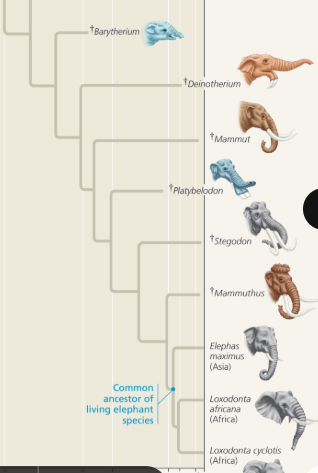
Evolutionary Tree: A diagram that reflects evolutionary relationships among groups of organisms.
A branching process in which the node (part of the tree where it branches out) represents a common ancestor that went extinct. If an organism does not reach the end of the tree it is extinct.
Branch point: Where linkages diverge.
Polytomy: An unsolved pattern of divergence (when there are 3+ branches).
The farther the ancestor is, the bigger the group of organisms that share that characteristic (genetic code) and vice versa.
Each branch represents the most recent common ancestor of the two lineages diverging from that point.
A hatch mark represents a homologous characteristic shared by all groups following the mark.
The closer two organisms share a common ancestor the more related they are.
Unity of life
Unity of life: Organisms share many characteristics, the descent of all organisms came from an ancestor that lived in the past.
As the descendants of that ancestral organisms lived in various habitats, they gradually accumulated diverse modifications, or adaptations that fit them to specific ways of life.
This eventually led to the rich diversity of life we see today.
Artificial selection
When humans modify species over many generations by selecting and breeding individuals that possess desired traits.
Darwin’s observations and inferences
Observation #1: Members of a population often vary in their inherited traits (natural variation).
Observation #2: All species can produce more offspring than their environment can support, and many of these offspring fail to survive and reproduce.
Inference #1: Individuals whose inherited traits give them a higher probability of surviving and reproducing in a given environment tend to eave more offspring than do other individuals.
Inference #2: This unequal ability for individuals to survive and reproduce will lead to the accumulation of favorable traits in the population over generations.
Thomas Malthus
Thomas Malthus: More babies born than deaths, consequences of overproducing within the environment equals war, famine, disease, struggle for existence (competition).
Competition - Organisms struggle for survival: more organisms are produced than the environment can support.
Competition for limited resources results in differential survival.
Survival of the fittest: Only the best adapted survives.
Key Features of Natural Selection
Natural selection should be capable of substantial modification of species over many hundreds of generations. Over time it will increase the frequency of adaptations that are favorable in a given environment.
If an environment changes, or if individuals move to a new environment, natural selection may result in adaptation to these new conditions, sometimes giving rise to new species.
Individuals do not evolve, it is the population that evolves over time.
Natural selection can amplify or diminish only traits that already exist in that population.
Natural Selection in Response to Introduced Species
Soapberry bugs have different beaks depending on the plant/fruit that is most common in the area.
The Evolution of Drug-Resistant Bacteria
Use of antibiotics has caused natural selection to pick the specific bacteria that can survive them overtime causing the whole population to be resistant.
In species like bacteria, which can reproduce quickly, evolution by natural selection can occur rapidly.
Homology
Homology: Related species that have characteristics that have an underlying similarity.
Anatomical and Molecular Homologies
Homologous structures: Variations on a structural theme that was present in their common ancestor. Similar characteristics but function differently. This is caused when one species evolves in different environments.
Embryonic homologies: similar early development.
Vestigial Structures: Remnants of features that served a function in the organism's ancestors but are now useless.
Molecular homologies: similar DNA and amino acid sequences
Pseudogenes: Genes that have lost their function even though the homologous genes in related species may be fully functional.
Convergent Evolution
Convergent Evolution: Independent evolution of similar features in different lineages.
This happens when two animals adapt to similar environments in similar ways.
The resemblance is called analogous. Analogous features share similar function, but not common ancestry.
Biogeography & Continental drift
Biogeography: The scientific study of the geographic distributions of species.
Continental drift: Slow movement of Earth’s continents over time.
Pangaea: 250 million years ago, these movements united all of Earth’s landmasses into a single continent (which was slowly broken apart into the continent we know today).
Closely related species can be found far away from each other due to this.
Endemic species
Endemic species: found at a certain geographic location and nowhere else
Ways natural selection changes a population
Directional (selection): A shift in the frequency of a trait in a particular direction (conditions favor individuals exhibiting one extreme of a phenotypic range).
Example: Super dark OR white mouses
Common in changing environments or when members of a population migrate to a new habitat.
Stabilizing: Favors intermediate phenotypes and is against extreme phenotypes.
Example: Gray mouses
Common in a stable, unchanging environment. Reduces variation.
Disruptive (selection) : Favors individuals at both extremes of a phenotypic range and is against intermediate phenotypes.
Example) Super dark AND light mouses.
Cladogram
Cladogram: Diagram that depicts patterns of shared characteristics among groups.
Clade: Group of species that includes an ancestral species + all descendents.
Shared derived characteristics (evolutionary novelties) are used to construct caldograms.
Shared ancestral characteristics ( of all vertebrates) = all have the characteristic.
Shared derived characteristics of mammals = only one has the characteristic.
Systematics
Systematics: Classifying organisms and determining their evolutionary relationships.
Maximum Parsimony
Maximum Parsimony: Uses simplest explanations (fewest DNA changes) to construct trees.
Molecular clocks
Molecular clocks: Measure evolutionary change based on regions of the genome that appear to evolve at constant rates.
Horizontal Gene Transfer
Horizontal Gene Transfer: Movement of genes between different domains that is not parent to offspring.
Exchanging transposable elements, plasmids, viral infections, fusion of organisms.
Adaptive Radiation
Adaptive Radiation: Many new species arise from a single common ancestor.
Occurs when:
A few organisms make way to new, distant areas allopatric speciation).
Environmental change → extinctions → open up new niches (the role for something in an ecosystem) for survivors
Microevolution & It’s causes
Microevolution: Evolution at its smallest scale, a change in allele frequencies in a population over generations.
Caused by . . .
Natural selection
Genetic drift (chance events that alter allele frequencies, usually occurring in small populations)
Founder Effect: Few individuals become isolated from larger populations → certain alleles over/under represented.
Bottleneck Effect: Severe drop in population size due to sudden change in environment. Certain alleles may be over/under represented in the survivors.
Gene flow (the transfer of alleles between populations due to fertile individuals or their gametes).
Migration (immigration or emigration), pollination
Reduces genetic differences between populations and may result in two populations combining into one.
Can prevent populations from fully adapting to their environment as it can keep introducing unbeneficial genes (or the opposite, benefiting the population).
Neutral variation
Neutral variation: Point mutations in noncoding regions that result in differences in DNA sequence that do not confer to a selective advantage or disadvantage.
Mutations
A mutation tends to be more harmful as organisms are often already suited well for their environment.
Natural selection often can get rid of these harmful alleles but recessive alleles can persist for generations in heterozygous individuals, maintaining a huge pool of alleles with harmful mutations.
Gene duplications
Duplication of smaller pieces of DNA may not be harmful.
Gene duplications that do not have severe effects can persist over generations, allowing mutations to accumulate. Resulting in an expanded genome with new genes that may take on new functions.
This played a major role in evolution as one single gene (example for detecting odors) may evolve into hundreds of genes (for detecting odors).
Population
Population: A group of individuals of the same species that live in the same area and interbreed, producing fertile offspring.
Some species may be isolated geographically from one another, exchanging genetic material only rarely. Although, not all populations are isolated. Still, members of a population typically breed with one another and thus are more closely related to each other than to members of other populations.
Gene Pool
Gene Pool: Consists of all copies of every type of allele at every locus in all members of the population.
Fixed Allele
Fixed allele: Only one allele existed for a particular locus.
Hardy-Weinberg Equation
Hardy-Weinberg Equilibrium: When a population is not evolving and allele and genotype frequencies remain constant from generation to generation.
Equations: p + q = 1 | p^2 + 2pq + q^2 = 1
p & q stand for the allele frequencies (dominant and recessive).
The probability for p (dominant) is p^2.
The probability for q (recessive) is q^2.
The probability for heterozygous is 2*p*q.
Hardy-Weinberg Conditions
No mutations.
Random Mating.
No natural selection.
Extremely large population size (small population size can cause genetic drift).
No gene flow.
Adaptive Evolution
Adaptive Evolution: Traits that enhance survival or reproduction tend to increase in frequency over time.
Case Study: Impact of Genetic Drift on the Greater Prairie Chicken
Human actions sometimes create severe bottlenecks. There used to be millions of prairie chickens in Illinois but as the land was converted to farmland the chickens plummeted. By 1993 fewer than 50 birds remained and the surviving rods had low levels of genetic variation and harmful alleles.
Adding new organisms to a dying population can introduce genetic variation and therefore reduce harmful alleles.
Relative Fitness
Relative Fitness: The contribution an individual makes to the gene pool of the next generation relative to the contributions of other individuals.

