topic 3: nervous system I - neurons, impulse generation & transmission
 Studied by 0 people
 Call with Kai
 Learn
Learn Practice Test
 Spaced Repetition
 Match
Match Flashcards
 Knowt Play
1/97

There's no tags or description
Looks like no tags are added yet.
Name | Mastery | Learn | Test | Matching | Spaced | Call with Kai |
|---|
No analytics yet
Send a link to your students to track their progress
98 Terms
what is the primary role of the nervous system?
rapid communication and control to maintain homeostasis by monitoring changes, integrating information, and generating responses
why are neurons important to homeostasis?
they allow rapid signal transmission to coordinate sensory information and vital functions (heart rate, respiration, digestion)
why is understanding normal nervous system physiology important?
helps us understand disease states and their treatments
examples of processes controlled by the nervous system
heart rate
blood pressure
respiration
digestion
temperature
pain
why is the nervous system physiology relevant to disease?
disorders arise from abnormal neuron function
e.g. multiple sclerosis, pain conditions
what does it mean that neurons are excitable?
they are responsive to stimuli
responding to changes in the internal and external environment
what happens when neurons are stimulated?
when stimulated (usually on cell body or dendrites) an electrical impulse (signal)may be generated and propagated along the axon = nerve impulse (until getting to synaptic end pulse)
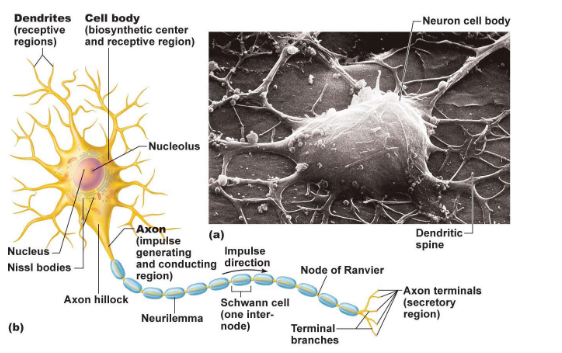
what is the most abundant neuron?
multipolar
what is an electrochemical gradient in cells?
the differences in the concentration of ions and molecules between their intracellular and extracellular fluids
what can electrochemical gradients be used for?
signaling by some cells (especially nerve and muscle cells)
electrochemical gradients that give cells their electrical properties are due to
ionic concentration differences across membrane (gradients)
permeability of cell membrane to ions
what creates ionic concentration gradients across the cell membrane?
unequal distribution of ions across the membrane maintained by transports, especially the Na+/K+ ATPase
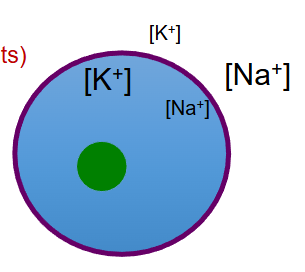
what ions are most important for membrane potential
K+
Na+
Cl-
Ca2+
large negatively charged organic ions (org-)
where is Na+ highest and why?
high in the ECF, low in the ICF due to the Na+/K+ -ATPase pumping Na+ out of the cell
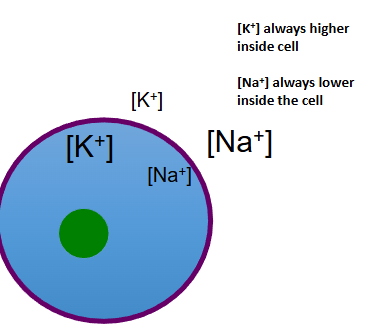
where is K+ highest and why?
high in the ICF, low in the ECF due to the Na+/K+ -ATPase pumping K+ into the cell
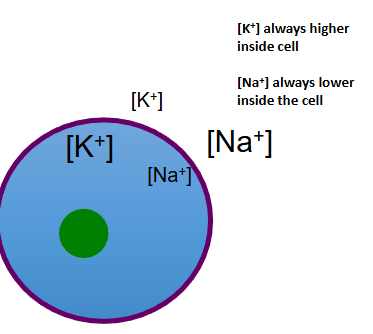
why is Ca2+ concentration low in the cytosol?
Ca2+ is actively transported out of the cytosol and stored in the smooth ER
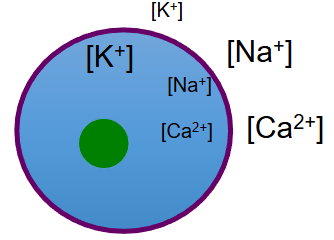
why is Cl- concentration higher in the ECF than the ICF?
Cl- is repelled by large negatively charged organic ions (org-) inside the cell
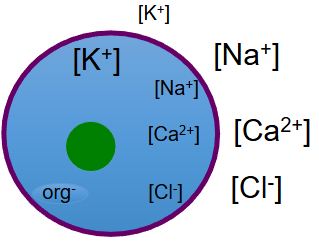
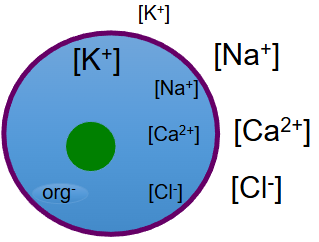
what are organic ions (org-) and where are they located?
large negatively charged proteins that are non-diffusible and remain inside the cell
what determines the permeability of cell membrane to ions?
opening and closing of ion channels that allow ions to diffuse down their concentration gradients
what are the ion channel types?
non-gated channels (leak channels)
gated channels
what are non-gated channels (leak channels)
always open and allow passive ion movement
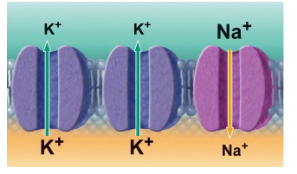
why is the resting membrane potential mainly determined by K+?
there are more non-gated K+ channels than Na+ channels, so the membrane is more permeable to K+ at rest
important in establishing the resting membrane potential
are gated channels involved at rest?
no, gated channels open only in response to specific stimuli
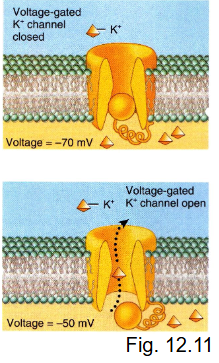
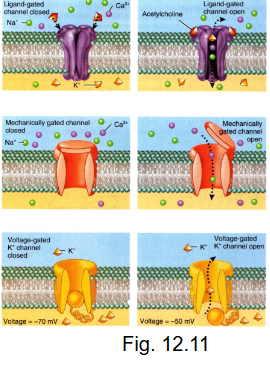
what are the four types of gated ion channels?
voltage-gated (changes in membrane voltage)
chemical/ligand-gated (neurotransmitters, hormones)
thermal-gated (temperature) receptors
mechanical-gated (stretch, pressure) deformation of cell membrane
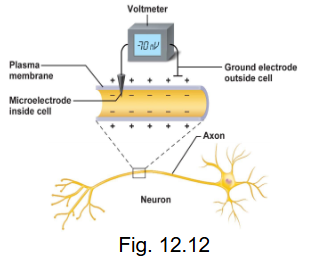
what is membrane potential?
the difference in electrical charge between the inside and the outside of a cell
how is membrane potential created?
by the movement of ions, which are charged particles, across the cell membrane
what is membrane potential measured in?
millivolts (mV)
what types of processes is membrane potential essential for?
nerve signaling
muscle contraction’
maintaining homeostasis
what is resting membrane potential (RMP)?
the charged difference (potential difference) just across the cell membrane of a resting (not stimulated) cell
voltage inside vs outside
what is the resting membrane potential value?
-70mV (inside of cell is more negative)
what are the factors establishing RMP?
Na+/K+ -ATPase (Na+/K+ pump) - not a channel
org- inside cell - can’t cross the membrane
there are more non-gated K+ channels than non-gated Na+ channels
what is the process of the Na+/K+ -ATPase?
breaks down 1 ATP and uses energy to pump 3 Na+ out and 2 K+ in → both ions are pump against their concentration gradients (therefore it is active transport)
what are the effects of the Na+/K+ -ATPase?
maintains the concertation gradients of Na+ and K+
contributed a little (a few mV) to the RMP (pumping more positive ions out than in)
how does org- (large negatively charged organic ions) inside the cell help establish RMP?
they can’t cross the membrane due to opposing charges
what is the major determinates of RMP and why?
K+ is the major determinate due to more non-gated K+ channels than non-gated Na+ channels (at rest the membrane is more permeable to K+)
how is the resting membrane potential established?
K+ diffuses out the cell through leak channels down its concentration gradient, cell loses positive charge and inside becomes more negative.
unlike charges attract and K+ diffusion slows as inside becomes increasingly more negative
Na+ diffuses into cell increases from increasing attraction to negatively charged cell interior
until -70mv is reached, the amount of positive charges (K+) moving out of the cell is greater than the amount of positive charges (Na+) moving in (GREATER K+ PERMEABLILITY)
once at -70mV, amount of positive charges (K+) moving out equals the amount of positive charges (Na+) moving in - electrical gradient increases the rate of Na+ entry into the cell, and slows down the K+ exiting cell
as a result the net movement of charged (ions) is 0 (equal in both directions) and the RMP at this point is -70mV)
what type of cells are electrically excitable cells?
ONLY muscles (contraction) and nerve cells (neurons, send electrical signals)
what does it mean for a cell to be electrically excitable?
it can respond to a stimulus by changing its membrane potential away from resting membrane potential (RMP) (= changes in the external or internal environment)
what happens when a neuron (electrically excitable) is stimulated?
gated ion channels to particular ions open
MP changes = production of a graded potential. if the threshold is reached (-55mV)…
an action potential is triggered
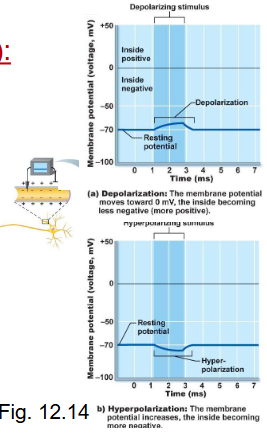
what are graded potentials (GPs)?
small local change in RMP, usually on dendrite or the cell body (no longer at rest) by opening gated channels
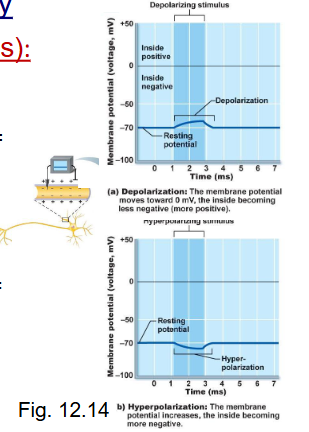
a membrane potential changes from -70mV to -65mV. what type of graded potential is this?
depolarization, the membrane becomes less negative and moves closer to 0
a membrane potential changes from -70mV to -75mV. what type of graded potential is this?
hyperpolarization, the membrane becomes more negative than RMP
which type of graded potential makes an action potential more likely?
depolarization, because it brings the membrane potential closer to threshold
how do ions move during a graded potential?
they move passively down electrochemical gradients, unlike charges attract, creating current flow that spreads depolarization or hyperpolarization to adjacent membrane areas
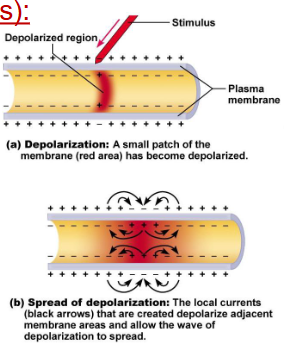
are graded potentials long-distance or short distance signals?
short distance, they die away quickly (short lived)
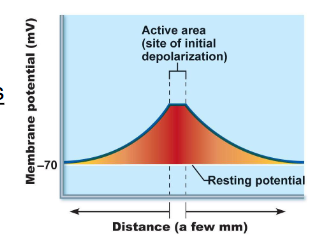
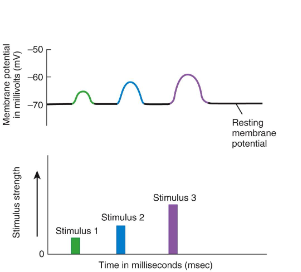
how does stimulus strength affect a graded potential?
stronger stimulus → larger graded potential → travels farther
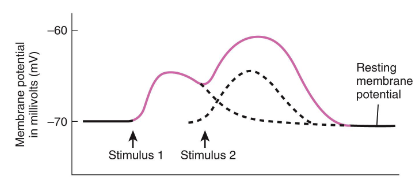
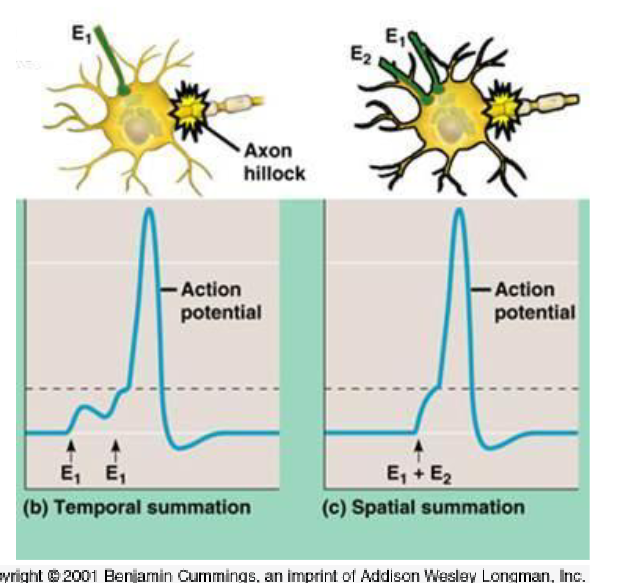
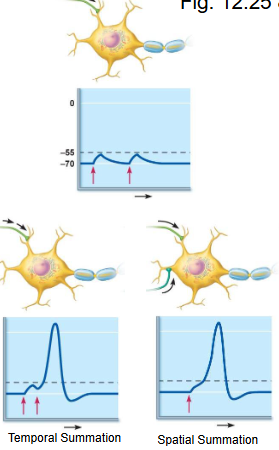
what is summation in graded potentials?
if one graded potential is still present when another occurs (2nd stimulus), they add together to produce a larger graded potential
what happens after a graded potential?
repolarization = return to RMP after depolarization or hyperpolarization
how are graded potentials essential to action potentials?
GPs are essential in initiating a nerve impulse (the action potential)
what happens if GP causes depolarization and if is large enough caused by a critical stimulus?
leads to an action potential
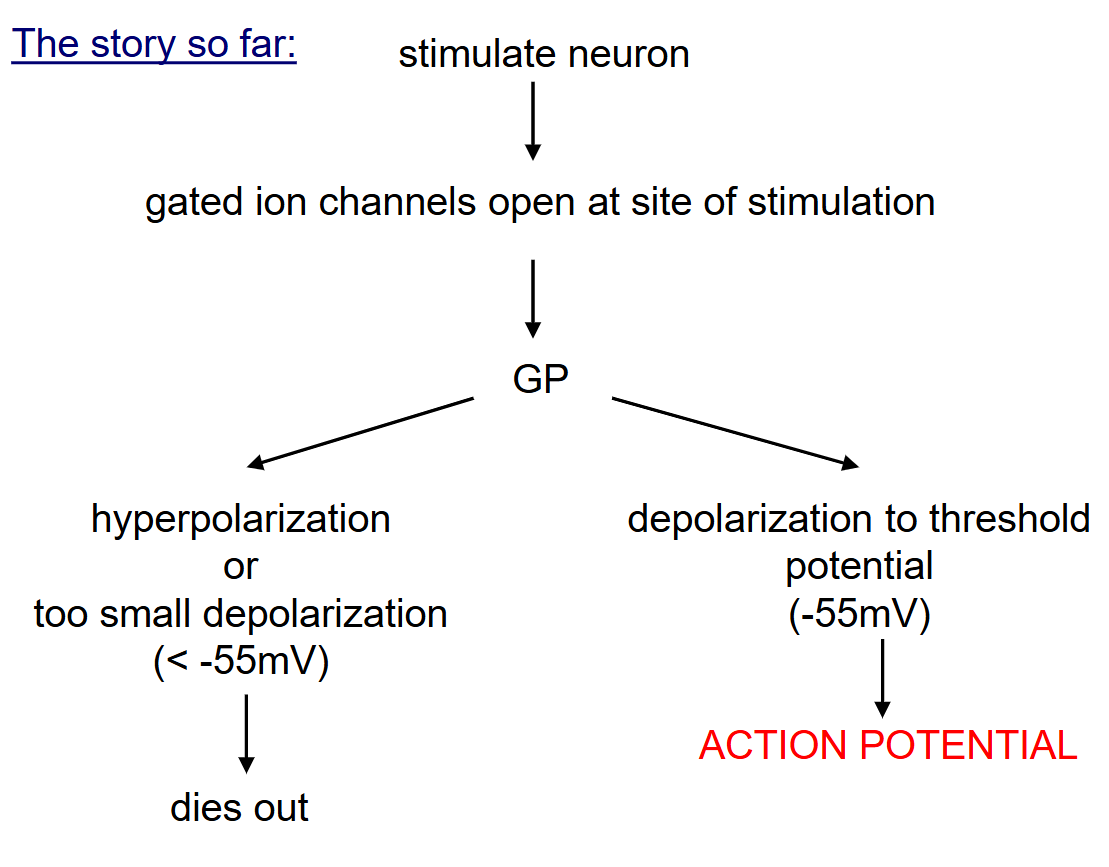
what are the steps of a graded potential triggering an action potential
critical stimulus (or summating stimuli) → GP reaching threshold → action potential
the story so far
what is an action potential?
a nerve impulse (signal) that causes a large change in membrane potential and propagates along an axon with no change in intensity
how does action potential intensity change as it travels along the axon?
it does not change, action potentials propagate without loss of intensity (all or nothing)
where is an action potential initiated?
at the trigger zone, typically the axon hillock or initial segment
where is the trigger zone in different neuron types?
multipolar & bipolar: axon hillock
unipolar: just past the dendrites
what are the events of an action potential?
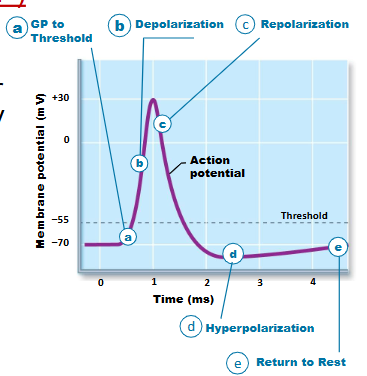
a) GP - membrane potential at axon hillock reaches - 55mV (threshold)
b) depolarization phase, c) repolarization phase, d) after-hyperpolarization phase - action potential (phases)
what happens during the depolarization phase?
voltage-gated Na+ channels respond to MP change (i.e. GP) and open - greatly increases Na+ permeability
as gates open more Na+ diffuses in (further changing MP) → causes more Na+ gates to open (pos. feedback)
Na+ diffuses in causing depolarization to +30mv (inside becomes more pos relative to outside)
what happens in the repolarization phase
Na+ channels close, becoming inactivated (decrease Na+ permeability) → Na+ movement returns to resting levels
voltage gated K+ channels open (increasing permeability) THEREFORE K+ diffuses out (positive charges (K+) move out - decreases MP)
what happens in the after-hyperpolarization phase (below RMP)
K+ channels are slow to close and remain open longer than necessary
Na+ channels are reactivated - can respond to stimuli at this point
once K+ channels close → MP returns to RMP (-70mV)
what is the role of Na+/K+ ATPase in neurons?
it continuously maintains Na+ and K+ concentration gradients by pumping Na+ out and K+ into the cell
do action potentials significantly change intracellular ion concentrations?
no, it takes thousands of action potentials to cause a measurable change in ion concentrations because the Na+/K+ -ATPase maintains gradient
what are the 2 refractory periods of an action potential?
absolute refractory
relative refractory
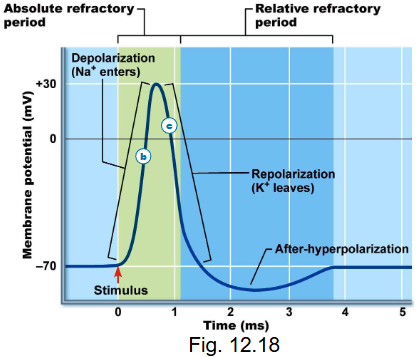
can an action potential be generated in the absolute refractory period?
NO ap can be generated regardless of the stimulus size
how does the absolute refractory period result from?
either from
all Na+ channels being open (region b)
all Na+ channels being inactivated (can’t open until MP reaches RMP, region c)
(all open because of positive feedback)
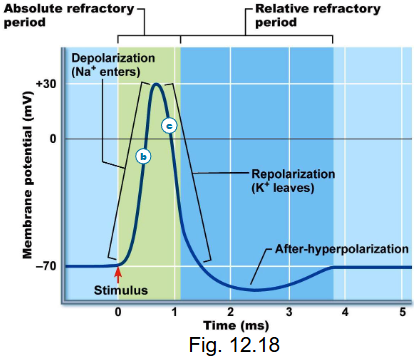
can an action potential be generated in the relative refractory period?
AP can generated by only by a greater than normal stimulus
what happens in the relative refractory period?
Na+ channels are reactivated when MP passes RMP therefore they are closed but can be reopen if threshold is reached
K+ channels are open and membrane is hyperpolarized
further to go get to threshold therefore need larger stimulus
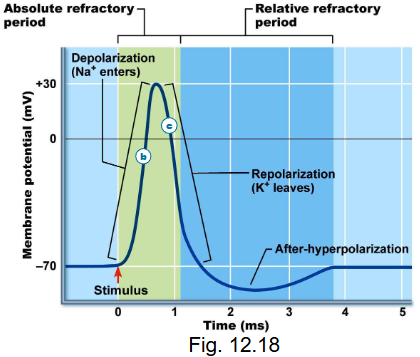
what is the all-or-none principle of APs?
ALL: if threshold reached AP is produced - same every time (same max depolarization etc.)
NONE: below threshold = no AP
why must action potential propagate along the entire axon? (action potential propagation)
to act as a communication signal, the action potential must ravel the full length of the axon to reach the axons terminals
how does depolarization at one part of the axon cause depolarization in the adjacent membrane?
Na+ influx creates local current flow
positive ions (Na+ in) move toward adjacent negative regions, depolarizing them to threshold and opening voltage gated Na+ channels
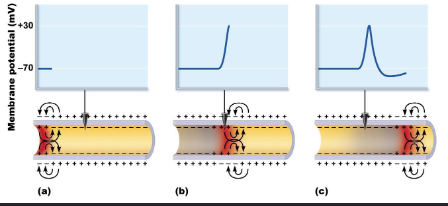
why do action potentials propagate in only one direction?
the membrane behind the action potential is in the absolute refractory period, so it cannot fire again
how do action potentials change as they propagate along the axon?
they do not change, each action potential is identical in size and intensity (all or none)
what does the rate of propagation depend on?
fiber (axon) diameter
myelination
how does the fiber (axon) diameter affect rate of propagation?
larger diameter = faster propagation because there is less resistance to ion flow (=current)
more channels, signal propagates fasters
how does unmyelinated fibers affect the rate of propagation?
APs all along the fiber (Na+ channels are adjacent to each other) = continuous conduction → SLOWER
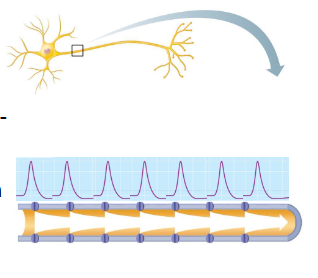
how does myelinated fibers affect the rate of propagation?
AP occurs at nodes of Ranvier (ion channels only present here) = saltatory (leaping) conduction → FASTER
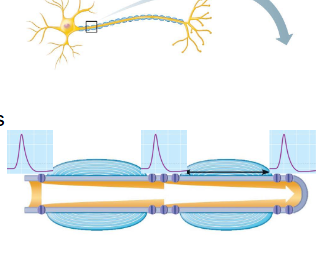
how is an action potential a positive feedback loop?
system is not trying to stop the depolarization
amplifies it until the membrane potential shoots up to +30mv
neuron is pushed far away from resting potential
loop only stops when Na+ channels inactivate & K+ channels open → repolarization
stopping mechanisms is external to the loop
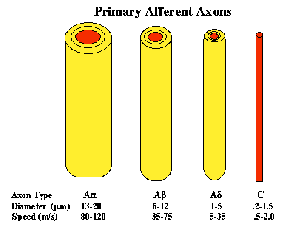
what are the different fiber types?
type A
type C
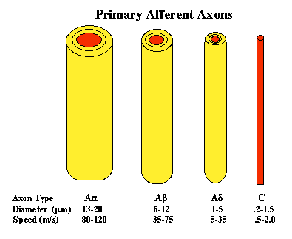
what are the characteristics of a type A fiber?
large diameter
myelinated (fast)
propagate APs @ ∼130 m/sec
most sensory neurons & motor neurons to skeletal muscle (pain receptors, reflexes)
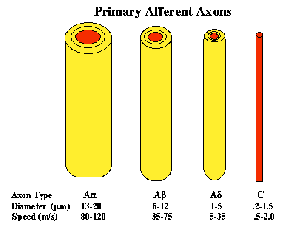
what are the characteristics of a type C fiber?
small diameter
unmyelinated (slower)
propagate @ ∼0.5 m/sec
found in autonomic NS (ANS) and some pain fibers (running in the background → not actively doing)
what is the difference in location between a GP and AP
GP: dendrites/cell body
AP: axon hillock/axon
what is the comparison of strength of MP between GP and AP
GP: variable
AP: all or nothing (+30mV)
what is the comparison of summation between GP and AP
GP: YES (use ions to create greater, can stack until overall change in MP)
AP: NO (open every channel, can’t make it stronger, refractory periods)
what is the comparison of repolarization between GP and AP
GP: current dies away (take stimulus away it stops)
AP: Na+ gates close, K+ gates open
what is the comparison of types of gates between GP and AP
GP: chemical, mechanical, thermal (i.e. NOT voltage) different stimulus
AP: only voltage ( difference in ions across the membrane)
what is the comparison of distance travelled between GP and AP
GP: short (1-2mm) & dies away
AP: produced anew on axon & propagates over long distances
what is the comparison of refractory period between GP and AP
GP: absent
AP: present
what is synaptic transmission (ST) at neuronal junction?
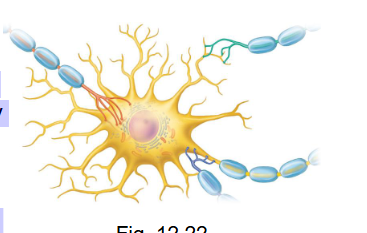
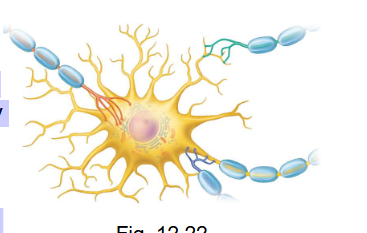
nervous system depends on chains of neurons connected by junctions called synapses
process by which neurons communicate at synapses, allowing signals to pass from presynaptic neuron to post synaptic neuron
in which direction does information flow at a synapse?
from the presynaptic neuron (sending signal) to the postsynaptic neuron (receiving signal)
steps of a synaptic transmission (synapse)
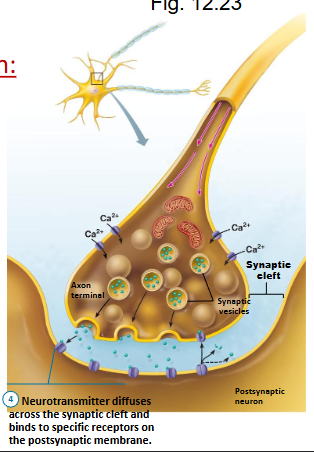
AP arrives at axon terminal (synaptic end bulb)
Ca++ voltage gates open (due to AP) and Ca++ enters (higher Ca++ outside)
rise in Ca++ triggers exocytosis of neurotransmitter (nt) containing vesicles
nt diffuses across synaptic cleft, binds to specific receptors on postsynaptic membrane
receptors = chemically-gated ion channels that open in response to binding of neurotransmitter
gated ion channels open - allowing movement of ions into (or out of) postsynaptic membrane
creates a graded potential (GP) called a postsynaptic potential (PSP)
what are the types of postsynaptic potentials (PSPs)?
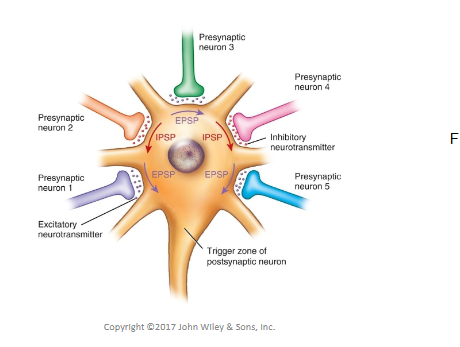
excitatory PSPs (EPSPs) = GP → depolarization
inhibitory PSPs (IPSPs) = GP → hyperpolarization
explain excitatory PSPs (EPSPs)
GP → depolarization
due to opening of Na+ (or Ca++) channels, or closing of K+ channels
neurotransmitter is often acetylcholine (ACh) or glutamate
causes more depolarization, more likely to reach threshold
explain inhibitory PSPs (IPSPs)
GP → hyperpolarization (further away from threshold)
due to opening of K+ or Cl- channels (inhibits neuron from reaching an AP)
neurotransmitter is often glycine or GABA
where do postsynaptic potentials (PSPs) occur?
on the dendrites and the cell body of the postsynaptic neuron
how do EPSPs lead to action potential?
multiple ESPs can summate, depolarizing a large area of the membrane
if the summed depolarization reaches threshold at the axon hillock, an action potential occurs
how do IPSPs affect action potential generation?
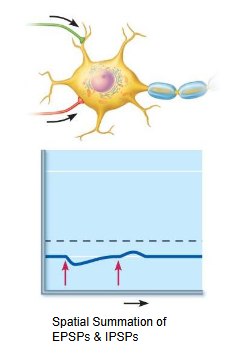
IPSPs hyperpolarize the membrane and counteract EPSPs
combined sum of EPSPs and IPSPs determines whether threshold is reached at the axon hillock
what is synaptic transmission (ST) at neuromuscular junction?
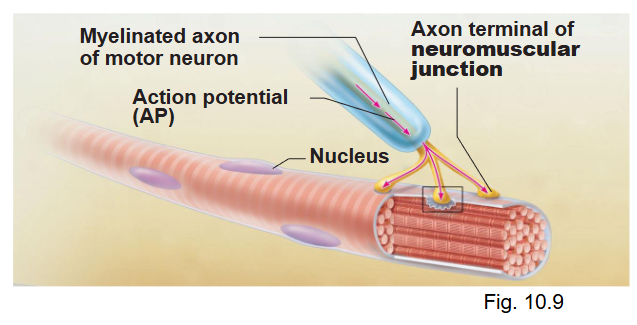
junction between the axon terminal of a lower neuron & individual muscle fiber
what are the steps to a synaptic transmission at neuromuscular junction?
(similar to those for neuronal junction with the following modifications)
neurotransmitter released = ALWAYS ACh
Na+ chemical gates on muscle motor end plate (=sarcolemma of muscle fiber) open
causes GP (= end plate potential (EPP)) on sarcolemma (always excitatory)
where synapses with neuron
EPP triggers AP on sarcolemma (leading to contraction)
lots of ACh released in step 1, therefore always get AP from an EPP
 Note
Note  Flashcards (54)