psych1102
 Studied by 0 people
 Call Kai
 Learn
Learn Practice Test
 Spaced Repetition
 Match
Match Flashcards
 Knowt Play
1/254

There's no tags or description
Looks like no tags are added yet.
Name | Mastery | Learn | Test | Matching | Spaced | Call with Kai |
|---|
No analytics yet
Send a link to your students to track their progress
255 Terms
Physical Development
body changes, motor skills, puberty, physical signs of ageing
Cognitive Development
Perception, language, learning, memory, problem-solving
Psychosocial Development
personality, emotions, gender identity, moral behaviour, interpersonal skills, roles
(1) Change and (2) Continuities
1) developmental milestones that are relatively systematic, orderly, patterned and enduring.
2) ways in which we remain the same or consistent over our life span.
Freud's Psychosexual Stages
mnemonic: "ONE A POUND, LET'S GO!"
Oral, Anal, Phallic, Latency, Genital.
Teratogens
any agent that can cause a birth defect and disrupt development
Period of greatest susceptibility for the early development/formation of a human:
embryonic period (up to 8 weeks)
Maturation
unfolding of genetically programmed behaviour patterns
Major Theorists of Development: Freud and Erikson
psychoanalytic theory
Major Theorists of Development: Piaget and Kohlberg
cognitive developmental theory
Major Theorists of Development: Bandura
social cognitive theory
Major Theorists of Development: Ainsworth and Bowlby
ethological theory
Major Theorists of Development: Erikson
stages of psychosocial development
Constructivist Theory
Piaget's theory based on the belief that children construct meaning and understanding from their own words.
What is an interactionist?
Someone who believes in the importance of both nature and nurture.
Id, Ego, Superego
ID= rash
EGO = rational
SUPEREGO = social
Assimilation vs. Accommodation in development
Assimilation: Information that fits into previous knowledge.
Accommodation: New information that alters a pre-existing schema to create new knowledge.
Piaget's Four Main Stages of Intellectual Growth:
Sensori-motor intelligence (birth - 2 years) -> object permanence
Pre-operational period (2 - 7 years) -> mental representations, pre-logical/egocentric
Concrete operations (7 - 11 years) -> mental operations for physical, concrete materials
Formal operations (11 years+) -> mental operations for abstract operations; hypothetical reasoning
Piaget's Deferred Imitation
The ability to remember and copy the behaviour of models who are not present (e.g., one object can represent another in make-believe play)
Piaget's Discovery of Object Permanence:
<8 months (?)
9-12 months (?)
12-18 months (?)
out of sight, out of mind (no effort to retrieve hidden object)
searches, but only where the object was last found (A not B effect)
understands invisible displacements; understands that objects continue to exist independent of child's interaction with them
Piaget's Theory of Conservation
The "logical" understanding that objects have a fundamental essence that remains the same irrespective of change in form, presentation or appearance. (e.g., glasses of same volume but different shape)
theory of mind
an awareness that other people's behaviour may be influenced by beliefs, desires, and emotions that differ from one's own
strange situation procedure (SSP)
(mnemonic: SCPs- as in, the strange monsters)
A laboratory procedure designed by Mary Ainsworth (1977) to capture individual differences in attachment; it involves separating infants and toddlers from their caregivers for brief periods and observing their responses when the caregivers return. The scoring dimensions are:
proximity and contact seeking
contact maintaining
resistance
avoidance
search
distance interaction
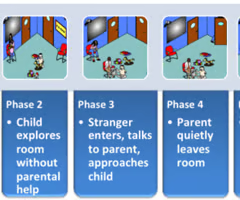
secure attachment in infants
(50-60%) --> separation distress but flexibly resume exploration with reunion
Insecure-anxious/ambivalent attachment in infants
(15-20%) --> extreme separation distress, not terminated by reunion, unable to resume exploration
Insecure-avoidant attachment
(15-20%) --> limited separation distress, exploration focus; indifferent when parent leaves/returns
Disorganised attachment
(5-10%) --> no coherent strategy; confusing/contradictory behaviour
Rouge Test
The exercise where a spot of red is placed on the infants nose and they are held up in front of a mirror; a measure of self-concept/self-recognition.
Jack in the box study
Participants who thought they were viewing a boy rated the infant's reaction to a jack-in-the-box as anger; those who thought they were viewing a girl rated the reaction as fear.
Similarity hypothesis
(Hyde, 2019) The gender similarities hypothesis holds that males and females are similar on most, but not all, psychological variables. That is, men and women, as well as boys and girls, are more alike than they are different.
Gender Constancy (Kohlberg)
The understanding that a person's sex remains the same even despite changes in surface characteristics (e.g., clothing, hairstyles, and play activities).
Three Components:
Gender Identity --> "are you a boy or a girl?"
Gender Stability --> "when you grow up, will you be a mummy or a daddy?"
Gender Consistency --> "if you played with dolls, what would you be?"
triadic reciprocal determinism
Belief that cognition, behaviour, and the environment operate interactively as determinants of one another.
morality of constraint vs. morality of cooperation
'Intentions vs. Consequences'
Constraint: (moral realism) children will unquestionably follow the rules laid down by their parents, without mounting any challenge; consequences determine all guilt
Cooperation: (moral relativism) biological and cultural solutions to recurrent social problems; intent is important in determining guilt
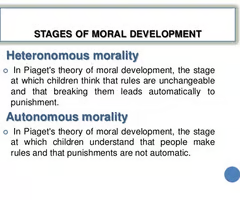
social cognitive theory of moral agency
Moral behaviour is regulated by social sanctions and self-evaluative sanctions
Moral standards are developed by enactive experience, direct tuitions and modelling
Moral standards are aligned with behaviour through the engagement of self-evaluative sanctions
moral disengagement
According to Bandura, the ability to avoid self condemnation when engaged in immoral behaviour by justifying, minimising, or blaming others for one's actions.
Moral justification, advantageous comparison, displacement of responsibility, diffusion of responsibility, vilifying recipients, and more.
moral justification
detrimental conduct is made personally and socially acceptable by portraying it as serving socially worthy or moral
advantageous comparison
people compare their own behaviour to more reprehensible behavior and, making their own behaviour seem more okay
diffusion of responsibility
the tendency for individuals to feel diminished responsibility for their actions when they are surrounded by others who are acting the same way
displacement of responsibility
reducing personal accountability by blaming their behaviour on others (e.g., "my boss made me do it").
cohort effects (generation effects)
effects observed in a sample of participants that result from growing up at the same time (during the same time period)
post hoc fallacy
false assumption that because one event occurred before another event, it must have caused that event (A must cause B logical error)
Piaget's Stages of Development
sensorimotor (birth-2): no thought beyond immediate physical experiences
preoperational (2-7): able to think beyond the here and now, but egocentric
concrete operational (7-11): can perform mental transformations (create mental images) but only on concrete physical objects
formal operational (11-adulthood): can perform hypothetical and abstract reasoning
Scaffolding (Vygotsky)
parents provide initial assistance but gradually remove structure as children become more competent
Difference in Piaget's and Vygotsky's Theories about developmental growth:
Piaget argued for sweeping stages in abilities to mentally represent experiences. Vygotsky argued for gradual changes over time based on experiences with parents and other caretakers.
contact comfort
positive emotions afforded by touch
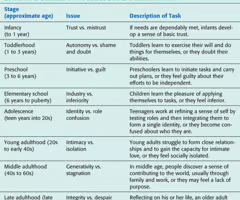
Erikson's model of identity
"Turtles Must Allow Some Important Gorillas Into Icy Igloos, Raking In Immense Gold So It's Delightful"
(TM) > trust vs. mistrust
(AS) > autonomy vs. shame/doubt
(IG) > initiative vs. guilt
(II) > industry vs. inferiority
(IR) > identity vs. role confusion
(II) > intimacy vs. isolation
(GS) > generativity vs. stagnation
(ID) > integrity vs. despair
emerging adulthood
spanning approximately 18 to 25 years of age, the period in which many aspects of emotional development, identity and personality become solidified.
reappraisal
Reframing the meaning of a situation to alter its emotional impact (Gross, 1998); putting things into perspective and then initiating change in order to not keep repeating the same pattern.
Baumrind's Parenting Styles
authoritarian, authoritative, permissive (+uninvolved [Maccoby and Martin])
Hippocrates Humoral Theory
4 major humors (fluids) in the body that need to be regulated: 1) Blood, 2) phlegm, 3) black bile 4) yellow bile
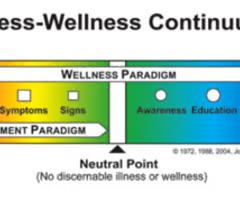
Illness-Wellness Continuum
a model that illustrates the full range of health between the extremes of illness and wellness
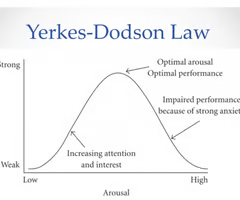
Yerkes-Dodson Law
the psychological principle stating that performance is best under conditions of moderate arousal rather than either low or high arousal
challenge vs. threat appraisals
a threat is taxing and strains a person, whereas a challenge is viewed as an opportunity to demonstrate skills or further growth in said skills
problem-focused vs. emotion-focused coping
focused on the objective stressor itself vs. focused on how the stress makes you feel.
active vs. avoidant coping
active: involves awareness of the problem or situation causing stress and conscious attempts to either reduce the resulting stress, eliminate the source of the stress, or both. Problem-focused. e.g joining yoga class, finding a way to cope with job that you can't quit right now
avoidant: may or may not be aware, but makes no active attempts to reduce stress or eliminate the problem. Instead, those engaging in avoidant coping will ignore or avoid the problem altogether. They may be aware that there is a problem or they may be in denial about the problem. e.g. not going home while going through breakup, procrastination
clinician's illusion
overestimating most people's fragility and underestimating their resilience
Corticosteroids
A group of hormones, including cortisol, released by the adrenal glands at times of stress
the Social Readjustment Rating Scale and the Hassles Scale
Two scales that endeavour to gauge and measure the nature and impact of differing stressful events.
The SSRS: based on 43 life events such as 'jail term' and 'personal injury or illness', ranked in terms of their stressfulness as rated by participants.
Hassles Scale: measuring a range of events from small annoyances to major daily pressures.
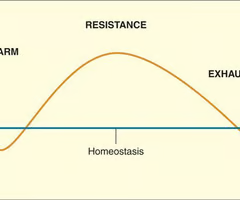
General Adaptation Syndrome (GAS)
Selye's concept of the body's adaptive response to stress in three phases—alarm, resistance, exhaustion.
Alarm stage: physiological/psychological reactions that mobilise us to either confront or escape a threatening situation.
Resistance stage: adaptation to the stressor; trying to find ways to cope.
Exhaustion stage: resources and coping abilities are strained; stress can damage organs and engender depression and PTSD.
tend-and-befriend response
under stress, people (especially women) often provide support to others (tend) and bond with and seek support from others (befriend)
crisis debriefing or Critical Incident Stress Debriefing (CISD)
A procedure that is often conducted days after a traumatic event, and involves standardised steps that are presented to whole groups of people that have been traumatised:
Strongly encouraging group members to discuss and 'process' their negative emotions
Listing post-traumatic symptoms that group members are likely to experiences
Discouragement of discontinuing participation once the session has started.
behavioural control
to step up and do something to reduce the impact of a stressful situation or prevent its recurrence.
cognitive control
thinking differently about negative emotions that arise in response to stress-provoking situations.
decisional control
choosing among alternative courses of action
informational control
acquiring information about a stressful event
emotional control
ability to suppress and express emotions
fallacy of uniform efficacy
assumption that certain ways of coping and regulating emotion are consistently beneficial
self-enhancers
people who see themselves more positively than others do and who tend to be emotionally well-adjusted
nocebo effect
a negative placebo effect; harm resulting from the expectation of harm
Psychoneuroimmunology
the study of the interaction of the immune system and the nervous system.
Leucocytes
another name for white blood cells; detect and deal with infections or foreign molecules. (phagocytes, T cells and B cells)
phagocytes
white blood cells that first inspect the scene of an infection in the body and engulf an invader
cytokines
substances that send signals to natural T-killer cells
T cells
Cells from the thymus; they attach to proteins on the surface of virus and cancer-infected cells, popping them like balloons
B cells
Produce antibodies, slowing the progress of invaders and attracting proteins that destroy foreign organisms
biospychosocial perspective
most medical conditions are neither all physical nor all psychological, but rather an interplay of genes, lifestyle, immunity, social support, everyday stressors and self-perceptions (Engel, 1977; Sarafino & Smith, 2014; Turk, 1996).
Type A personality
Friedman and Rosenman's term for competitive, hard-driving, impatient, verbally aggressive, and anger-prone people
availability heuristic
basing the estimated probability of an event on the ease with which relevant instances come to mind
primary vs. secondary appraisal
Primary --> decision regarding whether an event is harmful.
Secondary --> perceptions of our ability to cope with an event.
allostatic load
(McEwan 1998) wear and tear (long-term negative impacts) on the body caused by prolonged or excessive stress responses
Mechanism of Action
how behaviour change is enabled
noxious stimulation
A stimulus that is damaging or threatens damage to normal tissues.
Nociceptive input
perceived as pain in the brain; the input can be manipulated to create more or less pain (e.g., through mood or 'Rubber Hand Illusion').
Expecatancy Theory
The belief that efforts will result in the intended performance goals
vagus nerve
main component of the parasympathetic nervous system; controls mood, immune response, digestion and heart rate.
Visceral hypersensitivity
Characteristic of IBS: lower visceral pain threshold, bloating and distention common complaints, rectal urgency despite small stool volumes
The ABC of attitudes
Affective: Emotional reactions to an attitude object
Behavioural tendency: Knowledge about interactions with an attitude object
Cognitive: Thoughts about the attitude object
Bem's self-perception theory (1972)
The idea that we gain knowledge of ourselves only by making self-attributions (attributing internal or external causes for our behaviour).
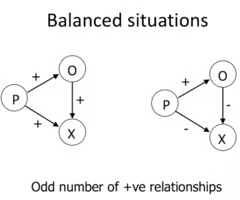
Balance Theory (Heider)
Unbalanced relationships cause tension (dissonance) in groups that is relieved when likes and dislikes are balanced.
An odd number of positive relationships within a triad creates a balanced situation.
Relationship between three elements:
P --> person
O --> other
X --> attitude object
implicit attitudes
Attitudes that are involuntary, uncontrollable, and at times unconscious; automatic; difficult to change.
explicit attitudes
attitudes that we consciously endorse and can easily report; easy to change; socially desirable.
attitude-behaviour link
the assumption that attitudes are the predictor of behaviour.
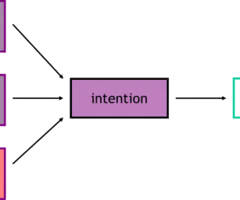
Theory of Planned Behaviour
Attitude-behaviour relationship is stronger with an understanding of attitudinal influences (Ajzen & Fishbein, 1980).
Suggests that attitudes guide intentions.
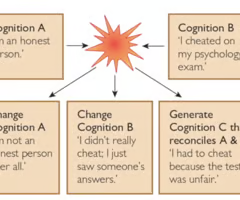
Cognitive Dissonance Theory
The theory that we act to reduce the discomfort we feel when thoughts or actions are inconsistent (Festinger, 1957).
The Ben Franklin Effect
A person who has performed a favour for someone is more likely to do another favour for that person than they would be if they had received a favour from that person.
social comparison theory
The idea that we evaluate our beliefs, abilities and reactions by comparing them with those of others (Festinger, 1954).
upward social comparison
comparing ourselves to people who are superior or better than we are with regard to a particular trait or ability
downward social comparison
comparing ourselves with others who seem inferior
social contagion
Imitative behaviour involving the spread of behaviour, emotions, and ideas.
THINK: 'mass hysteria'

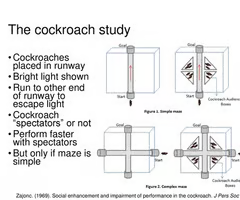
social facilitation
the phenomenon that describes how people tend to perform simple well-learned tasks better when other people are present
 Note
Note  Flashcards (85)