Ag policy
 Call Kai
 Learn
Learn Practice Test
 Spaced Repetition
 Match
Match Flashcards
 Knowt Play
1/128

There's no tags or description
Looks like no tags are added yet.
Name | Mastery | Learn | Test | Matching | Spaced | Call with Kai |
|---|
No analytics yet
Send a link to your students to track their progress
129 Terms
What is Agricultural Policy
Any government policy that affects the economic interests of the agricultural community
Why was a common market set up post WW2
No barriers to trade between member states, Free movement of labour, capital & entrepreneurs between member states
Who is the Europena council
heads of goverment
What does the European council do
major strategic decisions, clearing house for council (budget, milk quota)
Who is part of the council of the EU
ministers
What does the council of the EU do
co decides with EP by adopting legislations
Who is the European parliment
MEPs
What does the European Parliament do
powers to codecide with council, actual decision makers
Who is the European Commission
officials
Who is the commissioner for agriculture
Christophe Hansen
What are the 5 objectives of CAP
increase ag productivity, ensure fair standard of living, stabilize markets, assure availability of supplies, ensure supplies reach consumers at reasonable price
What does inelastic mean
Consumption is not very responsive to price changes
Is consumer demand for farm produce price inelastic or elastic
inelastic
When was the CAP created
1957
What are the general problems caused by the CAP
Comparatively low & volatile farm incomes, Volatile & falling farm-gate prices due to low price & income elasticities of demand
What does the common EU wide target price do for ag commodities?
supports market for farmers, set tariffs on imports outside EU
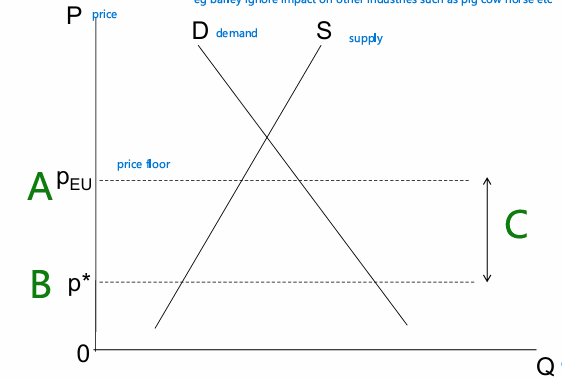
What is A?
intervention price
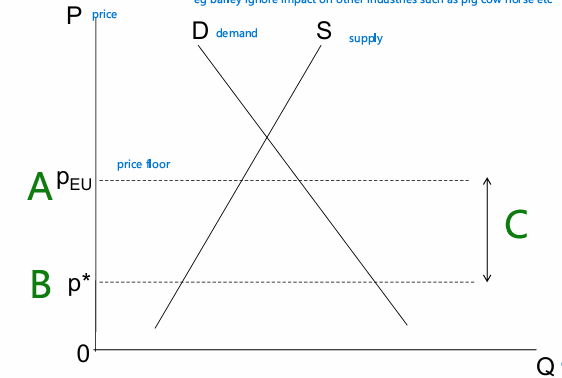
What is part B?
world price
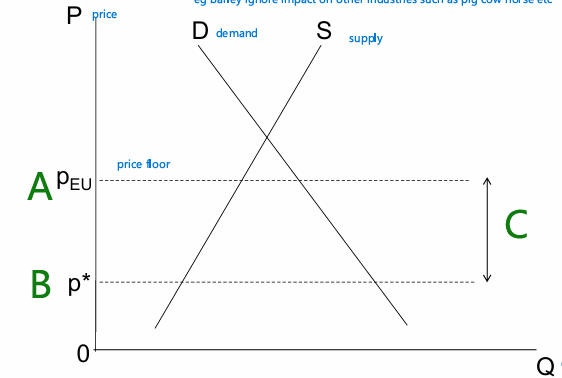
What is part C?
tarriff
What did the CAP do about surplus product?
given as food aid or subsidised exports to world markets
What is the economic theory in relation to CAP?
transfers tend to end up being capitilised into a higher purchase price of EU farm land
What is regressive impacts on consumers in regards to the ‘old’ CAP?
hits the poor harder than the rich, as the poor spend a larger % of income on food
What is progressive impact on taxpayers in regards to the ‘old’ CAP?
rich hit the hardest, as they pay more of their income on tax
What is the ‘80/20’ rule in regards to CAP?
80% benefits of CAP go to 20% of farmers
What were the problems of the old CAP?
excess supply, follow on problems (high cost to EU budget and consumer)
What was the 1980s supply controls in regards to CAP?
physical limit on production - uk decrease 10% , ireland increase 5%
What were the key MacSharry reforms?
Sizeable reductions in price support, Farmers compensated through direct payments, Extension of supply controls, ‘Accompanying measures’
What industrys recieved substantial cuts due to the MacSharry reform?
beef & cereals
How were direct payments decided due to the MacSharry reform?
Premium paid per head of livestock or per ha
Why were the new direct payments from the MacSherry reform prefered?
Subsidies not linked directly to current production, no incentive to ramp up production
What is ‘coupled’ in relation to the MacSharry reform?
Payments linked directly to production levels
What is ‘decoupled’ in relation to the MacSharry reform?
Payments not linked to current production decisions or output levels
What % of ‘set aside’ land was required to qualify for cereals direct payments?
15%
What were the accompanying measures of the MacSheery reform?
Afforestation aid, early retirement scheme, agri-enviromental schemes
What is the GATT?
General Agreement on Tariffs & Trade
When was the first GATT Round to really tackle world agricultural protectionism?
1989
When was the MacSharry CAP reform?
1992
What is the blue box accord?
agreement under the GATT/WTO allowing certain production-limiting agricultural subsidies to be exempt from reduction commitments
What caused the MacSharry reform?
Forced by Uruguay World Trade Round
When was the 2000 reform agreed?
March 1999
What was the limit put on CAP spending agreed with the 2000 reform?
€40.5bn
What compensatory increase was there for direct payments due to the 2000 reform?
Increased headage payments in beef sector, Increased area aid in cereals sector, Dairy premia
What were the reinforced rural development policies implemented due too the 2000 reform?
Clearer statement of policy objectives and rural development regulation
Why were there continued criticisms of the 2000 CAP reform?
Not full liberalisation of protectionist CAP, Inequality of CAP support continued, Farmers only received about 48c in the €
When did the UK finally leave the European Union?
31 Jan 2020
When was the EU-Mercosur Trade Agreement adopted
September 2025
What was the concern with capping a recipients SFP?
Legal splitting of holdings to avoid a cap, Need for investment & efficienc
What was the modulation introduced in pillar 2 of the 2003 reform?
Designed to transfer € from Pillar 1 → 2, Reductions in SFP, Most modulation € remained in Member State to help finance its rural development programme
What are some Reasons Why Decoupled Payments May Still Influence Behaviour?
payments slowed down restructuring by allowing farmers continue to operate at a loss, enhance liquidity, allowing for more investment
What were the impacts of the old CAP on the rest of the world?
Downward pressure on world agricultural commodity prices and high import tariff (& non-tariff) barriers
What is a producer support estimate (PSE)?
Quantifies the annual monetary value of transfers from consumers and taxpayers to agricultural producers arising from government policies.
What is a partially decoupled direct payments(blue box)?
distort decision but have a ceiling, no extra payments above this ceiling
What is a decoupled direct payments (green box)?
there is no direct link between on farm activity and support from CAP
What is a coupled support (orange box)?
intervention purchases, no limits
What triggered the 2005 CAP sugar reform?
2005 WTO legal ruling
What are ag modalities?
A technical framework for implementing agricultural trade reform, concrete proposols
How many countries joined the EU in the 2004 enlargement?
10
The 2004 enlargement mainly involved countries from
Central and Eastern Europe
Before joining the EU, many Central and Eastern European countries transitioned from
Command economies to market economies
One key feature of the economic transition in Central and Eastern Europe after 1989 was
Privatization of land
Which of the following occurred during the transition period after the collapse of communism?
Large falls in national income
Before enlargement, agricultural prices in the EU-15 were generally
Higher than EU-N10
The Single Area Payment Scheme (SAP) was mainly used in
EU-N10 countries
Which agreement helped phase in free trade before EU enlargement?
Association Agreements
The Copenhagen meeting in 1993 was significant because:
Membership was agreed in principle
Final accession negotiations for the 2004 enlargement were completed at
Brussels 2003
After accession, many new member states initially struggled with
Administering CAP policies
Which issue increased pressure on the CAP budget after enlargement?
Increased number of farmers eligible for support
Which country is often cited as having the best agricultural performance among the new member states?
Poland
Accession talks between Ukraine and the EU began in
2024
Ukraine could potentially join the EU
Before 2035 or after 2040
Ukraine has approximately how much arable land?
33 million ha
Ukraine’s main agricultural sectors include
Wheat, maize, and sunflower
Agriculture contributes approximately what percentage of Ukraine’s GDP?
10%
If Ukraine joined the EU today, it would receive approximately how much CAP funding?
€11 billion
Rural development funding during 2007–2013 totalled approximately
€96.2 billion
The rural development programme was funded by which EU fund?
EAFRD
Axis 1 of rural development focused mainly on:
Competitiveness
Axis 2 mainly addressed
Environment and land management
Axis 3 focused on:
Diversification and quality of life
The largest share of rural development funding was allocated to:
Axis 2
The CAP Health Check was agreed in
2008
The purpose of the Health Check was mainly to
Conduct a scheduled policy review
One key change introduced in the Health Check was
Abolition of compulsory set-aside
Set-aside was abolished mainly because
Tight global cereal supplies
The Health Check increased funding for “new challenges” such as
Climate change and biodiversity
EU milk quotas officially ended on
1 April 2015
The end of milk quotas was expected to:
Allow greater freedom to increase production
Increasing milk supply could lead to:
Lower farm-gate prices
The Irish Suckler Cow Welfare Scheme began in:
2008
The original payment under the scheme was approximately:
€80 per cow
When did discussions on the 2013 CAP reform begin?
2009
The 2013 CAP reform was negotiated alongside which major EU framework?
Multiannual Financial Framework (MFF)
What was significant about the decision-making process of the 2013 reform?
European Parliament had co-decision power
What effect did European Parliament involvement have?
Complicated the process
Why was 2014 considered a transitional year?
Old rules with new budget applied
What cut was applied to large Single Farm Payments in 2014?
10.5%
What happened to the CAP budget in real terms (2014–2020)?
Decreased
Approximately what percentage of the EU budget did CAP represent (2014–2020)?
37.8%

