CAPE Bio (P1/2) - Cellular Respiration and ATP Synthesis
 Studied by 2 people
 Call with Kai
 Learn
Learn Practice Test
 Spaced Repetition
 Match
Match Flashcards
 Knowt Play
1/19

There's no tags or description
Looks like no tags are added yet.
Name | Mastery | Learn | Test | Matching | Spaced | Call with Kai |
|---|
No analytics yet
Send a link to your students to track their progress
20 Terms
cellular respiration
the process occurring within the mitochondria in which organic molecules are broken down within a cell to generate ATP to fuel the cell’s functions
State the three main processes in cellular respiration
glycolysis, the Krebs cycle and oxidative phosphorylation
glycolysis
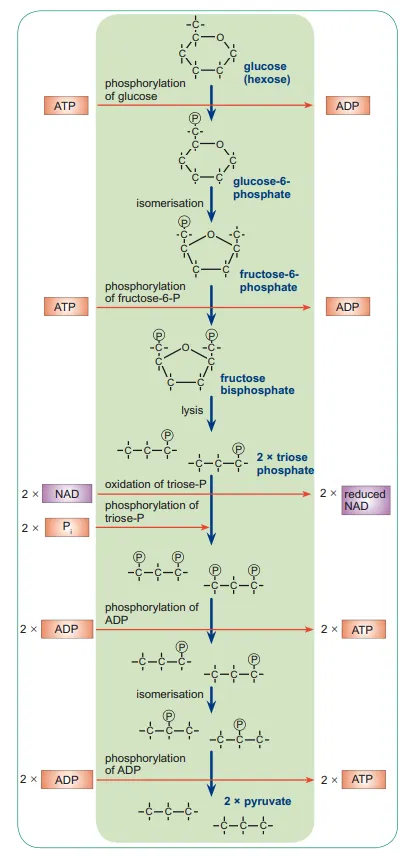
a series of reactions, occurring in the cytosol, which convert glycolysis to pyruvate while simultaneously generating a small amount of ATP
Describe the process of glycolysis
Glycolysis starts with taking a phosphate group form 1 ATP molecule and adding it to glucose which forms glucose-6-phosphate and ADP. Glucose-6-P is then rearranged into its isomer fructoser-6-P. After which, 1 ATP molecule reacts with fructose-6-P to form fructose 1,6-biphosphate and ADP. Fructose 1,6-biphosphate is then split into the two molecules G3P and dihydroxyacetone phosphate, the latter of which is readily converted into the former using an enzyme. Each G3P molecule is then oxidized, removing protons and electrons which are used to reduce NAD to NADH, which is used elsewhere in the cell. G3P is then phosphorylated using phosphate ions from the cytosol to form 1,3-biphosphoglycerate. This molecule then undergoes substrate-level phosphorylation and is used to enzymatically transfer a phosphate group from itself to ADP forming 1 molecule of ATP and 3-phosphoglycerate. A molecule of water is then removed from 3-phosphoglycerate and phosphoenolpyruvate is formed. Phosphoenolpyruvate then undergoes substrate-level phosphorylation and a phosphate group is transferred to the remaining ADP molecule, forming 1 molecule of ATP and pyruvate, each
Describe the fate of pyruvate under aerobic conditions
After glycolysis, pyruvate is oxidized and decarboxylated, removing one molecule of carbon dioxide to form an acetyl group which attaches to coenzyme A to form acetyl-CoA and simultaneously NAD is reduced to form NADH
link reaction -
Describe the fate of pyruvate under anaerobic conditions
Alcohol fermentation occurs in yest and plant cells. Lactate fermentation occurs in animal cells and lactic bacteria/fungi
alcohol fermentation -anaerobic instance in which yeast and plant cells decarboxylate pyruvate to produce acetaldehyde, removing one molecule of carbon dioxide. After which, two electrons and protons from NADH in the cell are transferred to acetaldehyde, producing ethanol
lactate fermentation
anaerobic instance in which pyruvate is broken down into lactate using lactate dehydrogenase
Explain the phenomenon of the oxygen debt
When animals undergo anaerobic respiration, lactic acid builds up in the cell which is transported to the liver where it is converted to pyruvate, however, oxygen is needed to clear lactic acid from the cell and, hence, the cell often requires more oxygen than currently available to do so
The Krebs Cycle
the repeating series of reactions that occur in the mitochondria that break down the products of the link reaction to produce ATP and generate energy for further ATP production
Explain how the structure of the mitochondria contributes to the Krebs Cycle
The outer membrane of the mitochondria is freely permeable while the inner permeable is selectively permeable so as to prevent the loss of protons and other important particle. The inner membrane has folds known as the cristae at which ATPase is attached. The large surface of the cristae allows NAD to be recycled as it occurs through enzymatic action in the intramembranal space. Its matrix is a lipid bilayer within the mitochondria that contains the enzymes for Krebs cycle, water, coenzymes and ions for respiration
Describe the Krebs Cycle
The cycle is initiated when pyruvate enters the mitochondrial matrix and the link reation occurs. The acetyl group then combines with oxaloacetate to form citrate, after which the coenzyme A will release the acetyl group and combine with a newly generated one. Citrate then rearranges itself to form is isomer, isocitrate which is oxidized by NAD to a-ketoglutarate, reducing NAD to NADH, which takes electrons to the transport system, and producing carbon dioxide. a-ketoglutarate is then oxidized to succinyl-CoA and carbon dioxide is produced while also simultaneously reducing another NAD molecule to NADH which takes electrons to the transport system. Succinyl-COA is then oxidized into succinate which results in the formation of succinate and one ATP molecule via substrate-level phosphorylation due to the high energy of the thioester bonds of succinyl-CoA. Succinate is then conveted to fumarate which simultaneously reduces FAD to FADH2, which takes electrons to the electron transport system. Water is added to fumarate and malate is produced which is then converted to oxaloacetate and is linked to the formation of another NADH molecule. At the end of each turn, 1 molecule of ATP, one molecule of FADH2, two molecules of carbon dioxide and three molecules of NADH are created
oxidative phosphorylation
the process, occurring at the cristate, in which oxidation is used to power the phosphorylation of ADP to produce ATP in high yields, fulled by the mechanisms of the electron transport chain (ETC)
the electron transport chain
a chain of protein carriers in the cristae which creates a circuit of electron carriers that generates enough energy to phosphorylate ADP once electrons have been transferred from one end to the other by creating a proton gradient, involving Complex I, Complex II, Coenzyme Q, Complex III, Cytochrome c and Complex IV.
Explain the mechanisms of the ETC and specify why it requires oxygen
Electrons enter the chain when NADH donates its electrons to Complex I and FADH donates its electrons to Complex II (the only non-proton pumper). Electrons are transferred via the mobile electron carriers, coenzyme Q and cytochrome c down the electron chain as they lose energy which is used by the complexes to pump protons from the matrix to the intermembrane space, creating a proton gradient. Coenzyme Q transferes electrons from Complex I/II to Complex III and cytochrome c transfers electrons from Complex III to Complex IV. Complex IV then transfers its electrons to oxygen which also binds with two protons to form water. The protons pumped into the intermembrane space create a proton gradient where there is a low amount of protons in the matrix which leads them to flow back into the matrix via the ATPase. When protons do this, the energy they possess from going with their gradient rotates the ATPase in a manner that binds ADP and a phosphate group to the enzyme, brings them closer together and catalyses their reaction into ATP. In the absence of oxygen, the chain starts to back up as each successive complex requires a particular level of electronegativity for it to transfer its electrons. Particularly, Complex IV is structured specifically to transfer electrons to oxygen so its absence results in a half of the chain and a cease of proton pumping
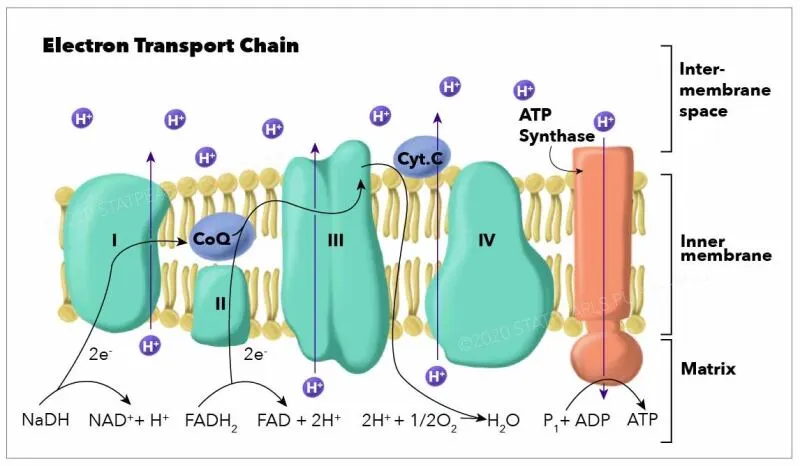
Describe this image
Movement of protons in the electron transport chain
Image the Krebs Cycle
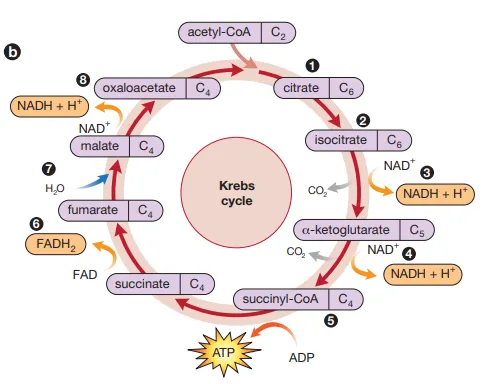
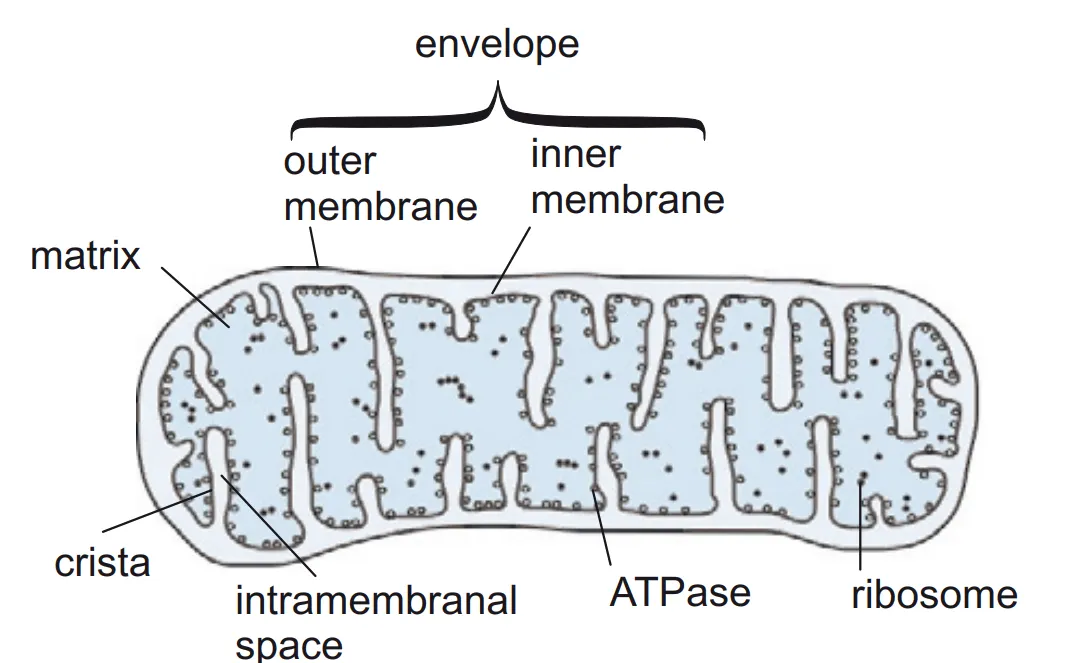
Describe this image
The structure of the mitochondria
Image glycolysis
 Note
Note  Flashcards (49)