Graded potential
 Call Kai
 Learn
Learn Practice Test
 Spaced Repetition
 Match
Match Flashcards
 Knowt Play
1/12

There's no tags or description
Looks like no tags are added yet.
Name | Mastery | Learn | Test | Matching | Spaced | Call with Kai |
|---|
No analytics yet
Send a link to your students to track their progress
13 Terms
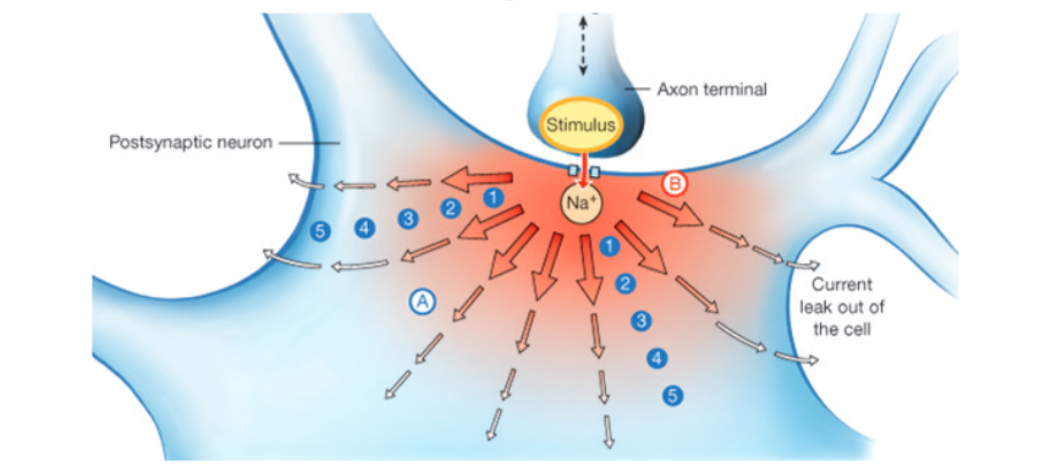
Graded potentials
signal molecules bind to receptors, ion channels open, ions move down concentration gradients
for ex: Na+ influxes through the plasma membrane and causes a small depolarization that dissipates over space and time
→ more Na+ ions at the point of entry;less further away
More signal molecules received → more binding to receptors → more channels open → more ions move → greater graded potential in target cell
When a neuron binds chemical signal molecules at the dendrites or cell body, it experiences one of two types of graded potential
Excitatory post-synaptic potentials (EPSP)
Inhibitory post-synaptic potential (IPSP)
Excitatory post-synaptic potential
depolarization occurs in the dendrites or cell body
These are caused by neurons binding excitatory neurotransmitters
Movement of Na+ and Ca++ would cause this
Inhibitory post-synaptic potential
hyperpolarization occurs in the dendrites or cell body
these are caused by neurons binding inhibitory neurotransmitters
movement of Cl- and K+ would cause this
If the neuron’s “trigger zone detects sufficient depolarization from the sum of all EPSPs and IPSPs in a short period of time, an action potential will be created
the trigger zone is the axon hillock in most neurons
The sum of all EPSPs and IPSPs must reach a threshold voltage (typically -55mV in neurons) to generate an action potential
→ an all-or-nothing electrical (depolarization) signal
→ action potentials are not large or small - they are the same every time
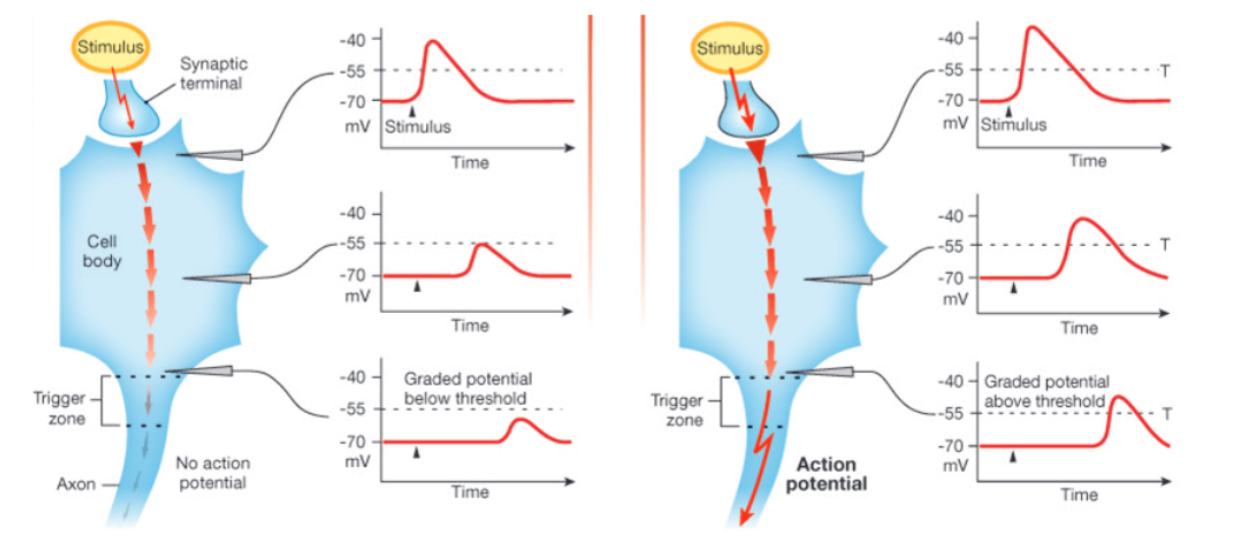
Graded potentials dissipate over time and space
Subthreshold and suprathreshold graded potentials in a neuron
Sub = below; no action potential is generated at the axon hillock
Supra = above; an action potential will be initiated at the axon hillock
→ voltage gated channels are opened at the axon hillock when the threshold is reached (~55mV)
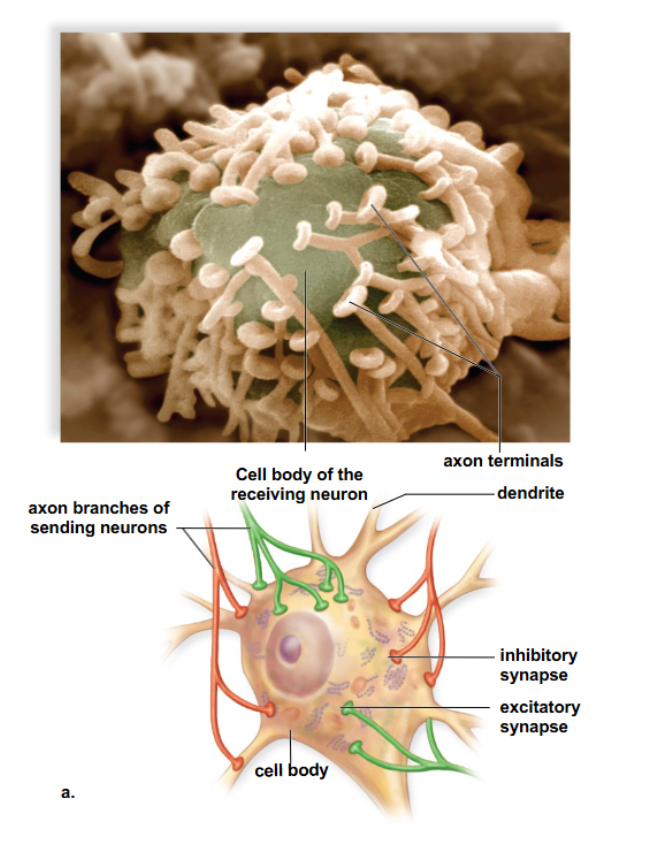
Integration of multiple graded potentials
Neurons receive MANY inputs from other neurons (perhaps hundreds or even thousands)
Neurons must integrate many excitatory and inhibitory stimuli
Integration in the summation of these excitatory and inhibitory signals received by a postsynaptic neuron
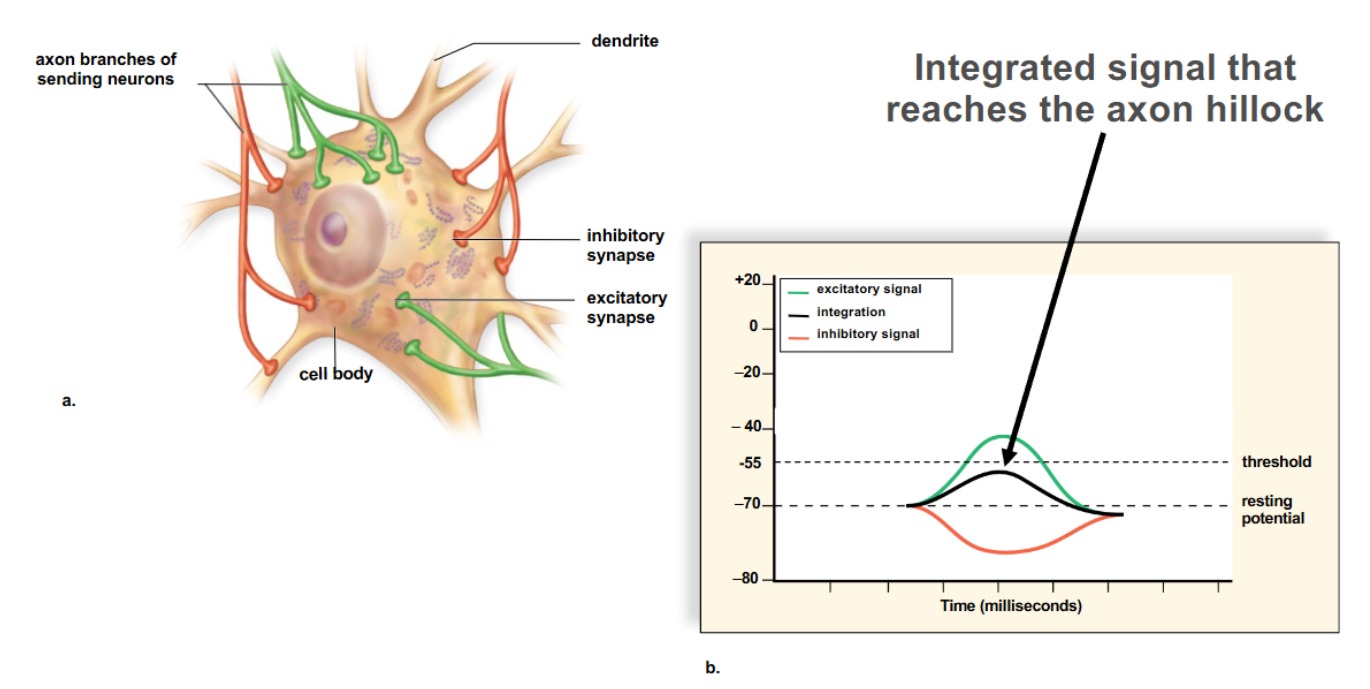
Integration in the summation of these excitatory and inhibitory signals received by a postsynaptic neuron
this integration occurs through spatial and temporal summation of multiple stimuli
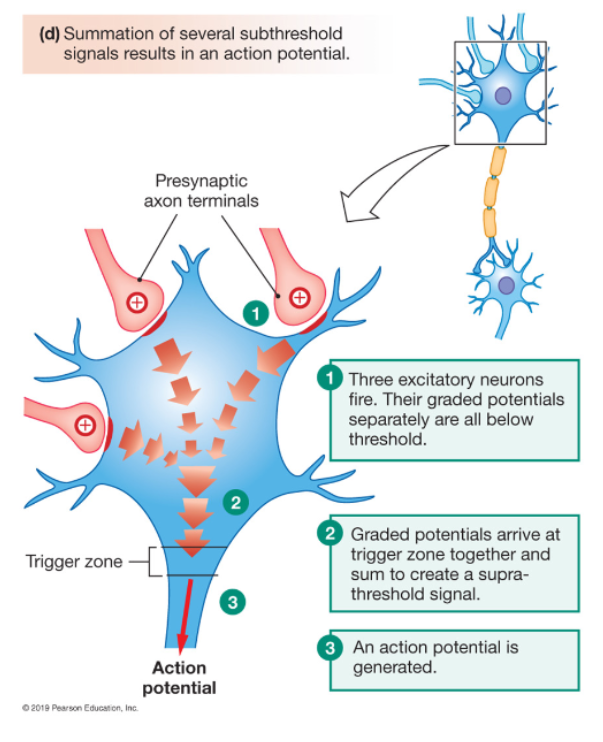
What is spatial summation?
multiple excitatory inputs
when more than one pre-synaptic neuron stimulates the post-synaptic cell simultaneously
→ all the EPSPs and IPSPs add up across the surface area of the neuron to determine if threshold is reached or not
All stimuli are excitatory in this example
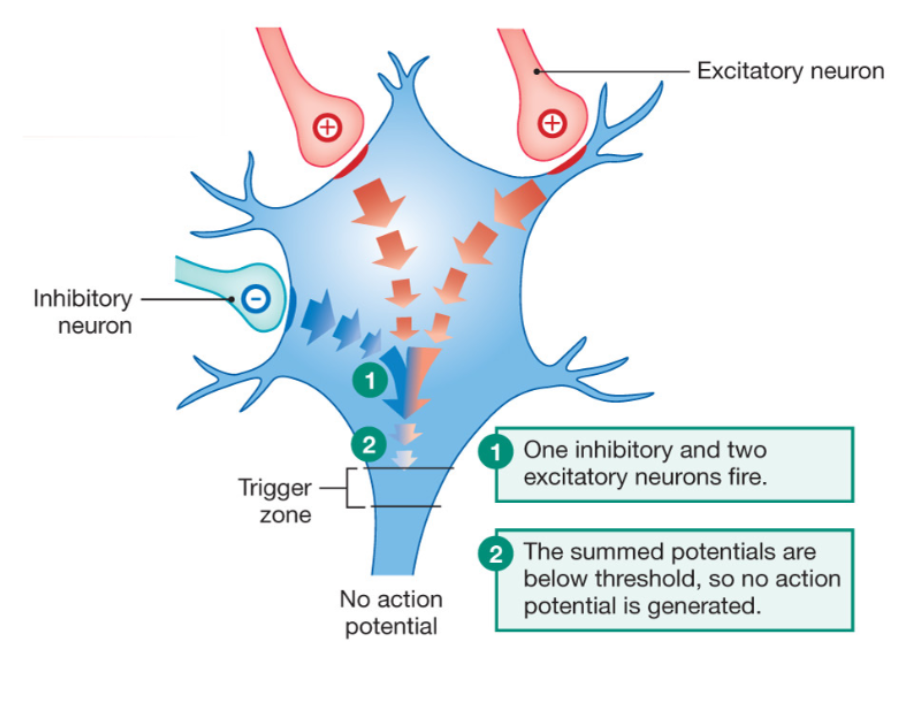
Special summation continued (a mix of excitatory and inhibitory inputs)
simultaneous excitatory AND inhibitory signals can co-occur across the surface of a neuron
Sum of all determines activity state of this neuron
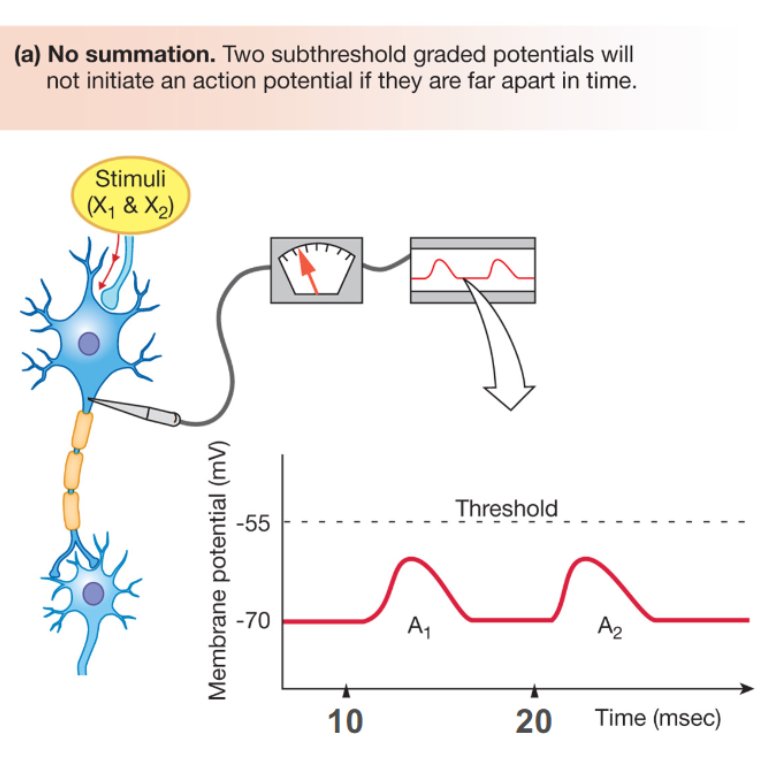
What is temporal summation?
Temporal = relating to time
a kind of integration influenced by the frequency or timing of incoming signals
In this example, no temporal summation occurs, because EPSPs are too far apart in time (10 milliseconds)
If there is an increase in the rate of the incoming signals, then temporal summation occurs
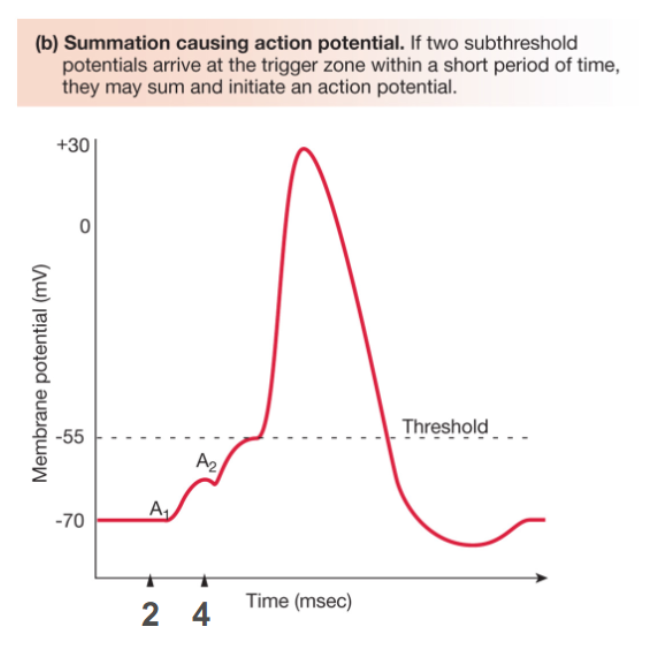
Temporal summation occurring
increase frequency or rate of EPSP
→ they will have an additive effect
as seen in this figure, the neuron receives a second signal before it has returned to resting state
These two EPSPs, very close in time (separated by only a few milliseconds), add together and the neuron reaches its threshold voltage
→ therefore, an action potential fires
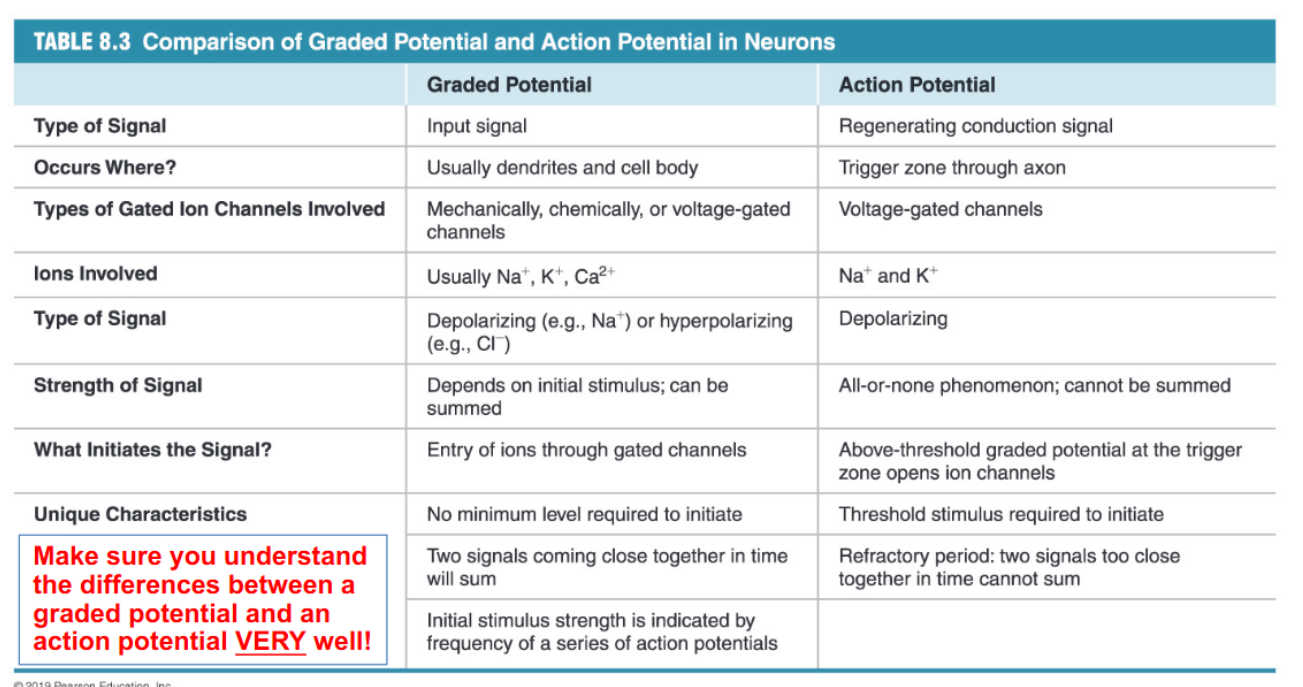
Summary of electrical signals in neurons
that

