MULTIPSYC FINAL EXAM
 Studied by 2 people
 Call Kai
 Learn
Learn Practice Test
 Spaced Repetition
 Match
Match Flashcards
 Knowt Play
1/90

Earn XP
Name | Mastery | Learn | Test | Matching | Spaced | Call with Kai |
|---|
No analytics yet
Send a link to your students to track their progress
91 Terms
Multicultural Psychology
The study of how culture effects behavior, cognition, and emotion.
6 Uses of Culture in Language
Descriptive → The specific behaviors and activities associated with a culture
Historical → A culture’s heritage and traditions
Normative → Rules that govern a culture (ex: religious texts)
Psychological → Behavioral processes such as learning and problem solving (ex: Asian immigrants assimilating into the U.S.)
Structural → Organizational elements of a culture (ex: emphasis on extended family)
Genetic → Genetic origins of a culture (ex: Indigenous South Americans & how they effect South Americans’ genetic makeup today)
Cultural Contact
The critical incident(s) where people from different cultural, ethnic, linguistic background come into social contact.
Occurs in 2 ways:
Contact occurs in a culturally diverse society (U.S.)
Individual visits culturally different society (tourism)
Multiculturalism is the “4th force” in Psychology
The belief that multiculturalism impacts the field of psychology as much as: psychoanalysis, behaviorism, and humanism
Biopsychosocial Model
A person’s behavior, health, and mental well-being are shaped by…
Biological:
Genetics, Brain chemistry, hormones, etcPsychological:
Cognitive Affective → The effect our thoughts & feelings have on our behavior (ex: mental disorders)
Social:
Social Interpersonal → Impact of social relationships on our behavior
Social-Institutional → How our behaviors are impacted by large institutions (ex: govt, military, corporations)

Culture
The systems of knowledge, values, and practices that are learned and transmitted across generations
Surface Structure of Culture → Physical manifestations of a culture, first impressions (ex: food, dress, language)
Deep Structure of Culture → Philosophies of a culture reflected in their values, practices, and beliefs
Whitelash
Backlash from White Americans in response to changing demographics in society (ex: Obama’s voter base mainly POC, white flight)
Normativity
The belief there is an ideal way that everyone should aspire to become (the inverse of diversity).
Ethnicity
The combination of race + culture. Emphasis on characteristics that are passed through generationally + genetically.
Multicultural Counseling and Therapy (MCT) Theory
MCT is a meta-theory of counseling and psychotherapy that argues the cultural identities of the client AND counselor matter.
Why?:
Each person has multiple levels of experiences and context
Cultural identity is a major factor in a client or counselor’s attitudes toward self, others, and groups.
Therapy’s effectiveness is tied to goals that align with client’s cultural values
Cultural Variables
The specific aspects of a culture (ex: individualistic vs collectivistic)
Internal Validity
Simple cause-and-effect relationship between variables (The dependent changed because of the independent variable)
External Validity
Applying the internal validity’s results on a population in a generalized manner
Quantitative Study
Research that turns questions into meaningful numbers (ex: “on a scale of 1-10…”)
Qualitative Study
Research question can be meaningfully answered by detailed verbal responses
Logical Positivism
Scientific approach that attempts to measure “truth” objectively through logical deduction, quantitative methods, and statistics
If you can’t measure it or prove it, it’s not scientific.
Functional Equivalence
Different behaviors can serve the same purpose or function across cultures, even if they look different.
Example: Inquiring an American boy’s knowledge of fairy tales by asking about “Beauty and the Beast”. If inquiring a boy from a different country, you would ask about a fairy tale familiar to his culture.
Conceptual Equivalence
A concept that has the same meaning across different cultures, even if it is expressed differently.
Example: The term “depression” does not exist in some cultures, but if you were to describe the symptoms of depression, they would be able to identify what you are talking about.
Linguistic Equivalence
When something is translated into another language, the words still have the same meaning, tone, and intent. Must be the same for the study to be considered acceptable.
Back Translation → The measure is translated into the target language and then translated back into the original language
Metric Equivalence
The numerical scores mean the same thing across cultures.
Example: Individuals from risk-averse cultures may avoid selecting the extremes of something in quantitative studies. To make up for this, the researcher makes “9” the equivalent to “10” in a 1-10 scale.
Haye’s ADDRESSING Model
Age and generational differences
Developmental disabilities
Disability (acquired: injury or illness)
Religion
Ethnicity and race
Socioeconomic status
S*xual orientation (i dont want my notes removed :c )
Indigenous peoples
National origin & language
Gender
Sternberg’s Conception of Intelligence
Argues that intelligence has 3 parts:
Analytical → Abstract thinking & processes info. effectively
Practical → Read and adapt to contexts of everyday life (ex: street smart)
Creative → Uses experience in ways that foster insight and invention
Gardner’s 8 Types of Intelligence
Linguistic → Good with words, persuasive, and good at explanations
Logical-Mathematics → Analyzing problems & mathematical operations
Spatial → Visual judgement, pattern recognition, interprets visuals
Musical → Rich understanding in sounds, music patterns, notes
Bodily-Kinesthetic → Motor control, muscle memory, skilled at sports
Intrapersonal → Self-reflection, sensitivity, introspection
Interpersonal → Understanding others, healthy relationships
Naturalist → Biology, botany, zoologist
Big 5 Personality Traits
Openness to new experiences
Conscientiousness → organized, disciplined, goal-focused
Extraversion
Agreeableness → trusting, helpful
Neuroticism → tendency to frequently experience negative emotions
Etic Perspective
Attempts to find the commonalities between cultures (outsider perspective)
Emic Perspective
Examines only one culture from within that culture. This approach attempts to derive what is meaningful among group members (insider perspective)
Imposed Etics
Forcing one’s worldview onto another culture with the false knowledge that their worldview is universal
Example: A researcher assuming their US-based study on child attachment styles apply to different cultures without considering the different culture’s parenting styles.
Idiocentric
An individual with individualistic traits
Allocentric
An individual with collectivistic traits
Counter culturalism
An individual becomes countercultural when they are in a “mismatched society”
Example: Idiocentric in Collectivist society & Allocentric in Individualist society
Vertical/Horizontal Individualist/Collectivist Scale
Vertical → Hierarchy and status matters
Horizontal → Equality matters; we are all the same status
Vertical-Individualism → Focuses on self, accepts inequality, ambitious, competitive, wants to stand out
Horizontal-Individualism → Focuses on self, values equality, independent but not competitive
Vertical-Collectivism → Focuses on group, accepts inequality, loyal to family/group, respects authority
Horizontal-Collectivism → Focuses on group, values equality, cooperative, emphasizes group harmony

WEIRD Ideology
Describes overrepresented populations in research
Western, Educated, Industrialized, Rich, Democratic
Cooperative Principle
We should strive to communicate truthfully/sincerely
Maxims:
Quality → Truth
Quantity → Appropriate amount of talking
Relevance → Remain on topic
Manner → Clear in Language
Relations → Know your audience
Rule Violations → Signal that we are about to violate a rule/maxim (meta-communication)
Nonverbal Types of Communication
Proxemics → Personal space
Kinesics → Communication through body movements
Oculesics → Kinesics that deal with gaze and eye contact
Haptics → The use of touch during communication
Paralanguage → Non-verbal cues in communication (ex: silence, rate of speech, voice volume)
High-Context Communication
The conversation depends on the context of the situation
Low-Context Communication
Language-dependent; the words themselves are the crucial aspect of communication instead of context
Direct Communication
Low-context form of communication that is assertive and literal
Indirect Communication
High-context form of communication that relies on context and the listener’s power of inference (ex: “aren’t you cold?” instead of “please close the window”).
Additive Bilingualism
When the 2nd language does not replace the native one
Subtractive Bilingualism
When the 2nd language replaces the native one
Native Bilingualism
Bilingual from birth; 2 languages commonly used in a household
Return Migration
When an immigrant periodically or permanently returns home.
Asylum Seeker
Special classification of a refugee who has successfully gotten asylum, or are actively asking to be taken in as an asylum seeker.
6 Stages of the Refugee Career
Predeparture
Flight
First Asylum [first place to be fled into]
Claimant [first country of potential settlement]
Settlement [official settlement country]
Adaptation [to new country]
Acculturative Stress
Negative changes in thoughts, feelings, behaviors, or attitudes as a result of exposure to a new dominant culture.
Bicultural Stress
Psychological stress of trying to maintain native culture whilst assimilating into the new one.
Acculturation
The process by which people change as a result of intercultural interactions
Enculturation
The retainment or deepened learning of their culture of origin.
Model of Acculturation
Assimilationist → People who have given up their native culture to assimilate into the new one.
Separationist → People who identify with their culture of origin and rejects the host country’s culture.
Marginalist → People who don’t identify with their native culture or the host’s culture.
Integrationist/Bicultural → Embrace both their origin culture as well as the host’s culture.
Layers of Ecological Context:
Potential stressors that may dictate an individual’s degree of acculturation
Microsystem → Immediate family members
Mesosystem → Relationships outside the immediate family
Exosystem → Major societal institutions
Macrosystem → Cultural and societal norms/expectations
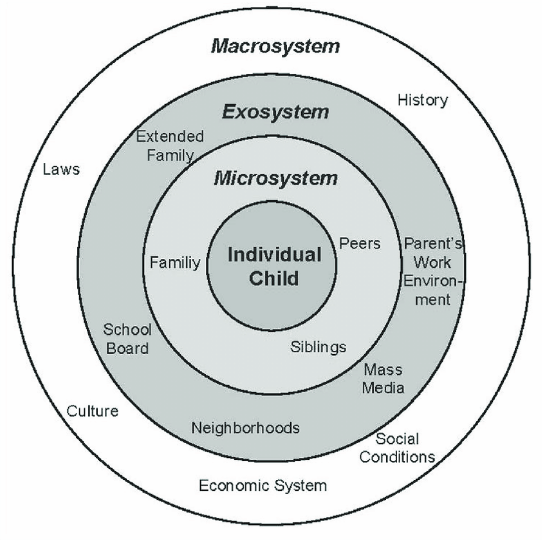
Ecological fit
The more similar the host’s culture is to yours, the easier the acculturation process will be.
Attribution Theory
Theory that describes how people explain the causes of human behavior.
Dimensions of Attribution Theory
Internal → Cause comes from the person
External → Cause comes from environmental/situational factors
Stable → Cause is permanent or consistent over time
Unstable → Cause is temporary or changeable

Internal-Stable
“They failed the test because they are bad at math.”
Internal → It’s them, not the situation.
Stable → It’s a permanent trait, not temporary.
most overused explanation for someone’s behavior
Internal-Unstable
“I failed the test because I didn’t study enough.”
Internal → It’s me, not the situation.
Unstable → I can do better next time if I study.
External-Stable
“Traffic always makes me late.”
External → It’s the situation, not me.
Stable → Traffic always happens, so it’s consistent.
External-Unstable
“I failed the test because the classroom was noisy.”
External → It’s the situation, not me.
Unstable → Next time, the classroom might be quiet.
Fundamental Attribution Error
Bias where people tend to overemphasize personality traits when judging other’s actions and downplaying external factors.
(internal-stable)
Ultimate Attribution Error
When attributions are directed towards an individual who represents a minority group. Their action is ascribed to the whole group rather than to the individual.
Example:
seeing a black person commit a crime and concluding that all black people are inherently criminals.
Illusory Correlation
Bias where people perceive a relationship between 2 things when no actual relationship exists.
Example:
Noticing violence and connecting it to the race or ethnicity of the perpetrator.
Availability Heuristic
Mental shortcut where the important/frequency of a thing is exaggerated because it comes to mind so easily.
Example:
overestimating the prevalence of negative events associated with a racial group because those events are more easily recalled due to media coverage or personal experiences.
Outgroup Homogeneity Effect
Tendency to see members of a social group that you are not a part of as all the same
Microassault
Blatant non-verbal, verbal, or environmental attacks (non-physical violence) that are intentionally discriminatory
Microinsult
Unintentional behavior or verbal comment conveying rudeness or insensitivity
Microinvalidation
Unintentional dismissal of POC experience
Attributional Ambiguity
Psychological state of uncertainty about the outcome of an event being a result of a person’s merit or their identity.
Cognitive Load
Total mental effort required to process information or complete a task
Implicit Association
The automatic unconscious connections between concepts in memory that influence a person’s attitudes, beliefs, and behaviors without awareness.
Example:
A doctor might automatically assume a Black adolescent is $exually active without asking open-ended questions
Tripartite Model of Personal Identity
Individual Level → genetics, nonshared experiences
Group Level → gender, race, culture, ethnicity
Universal Level → common life experiences, self-aware

African American Identity Development Model
Pre-encounter stage → Internalized white supremacy causes devaluing of blackness and idealization of whiteness
Encounter stage → Significant event forces individual to reevaluate their previous ideas of race.
Immersion/Emersion stage → Fully embraces black identity and rejects anything “not black”
Internalization Stage → Secure in black identity and embraces other identities
Latino Identity Development Model
Casual stage → Internalizes negative attributions and feels shame, humiliation, traumatized
Cognitive Stage → Believes assimilation into white culture will grant success
Consequence Stage → Rejects Latino culture and feels less connected to the culture
Working-Through Stage → Alienation from origin culture causes distress, and begins to integrate back into culture.
Successful Resolution Stage → Self-acceptance and sees heritage in a positive perspective
White Identity Development Model
Contact Status → Uninformed of racism and may be color-blind
Disintegration Status → Increased experience with POC challenges racist beliefs
Reintegration Status → Feelings of white guilt causes individual to avoid POC as a way to alleviate these negative feelings
Pseudo-Independence Status → Begins to recognize racism, but believes the oppressed must change to stop it
Immersion/Emersion Status → Begins to let go of racist idea and fight against racism. Recognizes that they are in a diverse society.
Autonomy Status → Feels good about their own identity as well as others’. Expands anti-racism to other forms of oppression.
LGBTQ+ Identity Development Model
Identity Confusion → Questions $exuality/gender.
Identity Comparison → Recognizes their feelings for same-$ex individuals
Identity Tolerance → Fully recognizes their feelings but attempts to hide them from others and themself to not be judged
Identity Acceptance → Fully accepts their identity and may begin coming out to others
Identity Pride → Openly expresses their $exuality/gender with pride
Identity Synthesis → Able to integrate all aspects of their identity (Example: Black lesbian).
General Racial & Cultural Identity Development Model (R/CID)
Conformity → Sees dominant culture as superior, and their own culture as less than.
Dissonance → A significant experience challenges person’s belief of the dominant group’s superiority over the minority group.
Resistance and Immersion → Immerses themselves in their culture, rejects dominant culture out of shame for seeing them as superior.
Introspection → Less angry and distrustful of dominant group, less immersed in one own’s group. Can appreciate other groups and their own, still with some inner conflict.
Integrative Awareness → Finds balance in appreciating own group as well as other groups. Aware of self as an individual and cultural being.
Common-Sense Model
A model developed to specifically explain how people make sense of illnesses and how those beliefs guide their coping behaviors.
How people understand illness → influences coping & treatment.
Health Behavior Belief Model
Explains why people do or do not engage in health behaviors (like taking medication, getting screened, exercising).
Main Areas:
Susceptibility
Some groups may underestimate risk due to cultural norms (e.g., “our people don’t get depression”).Severity
Some cultures may see mental illness as more shameful or dangerous, increasing perceived severity (and avoidance of treatment).Benefits
“Will this behavior help me?”Belief that taking action (e.g., therapy, screening, medication) will reduce risk or severity.
Barriers
Beliefs about obstacles to taking action—cost, stigma, time, access, family roles, cultural beliefs.
Ethnic Gloss
Labels used to identify cultural groups that have a great within-group heterogeneity
Example:
“Native American”, 562 unique native nations
Allostatic Load
The physiological cost of poverty-induced stress. Blood pressure, hypertension, high cortisol, etc
Stress from poverty = less healthy + less access to healthcare
Cultural Concepts of Distress
Ways that cultural groups experience, understand, and communicate suffering, behavioral problems, or troubling thoughts and emotions
Cultural Syndrome
Metal disorders that tend to occur in specific cultural groups (unique symptoms that manifest in specific cultures)
Cultural Idioms of Distress
Ways that different cultures express distress
Example:
Shared way of talking about or experiencing personal/social concerns
Cultural Explanations of Distress/Perceived Causes
The observation that cultural groups have different ways of explaining the causes of psychological symptoms
Culture-Bound Values
Principles, beliefs, and behaviors specific to a culture that may cause conflict w/ other cultures
Class-Bound Values
Mental health treatment centered around white middle class citizens
Clinicians may fail to consider the client’s lower-class perspective
Language Variables
Language barriers between a client and clinician
Prevalence
Current rate of a particular disorder at a given point in time → (example: “how many people have X right now?”)
Incidence
Number of new cases diagnosed in a given period of time → (example: “how many people diagnosed with X this week?”)
Lifetime Incidence
Number of cases that occur during one’s lifetime → (example: “how many people will be diagnosed with X before they die?”)
The 4 F Reactions
Responses to a potential threat
Freeze → stop and try to interpret a situation that may be a potential threat
Flee → Attempt to escape and uncomfortable or potentially dangerous situation
Fight → If escape is not possible, aggression is used as defense
Fright → Anxiety about the potentially dangerous situation
The 5 D’S of Difference
People’s reactions to situations where they feel different
Distancing → Avoiding situations in which one feels different
Denial → Pretending that no differences exist
Defensiveness → Protecting oneself from acknowledging difference as to avoid discomfort
Devaluing → Assessing differences as deficient or less important
Discovery → Appreciating differences and seeking out differences to gain familiarity
The Three S’ of Similarity
Similar things make us feel safe and sane
Simple → Things that are similar and simple to us and our values, are easy and comfortable
Safe → Similar things are not a threat because we know how to handle them
Sane → Similar things help us feel normal
 Note
Note  Flashcards (58)