Financing a business
 Call Kai
 Learn
Learn Practice Test
 Spaced Repetition
 Match
Match Flashcards
 Knowt Play
1/73

There's no tags or description
Looks like no tags are added yet.
Name | Mastery | Learn | Test | Matching | Spaced | Call with Kai |
|---|
No analytics yet
Send a link to your students to track their progress
74 Terms
Why do businesses need finance?
purchase long-term assets, materials, employing people
finance expansion
develop new products
enter new markets
new premises
pay for day to day
takeovers
What are the two sources of Finance (SoF)?
internal
external
What are internal sources of finance?
generated within the firm
no obligations
cheaper
What are external sources of finance?
obtained from outside the firm
conditions attached
more costly
What are short + long term internal sources of finance?
Short term: working capital management
Long term: retained profit
What are short + long term external sources of finance?
Short term:
bank overdraft
bills of exchange
debt factoring
invoice discounting
short term loans
Long term:
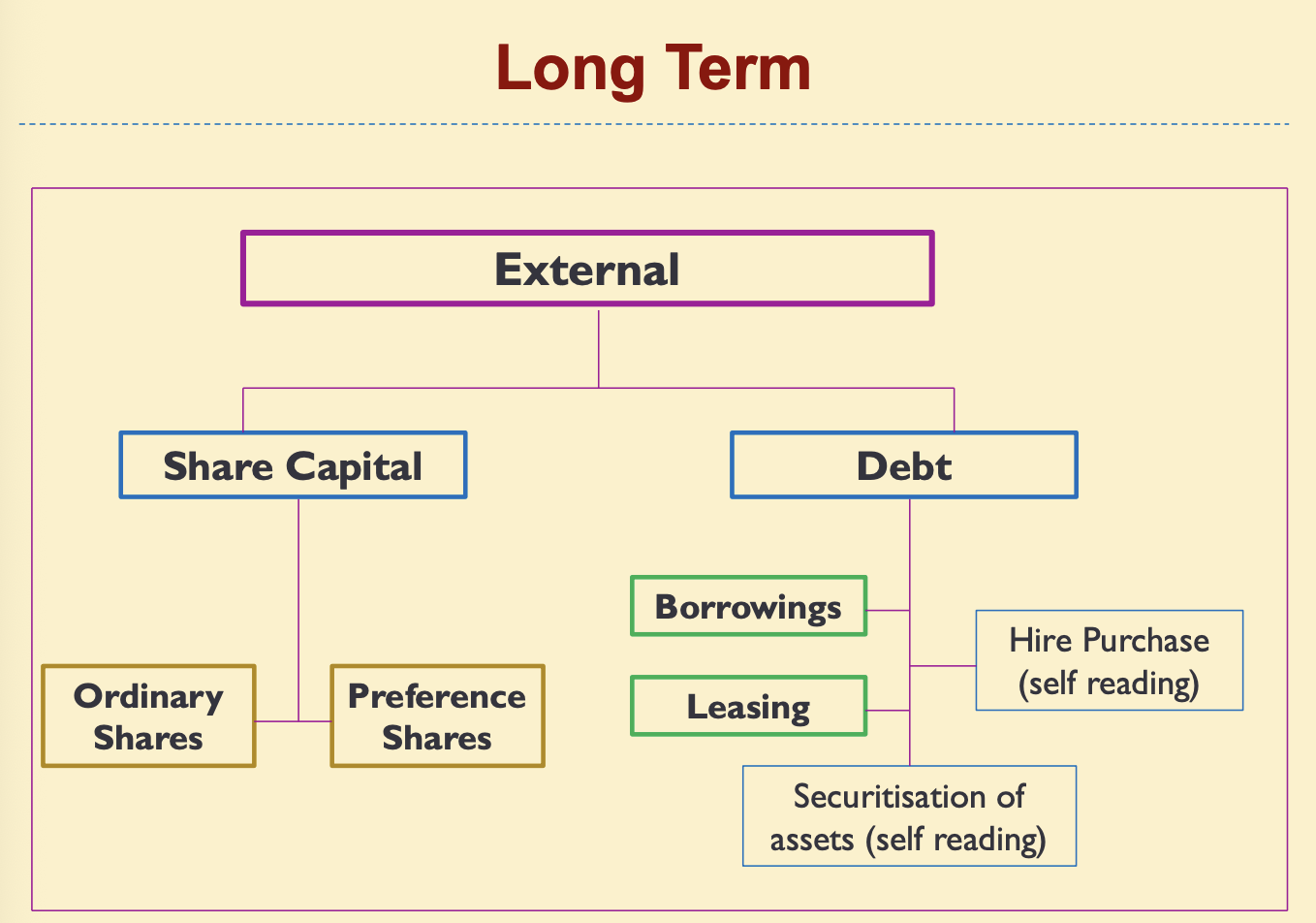
ordinary shares
preference shares
long term debt
leasing
What type of source of financing are retained profits?
Internal source of long term finance
What are the advantages of retained profits?
no additional costs
no annual interest cost
no obligations with outside parties —> other than shareholders
What are the disadvantages of retained profits?
Shareholders expect a return on their investment
Some investors rely on dividends as a main source of income
Decisions can negatively affect how the stock market views the company
What is Working capital management efficiencies?
how effectively a company manages its short-term assets and liabilities to keep operations running smoothly while minimising costs.
What are the efficiencies for working capital management?
tighter credit control
reducing inventory levels
delaying payment to trade payables
How do tighter credit controls improve working capital management efficiencies?
encourages receivables to pay earlier - less cash tied up
How does reducing inventory levels improve working capital management efficiencies?
less money tied up
How do delaying payment to trade payables improve working capital management efficiencies?
‘free’ credit
What is the diagram for long term external sources of finance?
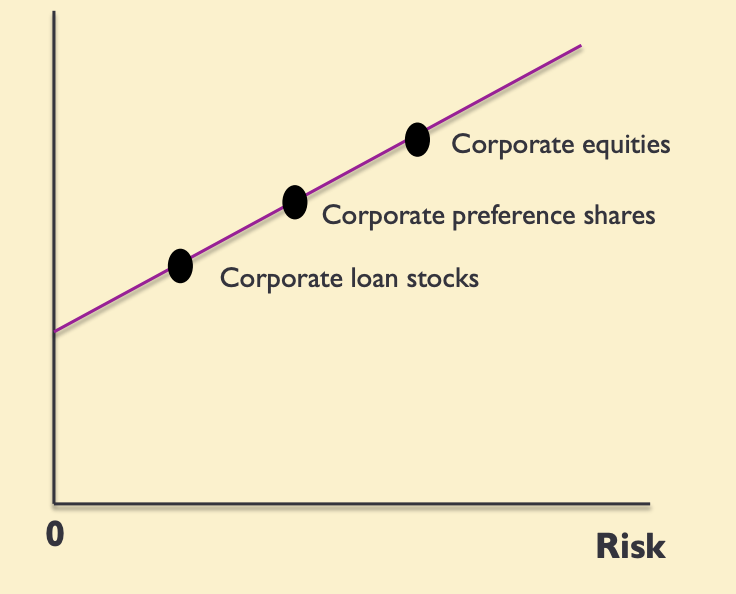
What do investors expect for riskand return in long-term finance?
High returns where higher risk is involved.
What does the graph for risk and return for long term finance look like?
What do ordinary shares represent?
equity share capital of the firm
Are shareholder returns guaranteed? and when do they get paid?
no - they are not guaranteed
They are the last to get paid
Who bears the greatest risk for owning shares?
ordinary shareholders
How does the cost of equity compare to the cost of debt for ordinary shares?
cost of equity > cost of debt
What are shareholder rights?
attend general meetings
vote
receive annual accounts and reports
receive a share of dividends paid
receive a share of assets
participate in new issues of shares
What can shareholders vote on?
appointing directors
appointing/removing auditors
important issues - repurchase of shares
What are the advantages of ordinary shares from the firms perspective?
no obligation to pay dividends
capital does not have to be repaid
What are the disadvantages of ordinary shares from the firms perspective?
higher cost
—> direct cost of issue
—> return required to satisfy shareholders
loss of control
dividends cannot be used to reduce taxable profits
What do preference shares offer?
their owners a fixed rate of dividend each year.
What happens to preference shares when the firm has insufficient funds?
the amount paid would be reduced, sometimes to zero
What is paid first the dividends on preference shares or ordinary shareholders?
Preference shares
Whats another name for preference shares? and what are their characteristics?
Hybrids - exhibit equity and debt
What are the advantages of preference shares from the firms perspective?
no need to pay dividends if profits poor
no dilution of ownership or control
unsecured, so preserve debt capacity
What are the disadvantages of preference shares from the firms perspective?
Higher cost compared to debt due to tax inefficiency
What are the special types of preference shares?
convertible
cumulative
redeemable
participating
What are convertible preference shares?
preference shares can be converted into ordinary shares at some future date
What are cumulative preference shares?
if a dividend is not paid, it will be carried forward for payment at some future date
What are redeemable preference shares?
Holders will eventually be repaid their capital, usually at par
What are participating preference shares?
In a good year, the director may decide to declare an extra dividend for these preference shareholders
What are examples of financial debts?
bank loans, debentures, other loans
What 3 ways are borrowings secured?
fixed (on specific property)
floating charge (all assets)
unsecured
How is the riskiness of a debt measured?
Rating agencies
Do lenders become owners of the company?
No
Must loan capital be repaid?
Yes, but it also can be convertible
Why don’t lenders benefit from a company’s extraordinary success?
Lenders receive fixed interest payments, so they generally do not share in the extra value created by a highly successful business.
What might lenders impose on the company? and what are they?
Loan covenants
obligations and restrictions such as terms and conditions, limits to dividend payment, liquidity criteria
What can lenders do if they do not receive interest or capital when due?
initiate insolvency proceedings
What are insolvency proceedings?
legal processes that take place when a person or company cannot pay their debts.
What do the tax authorities regard companies paying interest as?
a cost of doing business - can be used to reduce the taxable profit
What are examples of borrowings?
term loans
mortgages
loan notes / stocks / bonds
eurobonds
convertible bonds
What are finance leases?
Financial arrangements to acquire the right to use a particular asset for a specific purpose
When might finance leases occur?
Instead of buying a asset directly from a supplier business arranges for a bank to buy it and lease it to the business.
What is the lessor?
the bank that owns the asset
What is the lessee?
the business that leases the asset
Who has the ownership in the finance lease and who has the risks and rewards?
Ownership - lessor
risks and rewards - lessee
What are the advantages of leasing?
Ease of borrowing (compared to other sources)
Lower administration costs
flexibility
large outflows avoided
How do businesses raise finance?
selling assets to financial institutions and leasing it back
Are lease payments allowable for tax purposes?
Yes
What do businesses have when taking on long-term financing?
A pecking order
What is the businesses pecking order?
retained earnings used to finance the business
If retained earnings are inefficient, then loan capitals will be used
if loan capitals are inefficient, share capital is used
How do managers change new equity finance depending on shares?
High shares price = raise new equity finance
Low shares price = issue debts
What is asymmetrical information?
a situation where one party in a transaction has more or better information than the other.
Why might managers avoid issuing new shares when they believe their company is undervalued?
If managers know the company’s prospects are better than the market believes, shares will be undervalued. Issuing shares at this time would raise less capital than the company is worth, so managers prefer other sources of finance.
What is optimal capital structure?
best mix of debt and equity financing a company uses to maximise its value and minimise its cost of capital.
What are overdrafts?
Allow you to have a negative bank balance
What are the advantages of overdraft?
availability
flexibility
What are the disadvantages of overdraft?
higher interest rates than term loans
repayable on demand
limit of overdraft depending on credit worthiness
What are Bills of exchange (BoE)?
A written order from one person to another, requiring them to pay a set amount at a future date.

