Neo-behaviourism
 Studied by 0 people
 Call with Kai
 Learn
Learn Practice Test
 Spaced Repetition
 Match
Match Flashcards
 Knowt Play
1/16

There's no tags or description
Looks like no tags are added yet.
Name | Mastery | Learn | Test | Matching | Spaced | Call with Kai |
|---|
No study sessions yet.
17 Terms
Positivism
Positivism emphasised observable data and rejected metaphysics However, strict positivism limited theoretical explanation.
Logical positivism
Solved this problem by distinguishing between empirical observations and theoretical terms, allowing theory as long as it was logically defined and empirically testable.
Logical positivism divides science into two levels: Developed by the Vienna Circle (around 1924)
Empirical level
Observable events
Measurable data
Theoretical level
Concepts that explain observations
Must be: Logically defined and Indirectly testable
The problem positivism created
Pure positivism says:
“If you can’t observe it, don’t talk about it.”
But science needs theory to: explain behaviour and make predictions.
The problems psychology faced
Psychology wanted to use concepts like:
Drive
Learning
Anxiety
Intelligence
But these are: Abstract, Invisible, Mental
Operationalism
Operationism, introduced by Bridgman, required that all scientific concepts be defined in terms of the operations used to measure them. Operationism helped shape neobehaviourism by permitting theory while maintaining objectivity and empirical testability.
Neobehaviourism
Neobehaviorism emerged from the combination of behaviorism and logical positivism. Neobehaviorists allowed the use of theory provided it followed the rules of logical positivism.
Learning = the primary mechanism through which organisms adapt to their environments.
How does neobehaviorism differ from early behaviorism?
Watson (Behaviorism) | Neobehaviorism |
Rejected theory | Allowed theory |
Anti-mentalism | Used theoretical constructs |
Focused on Stimulus–Response | Allowed intervening variables |
Strict objectivism | Logical positivism |
Edward Chase Tolman
Edward Chase Tolman was a neobehaviorist, but unlike Watson or Hull, he believed that: Behavior is purposeful, organised, and guided by mental representations. He called his approach intentional behaviorism.
Tolman:
Learning ≠ association
Learning = acquisition of knowledge
Reinforcement affects performance, not learning itself
According to Tolman:
The organism is active, not passive
It forms: Expectations about outcomes and beliefs about the environment
Classical behaviorism
Learning = strengthening Stimulus–Response associations
Reinforcement is necessary for learning
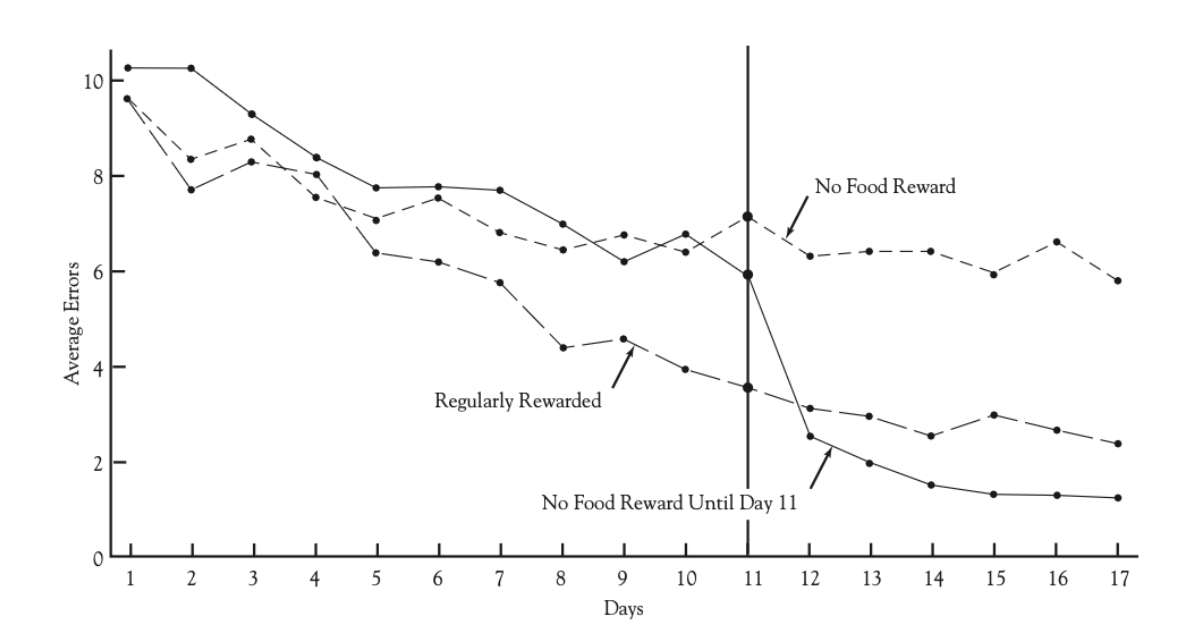
Tolman & Honzik (1930): Latent learning experiment
Rewarded group
Food at the end every day
Non-rewarded group
No food ever
Latent learning group
No food at first
Food introduced later (around day 11)
Results
Group 1: Gradual improvement
Group 2: Little improvement
Group 3: Sudden, dramatic improvement once food was introduced
Tolman concluded:
Rats learned the maze without reinforcement
Learning was latent (hidden)
Reinforcement only revealed what was already learned
This contradicted strict behaviorism.
Cognitive map experiment (maze with shortcuts)
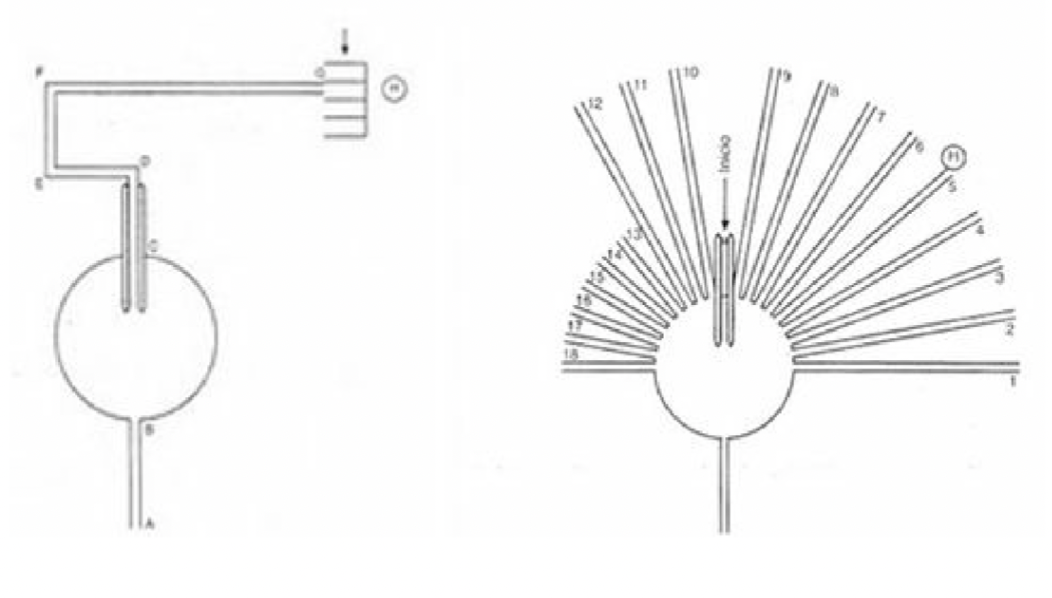
Rats learned a complex maze to reach food
Later, the usual path was blocked
Several new paths (shortcuts) were opened
Rats chose the path that:
Led most directly to the goal
Even if they had never used it before
Interpretation:
They formed a cognitive map of the maze
Behavior was guided by an internal spatial representation
Tolman – Intentional Behaviorism
Behavior is purposive & organized
Learning ≠ S–R associations
Active organism → expectations
Cognitive maps guide behavior
Latent learning → learning without reinforcement
Clark L. Hull: the drive theory
Drive theory (basic idea)
Hull believed that:
Organisms are motivated by biological needs
These needs create a drive (e.g., hunger, thirst)
Learning mechanism
Hull proposed the following sequence:
Stimulus → Drive → Response → Drive reduction → Reinforcement
Hull’s system was powerful but limited:
Could not explain:
Latent learning
Insight learning
Cognitive maps
Complex human behavior
Overly mechanistic
Reduced behavior to biological needs
Criticism of neo-behaviorism and transition to cognitive psychology
Excessive reductionism: complex phenomena were left behind.
Hypothetical constructs that are difficult to verify: cognitive maps and drives.
Theoretical rigidity: Hull’s models were too strict.
Partial successes: only effective in controlled contexts.
Behaviorism failed to explain cognition adequately.
Cognitive psychology:
Reintroduced the mind
Maintained scientific rigor
This marked a new paradigm in psychology.
Cognitive revolution (1950s–60s)
Chomsky (1959): language ≠ reinforcement
Miller (1956): memory limits (7 ± 2)
Simon & Newell: computational models
More Definitions
Latent learning - According to Tolman, learning that has occurred but is not translated into behavior.
Law of contiguity - Guthrie’s one law of learning, which states that when a pattern of stimuli is experienced along with a response, the two become associated. In 1959 Guthrie revised the law of contiguity to read, “What is being noticed becomes a signal for what is being done.”
Logical positivism - The philosophy of science according to which theoretical concepts are admissible if they are tied to the observable world through operational definitions.
Positivism - The belief that science should study only those objects or events that can be experienced directly. That is, all speculation about abstract entities should be avoided.
 Note
Note  Flashcards (22)