Chapter 10: Phylum Platyhelminthes
 Call Kai
 Learn
Learn Practice Test
 Spaced Repetition
 Match
Match Flashcards
 Knowt Play
1/75

There's no tags or description
Looks like no tags are added yet.
Name | Mastery | Learn | Test | Matching | Spaced | Call with Kai |
|---|
No analytics yet
Send a link to your students to track their progress
76 Terms
Phylogeny of platyzoa
tripblostic
spiral cleavage
mouth formed from blastopore
Phylum Platyhelminthes has what type of gut
Acoelomate
Phylum Platyhelminthes symmetry
bilateral
Phylum Platyhelminthes is _________ flattened
Dorsoventrally
Platyheminthes has a _______ cavity with one opening
gastrovascular
Platyhelminthes has a _____ Embryo
Triploblastic (ectoderm, mesoderm, endoderm)
Platyhelminthes does not have a ______ system
Hemal (blood)
Platyhelminthes does not have a circulatory system and relies on ______ for gas exchange
diffusion
Parenchyma
(mesoderm) composed of tissue filling
space between epidermis (ectoderm) and gastrovascular
cavity (endoderm)
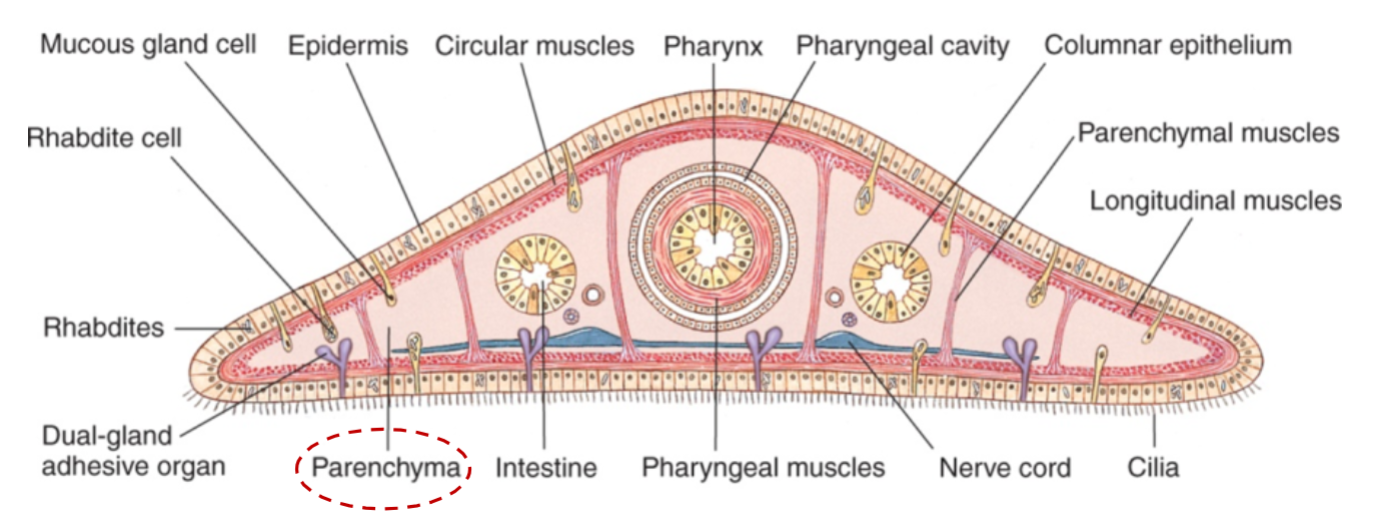
Platyhelminthes has ____ organ systems
true
nervous system is ______ shaped with large ________ at the head
ladder , cerebral ganglia
most have 2 major _______
nerve chords
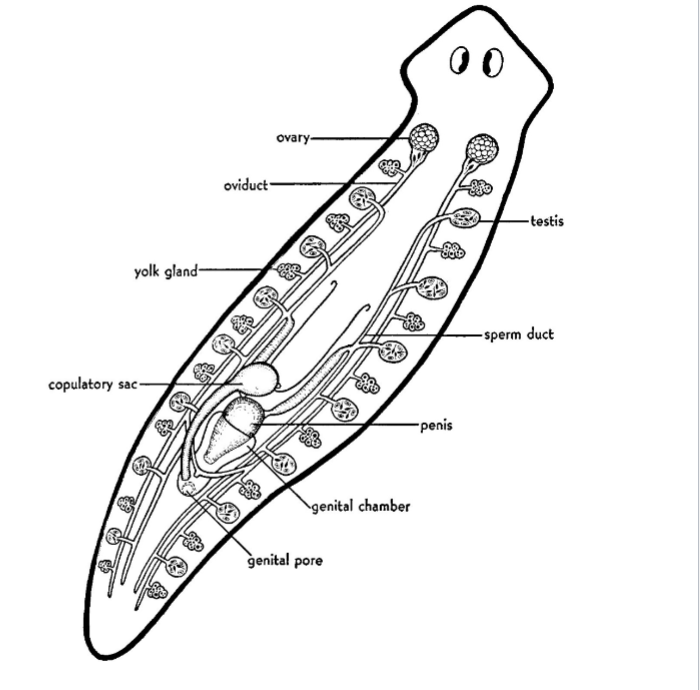
Reproductive systems are highly _____
developed
some species have high
fecundity ( produce lots of babies at once)
most species are ________ (have male and female parts)
hermaphroditic
no ________ proposed for phylum
synapomorphy
Four classes of flatworms:
Turbellaria (free living flat worm)
Cestoda (tape worm)
Trematoda (flukes)
Monogenea ( monogeneans)
Class Turbellaria
mostly marine, some freshwater
few terrestrial in damp areas
few are parasitic
benthic
5mm-50cm
Turbellaria Black spot disease
Ichthyophaga
Turbellaria feeding
most are predators or scavengers
eat protozoans, small molluscs, crustaceans, insects, other
worms
juvenile eat algae
Turbellaria digenstion
pharynx lead to Gastrovascular cavity
mouth position mid-ventral to anterior
pharyngeal glands
Protrusible and retractable pharynx
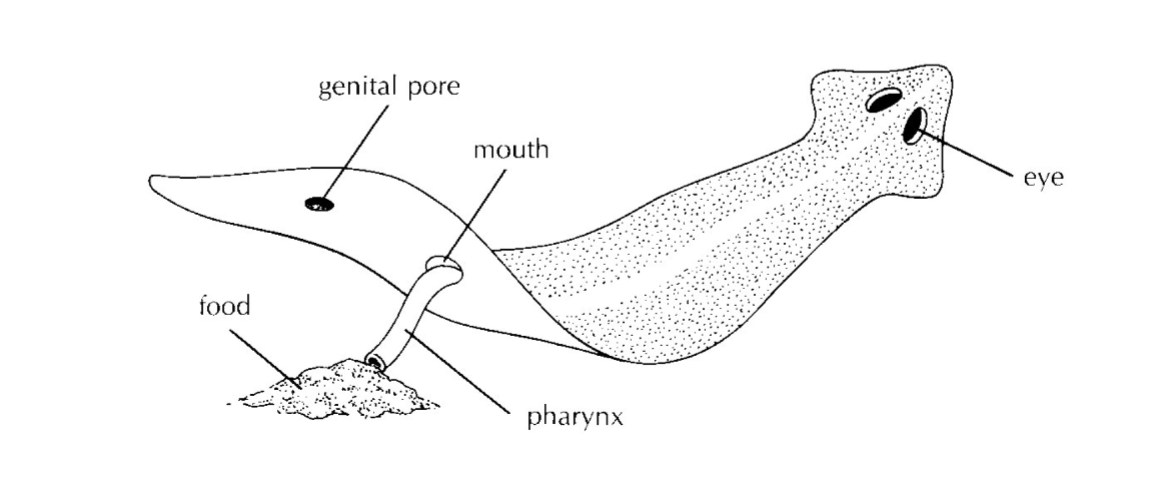
Pharyngeal glands produce
mucus and digestive enzymes
Turbellaria epidermis
ciliated cells (vental) (facilitate movement)
specialized secretory cells
Rhabdites
mucous gland cells
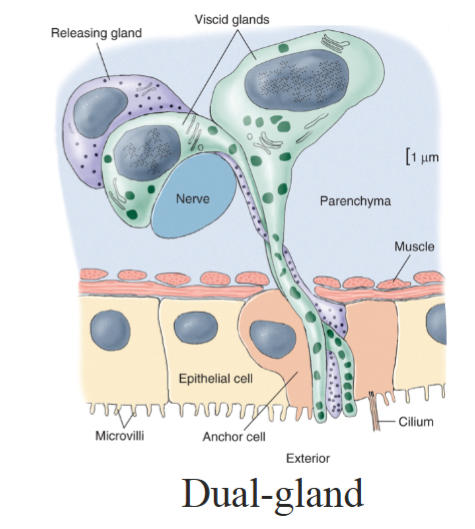
dual gland adhesive organs
Rhabdites
rod shaped vesicles inside epidermal cells
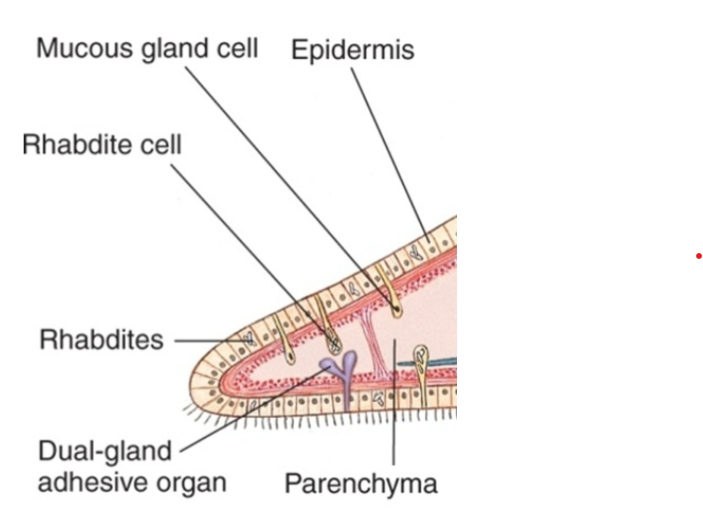
mucous gland cells
secrete mucous
dual gland adhesive organs
viscid glands
anchor cells
releasing gland
viscid gland
secrete adhesive (allows to anchor)
anchor cells
allows worm to attach
releasing gland
removes adhesive
Muscle
muscle- longitudinal and circular (allows for movement)
what is in between the dorsal and ventral muscle layers
parachymal tissue
Osmoregulation and excretion
Metabolic wastes voided by diffusion
Water and some ammonia removed via
osmoregulatory tubules
(protonephridia)
have beating flagella draw fluids into tubule
Flame cells
Turbellaria Sexual Reproduction
Monoecious with paired female and male reproductive tracts
Each reproductive tract has an independent
gonopore
Some species engage in
reciprocal sperm transfer
Turbellaria Other species engage in
traumatic insemination
traumatic insemination
One worms pierces body of the other with its
hypodermic penis (or penises)`
Parasitism is a type of
symbiotic relationship`
one host
direct lifestyle
more than one host (typically an invertebrate
and a vertebrate)
Indirect lifecycle
Host in which parasite undergoes
development, but not maturity
Intermediate host
Host in which parasite undergoes sexual
maturity
Definitive host
Classes Trematoda, Monogenea, Cestoda Integument
Syncytial integument
Syncytial integument
a multinucleated skin (cells not
fully enclosed by cell
membrane) lacking cilia and
rhabdites
This tegument unites
these classes in the
clade
Neodermata
(parasitic)
Class Trematoda: Subclass
Digenea
Class Trematoda morphology
anterior oral sucker for attatchment
acetabullum
Complex reproductive system
Two-branched gastrovascular cavity
acetabullum
ventral sucker
Complex reproductive system
- Single ovary
- Pair of testes
- Coiled uterus
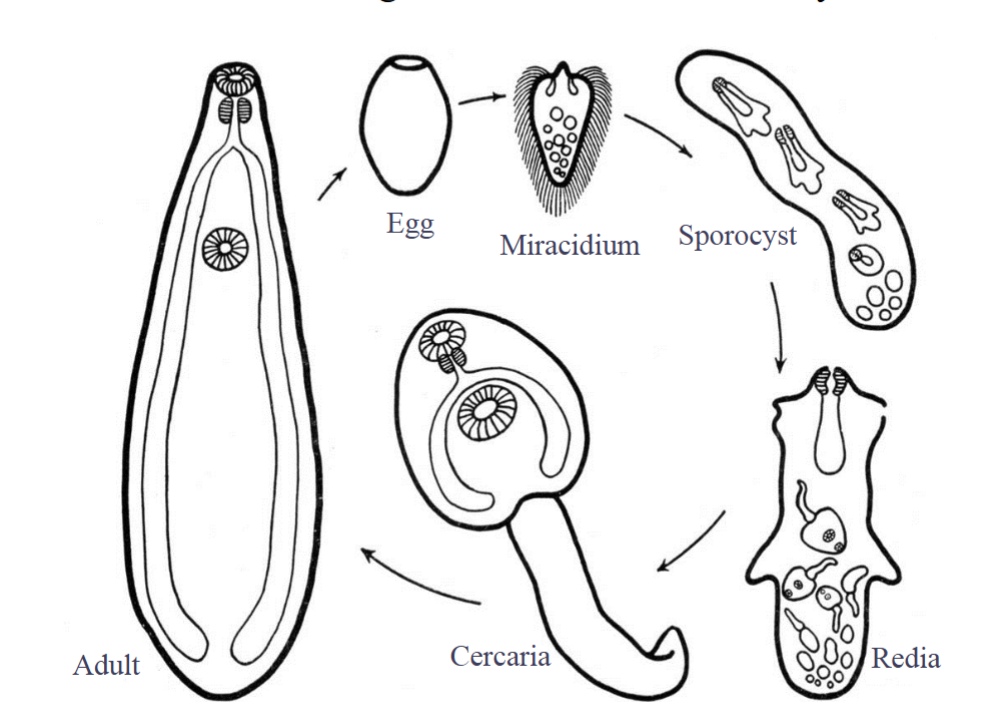
Subclass Digenea: Generalized Life Cycle
Egg- miracidium-sporocyst-redia-cercaria
Subclass Digenea: liver fluke,
Clonorchis sinensis
Chlonorchis sinensis lifecycle
infect snail, infect fish, then infect human
Disease associated with
Chlonorchis sinensis
Can cause inflammation,
abdominal pain, nausea, diarrhea
• Associated with cancer in
prolonged chronic infections
Subclass Digenea: Blood Flukes
• Schistosoma spp. Dioecious
Sexual dimorphism
Life Cycle of Schistosoma spp
snail- human
• Each egg has a spine, can cause
tissue damage
• Eggs in blood become lodged in liver
or other tissues
• Eggs can puncture intestinal wall
• Disease associated with immune
response to eggs and tissue damage
Schistosomiasis
Schistosomiasis
Dysentery, anemia, swollen liver
and spleen, dwarfism, brain damage
About 200 million people
infected in Africa,South
America, the West Indies, Middle
East, and Asia…77 countries
“swimmer’s itch”
Schistosome dermatitis
cercariae of a species whose
normal hosts are birds penetrate human skin
Class Monogenea
• Monogenetic
Mostly ectoparasitic, few endoparasitic spp
Infect aquatic animals, typically fish
monogenetic
one host, direct life cycle `
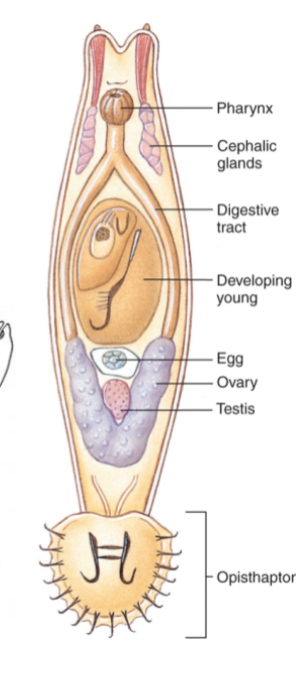
Monogenea posterior attachment organ, may
have suckers and or hooks
Opisthaptor
Class Cestoda General biology
Tapeworms have long, flat,
ribbon-like bodies
Most species have
at least two hosts:
- Intermediate host: invertebrate
- Definitive host: vertebrate
Class Cestoda Morphology
proglottids
Scolex
No mouth or digestive system
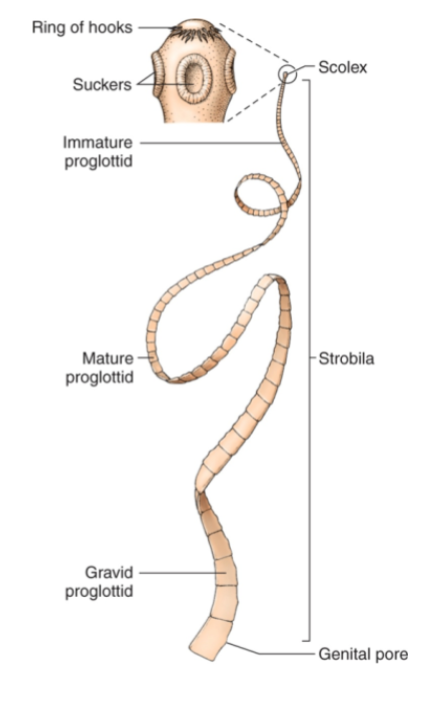
scolex
holdfast structure with suckers and hooks
proglottids
reproductive units
Cestoda Integument covered with
microtriches
microtriches
projections than
increase the surface area for
absorption
(nutrients absorbed by integument)
Cestoda Reproduction
• Posterior proglottids
break off when gravid
• Gravid proglottids, eggs
shed in the feces
Each proglottid produces
about 50,000 eggs
Beef Tapeworm
Taenia saginata
Taenia saginata Lifecycle
cows - humans
Beef tapeworms were
once marketed as a
weight-loss product
(most do not cause tissue damage)
Diseases associated with tapeworms
Pork tapeworm Taenia solium
-from eating under cooked pork
-can cause death and can infect the brain

