7.2 Classes Of Variables To Assess
 Call Kai
 Learn
Learn Practice Test
 Spaced Repetition
 Match
Match Flashcards
 Knowt Play
1/21

Earn XP
Description and Tags
Classes Of Variables To Assess
Name | Mastery | Learn | Test | Matching | Spaced | Call with Kai |
|---|
No analytics yet
Send a link to your students to track their progress
22 Terms
Classes Of Variables To Assess
Traits, dimensions or factors (e.g. personality traits)
States (e.g. anxiety)
Behavioral repertoires (e.g. social skills)
Cognitive repertoires (e.g. attributional style)
Ideographic constructions (e.g. autobiography, meaning)
TRAITS, DIMENSIONS OR FACTORS
Personality tests
Characteristics
Personality tests
Standardized self-report
Normed scores
They measure one or more constructs, dimensions, factors
Characteristics
Behavior as a sign of an underlying attribute
Indirect measure of an attribute
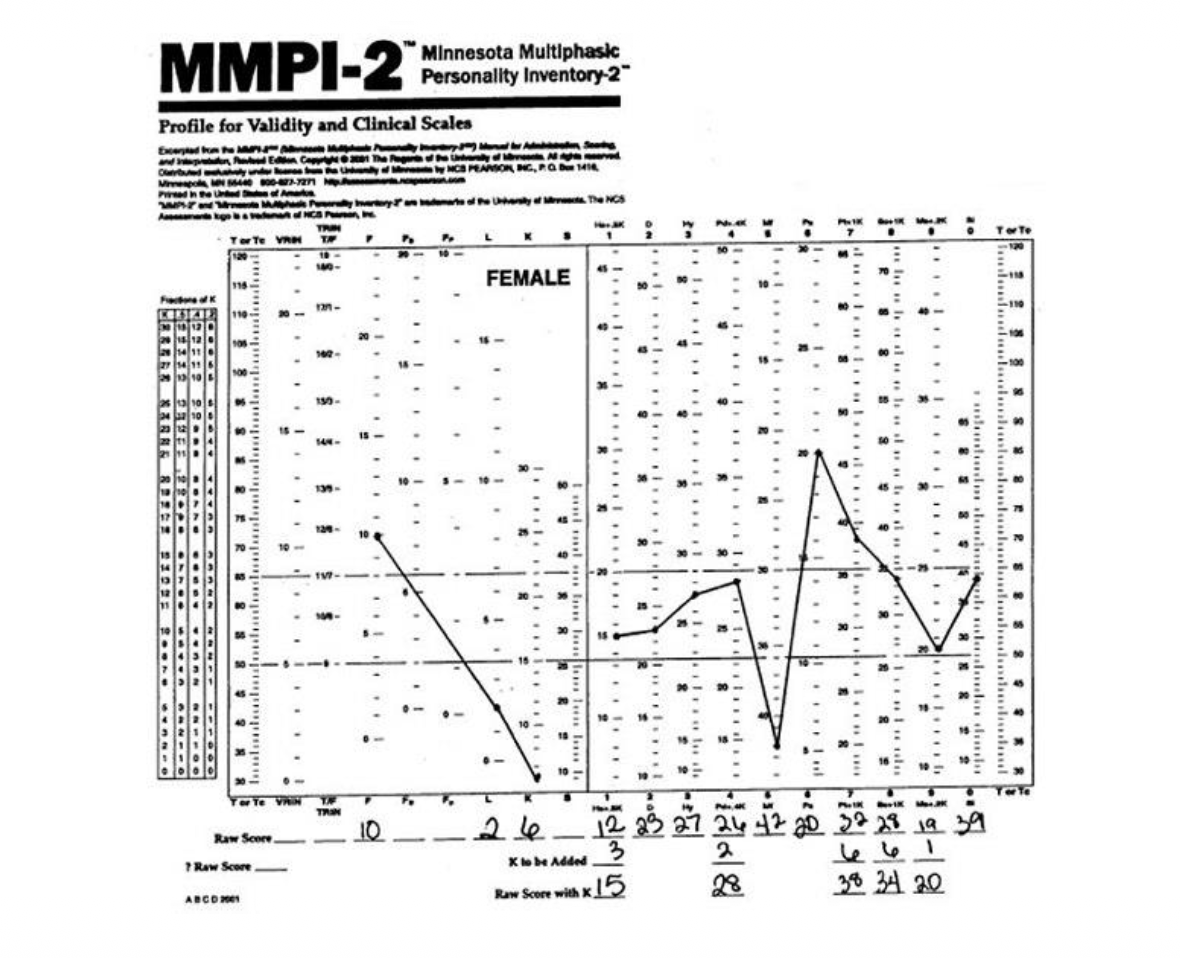
MMPI is applied in
Minnesota Multiphasic Personality Inventory
MMPI-2 scales
not highly accurate, but help describe personality & behaviour
should be interpreted alongside other scales
proper use → training & clinical experience
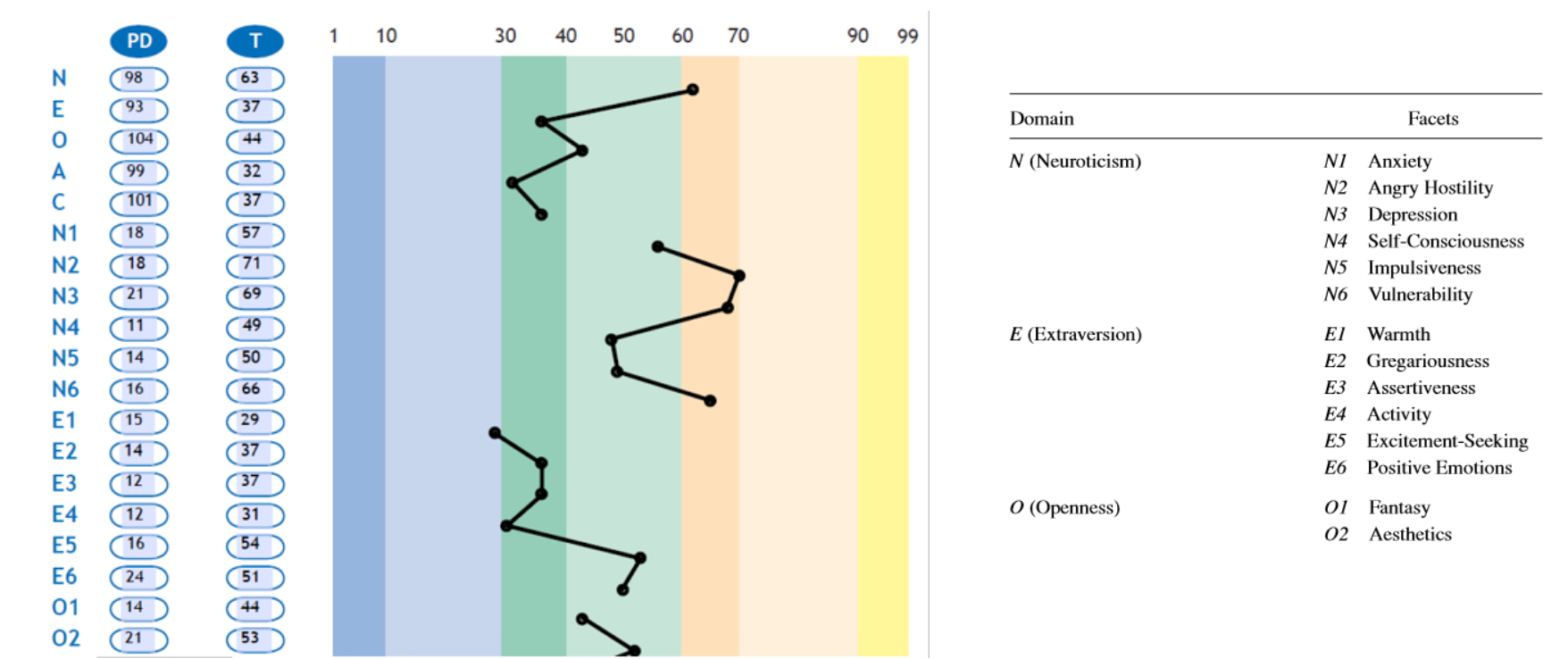
NEO PI-R
Measure five broad personality domains in adults → provide personality description
Three core domains (NEO)
Two additional domains (AC)
Two additional domains (AC)
Agreeableness (A)
Conscientiousness (C)
Three core domains (NEO)
Neuroticism (N)
Extraversion (E)
Openness to Experience (O)
The NEO PI-R, based on the
Five Factor Model (FFM) → systematically assesses personality traits for professional use
NEO PI-R Administration/Scoring
The NEO PI-R is self-administered with two parallel versions (240 items + 3 validity items)
Form S (self-reports) is for adults, including college-aged individuals
Form R (observer reports) is for ratings by peers, spouses, or experts
Takes 30-40 minutes to complete (ages 17-89)
Uses a 5-point rating scale and includes three profile forms for scoring
Internal consistency: .86–.95 for domains, .56–.90 for facets
Validated against other personality measures and projective techniques
Can be scored/administered electronically via the NEO Software System
Big Five Inventory-10 (BFI-10)
consists of 44 short phrases → duration: 5 minutes
10-item version is available, but not recommended
States (e.g. anxiety)
Dependent on the present stimuli or situation (STAI, ISRA)
Characteristics of STATES
Behavior as a sign of the specific state/situation
Measures a specific dimension: anxiety, dependency, hostility
The situations to which it refers have been selected theoretically or ideographically
Useful for predicting behaviors
State-Trait Anxiety Inventory (STAI)
helps distinguish anxiety from depression
applied in clinical & research settings
40 item (20 traits/20 state) → 4-point scale
Higher score = greater anxiety
Suitable for individuals with a sixth-grade reading level
strong evidence: validity & reliability
BEHAVIORAL REPERTOIRES
Verbal reports reflecting behavior, not internal psychological constructs
Mainly used in clinical settings (e.g., FSS-III Fear Scale, Pleasant Events Scale) to assess disorders like fears, depression, and obsessions
Focus on physiological, motor, & cognitive behaviors based on their frequency in specific disorders
Used as indicators of problematic behavior, not as signs of internal traits
These behaviors are situation-specific
COGNITIVE REPERTOIRES
Cognitive processes mediate motor behavior & physiological responses
Cognitive-behavioral approach explains patterns
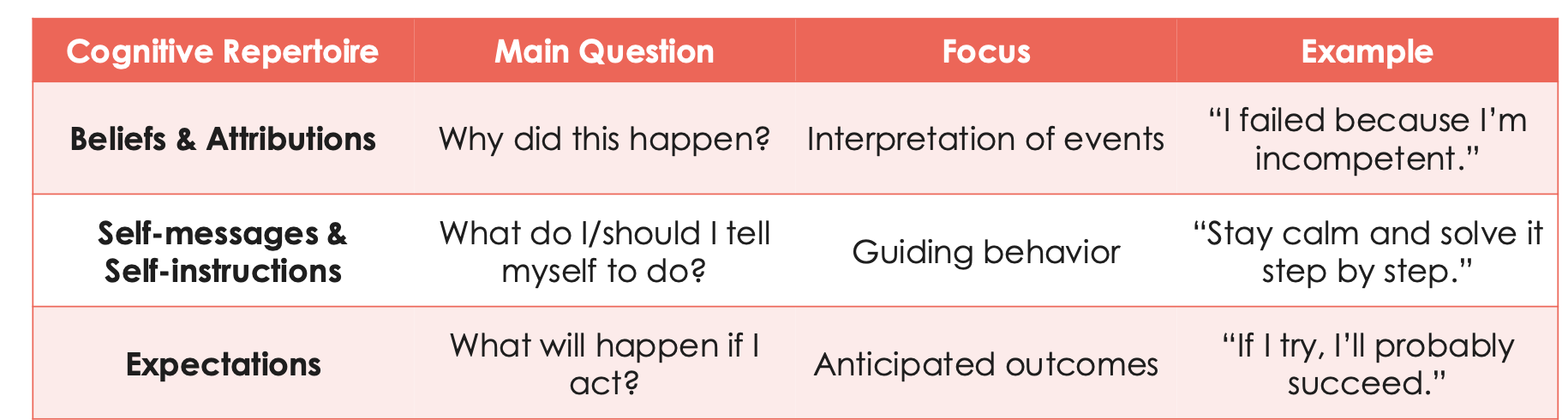
Three types of cognitive-behavior repertoires:
Beliefs & Attributions → shape perception
Self-messages & Self-instructions → internal thoughts
Expectations → Relate to behaviour outcomes & motivation
What are cognitive repertoires in psychological assessment?
Cognitive repertoires refer to thoughts and beliefs revealed through self-reports, which indicate a person's cognitive behavior & underlying cognitive structures.
When are cognitive repertoires especially useful in psychological assessment?
The problem is cognitive (e.g., irrational thoughts).
Cognitive factors influence motor or physiological disorders.
It is necessary to control cognitive variables or skills during treatment (e.g., expectations about therapy).
IDEOGRAPHIC CONSTRUCTIONS
of the subject & NOT constructions elaborated by the psychologist
Characteristics of IDEOGRAPHIC CONSTRUCTIONS
From very qualitative (diaries) to quantitative (lists of adjectives)
From highly structured (list of adjectives) to unstructured (interview)

