Immunology MICI 3115- Final/ Unit 2

0.0(0)
studied byStudied by 0 people
0.0(0)
full-widthCall Kai
learnLearn
examPractice Test
spaced repetitionSpaced Repetition
heart puzzleMatch
flashcardsFlashcards
GameKnowt Play
Card Sorting

1/259

encourage image

There's no tags or description

Looks like no tags are added yet.

Study Analytics
Name
Mastery
Learn
Test
Matching
Spaced

No study sessions yet.

260 Terms

1
New cards

What are the features of antibody structure?

  1. polypeptides – combination of 2 heavy chains and 2 light chains linked together

  2. Variable regions – recognize antigens

  3. Heavy chain constant region – determines function of the antibody

  4. Different classes of immunoglobulin (antibodies) are expressed depending on activation and development of the B cell
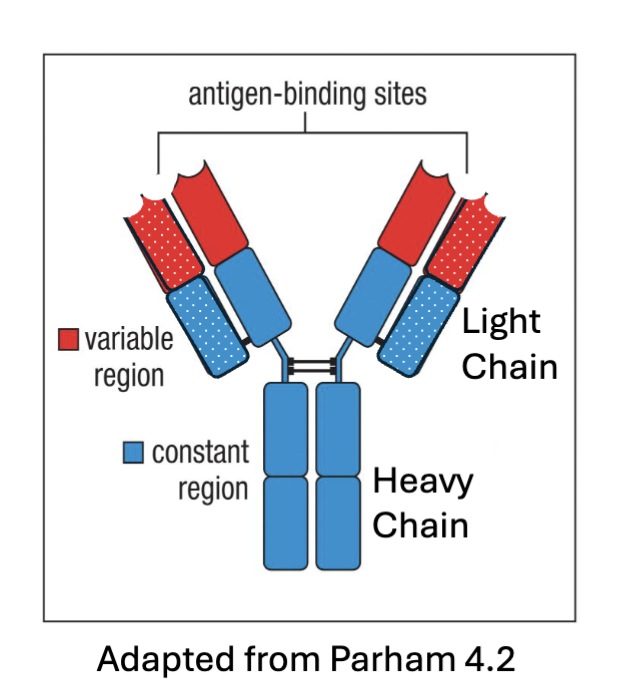
<ol><li><p><span>polypeptides – combination of 2 </span><strong><span>heavy</span></strong><span> chains and 2 </span><strong><span>light</span></strong><span> chains linked together</span></p></li><li><p><strong><span>Variable</span></strong><span> regions – recognize antigens</span></p></li><li><p><span>Heavy chain </span><strong><span>constant</span></strong><span> region – determines function of the antibody</span></p></li><li><p><span>Different classes of immunoglobulin (antibodies) are expressed depending on activation and development of the B cell</span></p></li></ol><p></p>
2
New cards

How do we get recognition of different antigens? (What are the two theories? Which is correct?)

A1:Germ line theory

A2: Rearrangement of germline gene segments (somatic recombination) during B cell development -Correct

3
New cards

What are the features of Germ line theroy?

genetic info for each immunoglobulin encoded directly in genome

→wrong bc: Genome doesn’t contain enough DNA for this

4
New cards

What are the features of Rearrangement of germline gene segments (somatic
recombination) during B cell development (historically speaking/ it’s discovery)?

1965: Theory proposed by Dreyer and Bennett

1976: Tonegawa and Hozumi demonstrate that separate gene segments encode the V and C regions of immunoglobulins

Individual B cells had different sequences at the BCR locus and mature B cells were often missing parts of the constant locus

1987: Tonegawa won the Nobel Prize 

(rearrangement: increase specificity w/out enormous genome)
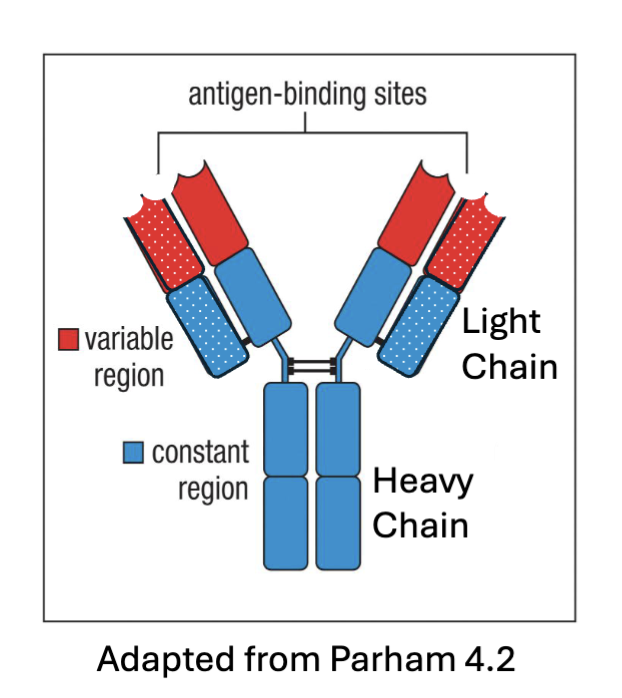
<p><span><span>1965: Theory proposed by Dreyer and Bennett</span></span></p><p><span><span>1976: Tonegawa and Hozumi demonstrate that separate gene segments encode the V and C regions of immunoglobulins</span></span></p><p><span><span>Individual B cells had different sequences at the BCR locus and mature B cells were often missing parts of the constant locus</span></span></p><p>1987: Tonegawa won the Nobel Prize&nbsp;</p><p>(rearrangement: increase specificity w/out enormous genome)</p>
5
New cards

What are the features of rearrangement of germline gene segments?

Immunoglobulins are generated from 3 gene loci: heavy chain (Ch 14), with 𝛋 light chain (Ch 2) or 𝜆 light chain (Ch 22) 

Undergo rearrangement of germline gene segments (somatic recombination) during B cell development

Recombination of Variable (V), Diversity (D), and Joining (J) segments → variable regions with different specificity 

6
New cards

How does rearrangement of germline gene segments work? (process)

  • Recombination is mediated by the Recombination Activating Gene (Rag1/Rag2) complex  (Rag1/2 forms dimer)

  • Recognize recombination signal sequences (RSS) flanking the gene segments – bind conserved Nonamer (N) and Heptamer (H) sequences (Rag1 recognizes certain sequences downstream of gene sequences that have RSSs (have few diff. domain, N and H activate: conformational change)

  • Endonuclease activity cleaves at RSS and DNA repair enzymes join the DNA ends (Rag1 has endonuclease activity)

  • Excised DNA material is lost from the cell ... no going back

  • Rag mutations → severe combined immunodeficiency (SCID) or Omenn syndrome (hypomorphic RAG)

(large chunk of DNA is cut out (thrown out- at single cell level) happens w/in individual B cells)

<ul><li><p><span>Recombination is mediated by&nbsp;the </span><strong><span>Recombination Activating&nbsp;Gene (Rag1/Rag2</span></strong><span>) complex&nbsp;&nbsp;</span>(Rag1/2 forms dimer)</p></li><li><p><span>Recognize recombination signal&nbsp;sequences (</span><strong><span>RSS</span></strong><span>) flanking the&nbsp;gene segments – bind&nbsp;conserved Nonamer (</span><strong><span>N</span></strong><span>) and&nbsp;Heptamer (</span><strong><span>H</span></strong><span>) sequences&nbsp;</span>(Rag1 recognizes certain sequences downstream of gene sequences that have RSSs (have few diff. domain, N and H activate: conformational change)</p></li><li><p><span>Endonuclease activity cleaves at RSS and DNA repair enzymes&nbsp;join the DNA ends&nbsp;</span>(Rag1 has endonuclease activity)</p></li><li><p><span>Excised DNA material is lost&nbsp;from the cell ... no going back</span></p></li><li><p><span>Rag mutations → severe combined immunodeficiency (SCID) or Omenn syndrome (hypomorphic RAG)</span></p></li></ul><p>(large chunk of DNA is cut out (thrown out- at single cell level) happens w/in individual B cells)</p>
7
New cards

What makes sure you rearrange the right segments?

  • Recombination signal sequences (RSS) flanking the gene segments have different spacer sequences between the N and H sequences – 12 or 23 base pairs (12/23 rule)

  • Recombination only occurs between segments that have different spacers

  • Cannot recombine with genes lacking an RSS

(this is how the regulation of the junctions is done)

Spacer: between N and H there is a spacer sequence (12 or 23bp) added into gene segment and can rearrange between signal sequences that are different need a 12 and 23

23’s can’t join together

if gene segment lacks spacer can’t recombine
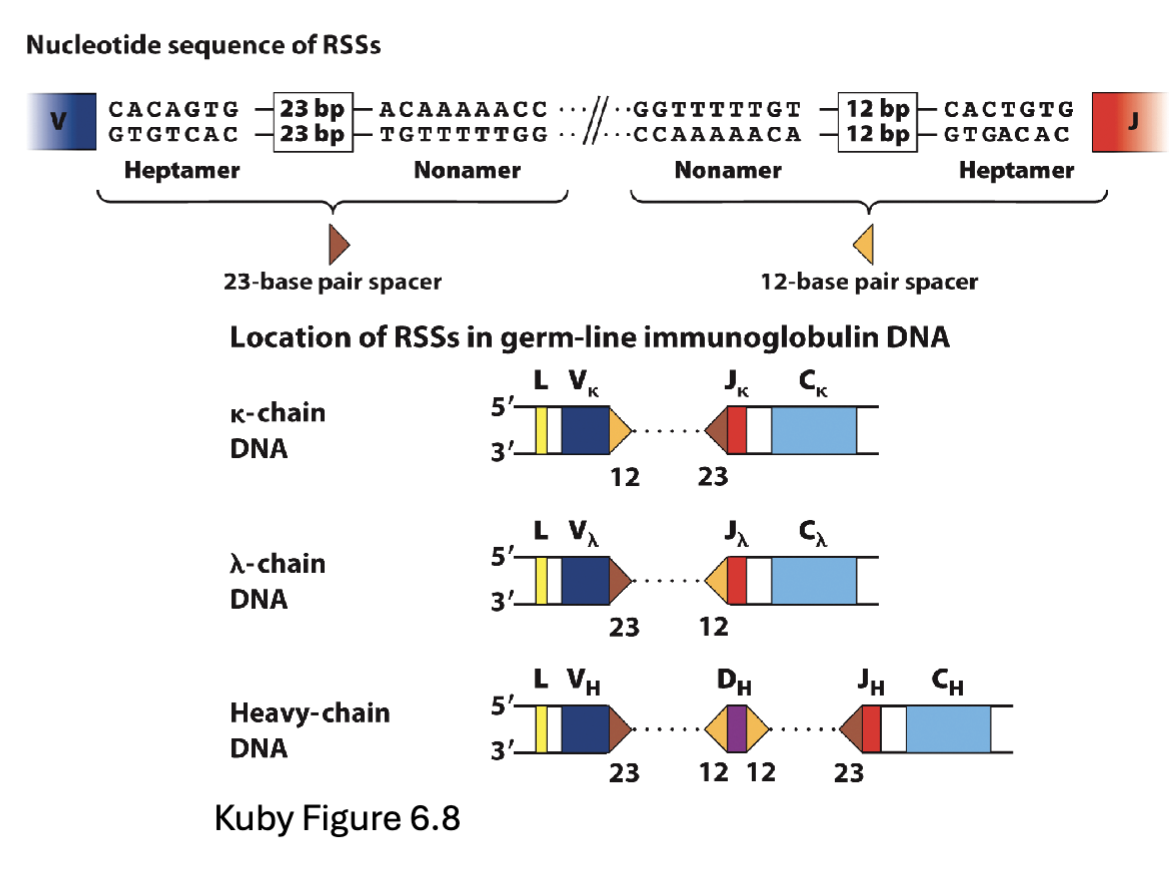
<ul><li><p><span>Recombination signal sequences (</span><strong><span>RSS</span></strong><span>) flanking the gene segments have different </span><strong><span>spacer</span></strong><span> sequences between the N and H sequences – 12 or 23 base pairs (</span><strong><span>12/23 rule)</span></strong></p></li><li><p><span>Recombination only occurs between segments that have different spacers</span></p></li><li><p><span>Cannot recombine with genes lacking an RSS</span></p></li></ul><p>(this is how the regulation of the junctions is done)</p><p>Spacer: between N and H there is a spacer sequence (12 or 23bp) added into gene segment and can rearrange between signal sequences that are different need a 12 and 23</p><p>23’s can’t join together</p><p>if gene segment lacks spacer can’t recombine</p>
8
New cards

What is combinatorial diversity?

shuffling use of V, D, and J gene segments generates different variable regions

(190 k-chains + 165 𝝀-chains) X 6348 H-chains = ~2.25 Million combinations from 156 gene segments

(don’t need to know the numbers just know which has most and know more V > D, J)
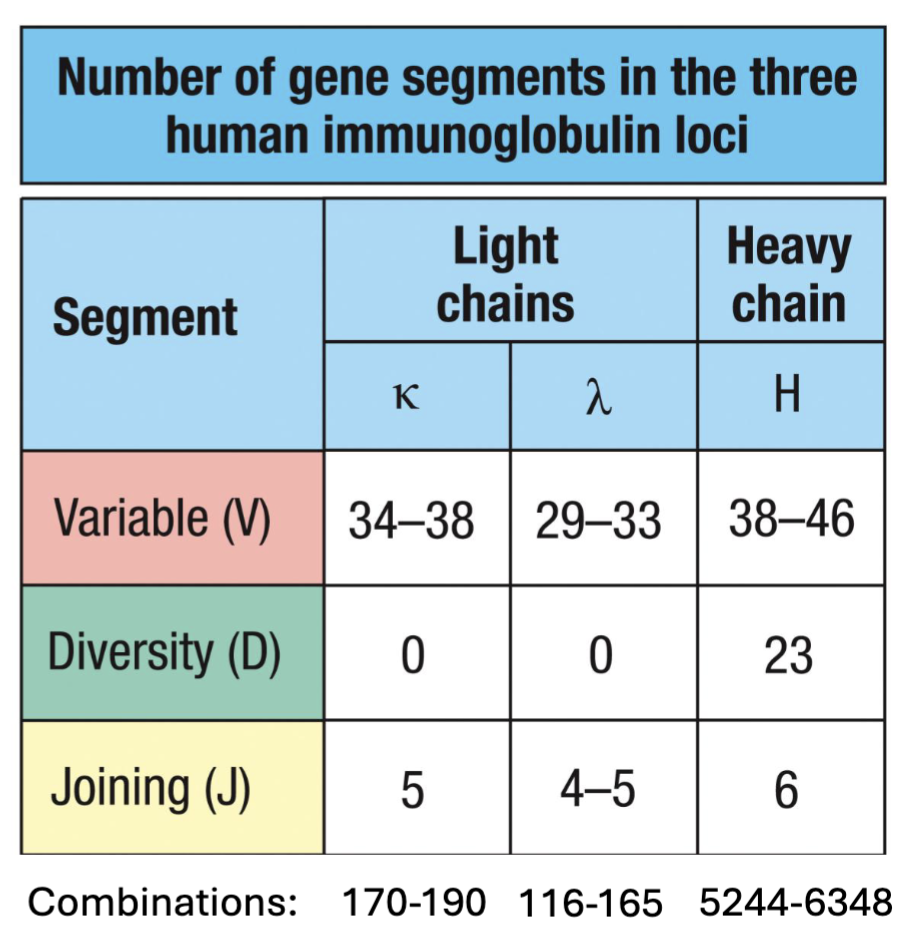
<p><span><span>shuffling use of V, D, and J gene segments generates different variable regions</span></span></p><p><span><span>(190 k-chains + 165 𝝀-chains) X 6348 H-chains = ~2.25 Million combinations from 156 gene segments</span></span></p><p></p><p><span><span>(</span></span>don’t need to know the numbers just know which has most and know more V &gt; D, J)</p>
9
New cards

Immunoglobulin repertoire is generated by ____&____?

combinatorial diversity & junctional diversity 

10
New cards

What is junctional diversity?

Immunoglobulin diversity is further increased by the DNA repair process during recombination:

  • Excision (by Rag) forms DNA hairpin loops → unfolding adds palindromic sequences (P-nucleotides)

    • Mediated by Artemis (endonuclease)

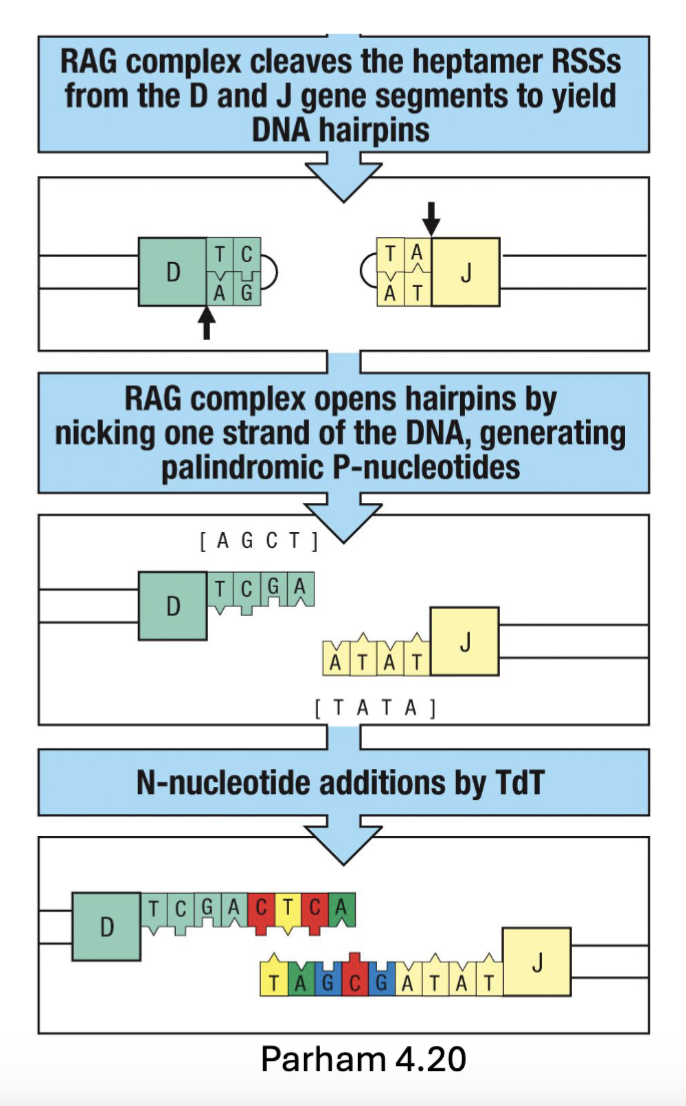
  • Terminal deoxynucleotidyl transferase (TdT) adds random non-templated nucleotides (N-nucleotides)

  • Nonhomologous end joining (NHEJ) ligates DNA ends

  • Increases repertoire diversity by factor of 3 X 10⁷ → Total diversity ~ 5 X 10¹³ (increase diversity adding more sequence)

(DNA repair enzymes cleave the hairpin and create a nick, cleaved 2bp in (hairpin opens up= 2 extra a.a that weren’t there before))
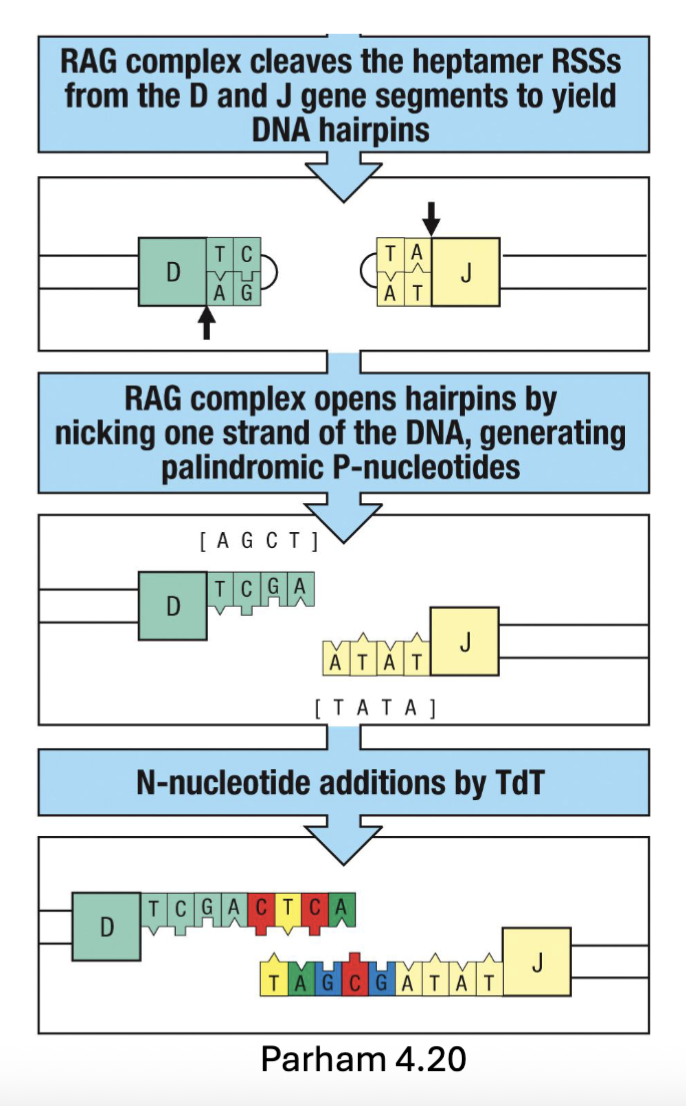
<p><span>Immunoglobulin diversity is further increased by the DNA repair process during recombination:</span></p><ul><li><p><span>Excision (by Rag) forms DNA hairpin loops → unfolding adds </span><strong><u><span>p</span></u></strong><span>alindromic sequences (</span><strong><u><span>P</span></u><span>-nucleotides</span></strong><span>)</span></p><ul><li><p><span>Mediated by </span><strong><span>Artemis</span></strong><span> (endonuclease)</span></p></li></ul></li><li><p><span><span>Terminal deoxynucleotidyl transferase (</span><strong><span>TdT</span></strong><span>) adds random </span><strong><u><span>n</span></u></strong><span>on-templated nucleotides (</span><strong><u><span>N</span></u><span>-nucleotides</span></strong><span>)</span></span></p></li><li><p><span><span>Nonhomologous end joining (</span><strong><span>NHEJ</span></strong><span>) ligates DNA ends</span></span></p></li><li><p><span><span>Increases repertoire diversity by factor of 3 X 10</span><sup><span>7</span></sup><span> → Total diversity ~ 5 X 10</span><sup><span>13 </span></sup><span>(</span></span>increase diversity adding more sequence)</p></li></ul><p>(DNA repair enzymes cleave the hairpin and create a nick, cleaved 2bp in (hairpin opens up= 2 extra a.a that weren’t there before))</p>
11
New cards

What do non-template nucleotides do?

randomly adds nucleotides into cut space, then anneals and refills, sequence that is repaired and has extra nucleotides (increase diversity)
<p>randomly adds nucleotides into cut space, then anneals and refills, sequence that is repaired and has extra nucleotides (increase diversity)</p>
12
New cards

What is the finished product of Immunoglobulin gene recombination? What happens next?

  • Heavy chain recombines D-J segments before recombination with V segment

  • Each B cell only rearranges one heavy and one light chain → generates one
    specificity (allelic exclusion)

  • Recombination brings promotors and enhancers close → transcription

  • Unstimulated B cells are ready to express B cell receptors (BCR)

(when the rearrangement happens have allelic exclusion, brings everything closer and can induce transcription)

<ul><li><p><span><span>Heavy chain recombines D-J segments before recombination with V segment</span></span></p></li><li><p><span><span>Each B cell only rearranges one heavy and one light chain → generates one</span></span><br><span><span>specificity (</span><strong><span>allelic exclusion</span></strong><span>)</span></span></p></li><li><p><span><span>Recombination brings </span><strong><span>promotors and enhancers</span></strong><span> close → transcription</span></span></p></li><li><p><span><span>Unstimulated B cells are ready to express B cell receptors (</span><strong><span>BCR</span></strong><span>)</span></span></p></li></ul><p>(when the rearrangement happens have allelic exclusion, brings everything closer and can induce transcription)</p>
13
New cards

What are the features of B cell expression?

  • Cμ (mu) and Cδ (delta) are available downstream of rearranged VDJ segments

  • mRNA splicing generates transmembrane forms of IgM > IgD (common on immature B cells)

    • hypdrophobic C-terminal → membrane interaction in ER

  • IgM/IgD need to associate with Ig⍺ (CD79a) and Igβ (CD79b) for transport to the cell surface

  • Ig⍺ and Igβ are important for BCR signaling (bring it to receptor)

(downstream of VDJ is the constant region, happening at splicing level not genomic can’t signal on its own need Igalpha and beta to mediate)

<ul><li><p>Cμ (mu) and Cδ (delta) are available downstream of rearranged VDJ segments</p></li><li><p><span>mRNA splicing generates </span><strong><span>transmembrane</span></strong><span> forms of </span><strong><span>IgM &gt; IgD </span></strong><span>(common on immature B cells)</span></p><ul><li><p><span>hypdrophobic C-terminal → membrane interaction in ER</span></p></li></ul></li><li><p><span>IgM/IgD need to associate with </span><strong><span>Ig⍺</span></strong><span> (CD79a) and</span><strong><span> Igβ</span></strong><span> (CD79b) for transport to the cell surface</span></p></li><li><p><span>Ig⍺ and Igβ are important for BCR signaling (bring it to receptor)</span></p></li></ul><p>(downstream of VDJ is the constant region, happening at splicing level not genomic can’t signal on its own need Igalpha and beta to mediate)</p>
14
New cards

What are the features of B cell receptor signalling? 

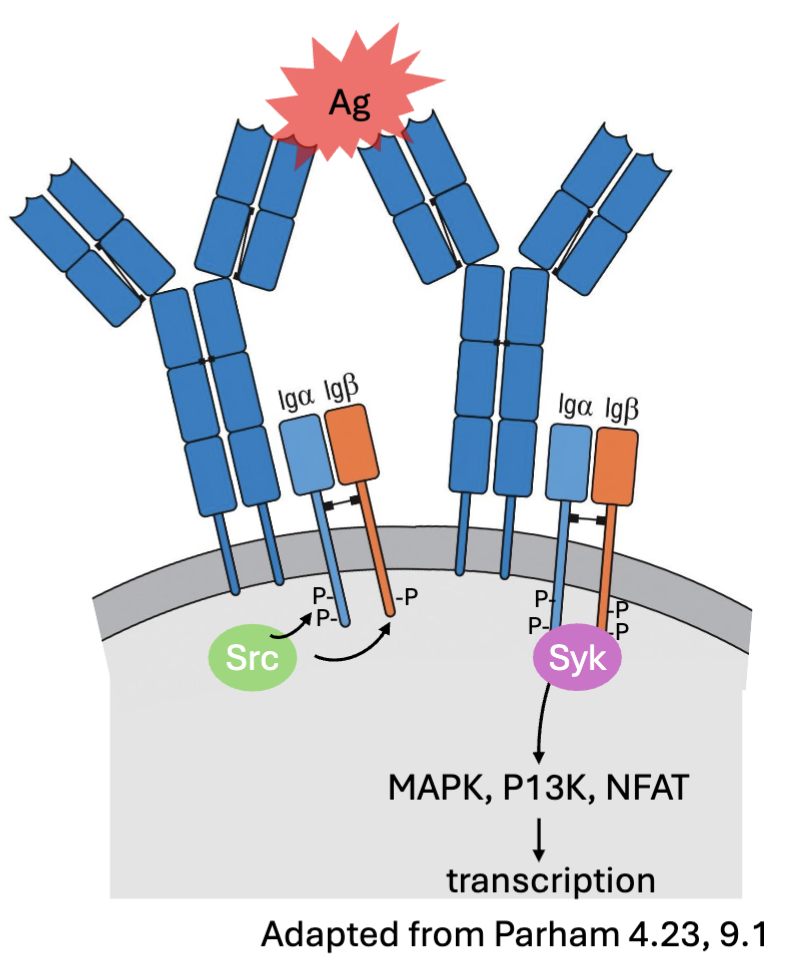
  • Antigen binding → IgM/IgD clustering

  • Phosphorylation of ITAMs in Ig⍺ (CD79a) and Igβ by Src kinases (Blk, Fyn, Lyn) →

  • Recruitment of kinase Syk → downstream signaling (MAPK, P13K, NFAT) →transcription activation → survival, proliferation, differentiation

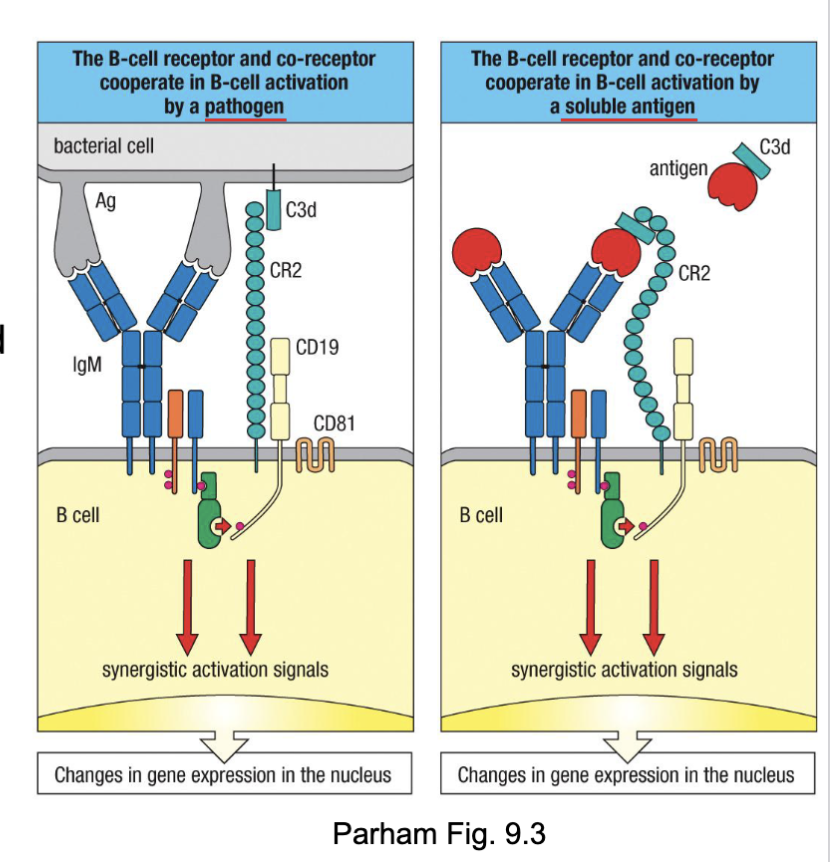
  • Outcome influenced by strength and duration of binding (affinity), co-stimulatory interactions (CD19:CD81,CD21/ CR2), and T cell help 

(can crosslink the antigen, when cluster→activation, recruitment of certain kinases,  binds strongly= longer signalling, costimulatory signals: other molecules)
<ul><li><p><span><span>Antigen binding → IgM/IgD </span><strong><span>clustering</span></strong><span> →</span></span></p></li><li><p><span><span>Phosphorylation of </span><strong><span>ITAMs</span></strong><span> in Ig⍺ (CD79a) and Igβ by </span><strong><span>Src kinases </span></strong><span>(Blk, Fyn, Lyn) →</span></span></p></li><li><p><span><span>Recruitment of kinase </span><strong><span>Syk</span></strong><span> → downstream signaling (</span><strong><span>MAPK, P13K, NFAT</span></strong><span>) →transcription activation → survival, proliferation, differentiation</span></span></p></li><li><p><span><span>Outcome influenced by strength and duration of binding (affinity), co-stimulatory interactions (</span><strong><span>CD19</span></strong><span>:CD81,CD21/ </span><strong><span>CR2</span></strong><span>), and T cell help&nbsp;</span></span></p></li></ul><p>(can crosslink the antigen, when cluster→activation, recruitment of certain kinases,&nbsp; binds strongly= longer signalling, costimulatory signals: other molecules)</p>
15
New cards

What is the difference between a BCR and an antibody?

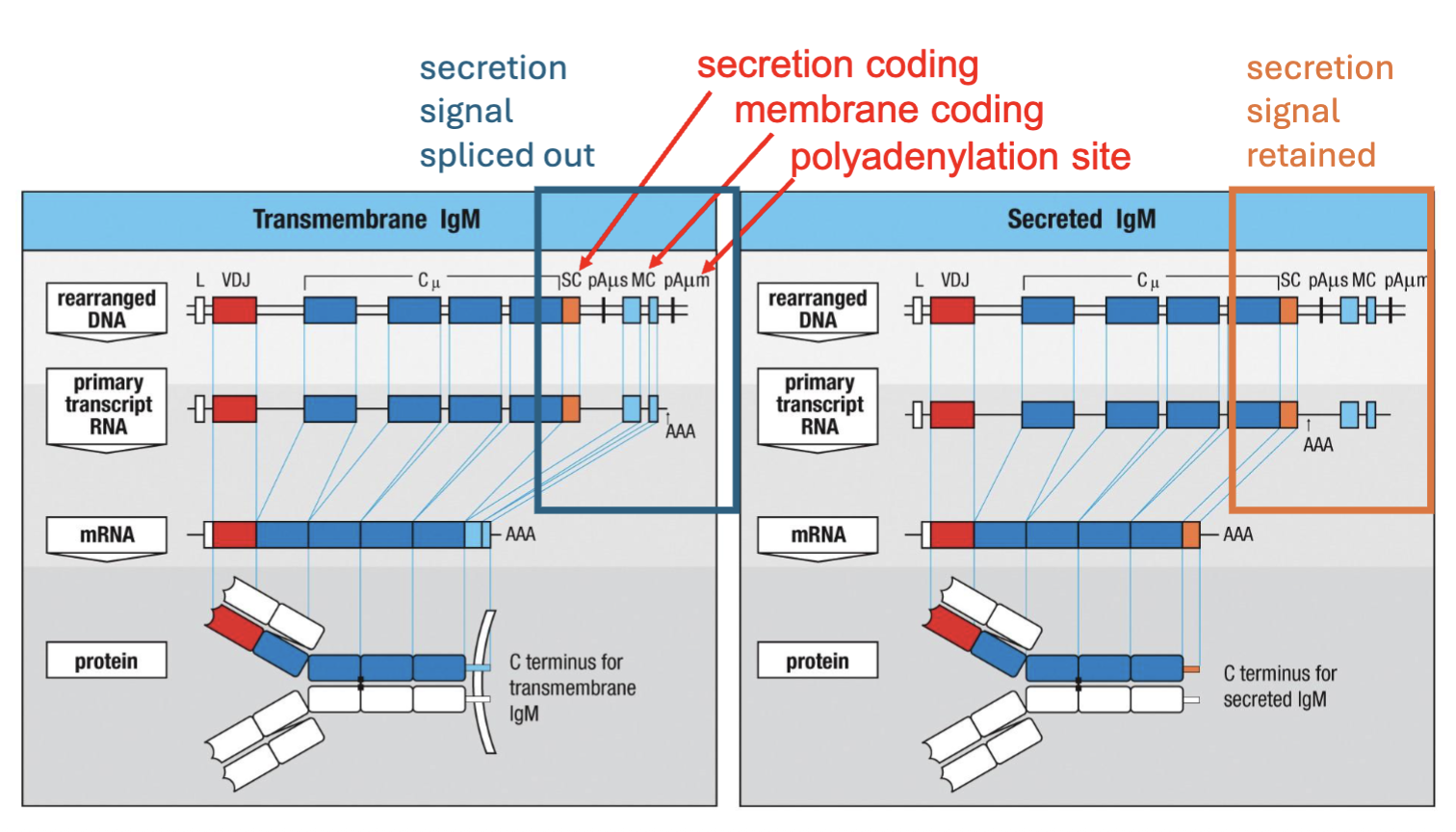
alternative RNA splicing

  • Antibodies are made at higher concentrations than BCR

  • The difference between the membrane bound and secreted forms comes down to a hydrophobic or hydrophilic C terminus, respectively

(B cell receptor on surface when cell is activated goes from making receptor to making antibody couple of diff. sequences, secretion, membrane and polyadenylation)
<p><span><strong><span>alternative RNA splicing</span></strong></span></p><ul><li><p><span><span>Antibodies are made at higher concentrations than BCR</span></span></p></li><li><p><span><span>The difference between the membrane bound and secreted forms comes down to a hydrophobic or hydrophilic C terminus, respectively</span></span></p></li></ul><p>(B cell receptor on surface when cell is activated goes from making receptor to making antibody couple of diff. sequences, secretion, membrane and polyadenylation)</p>
16
New cards

What makes a better B cells (survival of the fittest)?

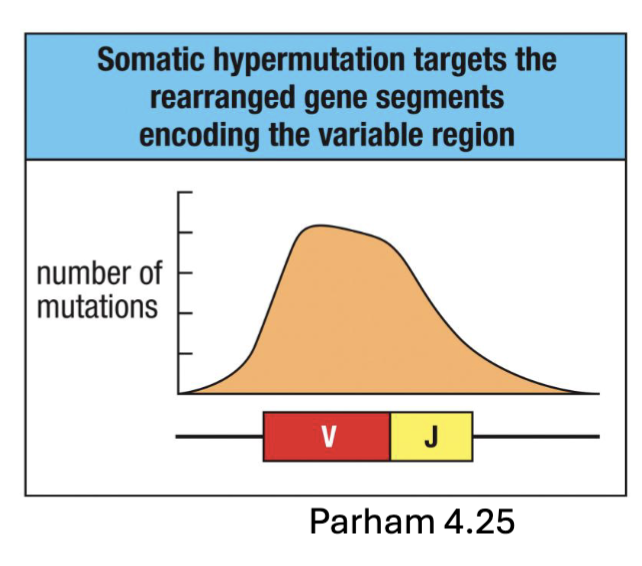
  • Rearranged V-region sequences are further mutated in activated B cells (Somatic Hypermutation)

  • Mediated by activation-induced cytidine deaminase (AID) generated in proliferating B cells

    • Induces mutations during transcription when DNA strands are separated → repair errors

    • Single nucleotide mutations induced in variable regions (CDRs) at ~ 1 mutation per dell division (> 1 million times normal mutation rate)

    • Ig variable regions enriched in sequence motifs susceptible to AID (mutational hot spots) (MHS:allows for selection of antibodies that bind better)

  • B cells with mutant immunoglobulins undergo competition and are selected for higher antigen binding (affinity maturation) → go on to form plasma cells and memory B cells

(when B cell activating make AID→ causes mutations in antibody gene sequence, can create a nick and needs to be repaired not always repaired properly

high mutation rate, tend to have mutation every time dell divides because of the repair error

the antibodies are competing with one another, if increased affinity of the B cell receptor: more signalling

strongest binding to antigen will survive and bind: affinity maturation (selected for really high affinity these will make plasma B cells or memory B cells)
<ul><li><p><span><span>Rearranged V-region sequences are further mutated in activated B cells (</span><strong><span>Somatic Hypermutation</span></strong><span>)</span></span></p></li><li><p><span><span>Mediated by </span><strong><span>activation-induced cytidine deaminase (AID</span></strong><span>) generated in proliferating B cells</span></span></p><ul><li><p><span><span>Induces mutations during transcription when DNA strands are separated → repair errors</span></span></p></li><li><p><span><span>Single nucleotide mutations induced in variable regions (CDRs) at ~ 1 mutation per dell division (&gt; 1 million times normal mutation rate)</span></span></p></li><li><p><span><span>Ig variable regions enriched in sequence motifs susceptible to AID (</span><strong><span>mutational hot spots</span></strong><span>) (MHS:</span></span>allows for selection of antibodies that bind better)</p></li></ul></li><li><p><span><span>B cells with mutant immunoglobulins undergo competition and are selected for higher antigen binding (</span><strong><span>affinity maturation</span></strong><span>) → go on to form plasma cells and memory B cells</span></span></p></li></ul><p>(when B cell activating make AID→ causes mutations in antibody gene sequence, can create a nick and needs to be repaired not always repaired properly</p><p><u>high mutation rate, tend to have mutation every time dell divides because of the repair error</u></p><p>the antibodies are competing with one another, if increased affinity of the B cell receptor: more signalling</p><p>strongest binding to antigen will survive and bind: affinity maturation (selected for really high affinity these will make plasma B cells or memory B cells)</p>
17
New cards

What is class switch recombination? 

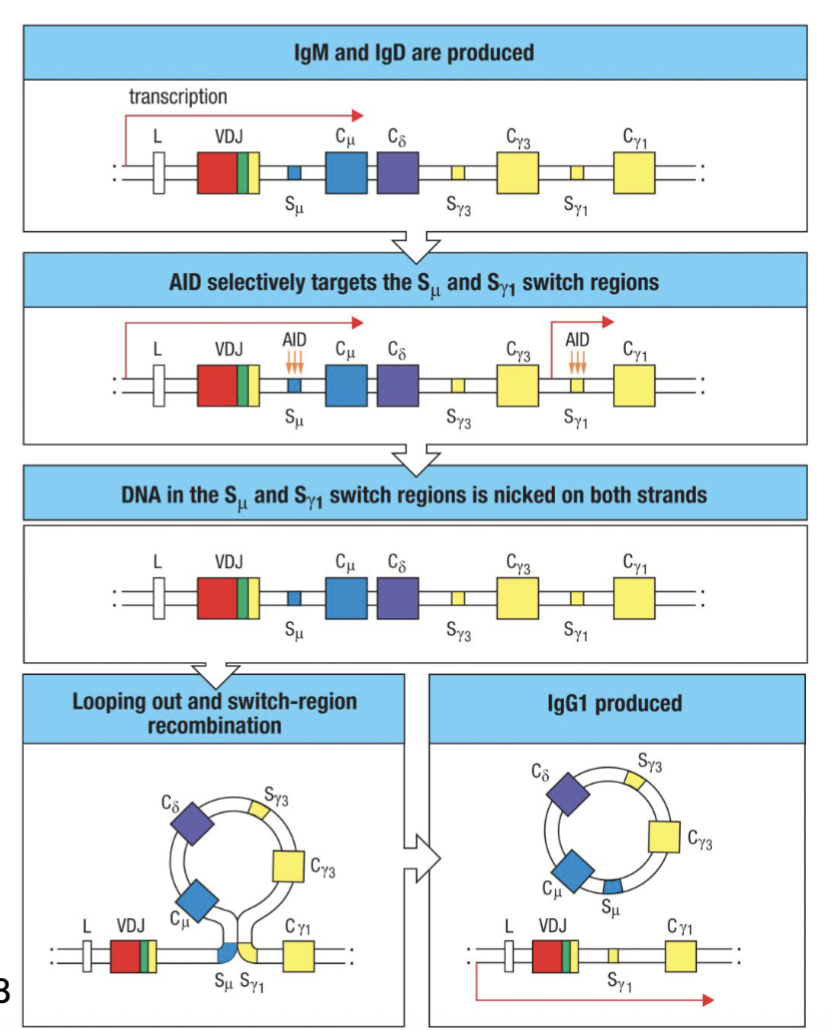
  • Activated B cells undergo recombination of heavy-chain C gene segments (Class Switch Recombination)

  • Requires transcriptional activity in C region to be switched to – regulated by cytokines and environment (e.g. IL-4 → IgE, IgG1; TGFβ/ IL-5→IgA; IFNɣ→IgG2a, IgG3) 

  • Mediated by activation-induced cytidine deaminase (AID) in proliferating B cells 

    • Single nucleotide mutations induced in switch regions (S) flanking C regions →

    • Nicks on both strands facilitate homologous recombination that excises upstream C regions ... no going back

  • AID deficiency associated with hyper-IgM syndrome (increased infections, and cancer risk)

(requires active transcription at the sites, depending on cytokine will get signals from the environment)

(in presence of certain cytokines will have transcription (DNA opens up) AID create nicks in the sequences (switch regions) and then homologous recombination occurs→ cleaves out the sequence can no longer make IgD and IgM (irreversible) creates different antibody)
<ul><li><p><span><span>Activated B cells undergo recombination of heavy-chain C gene segments (</span><strong><span>Class Switch Recombination</span></strong><span>)</span></span></p></li><li><p><span><span>Requires transcriptional activity in C region to be switched to – regulated by cytokines&nbsp;and environment (e.g. IL-4 → IgE, IgG1; TGFβ/ IL-5→IgA; IFNɣ→IgG2a, IgG3)&nbsp;</span></span></p></li><li><p><span><span>Mediated by </span><strong><span>activation-induced cytidine deaminase (AID</span></strong><span>) in proliferating B cells&nbsp;</span></span></p><ul><li><p><span><span>Single nucleotide mutations induced in </span><strong><span>switch regions (S</span></strong><span>) flanking C regions →</span></span></p></li><li><p><span><span>Nicks on both strands facilitate homologous recombination that excises upstream C regions ... no going back</span></span></p></li></ul></li><li><p><span><span>AID deficiency associated with </span><strong><span>hyper-IgM syndrome</span></strong><span>&nbsp;(</span></span>increased infections, and cancer risk)</p></li></ul><p>(requires active transcription at the sites, depending on cytokine will get signals from the environment)</p><p>(in presence of certain cytokines will have transcription (DNA opens up) AID create nicks in the sequences (switch regions) and then homologous recombination occurs→ cleaves out the sequence can no longer make IgD and IgM (irreversible) creates different antibody)</p>
18
New cards

What is the mechanism and the nature of change to the B cell’s genome in V-region assembly from gene fragments?

Mechanism: Somatic recombination of genomic DNA

Nature of change to the B cell’s genome: Irreversible

19
New cards

What is the mechanism and the nature of change to the B cell’s genome in generation of junctional diversity?

Mechanism:  Imprecision in joining rearranged DNA segments adds non-germline nucleotides (P and N) and deletes germline nucleotides

Nature of change to the B cell’s genome: Irreversible

20
New cards

What is the mechanism and the nature of change to the B cell’s genome in assembly of transcriptional control elements?

Mechanism: Promoter and enhancer are brought closer together by V-region assembly 

Nature of change to the B cell’s genome: Irreversible

21
New cards

What is the mechanism and the nature of change to the B cell’s genome in transcription activated with coexpression of surface IgM and IgD?

Mechanism: Two patterns of splicing and processing RNA are used

Nature of change to B cell’s genome: Reversible and regulated 

22
New cards

What is the mechanism and the nature of change to the B cell’s genome in synthesis changes from membrane Ig to secreted antibody?

Mechanism: Two patterns of splicing and processing RNA are used

Nature of change to B cell’s genome: Regulated 

23
New cards

What is the mechanism and the nature of change to the B cell’s genome in somatic hypermutation?

Mechanism: Point mutation of genomic DNA

Nature of change to B cell’s genome: Irreversible

24
New cards

What is the mechanism and the nature of change to the B cell’s genome in isotype switch?

Mechanism: Somatic recombination of genomic DNA

Nature of change to B cell’s genome: Irreversible

25
New cards

What gene segments come together in the heavy chain what genes come tofether in the light chain?

Heavy: D→J and then V→DJ

Light: V→J

26
New cards

What is the Clonal Selection Hypothesis?

research that led to the discovery of B cell development

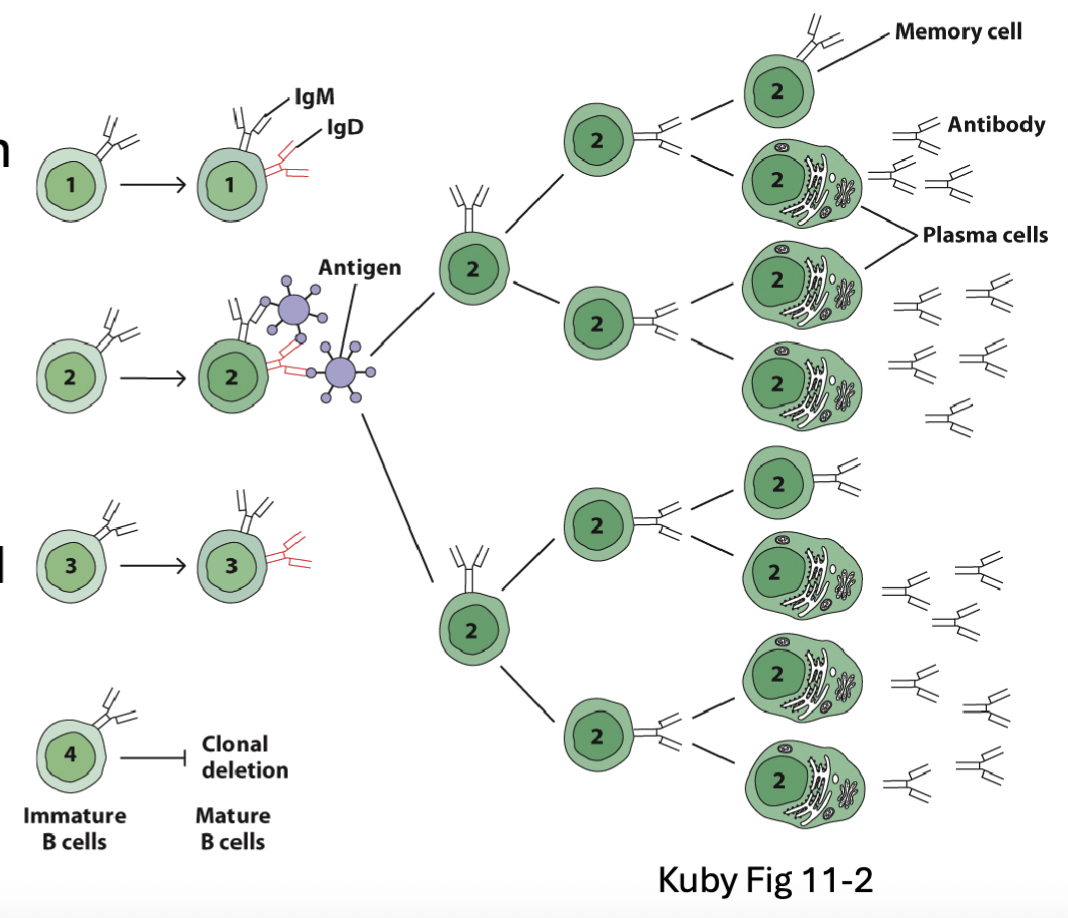
Frank Macfarlane Burnet (1957):

  • Predicted one Ig specificity for each developing cell

  • Activated cells would replicate and produce offspring with same Ig specificity as parent (partially correct-there are hypermutation later on so not exactly the same but come from the same progenitor) 

  • Memory B cells would allow enhanced secondary response

  • Self-reactive cells would be deleted

predicted the BCR rearrangement 
<p>research that led to the discovery of B cell development</p><p><span><span>Frank Macfarlane Burnet (1957):</span></span></p><ul><li><p><span><span>Predicted one Ig specificity for each developing cell</span></span></p></li><li><p><span><span>Activated cells would replicate and produce offspring with same Ig specificity as parent&nbsp;</span></span>(partially correct-there are hypermutation later on so not exactly the same but come from the same progenitor)&nbsp;</p></li><li><p><span><span>Memory B cells would allow enhanced secondary response</span></span></p></li><li><p><span><span>Self-reactive cells would be deleted</span></span></p></li></ul><p>predicted the BCR rearrangement&nbsp;</p>
27
New cards

What are the general features and influences of B cell development?

  • Human bone marrow generates ~60 billion B cells per day (35-55 billion of them will die)

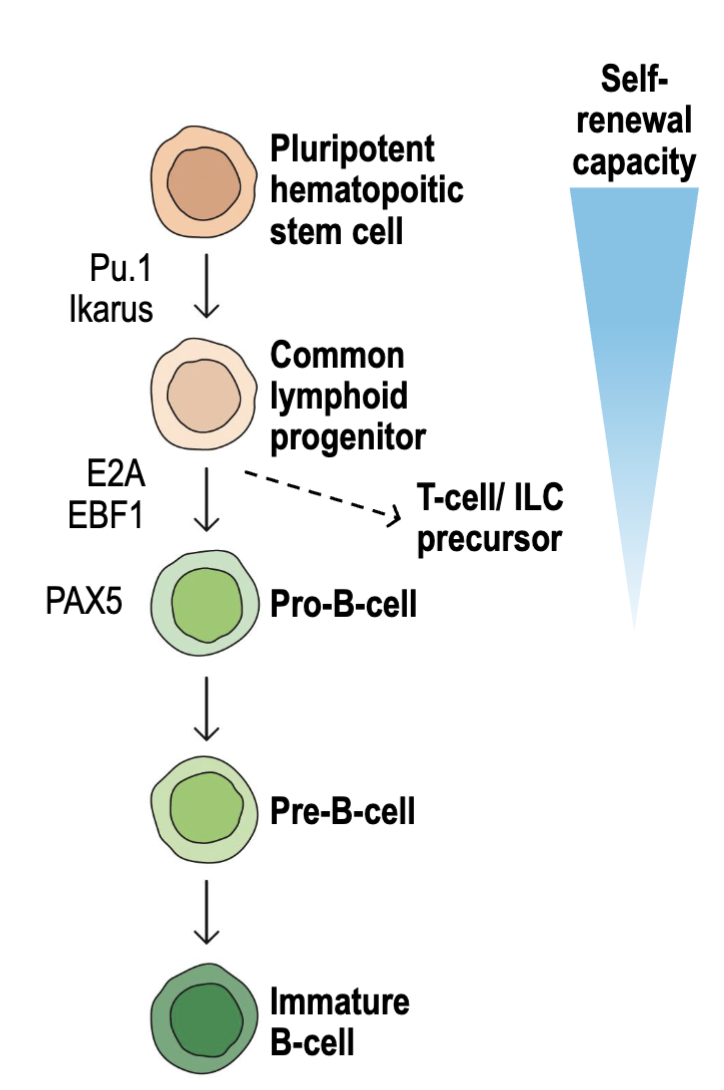
  • B cells are derived from the common lymphoid progenitor (CLP)

    • Transcription factors E2A and EBF1 drive B cell commitment and BCR rearrangement

    • PAX5 critical for B cell development

  • Ig rearrangement and selection take place during pro- and pre- B cell stages

  • Immature B cells migrate through secondary lymphoid tissues and undergo
    additional selection and differentiation

E2A and EBF1 commit to B cell lineage, will undergo BCR rearrangement

PAX5 major factor of rearrangement
<ul><li><p><span><span>Human bone marrow generates ~60 billion B cells per day (35-55 billion of them will die)</span></span></p></li><li><p><span><span>B cells are derived from the common lymphoid progenitor (</span><strong><span>CLP</span></strong><span>)</span></span></p><ul><li><p><span><span>Transcription factors </span><strong><span>E2A</span></strong><span> and </span><strong><span>EBF1</span></strong><span> drive B cell commitment and BCR rearrangement</span></span></p></li><li><p><span><strong><span>PAX5</span></strong><span> critical for B cell development</span></span></p></li></ul></li><li><p><span><span>Ig rearrangement and selection take place during </span><strong><span>pro</span></strong><span>- and </span><strong><span>pre</span></strong><span>- B cell stages</span></span></p></li><li><p><span><span>Immature B cells migrate through secondary lymphoid tissues and undergo</span></span><br><span><span>additional selection and differentiation</span></span></p></li></ul><p></p><p>E2A and EBF1 commit to B cell lineage, will undergo BCR rearrangement</p><p>PAX5 major factor of rearrangement</p>
28
New cards

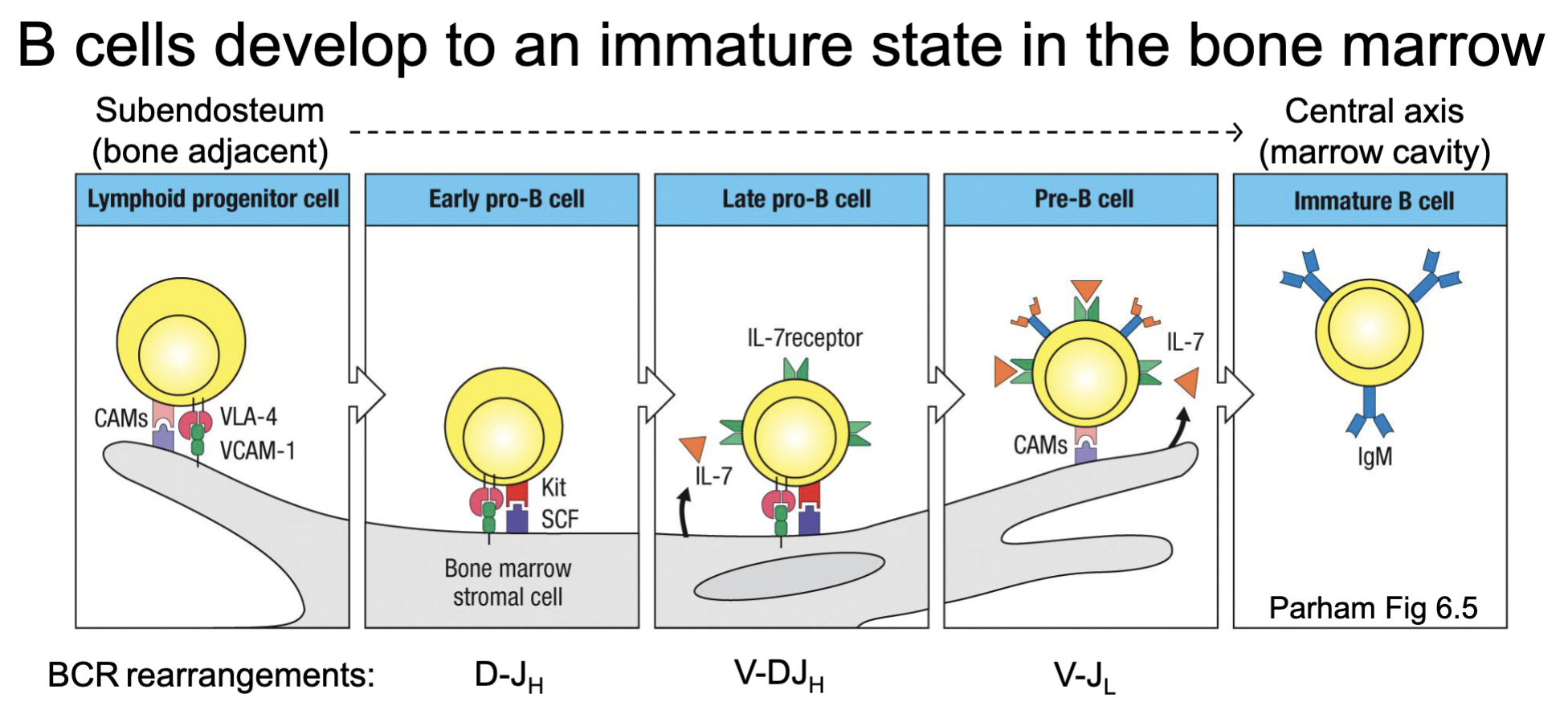
What are the features of B cell development to an immature state?

Happen in the bone marrow

  • As B cells develop, they move along the stroma from bone edge to central marrow

    • Receive different signals in different regions

  • Pro- and Pre-B cell stages correspond with B cell receptor rearrangements

<p>Happen in the bone marrow</p><ul><li><p><span><span>As B cells develop, they move along the stroma from bone edge to central marrow</span></span></p><ul><li><p><span><span>Receive different signals in different regions</span></span></p></li></ul></li><li><p><span><span>Pro- and Pre-B cell stages correspond with B cell receptor rearrangements</span></span></p></li></ul><p></p>
29
New cards

What are the features of rearrangement in early pro-B cell and late pro-B cell development?

early pro-B cells starts to have D-J rearrangement

late pro-B cell will have some selection
<p>early pro-B cells starts to have D-J rearrangement</p><p>late pro-B cell will have some selection</p>
30
New cards

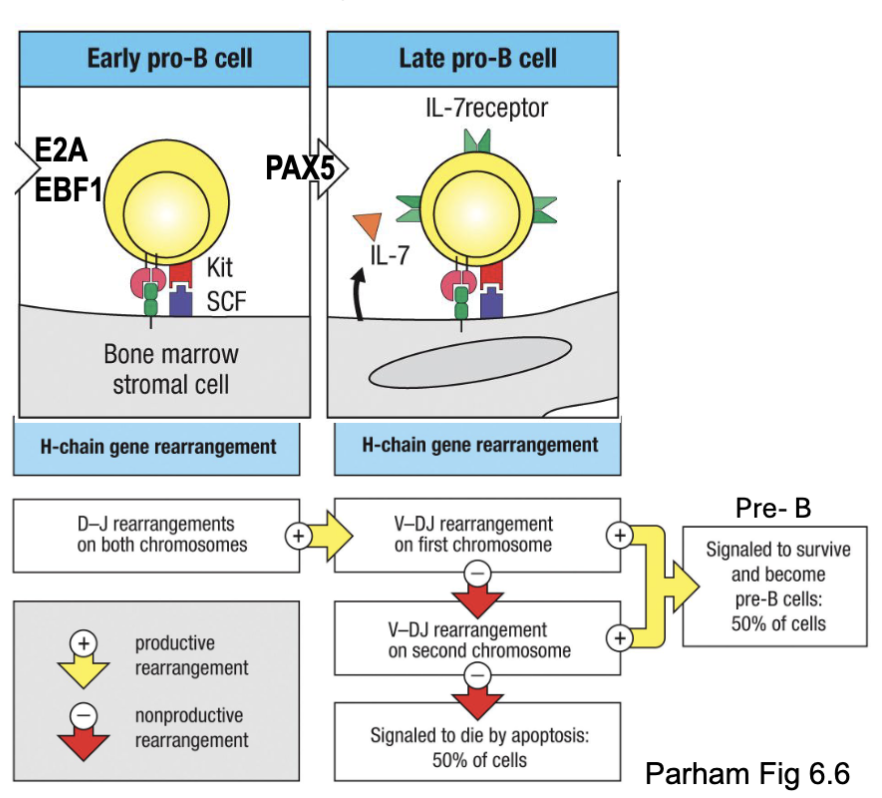
What are the features of pro-B cell: Heavy chain rearrangement?

  • E2A and EBF1 transcription factors:

    • Open chromatin at heavy chain locus

    • induce Rag1/2 and PAX5

  • PAX5 transcription factors:

    • B cell master regulator

    • induces V-DJ recombination (not needed for D-J), expression of
      Iga/IgB and VpreB/𝜆5, and downstream development

  • Two steps lead to heavy chain rearrangement

  • Apoptosis as a default in absence of positive survival signal (but this
    happens at pre-B cell stage

Vprebeta and Vprelamda5 important for development stage

2 chances of rearrangement (bc of 2 chromosomes)

first checkpoint
<ul><li><p><span><strong><span>E2A</span></strong><span> and </span><strong><span>EBF1</span></strong><span> transcription factors:</span></span></p><ul><li><p><span><span>Open chromatin at heavy chain locus</span></span></p></li><li><p><span><span>induce </span><strong><span>Rag1/2</span></strong><span> and </span><strong><span>PAX5</span></strong></span></p></li></ul></li><li><p><span><strong><span>PAX5</span></strong><span> transcription factors:</span></span></p><ul><li><p><span><span>B cell master regulator</span></span></p></li><li><p><span><span>induces V-DJ recombination (not needed for D-J), expression of</span></span><br><span><span>Iga/IgB and </span><strong><span>VpreB/𝜆5</span></strong><span>, and downstream development</span></span></p></li></ul></li><li><p><span><span>Two steps lead to heavy chain rearrangement</span></span></p></li><li><p><span><span>Apoptosis as a default in absence of positive survival signal (but this</span></span><br><span><span>happens at pre-B cell stage</span></span></p></li></ul><p>Vprebeta and Vprelamda5 important for development stage</p><p>2 chances of rearrangement (bc of 2 chromosomes)</p><p>first checkpoint</p>
31
New cards

What are the features of the Pre-B cells: pre-BCR checkpoint?

  • Transition from late pro-B cells to early (large) pre-B cells marked by upregulation of the surrogate light chain (SLC) – made up of VpreB and λ5 subunits

  • SLC associates with rearranged heavy chain → expression on cell surface as pre-BCR complex

  • SLCs cluster → pre-BCR signaling and survival (positive selection/ 1st checkpoint)

  • Cells lacking productive heavy chain rearrangements do not express pre-BCR → apoptosis

  • Pre-BCR signaling → clonal proliferation, transient downregulaion of RAG1/2 and chromatin condensation at unused heavy locus (allelic
    exclusion)

if signal, can’t go to surface cell will die

<ul><li><p><span><span>Transition from late pro-B cells to early (large) pre-B cells marked by upregulation of the surrogate light chain (SLC) – made up of VpreB and λ5 subunits</span></span></p></li><li><p><span><strong><span>SLC</span></strong><span> associates with rearranged heavy chain → expression on cell surface as </span><strong><span>pre-BCR</span></strong><span> complex</span></span></p></li><li><p><span><span>SLCs cluster → pre-BCR signaling and survival (</span><strong><span>positive selection/ 1st checkpoint</span></strong><span>)</span></span></p></li><li><p><span><span>Cells lacking productive heavy chain rearrangements do not express pre-BCR → apoptosis</span></span></p></li><li><p><span><span>Pre-BCR signaling → clonal proliferation, transient downregulaion of RAG1/2 and chromatin condensation at unused heavy locus (</span><strong><span>allelic</span></strong></span><strong><br></strong><span><strong><span>exclusion</span></strong><span>)</span></span></p></li></ul><p>if signal, can’t go to surface cell will die</p>
32
New cards

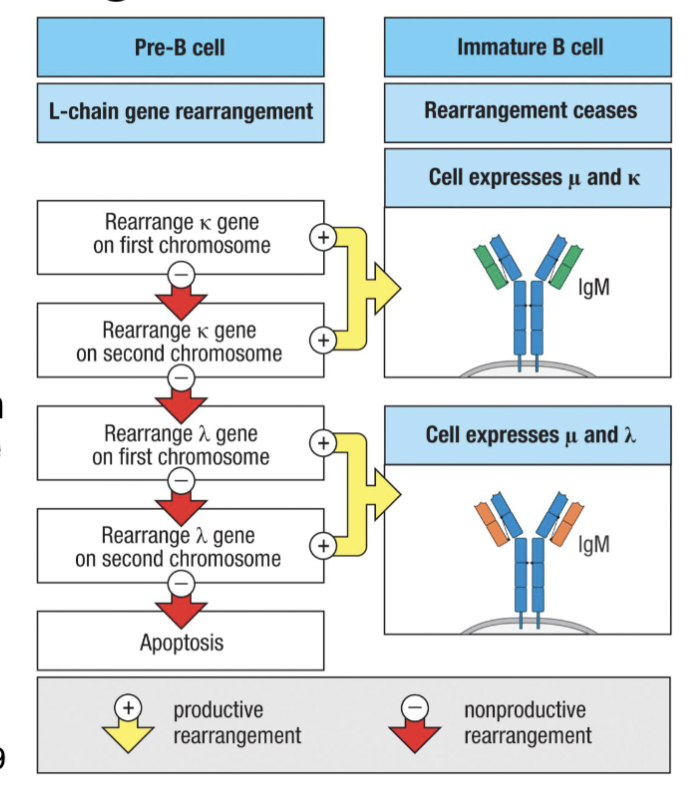
What are the features of Pre-B cells: Light Chain Rearrangement?

  • Following 1st checkpoint, pre-B cells proliferate and become late (small) pre-B cells

  • Pre-BCR signaling feedback turns off SLC expression, RAG genes reactivated (via IRF4 and 8) → light chain rearrangements

    • Mice rearrange KL-locus before λL-locus, random in humans (50/50 in humans)

  • Successful light chain rearrangement pairs with heavy chain in ER→ expression on cell surface as BCR complex

  • Low level (tonic) BCR signaling → survival (positive selection/ 2nd checkpoint), turns off further rearrangements

  • Success ... we now have immature B cells

signalling feedback turn of gene for surrogate light chain
<ul><li><p><span><span>Following 1st checkpoint, pre-B cells proliferate and become late (small) pre-B cells</span></span></p></li><li><p><span><span>Pre-BCR signaling feedback turns off SLC expression, RAG genes reactivated (via IRF4 and 8) → light chain rearrangements</span></span></p><ul><li><p>Mice rearrange K<sub>L</sub>-locus before λ<sub>L</sub>-locus, random in humans (50/50 in humans)</p></li></ul></li><li><p><span><span>Successful light chain rearrangement pairs with heavy chain in ER→ expression on cell surface as </span><strong><span>BCR</span></strong><span> complex</span></span></p></li><li><p><span><span>Low level (tonic) BCR signaling → survival (</span><strong><span>positive selection/ 2nd checkpoint</span></strong><span>), turns off further rearrangements</span></span></p></li><li><p><span><span>Success ... we now have immature B cells</span></span></p></li></ul><p>signalling feedback turn of gene for surrogate light chain</p>
33
New cards

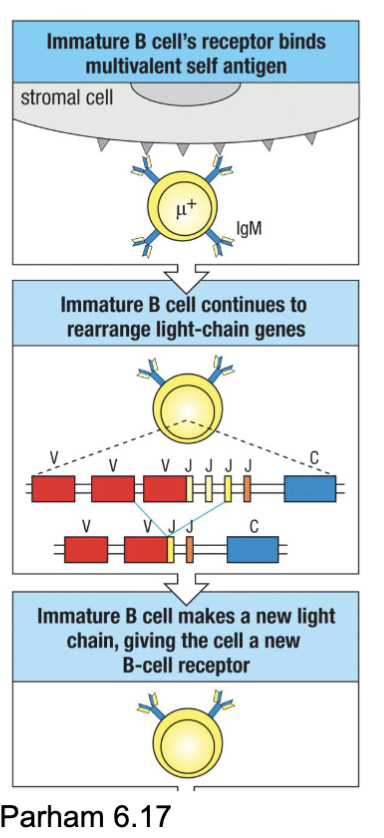
What are the features of Immature B cells: Tolerance Induction?

  • Developing B cells were positively selected for BCR activity → need to do something about autoreactive clones (~75% will have some self-reactivity)

  • Three central tolerance (at site of primary development) mechanisms

  • Export of autoreactive immature B cells can result in peripheral tolerance (elimination at other sites) or potential autoimmunity (i.e. SLE)

want to eliminate self recognition

75% removed bc autoreactive

central tolerance getting rid of cell where it was developed (bone marrow)

B cells look for surface antigen but don’t eliminate anything that targets the interior
<ul><li><p><span><span>Developing B cells were positively selected for BCR activity → need to do something about autoreactive clones (~75% will have some self-reactivity)</span></span></p></li><li><p><span><span>Three </span><strong><span>central tolerance</span></strong><span> (at site of primary development) mechanisms</span></span></p></li><li><p><span><span>Export of autoreactive immature B cells can result in </span><strong><span>peripheral tolerance </span></strong><span>(elimination at other sites) or potential autoimmunity (i.e. SLE)</span></span></p></li></ul><p></p><p>want to eliminate self recognition</p><p>75% removed bc autoreactive</p><p>central tolerance getting rid of cell where it was developed (bone marrow)</p><p>B cells look for surface antigen but don’t eliminate anything that targets the interior</p>
34
New cards

What are the three central tolerance mechanisms of immature B cells?

  • Clonal deletion → apoptosis of highly reactive clones (IgM cross-linking induces death of immature but not mature B cells)

  • Reactivate RAG genes and undergo light chain receptor editing → changed antigen specificity 

  • Anergy: induced unresponsiveness to antigen (usually soluble/monovalent Ags: no cross- linking) → short life

2nd form tries to save some of the B cells

anergy: turns off the cell (prevent signalling and have a shorter half life)

<ul><li><p><span><strong><span>Clonal deletion</span></strong><span> → apoptosis of highly reactive clones (IgM cross-linking induces death of immature but not mature B cells)</span></span></p></li><li><p><span><span>Reactivate RAG genes and undergo l</span><strong><span>ight chain receptor editing</span></strong><span> → changed antigen specificity&nbsp;</span></span></p></li><li><p><span><strong><span>Anergy</span></strong><span>: induced unresponsiveness to antigen (usually soluble/monovalent Ags: no cross- linking) → short life</span></span></p></li></ul><p></p><p>2nd form tries to save some of the B cells</p><p>anergy: turns off the cell (prevent signalling and have a shorter half life)</p>
35
New cards

Where does B cell maturation happen?

in the periphery (peripheral lymphoid organs- spleen, lymph nodes)

-enter T cell zones of lymphoid tissue and become transitional B cells
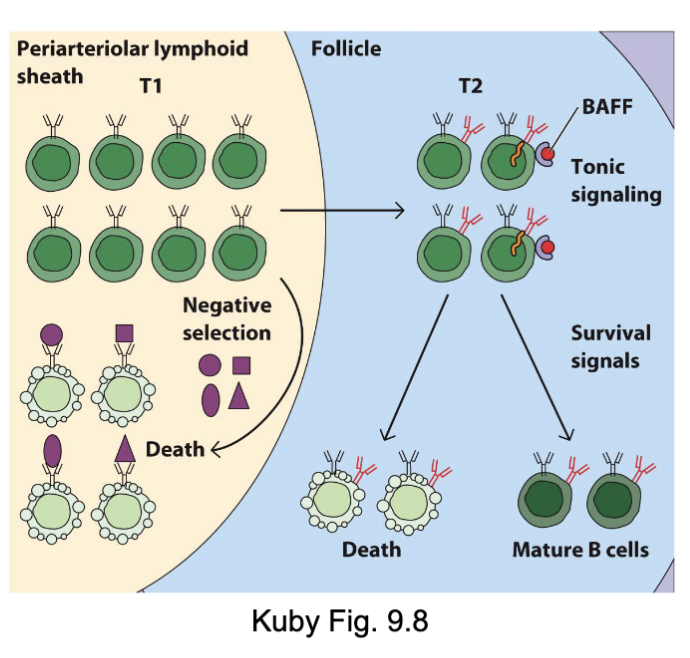
<p>in the periphery (peripheral lymphoid organs- spleen, lymph nodes)</p><p>-enter T cell zones of lymphoid tissue and become transitional B cells</p>
36
New cards

What are the features of B cell maturation in the periphery?

  • Immature B cells enter circulation in response to Spingosine1-phosphate (S1P) in blood

  • Localize to spleen and lymph nodes where they become known as transitional (T) B cells:

    • T1 B cells (mIgMhi/mIgDlo) enter T cell zone

      • Undergo negative selection if Ag encountered

      • upregulate IgD, CD21/CR2, CD23, BAFFR→ T2 B cells

    • T2 B cells (mIgMhi/mIgDint)→ enter follicle and interact with FDC → receive survival signals (tonic BCR, BAFF) → mature follicular B cell

      • Follicle niche size is limited and most B cells will die

  • Congratulations ... you made it to a mature
    B cell (mIgMlo/mIgDhi)

T1 B cells: see other antigens (new recognition and deletion of them in the T cell zone)

T2 B go into the follicular zone, switch from IgM to IgD (transcriptional switch)

signal from BAFF (B cell activating factor)

more IgD gets upregulated

(issue: resources in follicule limited, not enough BAFF to go around)

<ul><li><p><span><span>Immature B cells enter circulation in response to Spingosine1-phosphate (</span><strong><span>S1P</span></strong><span>) in blood</span></span></p></li><li><p><span><span>Localize to spleen and lymph nodes where they become known as transitional (T) B cells:</span></span></p><ul><li><p><span><span>T1 B cells (mIgMhi/mIgDlo) enter T cell zone</span></span></p><ul><li><p><span><span>Undergo negative selection if Ag encountered</span></span></p></li><li><p><span><span>upregulate IgD, CD21/CR2, CD23, BAFFR→ T2 B cells</span></span></p></li></ul></li><li><p><span><span>T2 B cells (mIgMhi/mIgDint)→ enter follicle and interact with FDC → receive survival signals (tonic BCR, BAFF) → mature follicular B cell</span></span></p><ul><li><p><span><span>Follicle niche size is limited and most B cells will die</span></span></p></li></ul></li></ul></li><li><p><span><span>Congratulations ... you made it to a mature</span></span><br><span><span>B cell (mIgM</span><sup><span>lo</span></sup><span>/mIgD</span><sup><span>hi</span></sup><span>)</span></span></p></li></ul><p>T1 B cells: see other antigens (new recognition and deletion of them in the T cell zone)</p><p>T2 B go into the follicular zone, switch from IgM to IgD (transcriptional switch)</p><p>signal from BAFF (B cell activating factor)</p><p>more IgD gets upregulated</p><p>(issue: resources in follicule limited, not enough BAFF to go around)</p>
37
New cards

What are the features of B cell recirculation?

  • Mature B cells survive ~100 days without antigen encounter

  • Mature naïve B cells recirculate through lymphoid tissues → enter LN primary follicles via HEV or afferent lymphatics

    • CXCL13 draws them into B cell zone

  • Interact with network of follicular dendritic cells (FDC) looking for antigens

  • No Ag → follow S1P gradient and exit via efferent lymphatics

leave lymph node will eventually return to the bloood

if they encounter antigen: B cell stimulation

<ul><li><p><span><span>Mature B cells survive ~100 days without antigen encounter</span></span></p></li><li><p><span><span>Mature naïve B cells recirculate through lymphoid tissues → enter LN primary follicles via HEV or afferent lymphatics</span></span></p><ul><li><p><span><span>CXCL13 draws them into B cell zone</span></span></p></li></ul></li></ul><ul><li><p><span><span>Interact with network of </span><strong><span>follicular dendritic cells</span></strong><span> (FDC) looking for antigens</span></span></p></li><li><p><span><span>No Ag → follow S1P gradient and exit via efferent lymphatics</span></span></p></li></ul><p></p><p>leave lymph node will eventually return to the bloood</p><p>if they encounter antigen: B cell stimulation</p>
38
New cards

What are the two things that can cause stimulation of B cells?

  • Antigen encounter → signaling via:

    • BCR complex (BCR, Ig⍺, Igβ)

    • B cell co-receptor complex (CR2, CD19, CD81): recognizes complement deposited on target → increases signaling 1000-10,000-fold

antigen with complement:

complement receptor recognizes it

activated by two things
<ul><li><p><span>Antigen encounter → signaling via:</span></p><ul><li><p><strong><span>BCR</span></strong><span> complex (BCR, Ig⍺, Igβ)</span></p></li><li><p><strong><span>B cell co-receptor complex</span></strong><span> (CR2, CD19, CD81): recognizes complement deposited on target → increases signaling 1000-10,000-fold</span></p></li></ul></li></ul><p></p><p>antigen with complement:</p><p>complement receptor recognizes it</p><p>activated by two things</p>
39
New cards

What are the features of B cell stimulation?

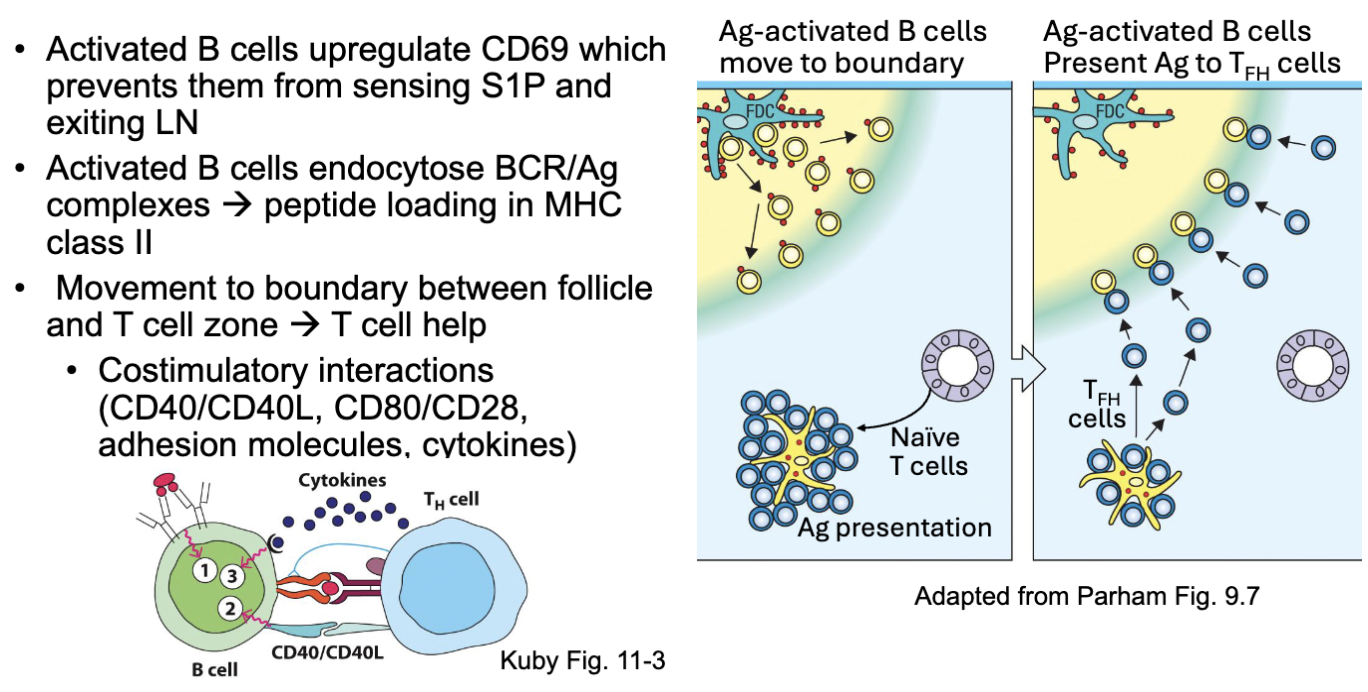
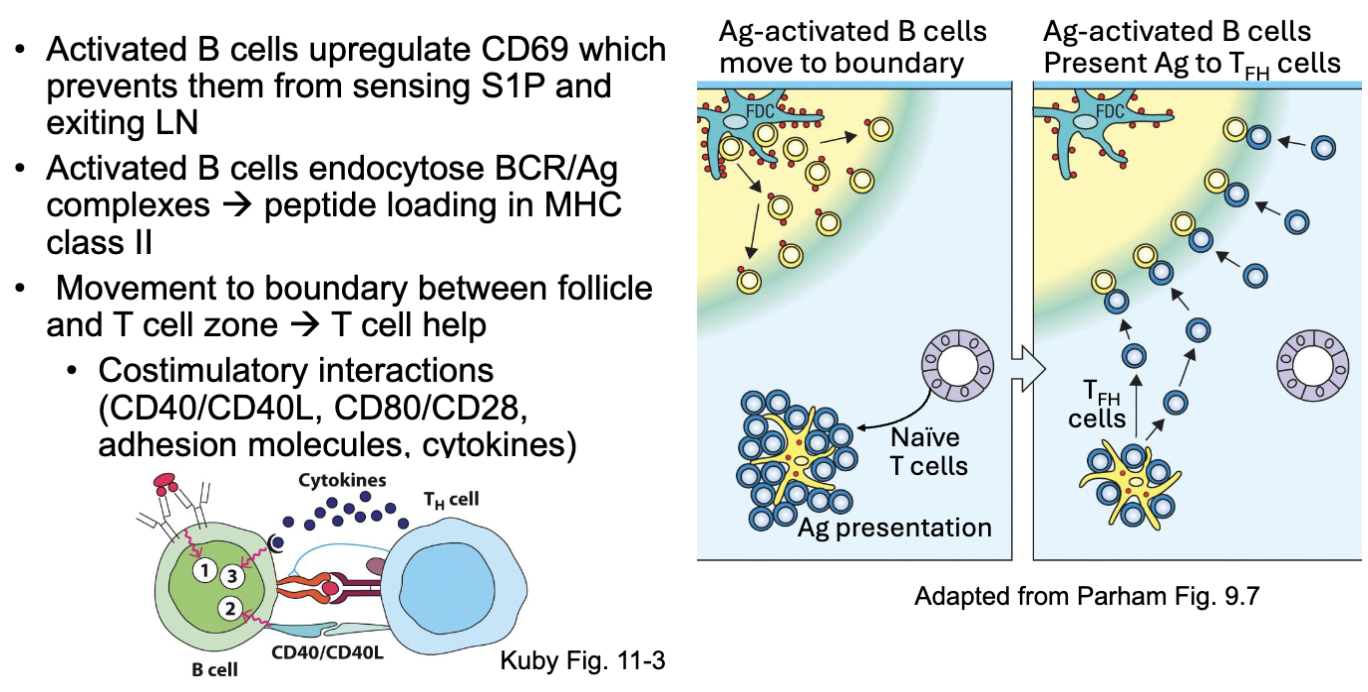
  • Activated B cells upregulate CD69 which prevents them from sensing S1P and exiting LN

  • Activated B cells endocytose BCR/Ag complexes → peptide loading in MHC
    class II

  • Movement to boundary between follicle and T cell zone → T cell help

    • Costimulatory interactions (CD40/CD40L, CD80/CD28, adhesion molecules, cytokines)

start to recognize signals from T cell zone and migrate there

T cells interact with DC cells that will cause them to differentiate (some into T helper ) go to border junction and interact with the B cells

present antigen to T cell: interactions where T cell helps B cell (if T cell recognizes the antigen) →red and purple binding in left image (BCR signal 1)

costimulatory molecules (2) and make cytokines (signal 3)
<ul><li><p><span><span>Activated B cells upregulate CD69 which prevents them from sensing S1P and exiting LN</span></span></p></li><li><p><span><span>Activated B cells endocytose BCR/Ag complexes → peptide loading in MHC</span></span><br><span><span>class II</span></span></p></li><li><p><span><span>Movement to boundary between follicle and T cell zone → T cell help</span></span></p><ul><li><p><span><span>Costimulatory interactions (CD40/CD40L, CD80/CD28, adhesion molecules, cytokines)</span></span></p></li></ul></li></ul><p>start to recognize signals from T cell zone and migrate there</p><p>T cells interact with DC cells that will cause them to differentiate (some into T helper ) go to border junction and interact with the B cells</p><p>present antigen to T cell: interactions where T cell helps B cell (if T cell recognizes the antigen) →red and purple binding in left image (BCR signal 1)</p><p>costimulatory molecules (2) and make cytokines (signal 3)</p>
40
New cards

What prevents B cells from exiting the lymph nodes once activated?

when stimulated don’t want it to leave lymph node: CD69 (prevents them from leaving associates with sphingosine 1 receptor)

S1R (what lets it out via a gradient)
<p>when stimulated don’t want it to leave lymph node: CD69 (prevents them from leaving associates with sphingosine 1 receptor)</p><p>S1R (what lets it out via a gradient)</p>
41
New cards

What are the features of the primary focus (medullary cords) and the germinal centres in relation to B cells?

  • B cell-TFH pairs move to medullary cords (primary focus) → proliferate (plasmablasts)

    • Primary focus forms in the medullary cords

    • Upregulation of BLIMP-1 and IRF4 causes differentiation into plasma cells →secrete low affinity IgM (early, short-lived)

  • Some B cell-TFH pairs upregulate Bcl6, move back to a primary follicle and form a germinal center (secondary follicle)

    • Expansion of Ag-activated B cells in primary follicle creates germinal center

haven’t undergo affinity maturation yet

some migrate back to the follicle (a lot of proliferation) creates germinal center

42
New cards

What are the features of B cell stimulation in the germinal centre? 

  • Dark zone: Centroblasts undergo massive proliferation and upregulate AID
    somatic hypermutation

  • Light zone: Centrocytes proliferate less and interact with TFH

    • affinity maturation – compete for antigen on FDCs → selection

    • class switching (regulated by cytokines and other signals)

    • Memory vs. plasma cell differentiation

      • depends on interactions with TFH cells

      • plasma cells develop later but at higher frequency
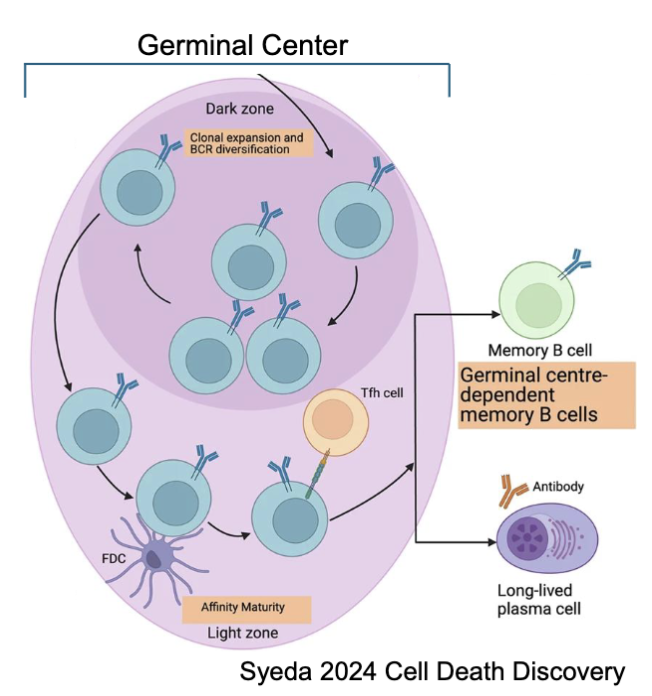
<ul><li><p><span><strong><span>Dark zone</span></strong><span>: </span><strong><span>Centroblasts</span></strong><span> undergo massive proliferation and upregulate AID</span></span><br><span><span>→ </span><strong><span>somatic hypermutation</span></strong></span></p></li><li><p><span><strong><span>Light zone: Centrocytes </span></strong><span>proliferate less and interact with T</span><sub><span>FH</span></sub><span> →</span></span></p><ul><li><p><span><strong><span>affinity maturation</span></strong><span> – compete for antigen on FDCs → selection</span></span></p></li><li><p><span><strong><span>class switching</span></strong><span> (regulated by cytokines and other signals)</span></span></p></li><li><p><span><span>Memory vs. plasma cell differentiation</span></span></p><ul><li><p><span><span>depends on interactions with T</span><sub><span>FH </span></sub><span>cells</span></span></p></li><li><p><span><span>plasma cells develop later but at higher frequency</span></span></p></li></ul></li></ul></li></ul><p></p>
43
New cards

B Cell Memory vs. Plasma Cell Fate. Which model is accurate in the differentiation in the type of B cell made?

Integrative Fate model: includes both quantity of signal and quality of the signal

higher affinity cells that underwent class switch now either become memory or plasma cell

follicular helper cells mediate what type of B cell it becomes

memory cells made early and plasma accumulates later

Asymmetric model (wrong): one cell upregulate one type of transcription factor whilst the other upregulates diff. transcription factors

Instructive (partly right) :need more signalling to be plasma cell

Decreasing potential (partly right): over time loose the ability to make memory cell

<p><mark data-color="yellow" style="background-color: yellow; color: inherit;">Integrative Fate model: includes both quantity of signal and quality of the signal</mark></p><p></p><p>higher affinity cells that underwent class switch now either become memory or plasma cell</p><p>follicular helper cells mediate what type of B cell it becomes</p><p>memory cells made early and plasma accumulates later</p><p>Asymmetric model (wrong): one cell upregulate one type of transcription factor whilst the other upregulates diff. transcription factors</p><p>Instructive (partly right) :need more signalling to be plasma cell</p><p>Decreasing potential (partly right): over time loose the ability to make memory cell </p>
44
New cards

What are the features of Memory B Cell Recall Response?

  • Transcriptionally poised to respond → faster response

  • Enhanced signaling response (Ca2+ mobilization) → larger response

  • Higher levels of costimulatory molecules (CD80, CD40)

  • Less reliant on T cell help (less bottleneck)

  • Already class switched and high affinity Igs (IMAGE)
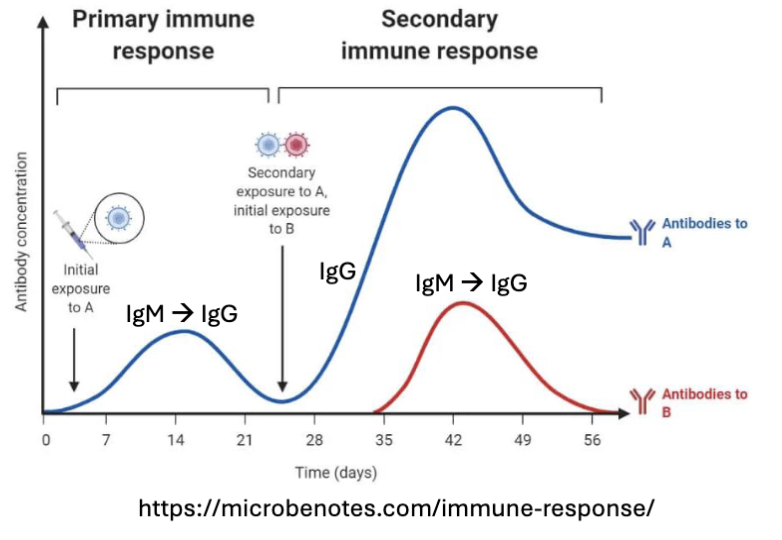
<ul><li><p><span><span>Transcriptionally poised to respond → faster response</span></span></p></li><li><p><span><span>Enhanced signaling response (Ca</span><sup><span>2+ </span></sup><span>mobilization) → larger response</span></span></p></li><li><p><span><span>Higher levels of costimulatory molecules (CD80, CD40)</span></span></p></li><li><p><span><span>Less reliant on T cell help (less bottleneck)</span></span></p></li><li><p><span><span>Already class switched and high affinity Igs (IMAGE) </span></span></p></li></ul><p></p>
45
New cards

What are the features of B-1B Cells?

  • B-1 B cells: arise early in embryonic development (fetal liver) → localize to
    peritoneal and pleural cavities

    • Limited diversity: Use VH genes closest to D segments; TdT not expressed in fetus

    • self-renewal (requires IL-10) and don’t need T cell help

  • Low affinity natural antibodies (mostly IgM)

    • recognize multiple carbohydrate/ lipid antigens (polyspecific) → clearance of certain pathogens, dying cells (self), and debris

Not the normal B cell referenced that is B-2 B cells (usually B cell made in later development)

limited diversity: use genes close together

polyspecific: recognize more than one antigen

antibodies can bind and mediate complement and phagocytosis of the bacteria

antibodies important for homeostasis recognize cells undergoing apoptosis, antibodies mark the cells undergoing apoptosis so that they can be phagocytosed

<ul><li><p><span><strong><span>B-1 B cells</span></strong><span>: arise early in embryonic development (fetal liver) → localize to</span></span><br><span><span>peritoneal and pleural cavities</span></span></p><ul><li><p><span><span>Limited diversity: Use VH genes closest to D segments; TdT not expressed in fetus</span></span></p></li><li><p><span><span>self-renewal (requires IL-10) and don’t need T cell help</span></span></p></li></ul></li><li><p><span>Low affinity </span><strong><span>natural antibodies</span></strong><span> (mostly IgM)</span></p><ul><li><p><span><span>recognize multiple carbohydrate/ lipid antigens (</span><strong><span>polyspecific</span></strong><span>) → clearance of certain pathogens, dying cells (self), and debris</span></span></p></li></ul></li></ul><p><mark data-color="yellow" style="background-color: yellow; color: inherit;">Not the normal B cell referenced  that is B-2 B cells (usually B cell made in later development) </mark></p><p></p><p>limited diversity: use genes close together</p><p>polyspecific: recognize more than one antigen</p><p>antibodies can bind and mediate complement and phagocytosis of the bacteria</p><p>antibodies important for homeostasis recognize cells undergoing apoptosis, antibodies mark the cells undergoing apoptosis so that they can be phagocytosed</p>
46
New cards

What is the difference between T-dependent vs. T-independent Antigens?

T-dependent Antigens (TD):

  • Soluble protein antigens that cross-link BCR

  • Require T cell help to provide signal 2 and 3

T-independent Antigens (TI):

  • TI-1: Bacterial cell wall/membrane components (e.g. LPS)

  • TI-2: Polymeric proteins (e.g. flagellin) and capsular polysaccharides

TD: need T cell help

exam don’t need to know diff between TI-2 and TI-1 just different between T dependent and T independent
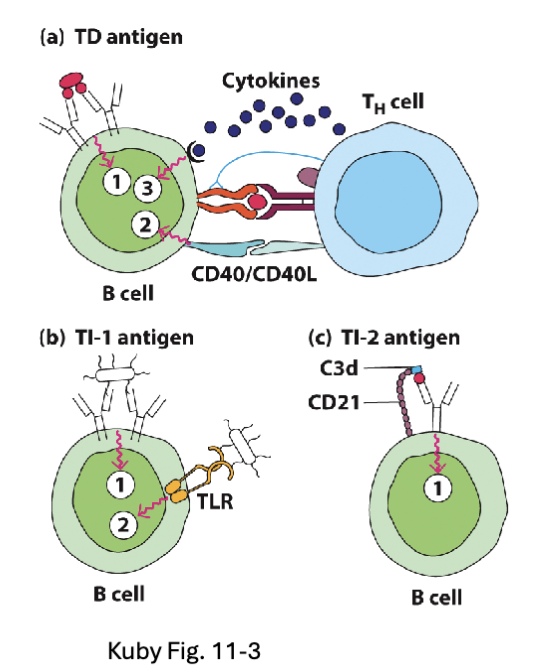
<p><span><strong><span>T-dependent Antigens</span></strong><span> (TD):</span></span></p><ul><li><p><span><span>Soluble protein antigens that cross-link BCR</span></span></p></li><li><p><span><span>Require T cell help to provide signal 2 and 3</span></span></p></li></ul><p><strong>T-independent Antigens </strong>(TI):</p><ul><li><p><span><strong><span>TI-1</span></strong><span>: Bacterial cell wall/membrane components (e.g. LPS)</span></span></p></li><li><p><strong>TI-2</strong>: Polymeric proteins (e.g. flagellin) and capsular polysaccharides</p></li></ul><p></p><p>TD: need T cell help</p><p>exam don’t need to know diff between TI-2 and TI-1 just different between T dependent and T independent</p>
47
New cards

What is the history of the discovery of the T cell receptors?

  • 1961-2 Jacques Miller – T cells are generated in thymus and
    are important for adaptive immunity (thymectomy experiments)

  • Hypothesis that T cells used clonal recognition structure similar
    to B cells

  • 1981-3: Alan Harris and Jim Golding, Ellis Reinherz, Jim Allison,
    – work characterizing structure of TCR

  • 1984-5: Mark Davis, Tak Mak – isolated and mapped -chain
    TCR genes in mice and humans

discovered later than B cells

48
New cards

What are teh features shared by TCR and BCR?

Polypeptides containing linked chains:

  • TCR resembles a membrane bound Fab made up of TCR⍺ and TCRβ (or TCRɣ and TCRδ)

  • Variable regions – recognize antigens

  • Constant regions – structure and function

Both undergo RAG-dependent somatic gene recombination to generate variable region
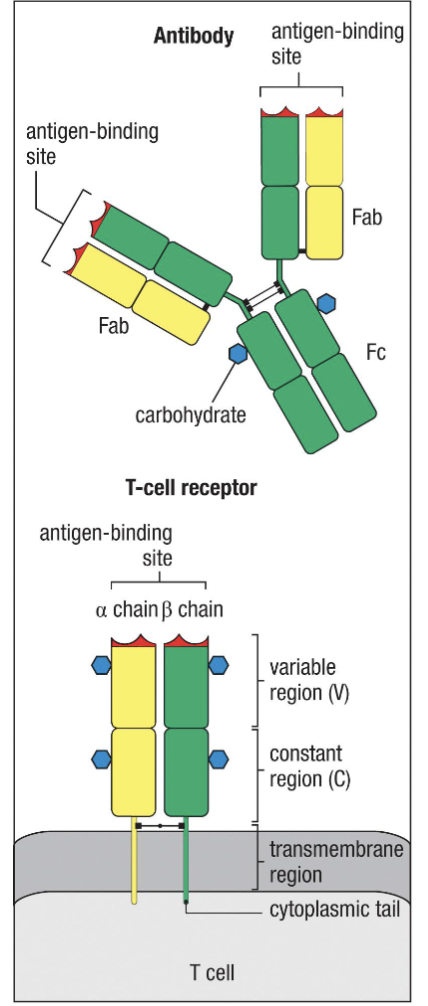
<p><span><span>Polypeptides containing linked chains:</span></span></p><ul><li><p><span><span>TCR resembles a membrane bound Fab made up of TCR⍺ and TCRβ (or TCRɣ and TCRδ)</span></span></p></li><li><p><span><strong><span>Variable regions</span></strong><span> – recognize antigens</span></span></p></li><li><p><span><strong><span>Constant regions</span></strong><span> – structure and function</span></span></p></li></ul><p><span><span>Both undergo RAG-dependent </span><strong><span>somatic gene recombination</span></strong><span> to generate variable region</span></span></p>
49
New cards

What are the differences of T receptors when compared to BCR?

  • Only contains one antigen binding site

  • Does not generate soluble form

  • Does not undergo somatic hypermutation

  • Does not undergo class switching

<ul><li><p><span><span>Only contains one antigen binding site</span></span></p></li><li><p><span><span>Does not generate soluble form</span></span></p></li><li><p><span><span>Does not undergo somatic hypermutation</span></span></p></li><li><p><span><span>Does not undergo class switching</span></span></p></li></ul><p></p>
50
New cards

What are the two classes of TCR?

⍺βTCR

ɣδTCR
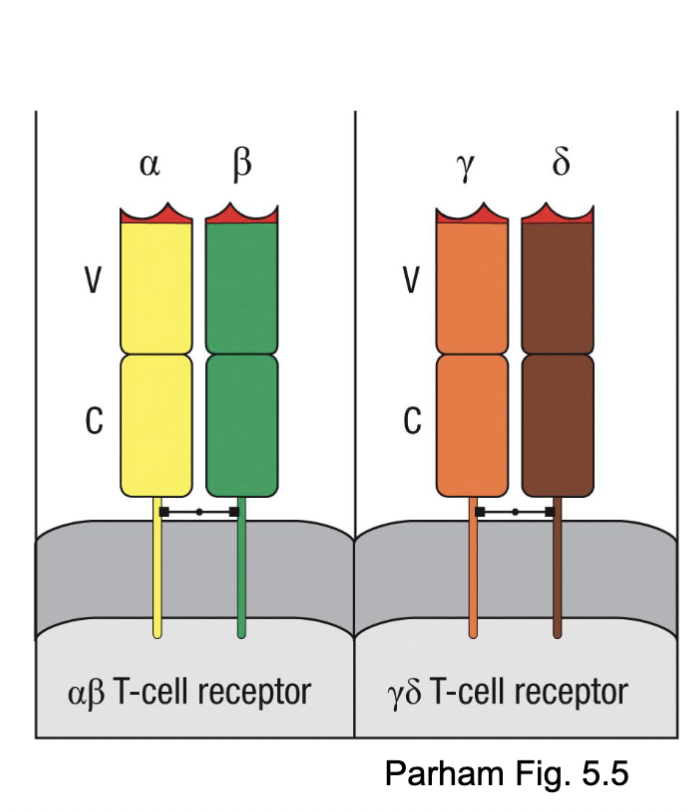
<p>⍺βTCR </p><p>ɣδTCR </p>
51
New cards

What are the features of ⍺βTCR?

  • Most diverse antigen recognition repertoire

  • Typically recognize MHC with short peptides

  • Most common in the human and mouse T cell repertoire

alpha/beta most common (very diverse repertoire, more segments for rearrangement)
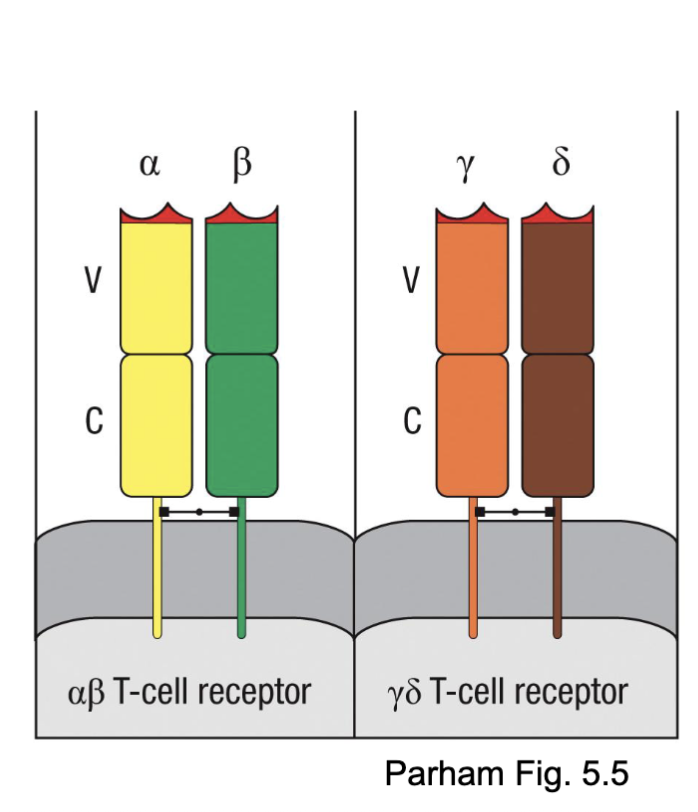
<ul><li><p><span><span>Most diverse antigen recognition repertoire</span></span></p></li><li><p><span><span>Typically recognize MHC with short peptides</span></span></p></li><li><p><span><span>Most common in the human and mouse T cell repertoire</span></span></p></li></ul><p>alpha/beta most common (very diverse repertoire, more segments for rearrangement)</p>
52
New cards

What are the features of ɣδTCR?

  • Less diverse (fewer gene segments)

  • Recognize a wider variety of antigens (lipids, phosphoproteins), with less requirement for classical MHC

  • Most common in the bovine T cell repertoire

gamma/delta recognize wide diversity mostly lipids and carbs (less need MHC)

<ul><li><p>Less diverse (fewer gene segments) </p></li><li><p><span><span>Recognize a wider variety of antigens (lipids, phosphoproteins), with less requirement for classical MHC</span></span></p></li><li><p><span><span>Most common in the bovine T cell repertoire</span></span></p></li></ul><p>gamma/delta recognize wide diversity mostly lipids and carbs (less need MHC)</p>
53
New cards

What are the features of TCR⍺β rearrangement?

  • Account for ~90% of T cells (85-95)

  • TCRs are generated from gene loci encoding TCR⍺ chain (Ch 14) paired with TCRβ chain (Ch 7)

  • Recombination of Variable (V), Diversity (D), and Joining (J) segments T cell receptors →variable regions with different specificity.

  • Regulated by RAG-1/2 complex acting on flanking RSS in segments

  • TCRβ chain recombines D-J segments before recombination with V segments.

  • P- and N- nucleotides added (TdT)

Ch= chromosome

same RAG complex with RSS

Rag cuts out sequence Artemis cuts open hairpin,

54
New cards

What are the features of TCR⍺β Diversity?

  • Compared to immunoglobulins:

    • Greater number of gene segments to recombine (combinatorial diversity)

    • Greater junctional diversity potential (N- and P-nucleotides)

      • TCR: both chains have N- and P-nucleotides added

      • BCR: light chains have few N- and P- nucleotides (TdT
        downregulated at time of rearrangement)

  • Lots of diversity without taking up a lot of space in the genome
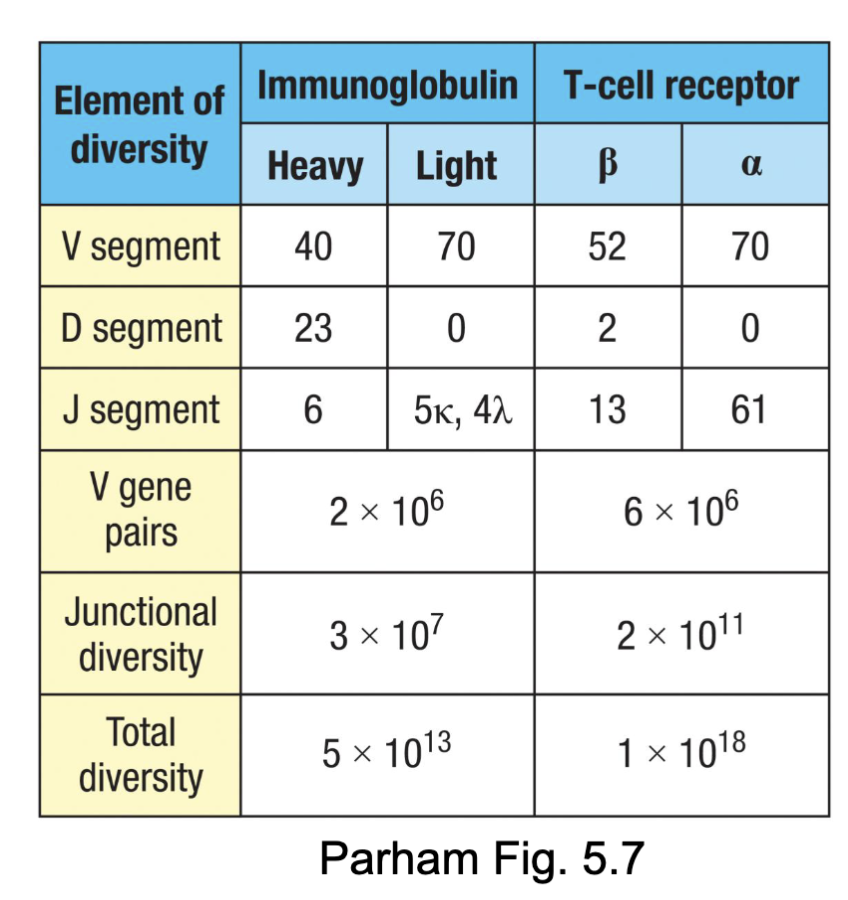
<ul><li><p><span><span>Compared to immunoglobulins:</span></span></p><ul><li><p><span><span>Greater number of gene segments to recombine (combinatorial diversity)</span></span></p></li><li><p><span><span>Greater junctional diversity potential (N- and P-nucleotides)</span></span></p><ul><li><p><span><span>TCR: both chains have N- and P-nucleotides added</span></span></p></li><li><p><span><span>BCR: light chains have few N- and P- nucleotides (TdT</span></span><br><span><span>downregulated at time of rearrangement)</span></span></p></li></ul></li></ul></li><li><p><span><span>Lots of diversity without taking up a lot of space in the genome</span></span></p></li></ul><p></p>
55
New cards

What are the features of TCRɣδ rearrangement?

  • Account for ~10% of T cells

  • TCRs are generated from gene loci encoding TCRɣ chain (Ch 7) paired with TCRδ chain (Ch 14)

  • TCRδ chain sequence are contained in the TCR⍺ locus → rearrangement of TCR⍺ locus deletes the TCRδ genes.

  • TCRδ chain can recombine incorporating 2 D segments → increased diversity

  • P- and N- nucleotides adde

delta -equivalent to the heavy chain in BCR

<ul><li><p><span><span>Account for ~10% of T cells</span></span></p></li><li><p><span><span>TCRs are generated from gene loci encoding </span><strong><span>TCRɣ</span></strong><span>&nbsp;chain (Ch 7) paired with </span><strong><span>TCRδ </span></strong><span>chain (Ch 14)</span></span></p></li><li><p><strong>TCRδ</strong> chain sequence are contained in the TCR⍺ locus → rearrangement of&nbsp;TCR⍺ locus deletes the TCRδ genes.</p></li><li><p><strong>TCRδ</strong>&nbsp;<span><span>chain can recombine incorporating 2 D segments → increased diversity</span></span></p></li><li><p><span><strong><span>P</span></strong><span>- and </span><strong><span>N</span></strong><span>- nucleotides adde</span></span></p></li></ul><p>delta -equivalent to the heavy chain in BCR</p>
56
New cards

What are the features of Recombination Signal Sequences (RSS)?

  • Recall: Heavy Ig chain had same RSS spacer sequence flanking D gene
    segments → 12/23 rule ensures recombination with V and J segments

  • TCRβ and δ have different RSS spacer sequences flanking D gene segments→potential to recombine without D segment or more than one

    • Not actually seen at TCRβ locus

    • Frequent D-D rearrangements found at TCRδ locus → increased
      diversity

same = cannot recombine

beta and delta chain have the diff. bp so have potential to recombine
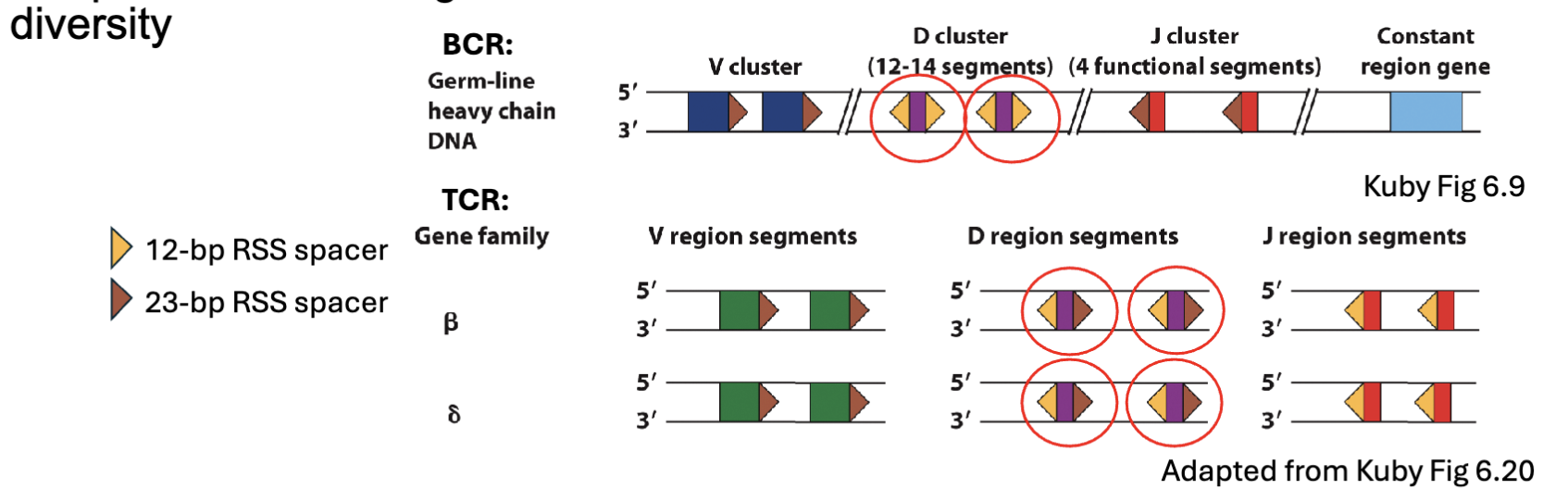
<ul><li><p><span><span>Recall: Heavy Ig chain had same RSS spacer sequence flanking D gene</span></span><br><span><span>segments → 12/23 rule ensures recombination with V and J segments</span></span></p></li><li><p>TCRβ and δ have different <span><span>RSS spacer sequences flanking D gene segments→</span><u><span>potential</span></u><span> to recombine without D segment or more than one</span></span></p><ul><li><p><span><span>Not actually seen at TCRβ locus </span></span></p></li><li><p><span><span>Frequent D-D rearrangements found at TCRδ locus → increased</span></span><br><span><span>diversity</span></span></p></li></ul></li></ul><p>same = cannot recombine</p><p>beta and delta chain have the diff. bp so have potential to recombine</p>
57
New cards

What are the features of T Cell receptor expression?

  • Allelic exclusion prevents rearrangement of more than one successful TCRβ or ɣ chain in mature T cells, TCR⍺ expression regulated after selection.

  • TCR chains expressed as transmembrane disulfide-linked polypeptides (no soluble form)

  • TCR chains associate with CD3 complex proteins: CD3ɣδε (linked genes on Ch 11), CD3ζ (Ch 1)- dimers of ɣε, δε and ζζ

    • Required for TCR transport out of ER

    • Contain transmembrane signalling domains: immunoreceptor tyrosine-based activation motifs (ITAMs)

only one TCR per cell

need to reach the surface to do that needs to associate with diff. protein: CD3 chains (gamma-epsilon or delta-epsilon chain and zeta chains

<ul><li><p><span><strong><span>Allelic exclusion</span></strong><span> prevents rearrangement of more than one successful TCRβ or ɣ chain in mature T cells, TCR⍺ expression regulated after selection.</span></span></p></li><li><p><span><span>TCR chains expressed as </span><strong><span>transmembrane&nbsp;</span></strong><span>disulfide-linked polypeptides (no soluble form)</span></span></p></li><li><p><span><span>TCR chains associate with </span><strong><span>CD3 complex&nbsp;</span></strong><span>proteins: CD3ɣδε (linked genes on Ch 11),</span><strong><span> CD3ζ</span></strong><span> (Ch 1)- dimers of ɣε, δε and&nbsp;</span></span><span>ζζ</span></p><ul><li><p><span><span>Required for TCR </span><strong><span>transport</span></strong><span> out of ER</span></span></p></li><li><p><span><span>Contain transmembrane </span><strong><span>signalling</span></strong><span> domains: immunoreceptor tyrosine-based activation motifs (ITAMs)</span></span></p></li></ul></li></ul><p>only one TCR per cell</p><p>need to reach the surface to do that needs to associate with diff. protein: CD3 chains (gamma-epsilon or delta-epsilon chain and zeta chains</p>
58
New cards

What are the features of CD4 and CD8 of the TCR?

  • TCR complex also includes CD4 or CD8 glycoproteins:

    • CD4: one chain, 4 domains, hinge in the middle

    • CD8: linked ⍺ and β chains

  • co-receptors that aid in binding MHC II or MHC I, respectively
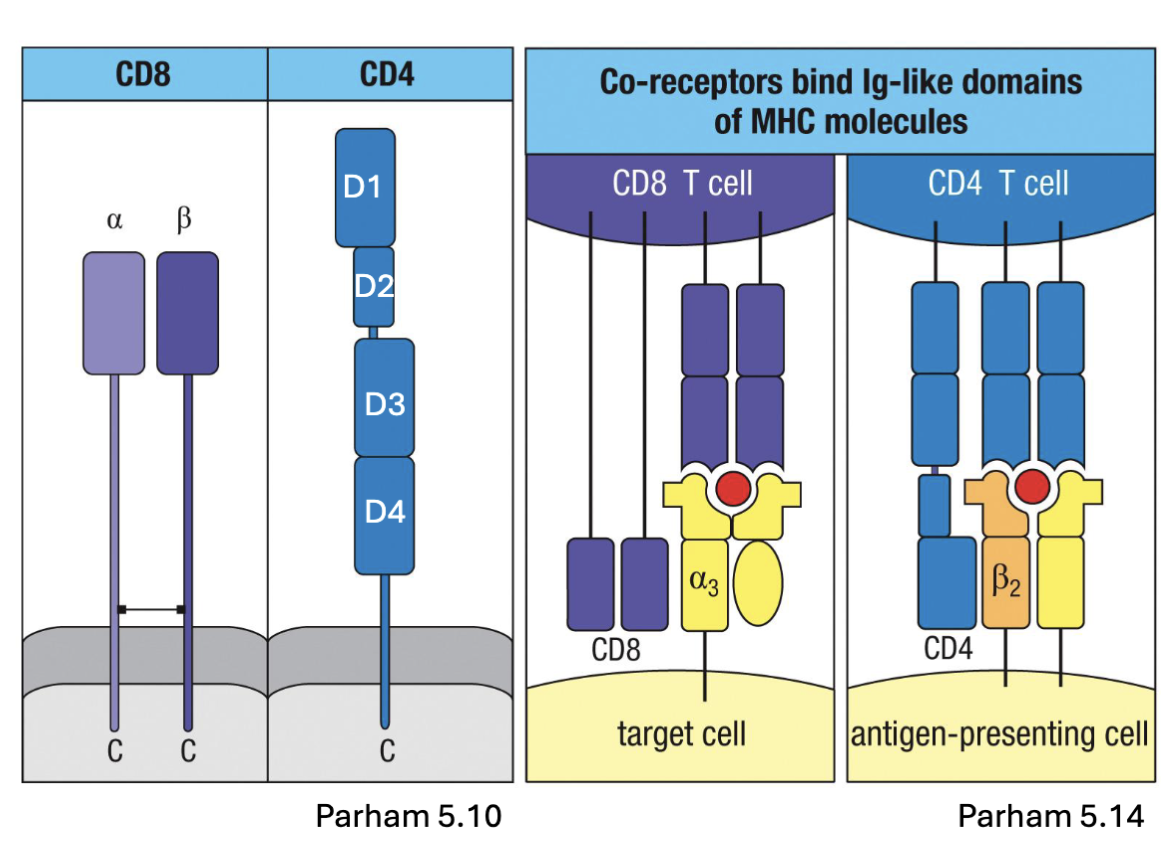
<ul><li><p><span><span>TCR complex</span><u><span> also</span></u><span>&nbsp;includes CD4 or CD8 glycoproteins:</span></span></p><ul><li><p><span><strong><span>CD4</span></strong><span>: one chain, 4 domains, hinge in the middle</span></span></p></li><li><p><span><strong><span>CD8</span></strong><span>: linked ⍺ and β chains</span></span></p></li></ul></li><li><p><span><span>co-receptors that aid in binding MHC II or MHC I, respectively</span></span></p></li></ul><p></p>
59
New cards

What are the differences between MHC class I and MHC class II?

MHC I: widely expressed (except erythrocytes)

MHC II: primarily APCs (DC, B cell, macrophage)

CD8 internal so virus infected

CD4 external
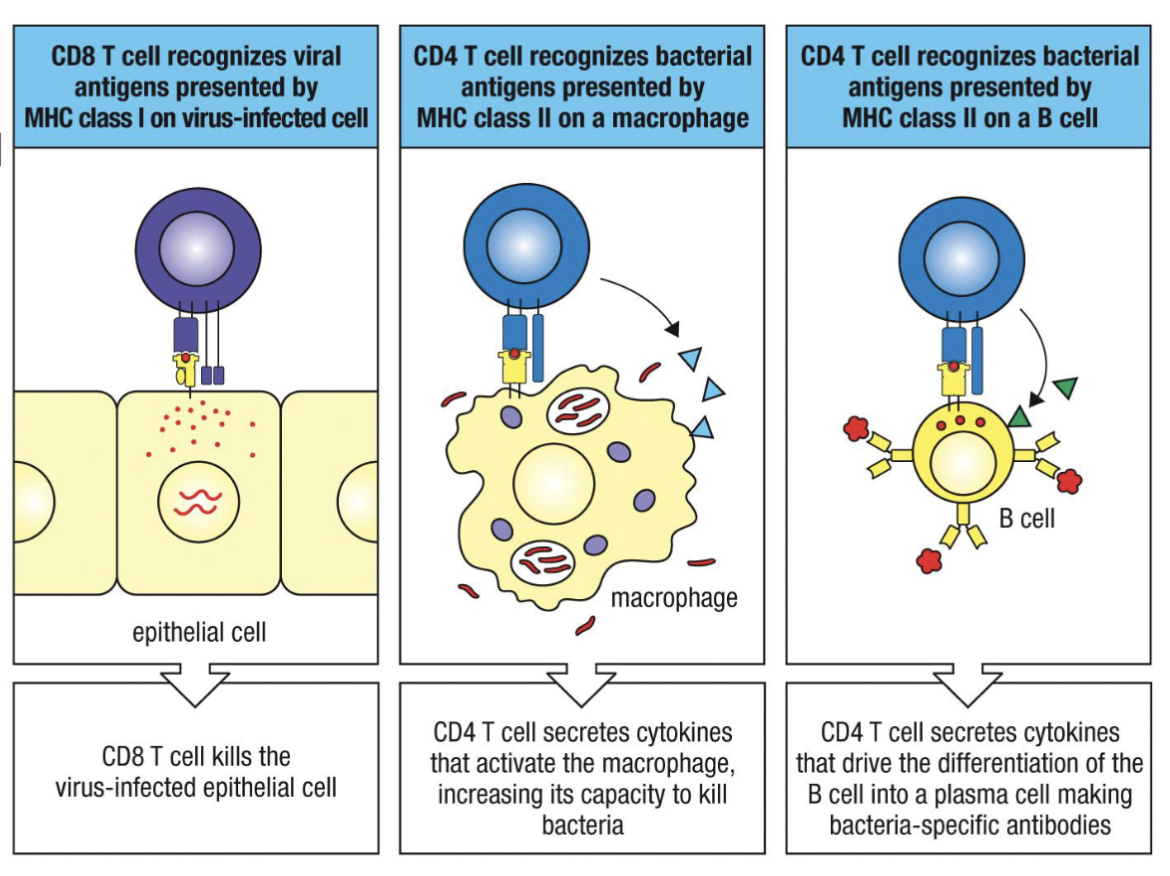
<p><strong>MHC I: </strong><span><span>widely expressed (except erythrocytes)</span></span></p><p><span><strong><span>MHC II</span></strong><span>: primarily APCs (DC, B cell, macrophage)</span></span></p><p>CD8 internal so virus infected</p><p>CD4 external</p>
60
New cards

What is the first signal of TCRs?

MHC binds to TCR

  • Signal 1: TCR:MHC clustering with CD4/CD8 stabilization→ recruitment and activation of Lck

  • Lck phosphorylates ITAMs in CD3 complex cytoplasmic tails

  • ZAP70 is recruited and activated (phosphorylated) → downstream signaling via PLCɣ → transcription factors (AP-1, NF𝛋B, NFAT-1) →survival, proliferation

CD4 enters and binds has LcK (tyrosine kinase) associated with it and it will phosphorylate ITAMs (can now act as docking site)

LcK can phosphorylate ZAP70
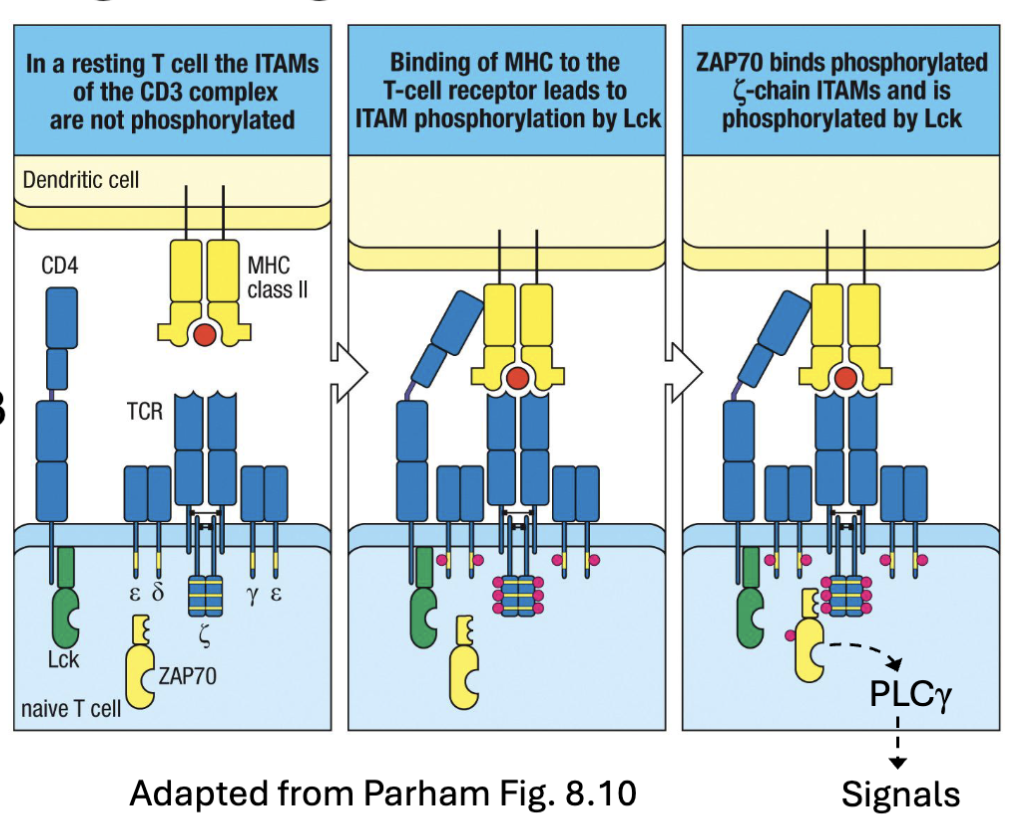
<p><strong><u>MHC binds to TCR </u></strong></p><ul><li><p><span><strong><span>Signal 1</span></strong><span>: TCR:MHC </span><strong><span>clustering </span></strong><span>with CD4/CD8 stabilization→ recruitment and activation of </span><strong><span>Lck</span></strong></span></p></li><li><p><span><span>Lck phosphorylates </span><strong><span>ITAMs</span></strong><span> in CD3 complex cytoplasmic tails</span></span></p></li><li><p><span><strong><span>ZAP70</span></strong><span> is recruited and activated (phosphorylated) → downstream signaling via PLCɣ → transcription factors (</span><strong><span>AP-1, NF𝛋B, NFAT-1)</span></strong><span> →survival, proliferation</span></span></p></li></ul><p>CD4 enters and binds has LcK (tyrosine kinase) associated with it and it will phosphorylate ITAMs (can now act as docking site)</p><p>LcK can phosphorylate ZAP70</p>
61
New cards

What are the second and third signals of the TCR?

  • TCR:MHC signaling is insufficient for full activation → anergy

  • Costimulation (signal 2): B7 molecules (CD80, CD86) upregulated on activated APCs→ bind CD28 on T cells→ enhance signal 20-30 fold

    • Src kinases (Lck, Fyn) phosphorylate cytoplasmic tail→ PI3K recruitment

  • AP-1/NFkB/NFAT-1 signaling → upregulation of IL-2 and CD25 (IL-
    2Rα chain)

  • Cytokine (signal 3): IL-2 is a critical survival and proliferation factor

signal 2 and 3 to reinforce activation

signal 2: costimulation CD80/86 of activated APCs

IL-2Ralpha (high affinity receptor- better than IL-2Rbeta)

signal 3: IL-2 signal
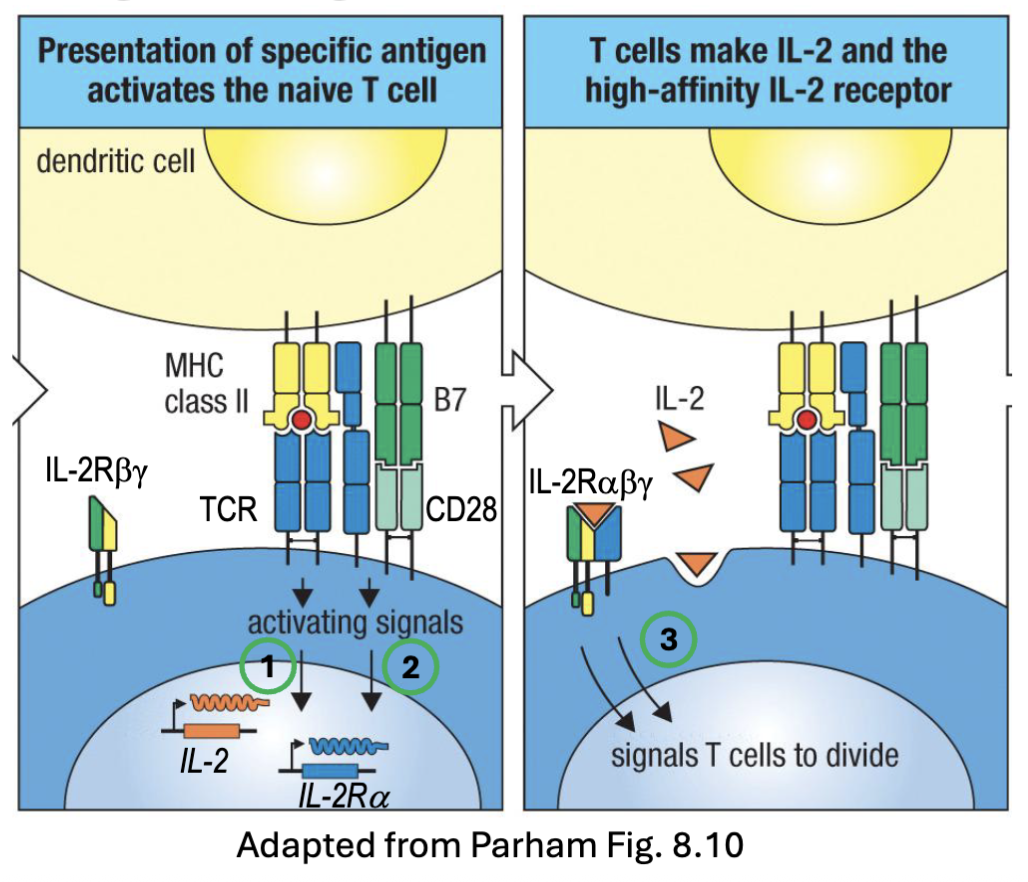
<ul><li><p><span><span>TCR:MHC signaling is insufficient for full activation → </span><strong><span>anergy</span></strong></span></p></li><li><p><span><strong><span>Costimulation (signal 2</span></strong><span>): B7 molecules (</span><strong><span>CD80, CD86</span></strong><span>) upregulated on </span><u><span>activated</span></u><span> APCs→ bind </span><strong><span>CD28 </span></strong><span>on T cells→ enhance signal 20-30 fold</span></span></p><ul><li><p><span><span>Src kinases (Lck, Fyn) phosphorylate cytoplasmic tail→ PI3K recruitment</span></span></p></li></ul></li><li><p><span><span>AP-1/NFkB/NFAT-1 signaling → upregulation of </span><strong><span>IL-2 </span></strong><span>and </span><strong><span>CD25</span></strong><span> (IL-</span></span><br><span><span>2Rα chain)</span></span></p></li><li><p><span><strong><span>Cytokine (signal 3)</span></strong><span>: IL-2 is a critical survival and proliferation factor</span></span></p></li></ul><p>signal 2 and 3 to reinforce activation</p><p>signal 2: costimulation CD80/86 of activated APCs</p><p>IL-2Ralpha (high affinity receptor- better than IL-2Rbeta)</p><p>signal 3: IL-2 signal</p>
62
New cards

What is JAK/STAT pathway? (recall)

  • Signaling mechanism for many cytokines (IL-2, IL-4, IL-5, Il-7, IL-12, Il-23, IFNɣ, etc.

  • IL-2R associates with JAK1 and JAK3 → STAT 5 (mostly), STAT1, STAT3

when the JAKs are together autophosphorylate and the receptor C’ terminus⇒ allows docking sites (STATs)

STATs become phosphorylated by JAK can then leave and dimerize: go to nucleus cause transcription
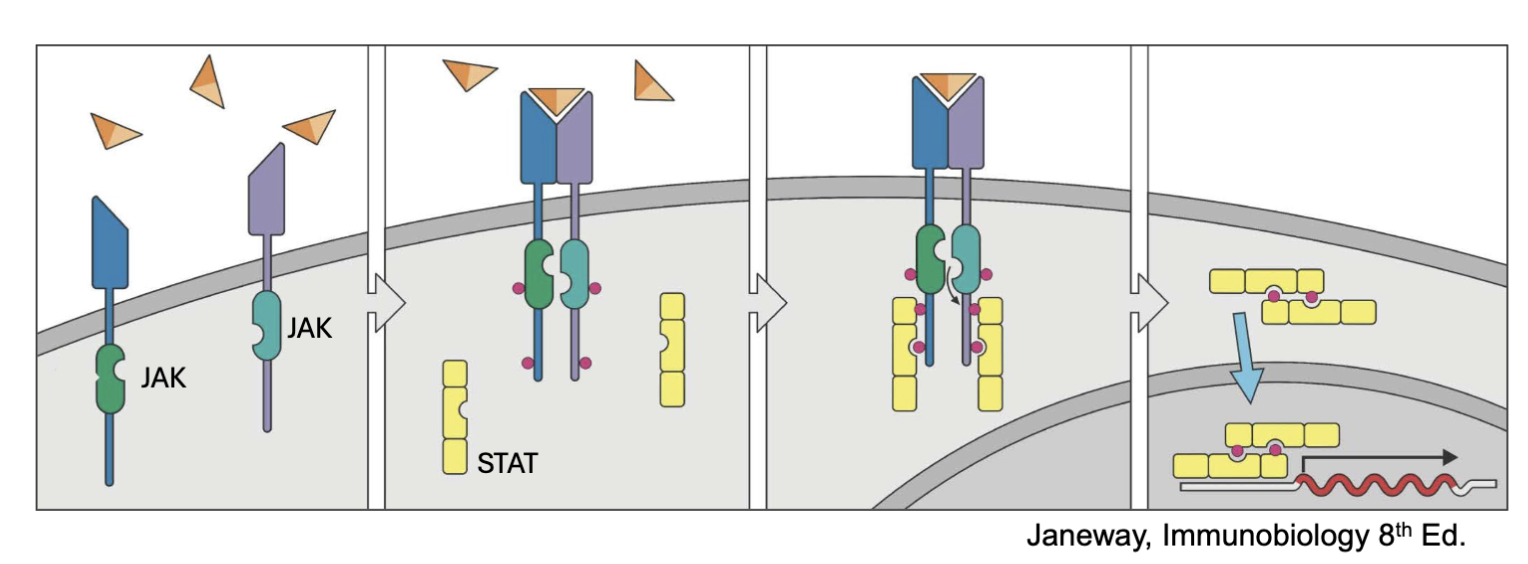
<ul><li><p><span><span>Signaling mechanism for many cytokines (IL-2, IL-4, IL-5, Il-7, IL-12, Il-23, IFNɣ, etc.</span></span></p></li><li><p><span><span>IL-2R associates with JAK1 and JAK3 → STAT 5 (mostly), STAT1, STAT3</span></span></p></li></ul><p>when the JAKs are together autophosphorylate and the receptor C’ terminus⇒ allows docking sites (STATs)</p><p>STATs become phosphorylated by JAK can then leave and dimerize: go to nucleus cause transcription</p>
63
New cards

What are the differences between BCR and TCR in regards to: antigen source, antigen features, composition, binding sites/ receptors, secreted products, germline rearrangement, RAG1/2 dependent, junctional diversity, somatic hypermutation, associated molecules?

                                            TCR                          BCR

antigen source:    Intracellular→MHC/HLA        Extracellular 

antigen features:   ⍺β: mostly peptides           Native structures 

                              ɣδ: native structures other 

composition:        2 chains ⍺β + ɣδ                  4 chains: 2 light chains (𝛋, 𝛌)

                                                                         +2 heavy chains (µ,⍺, ε, ɣ,δ)

binding sites/ receptors: 1                                    2

secreted products: No membrane TCR only  Yes, antibodies but also membrane BCR

germline rearrangement: Yes V(D) J segments   Yes V(D) J segments   

RAG1/2 dependent:         Yes                              Yes

junctional diversity:          Yes                              Yes (fewer N-nucleotides) 

somatic hypermutation:   No                                Yes

associated molecules: CD3 complex, CD4 or CD8  CD79a and CD79b

BCR: native 3D structure being recognized
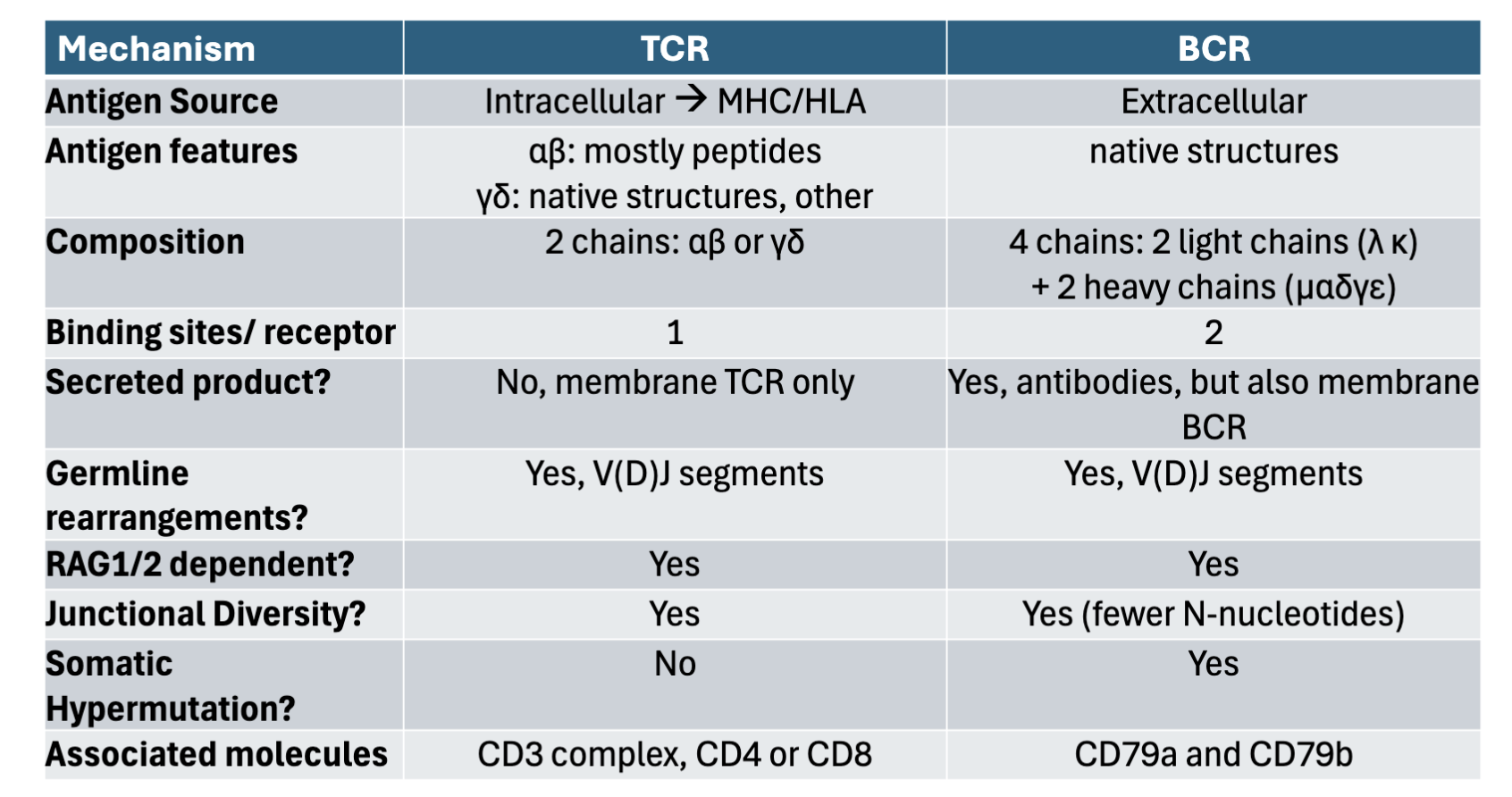
<p>&nbsp; &nbsp; &nbsp; &nbsp; &nbsp; &nbsp; &nbsp; &nbsp; &nbsp; &nbsp; &nbsp; &nbsp; &nbsp; &nbsp; &nbsp; &nbsp; &nbsp; &nbsp; &nbsp; &nbsp; &nbsp; &nbsp; TCR&nbsp; &nbsp; &nbsp; &nbsp; &nbsp; &nbsp; &nbsp; &nbsp; &nbsp; &nbsp; &nbsp; &nbsp; &nbsp; BCR</p><p>antigen source:&nbsp; &nbsp; Intracellular→MHC/HLA&nbsp; &nbsp; &nbsp; &nbsp; Extracellular&nbsp;</p><p>antigen features:&nbsp; &nbsp;⍺β: mostly peptides&nbsp; &nbsp; &nbsp; &nbsp; &nbsp; &nbsp;Native structures&nbsp;</p><p>&nbsp; &nbsp; &nbsp; &nbsp; &nbsp; &nbsp; &nbsp; &nbsp; &nbsp; &nbsp; &nbsp; &nbsp; &nbsp; &nbsp; &nbsp; ɣδ: native structures other&nbsp;</p><p>composition:&nbsp; &nbsp; &nbsp; &nbsp; 2 chains&nbsp;⍺β +&nbsp;ɣδ&nbsp; &nbsp; &nbsp; &nbsp; &nbsp; &nbsp; &nbsp; &nbsp; &nbsp; 4 chains: 2 light chains (𝛋, 𝛌)</p><p>&nbsp; &nbsp; &nbsp; &nbsp; &nbsp; &nbsp; &nbsp; &nbsp; &nbsp; &nbsp; &nbsp; &nbsp; &nbsp; &nbsp; &nbsp; &nbsp; &nbsp; &nbsp; &nbsp; &nbsp; &nbsp; &nbsp; &nbsp; &nbsp; &nbsp; &nbsp; &nbsp; &nbsp; &nbsp; &nbsp; &nbsp; &nbsp; &nbsp; &nbsp; &nbsp; &nbsp; &nbsp;+2 heavy chains (µ,⍺, ε, ɣ,δ)</p><p>binding sites/ receptors: 1&nbsp; &nbsp; &nbsp; &nbsp; &nbsp; &nbsp; &nbsp; &nbsp; &nbsp; &nbsp; &nbsp; &nbsp; &nbsp; &nbsp; &nbsp; &nbsp; &nbsp; &nbsp; 2</p><p>secreted products: No membrane TCR only&nbsp; Yes, antibodies but also membrane BCR</p><p>germline rearrangement: Yes V(D) J segments&nbsp; &nbsp;Yes V(D) J segments&nbsp; &nbsp;</p><p>RAG1/2 dependent:&nbsp; &nbsp; &nbsp; &nbsp; &nbsp;Yes&nbsp; &nbsp; &nbsp; &nbsp; &nbsp; &nbsp; &nbsp; &nbsp; &nbsp; &nbsp; &nbsp; &nbsp; &nbsp; &nbsp; &nbsp; Yes</p><p>junctional diversity:&nbsp; &nbsp; &nbsp; &nbsp; &nbsp; Yes&nbsp; &nbsp; &nbsp; &nbsp; &nbsp; &nbsp; &nbsp; &nbsp; &nbsp; &nbsp; &nbsp; &nbsp; &nbsp; &nbsp; &nbsp; Yes (fewer N-nucleotides)&nbsp;</p><p>somatic hypermutation:&nbsp; &nbsp;No&nbsp; &nbsp; &nbsp; &nbsp; &nbsp; &nbsp; &nbsp; &nbsp; &nbsp; &nbsp; &nbsp; &nbsp; &nbsp; &nbsp; &nbsp; &nbsp; Yes</p><p>associated molecules: CD3 complex, CD4 or CD8&nbsp; CD79a and CD79b</p><p></p><p>BCR: native 3D structure being recognized</p>
64
New cards

What are the stages of T cell development?

Originate from CLP (common lymphoid progenitor)- from bone marrow

Differentiate to T cell progenitor: upregulate Flt3, L-selectin, CCR7, CCR9

In thymus: become early thymic precursors (ETPs) a.k.a. double-negative (DN) thymocytes bc CD4- and CD8-

T cell development from this stage onwards is in thymus (primary lymphoid tissue)

T cell pool remains stable until old age (long lifespan w/ self-renewal) → but loses function over one’s lifetime (immunosenescence)

Stomal cells provide growth/ survival signals (IL-7, Ftl3L, Notch-1) & coordinate selection of developing TCRs for self-restriction (recognizes MHC) + self-tolerance

65
New cards

What is immunosenescence?

(thymus shrinks with age = can’t make new T cells so:)

T cell pool remains stable until old age (long lifespan w/ self-renewal) → but loses function over one’s lifetime

cells tired work less well

66
New cards

What are the features of T cell development in the thymus?

  • Thymus is a primary lymphoid tissue (site of development) lying over heart

    • fully developed at birth and shrinks over time

    • T cell pool remains stable until old age (long lifespan with self-renewal) → but loses function (immunosenescence)

    • DiGeorge syndrome → lack thymus → T cell deficiency

  • stromal cells provide growth/survival signals (IL-7, Flt3L, Notch-1)

  • interactions select for self-restriction
    (recognize MHC) and self-tolerance
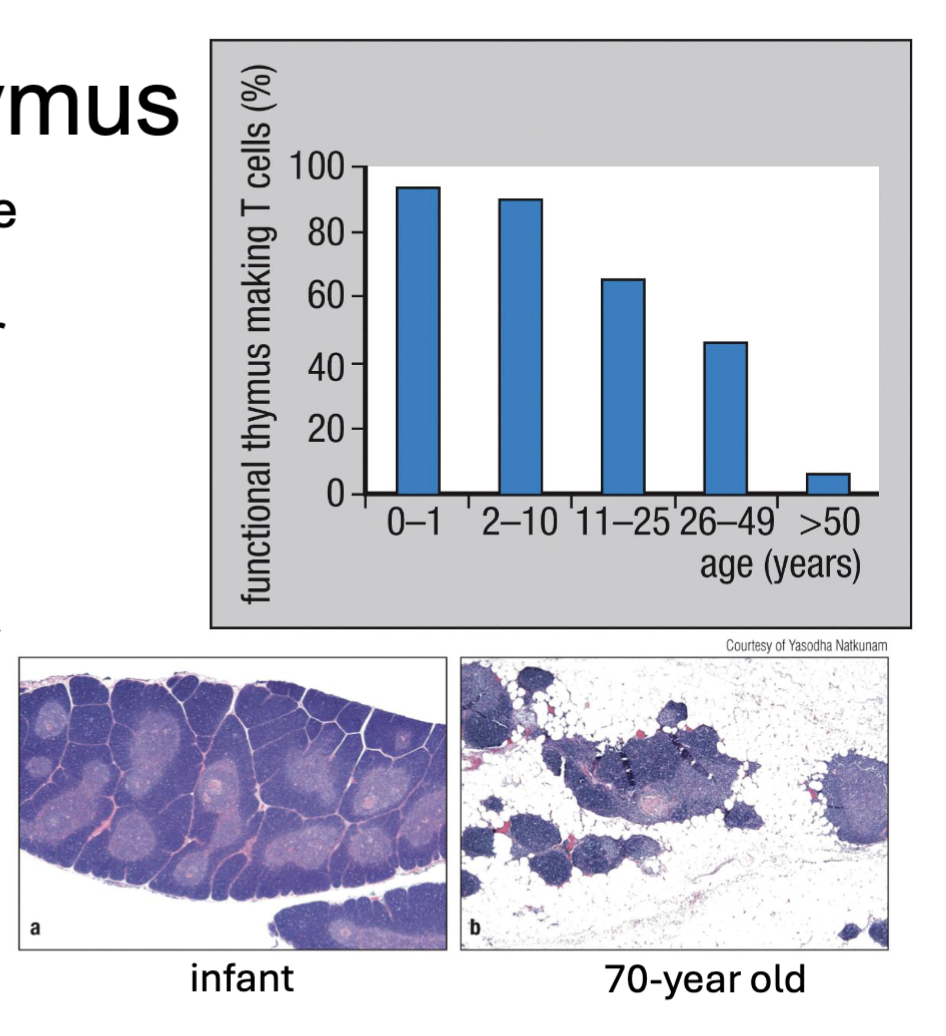
<ul><li><p><span><span>Thymus is a </span><strong><span>primary lymphoid tissue</span></strong><span> (site of development) lying over heart</span></span></p><ul><li><p><span><span>fully developed at birth and shrinks over time</span></span></p></li><li><p><span><span>T cell pool remains stable until old age (long lifespan with self-renewal) → but loses function (</span><strong><span>immunosenescence</span></strong><span>)</span></span></p></li><li><p><span><strong><span>DiGeorge syndrome</span></strong><span> → lack thymus → T cell deficiency</span></span></p></li></ul></li><li><p><span><span>stromal cells provide growth/survival signals (</span><mark data-color="yellow" style="background-color: yellow; color: inherit;"><span>IL-7, Flt3L, Notch-1</span></mark><span>)</span></span></p></li><li><p><span><span>interactions select for self-restriction</span></span><br><span><span>(recognize MHC) and self-tolerance</span></span></p></li></ul><p></p>
67
New cards

What are the features of T cell development (makes it a T cell)?

  • T cells are derived from a subset common lymphoid progenitors (CLP)

    • High levels of Flt3 (cytokine receptor)

    • Upregulate L-selectin, CCR7 and CCR9 (adhesion molecules)

  • Seed thymus and develop into early thymic precursors (ETPs/ DN): CD4-CD8-

    • Expansion, T cell commitment, TCRβ𝛄δ rearrangements

  • Double positive (DP): CD4+CD8+

    • TCR⍺ rearrangements expressed

    • Positive and negative selection

  • Single positive (SP): naïve CD4 or CD8 T cells → exit thymus and recirculate through lymphoid tissues
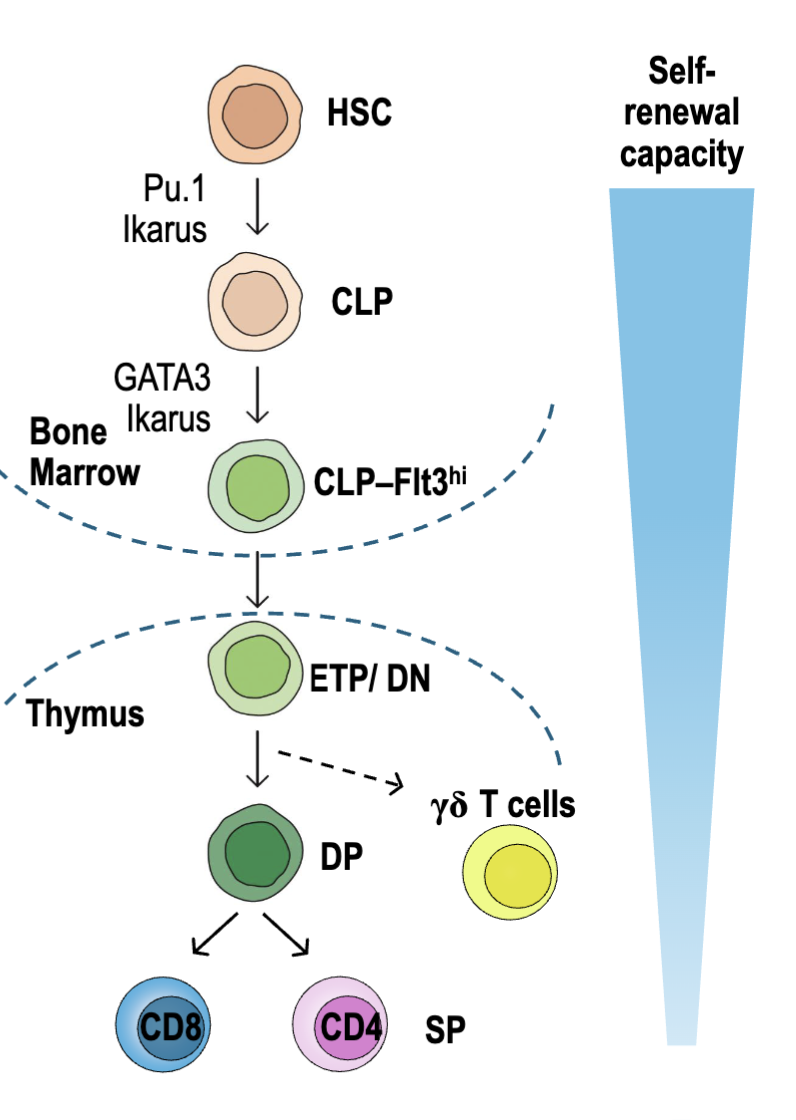
<ul><li><p><span><span>T cells are derived from a subset common lymphoid progenitors (</span><strong><span>CLP</span></strong><span>)</span></span></p><ul><li><p><span><span>High levels of </span><strong><span>Flt3</span></strong><span> (cytokine receptor)</span></span></p></li><li><p><span><span>Upregulate </span><mark data-color="yellow" style="background-color: yellow; color: inherit;"><span>L-selectin, CCR7 and CCR9</span></mark><mark data-color="#ffffff" style="background-color: rgb(255, 255, 255); color: inherit;"><span> (adhesion molecules) </span></mark></span></p></li></ul></li><li><p><span><span>Seed thymus and develop into early thymic precursors (</span><strong><span>ETPs/ DN</span></strong><span>): CD4-CD8-</span></span></p><ul><li><p><span><span>Expansion, T cell commitment, TCRβ𝛄δ rearrangements</span></span></p></li></ul></li><li><p><span><span>Double positive (</span><strong><span>DP</span></strong><span>): CD4+CD8+</span></span></p><ul><li><p><span><span>TCR⍺ rearrangements expressed</span></span></p></li><li><p><span><span>Positive and negative selection</span></span></p></li></ul></li><li><p><span><span>Single positive </span><strong><span>(SP</span></strong><span>): naïve CD4 or CD8 T cells → exit thymus and recirculate through lymphoid tissues</span></span></p></li></ul><p></p>
68
New cards

What are the features of T Cell Development: Double Negative (CD4-CD8-) Thymocytes?

  • DN1 (c-kit++ CD44+ CD25-): move from corticomedullary junction towards outer cortex  (C44+ surface= interactions with TEC)

  • interactions with stromal thymic epithelial cells (TEC)

    • IL-7 → survival, proliferation

    • Notch signaling → T cell commitment

  • DN2 (c-kit++CD44+CD25+): simultaneous rearrangements of TCRβ𝛄δ

  • DN3 (c-kit+CD44-CD25+): preTCR expressed → β-selection

  • DN4 (Ckit-CD44-CD25-): proliferation; allelic exclusion of β-chain; 𝛾-chain silencing

  • DP (CD4+CD8+): ⍺-chain rearrangement and TCR𝜶β expression → positive selection
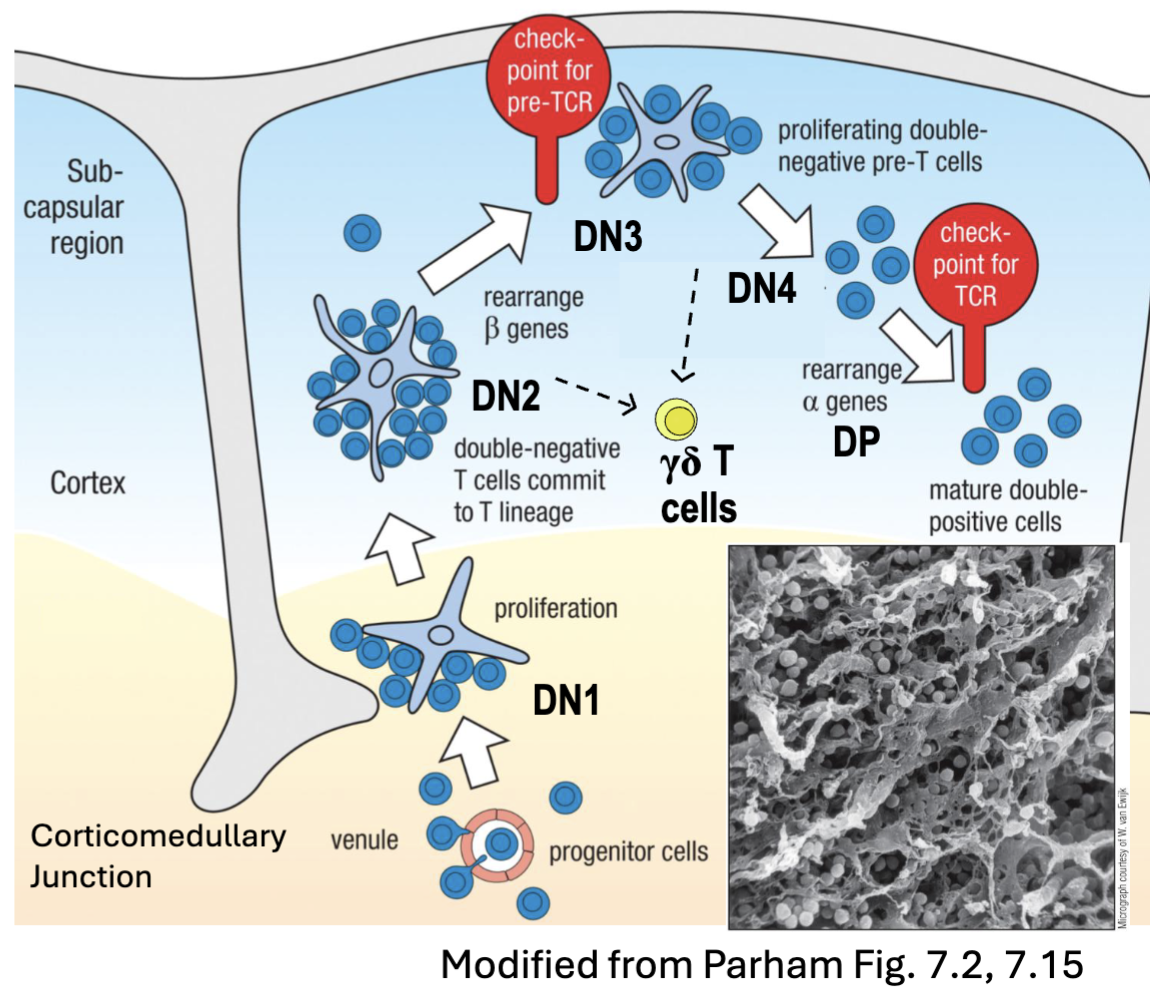
<ul><li><p><strong><span>DN1</span></strong><span> (c-kit++ CD44+ CD25-): move from corticomedullary junction towards outer cortex&nbsp; (C44+ surface= interactions with TEC)</span></p></li><li><p><span>interactions with stromal thymic epithelial cells (</span><strong><span>TEC</span></strong><span>)</span></p><ul><li><p><strong><span>IL-7 </span></strong><span>→ survival, proliferation</span></p></li><li><p><strong><span>Notch</span></strong><span> signaling → T cell commitment</span></p></li></ul></li><li><p><strong><span>DN2</span></strong><span> (c-kit++CD44+CD25+): simultaneous </span><strong><span>rearrangements</span></strong><span> of&nbsp;TCRβ𝛄δ</span></p></li><li><p><strong><span>DN3</span></strong><span> (c-kit+CD44-CD25+): </span><strong><span>preTCR</span></strong><span> expressed → β-</span><strong><span>selection</span></strong></p></li><li><p><strong><span>DN4</span></strong><span> (Ckit-CD44-CD25-): proliferation; allelic exclusion of β-chain; 𝛾-chain silencing</span></p></li><li><p><strong><span>DP</span></strong><span> (CD4+CD8+): ⍺-chain rearrangement and TCR𝜶β expression →</span><strong><span> positive selection</span></strong></p></li></ul><p></p>
69
New cards

What are the features of the Notch transcription factor in relation to DN thymocyte T cell development?

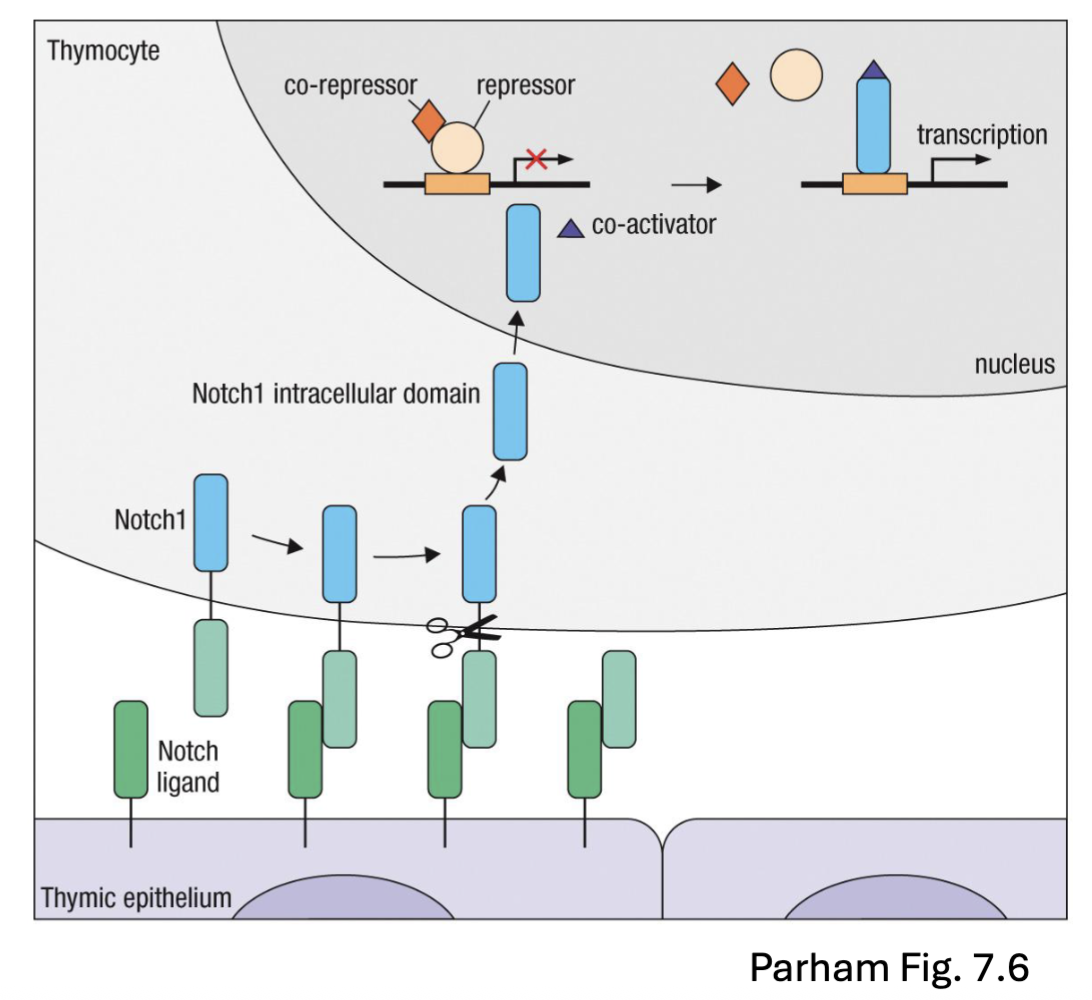
Notch: transcription factor

transcription factor leaves the membrane and then enter the nucleus and affect transcription
<p>Notch: transcription factor</p><p>transcription factor leaves the membrane and then enter the nucleus and affect transcription</p>
70
New cards

⍺β or 𝛾δ is it a race?

  • TCRβ, 𝛾, or δ rearrangements take place in thymocytes simultaneously

    • 𝛾δ T cells need to successfully rearrange both 𝛾 and δ chains→ TCR signalling → commitment

    • Cells fated to be ⍺β T cells only need a productive TCRβ rearrangement

      • β chains associates with preT⍺ and CD3 complex → pre-T cell receptor (preTCR) signalling → β-chain selection → commitment & proliferation

  • ⍺β T cells favoured due to:

    • Lots of V⍺ and Vβ segments and β-chain with two D-J-C regions → multiple attempts

    • β-selection checkpoint → proliferation of large
      pool for trying out ⍺-chain rearrangements

    • ⍺-chain rearrangements deletes the δ-chain gene segment

(gamma delta need to rearrange both at the same time for the lineage commitment

alpha beta only need to upregulate beta chain)
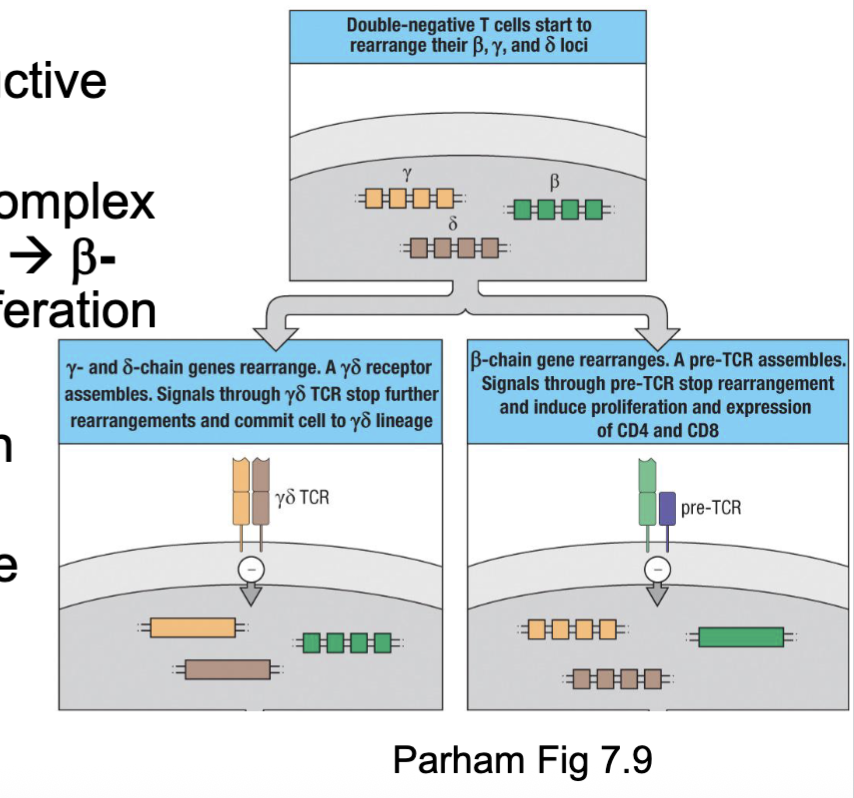
<ul><li><p>TCRβ, 𝛾, or δ r<span><span>earrangements take place in thymocytes simultaneously</span></span></p><ul><li><p> 𝛾δ T cells need to successfully rearrange both 𝛾 and δ chains→ TCR signalling → commitment </p></li><li><p><span><span>Cells fated to be </span></span>⍺β T cells only need a productive TCRβ rearrangement </p><ul><li><p>β chains <span><span>associates with </span><strong><span>preT</span></strong><span>⍺ and CD3 complex → pre-T cell receptor (preTCR) signalling → </span><strong><span>β-chain selection</span></strong><span> → commitment &amp; proliferation</span></span></p></li></ul></li></ul></li><li><p>⍺β T cells favoured due to: </p><ul><li><p><span><span>Lots of V⍺ and Vβ segments and β-chain with two D-J-C regions → multiple attempts</span></span></p></li><li><p><span><span>β-selection checkpoint → proliferation of large</span></span><br><span><span>pool for trying out ⍺-chain rearrangements</span></span></p></li><li><p>⍺-chain rearrangements deletes the δ-chain gene segment</p></li></ul></li></ul><p>(gamma delta need to rearrange both at the same time for the lineage commitment</p><p>alpha beta only need to upregulate beta chain)</p>
71
New cards

When are 𝛾δ T cells most regulated?

  • 𝛾δ T cells seem to be regulated during development

    • Come out of the thymus in early waves before birth

    • Likely regulated by transcription factors and gene segment accessibility within chromatin

  • 𝛾δ T cells at this point appear to be mature and exit the thymus without further education

    • Most recognize atypical antigens (e.g., lipids and phosphoantigens)
      independent of classical MHC

<ul><li><p>𝛾δ T cells seem to be regulated during development</p><ul><li><p><span><span>Come out of the thymus in early waves before birth</span></span></p></li><li><p><span><span>Likely regulated by transcription factors and gene segment accessibility within chromatin</span></span></p></li></ul></li><li><p>𝛾δ T cells at this point appear to be mature and exit the thymus without further education </p><ul><li><p><span><span>Most recognize atypical antigens (e.g., lipids and phosphoantigens)</span></span><br><span><span>independent of classical MHC</span></span></p></li></ul></li></ul><p></p>
72
New cards

What are the features of T Cell Development: Double Positive (CD4+CD8+) Thymocytes?

  • DP thymocytes (CD4+CD8+): represent >80% of cells in thymus

    • have undergone ⍺-chain rearrangement

    • upregulate CD4 and CD8

    • start to express mature ⍺βTCR

  • Migrate from subscapular region deeper into cortex

  • Interactions with cortical thymic epithelial cells (cTECs), macrophage →
    positive selection (MHC restriction) → survival (~ 2% are successful)

  • CD4 and CD8 ensure DP cells can engage with either MHC II or MHC I →
    differential signaling will commit to CD4 or CD8 SP thymocytes
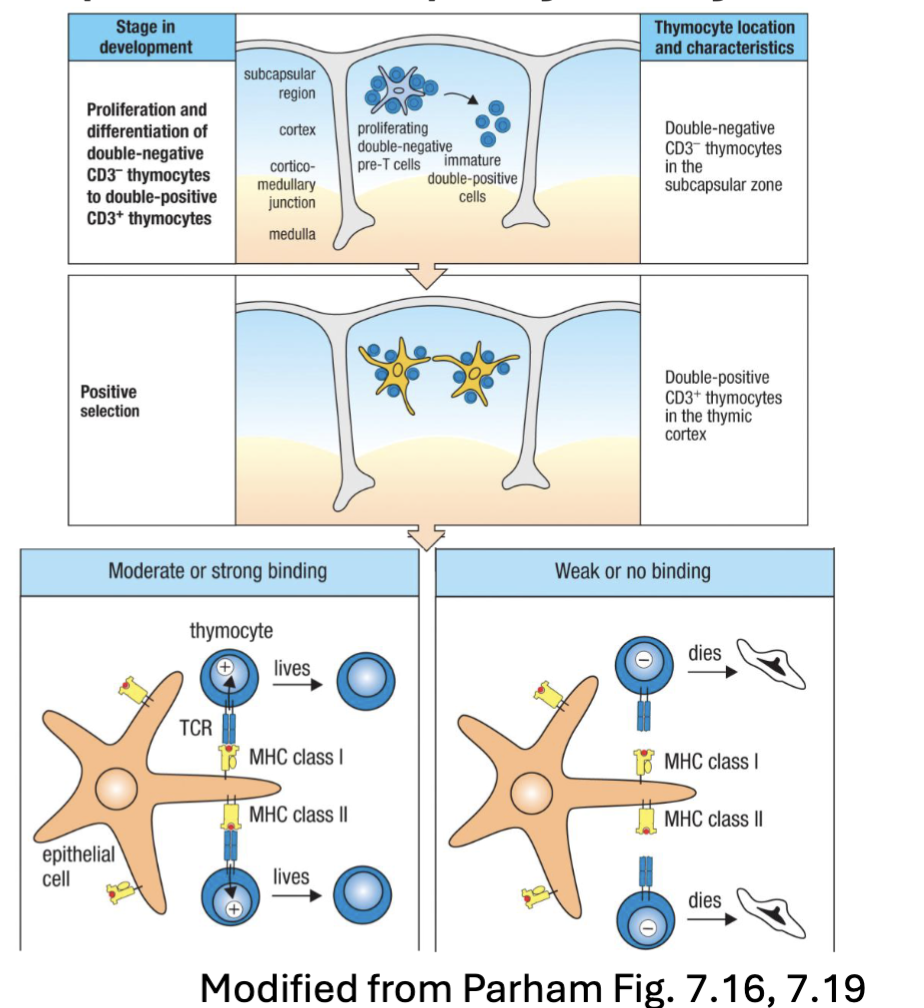
<ul><li><p><span><strong><span>DP thymocytes</span></strong><span> (CD4+CD8+): represent &gt;80% of cells in thymus</span></span></p><ul><li><p><span><span>have undergone ⍺-chain rearrangement</span></span></p></li><li><p><span><span>upregulate CD4 and CD8</span></span></p></li><li><p><span><span>start to express mature ⍺βTCR</span></span></p></li></ul></li><li><p><span><span>Migrate from subscapular region deeper into cortex</span></span></p></li><li><p><span><span>Interactions with cortical thymic epithelial cells (</span><strong><span>cTECs</span></strong><span>), macrophage →</span></span><br><span><strong><span>positive selection (MHC restriction)</span></strong><span> → survival (~ 2% are successful)</span></span></p></li><li><p><span><span>CD4 and CD8 ensure DP cells can engage with either MHC II or MHC I →</span></span><br><span><span>differential signaling will commit to CD4 or CD8 SP thymocytes</span></span></p></li></ul><p></p>
73
New cards

What is positive selection in DP thymocytes?

positive selection, if the cell can recognize MHC = positive selection

if not recognized the cell don’t get a signal and undergo apoptosis

(Positive selection is an immunological process that ensures lymphocytes, such as T cells, have receptors capable of recognizing self-MHC molecules)

74
New cards

What are the features of T Cell Development: Negative Selection? 

  • Negative selection eliminates autoreactive thymocytes binding to MHC/peptides

    • Results in central tolerance via apoptosis of autoreactive thymocytes → clearance by macrophage

    • Can take place in either the thymic cortex (DP cells) or medulla (SP cells)

  • Medullary thymic epithelial cells (mTEC) express AIRE (autoimmune regulator) and FEZ transcription factors

    • Bind histones with closed chromatin →recruit transcription factors and RNA polymerase →expression and MHC processing of proteins found outside thymus (i.e. insulin, MBP)

(presented peptides from self loaded by MHC)
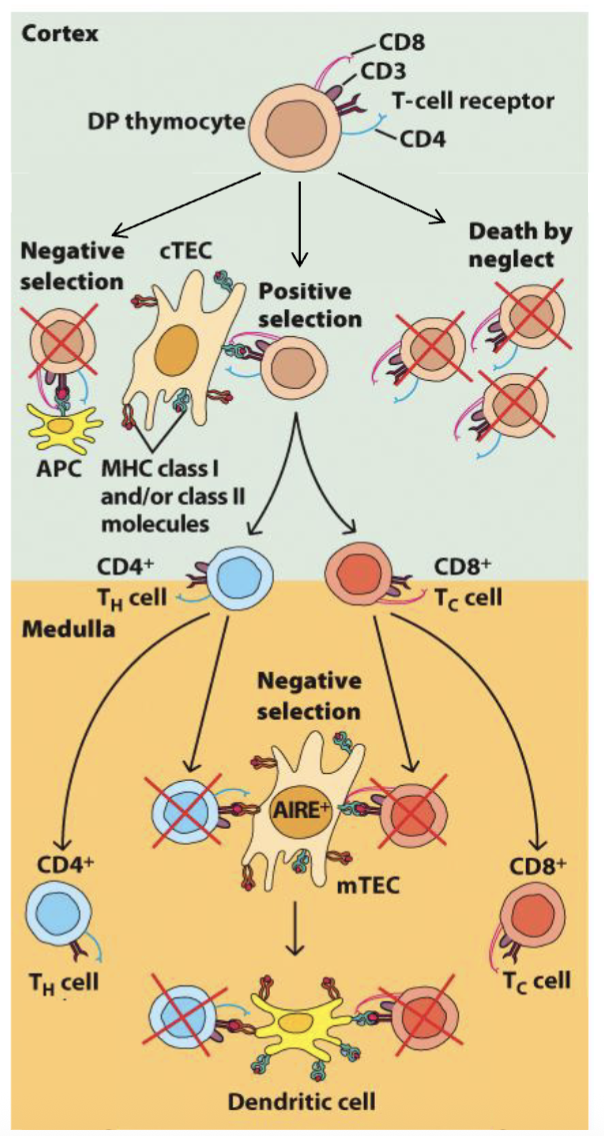
<ul><li><p><span><strong><span>Negative selection</span></strong><span> eliminates autoreactive thymocytes binding to MHC/peptides</span></span></p><ul><li><p><span><span>Results in </span><strong><span>central tolerance</span></strong><span> via apoptosis of autoreactive thymocytes → clearance by macrophage</span></span></p></li><li><p><span><span>Can take place in either the thymic cortex (DP cells) or medulla (SP cells)</span></span></p></li></ul></li><li><p><span><span>Medullary thymic epithelial cells (</span><strong><span>mTEC</span></strong><span>) express </span><strong><span>AIRE</span></strong><span> (</span><strong><span>autoimmune regulator</span></strong><span>) and FEZ transcription factors</span></span></p><ul><li><p><span><span>Bind histones with closed chromatin →recruit transcription factors and RNA polymerase →expression and MHC processing of proteins found outside thymus (i.e. insulin, MBP)</span></span></p></li></ul></li></ul><p>(presented peptides from self loaded by MHC)</p>
75
New cards

What is the selection paradox that arises during T cell development?

  • Positive selection: required to recognize self-MHC

  • Negative selection: eliminates autoreactive thymocytes

  • Q: Why aren’t positively selected thymocytes eliminated by negative selection?

  • Affinity model of selection: fate determined by binding/signal strength

    • No/low signal → death but neglect

    • Low/int signal → positive selection

    • High signal → negative selection

  • Altered peptide model: cTEC process different peptides for positive selection

    • Unique catalytic subunit in thymic proteosome → altered low affinity
      peptides

mix of both models, looking for intermediate zone (positively selected and not deleted)

Altered Peptide model: proposes thymic epithelial cells process peptides differently

thymic protoesome has different catylic region
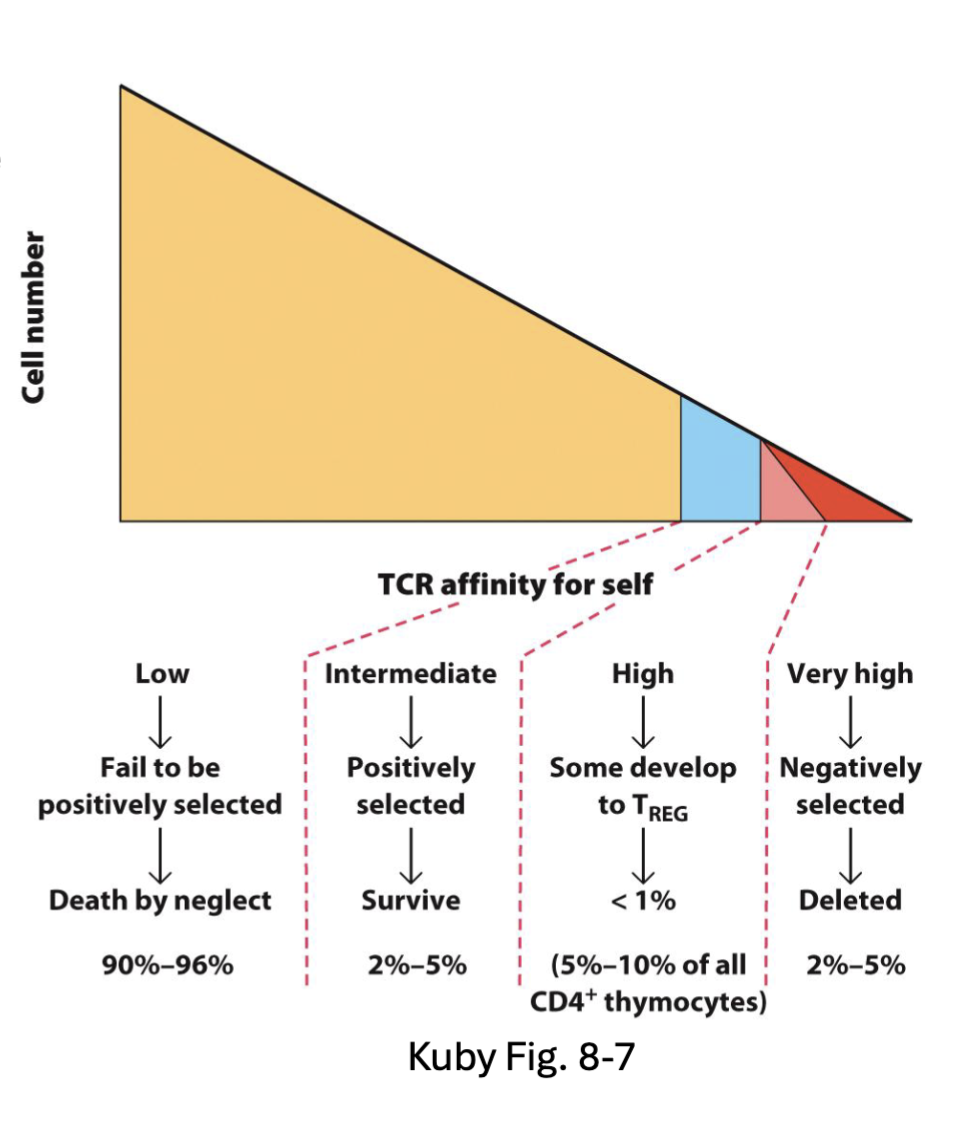
<ul><li><p><span><span>Positive selection: required to recognize self-MHC</span></span></p></li><li><p><span><span>Negative selection: eliminates autoreactive thymocytes</span></span></p></li><li><p><span><span>Q: Why aren’t positively selected thymocytes eliminated by negative selection?</span></span></p></li><li><p><span><span>Affinity model of selection: fate determined by binding/signal strength</span></span></p><ul><li><p><span><span>No/low signal → death but neglect</span></span></p></li><li><p><span><span>Low/int signal → positive selection</span></span></p></li><li><p><span><span>High signal → negative selection</span></span></p></li></ul></li><li><p><span><span>Altered peptide model: cTEC process different peptides for positive selection</span></span></p><ul><li><p><span><span>Unique catalytic subunit in thymic proteosome → altered low affinity</span></span><br><span><span>peptides</span></span></p></li></ul></li></ul><p></p><p>mix of both models, looking for intermediate zone (positively selected and not deleted)</p><p>Altered Peptide model: proposes thymic epithelial cells process peptides differently</p><p>thymic protoesome has different catylic region</p>
76
New cards

What are the features of CD4 and CD8 T Cell Commitment?

  • CD4 and CD8 ensure DP cells can engage with either MHC II or MHC I

  • Differential signaling commits DP cells to CD4 (Th-POK) or CD8 (RUNX3) program

    • Instructive Model – MHC restriction signals directly for cell fate

      • CD4/MHCII engagement → CD4 program

      • CD8/MHCI → engagement CD8 program

    • Stochastic Model – positively selected cells randomly select CD4 or CD8 program → survival only if TCR signal maintained

    • Kinetic Signaling Model – positively selected cells transiently downregulate CD8 → commit to CD4 if they receive continuous signal, commit to CD8 if signal interrupted (IL-7 maintains survival) (continuous signal commits to Th-POK)

after positive selection down regulate CD8

Kinetic is most consistent with experimental evidence
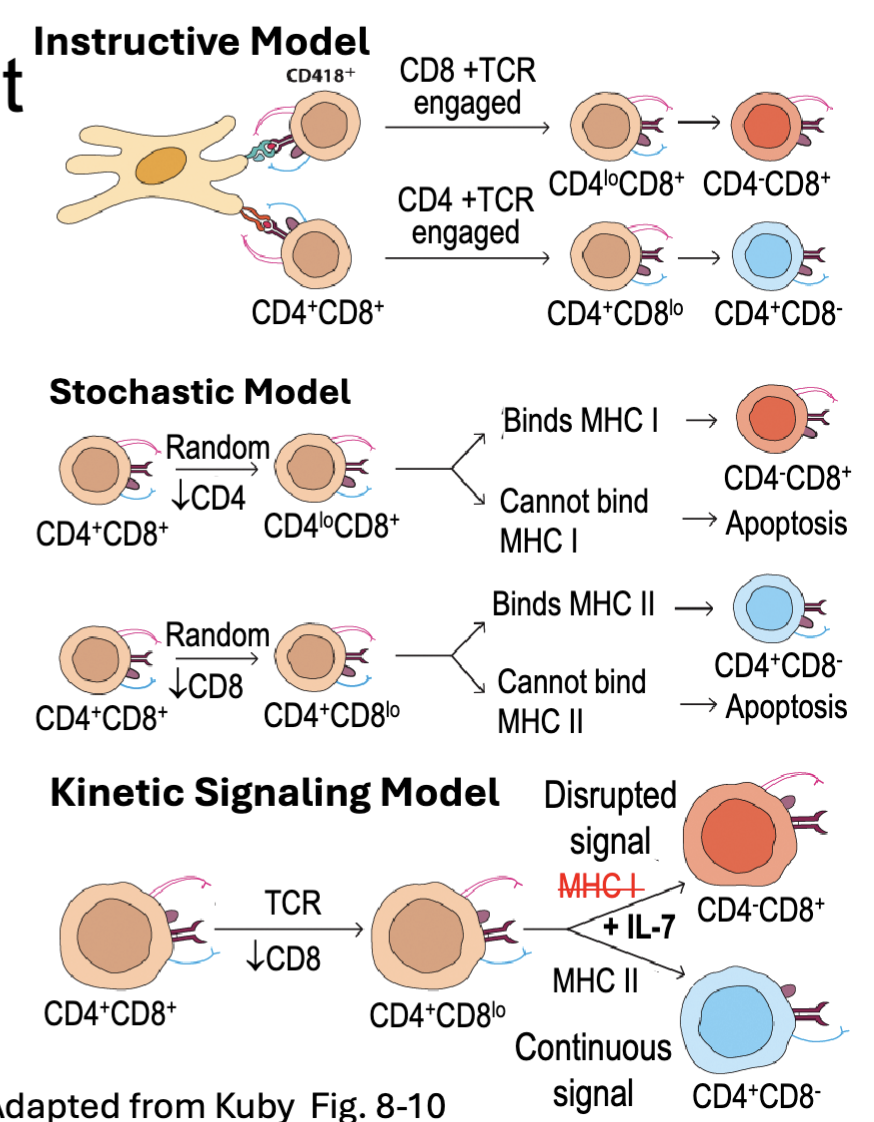
<ul><li><p><span><span>CD4 and CD8 ensure DP cells can engage with either MHC II or MHC I</span></span></p></li><li><p><span><span>Differential signaling commits DP cells to CD4 (</span><strong><span>Th-POK</span></strong><span>) or CD8 (</span><strong><span>RUNX3</span></strong><span>) program</span></span></p><ul><li><p><span><strong><span>Instructive Model </span></strong><span>– MHC restriction signals directly for cell fate</span></span></p><ul><li><p><span><span>CD4/MHCII engagement → CD4 program</span></span></p></li><li><p><span><span>CD8/MHCI → engagement CD8 program</span></span></p></li></ul></li><li><p><span><strong><span>Stochastic Model</span></strong><span> – positively selected cells randomly select CD4 or CD8 program → survival only if TCR signal maintained</span></span></p></li><li><p><span><strong><span>Kinetic Signaling Model</span></strong><span> – positively selected cells transiently downregulate CD8 → commit to CD4 if they receive continuous signal, commit to CD8 if signal interrupted (IL-7 maintains survival)  (continuous signal commits to Th-POK) </span></span></p></li></ul></li></ul><p>after positive selection down regulate CD8</p><p>Kinetic is most consistent with experimental evidence </p>
77
New cards

What are the features of Thymic Exit of T cells?

  • CD4 and CD8 SP T cells migrate back to corticomedullary junction (CCR7)

  • Exit thymus into blood (S1P)

  • Circulate and home to secondary lymphoid tissues (lymph nodes, spleen, Peyer’s patches)
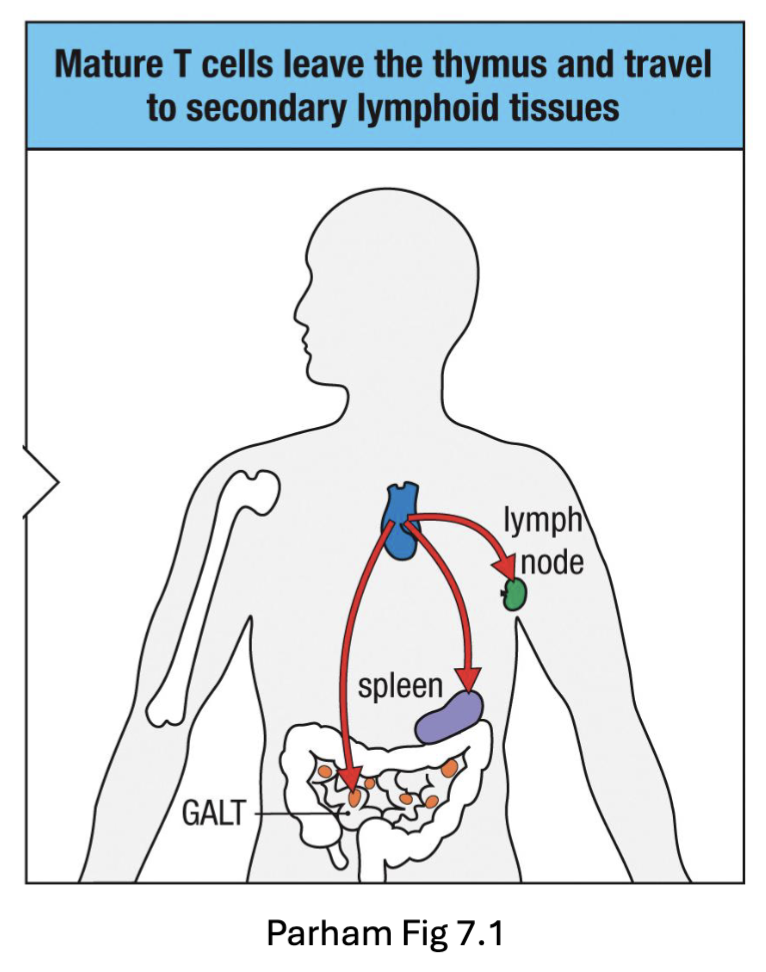
<ul><li><p><span><span>CD4 and CD8 SP T cells migrate back to corticomedullary junction (CCR7)</span></span></p></li><li><p><span><span>Exit thymus into blood (S1P)</span></span></p></li><li><p><span><span>Circulate and home to secondary lymphoid tissues (lymph nodes, spleen, Peyer’s patches)</span></span></p></li></ul><p></p>
78
New cards

What are the features of atypical T cell Populations 𝛾δ T cells?

  • 𝛾δ T cells exit thymus at DN2-3 stage

    • Limited TCR usage

    • Don’t require MHC for selection during thymic development

    • NOTCH signaling required for development

    • Accumulate in mucosal and epithelial tissues

  • recognize lipids and phosphoantigens upregulated by stress or infection:

    • TCR V𝛾4Vδ1 : recognizes lipids loaded on MHC-like molecules CD1c and CD1d

    • TCR V𝛾9Vδ2: binds BTN21/BTN3A1 complex after that forms after sensing phosphoantigens

phosphoantigen binds to BTN3A1= conformational change
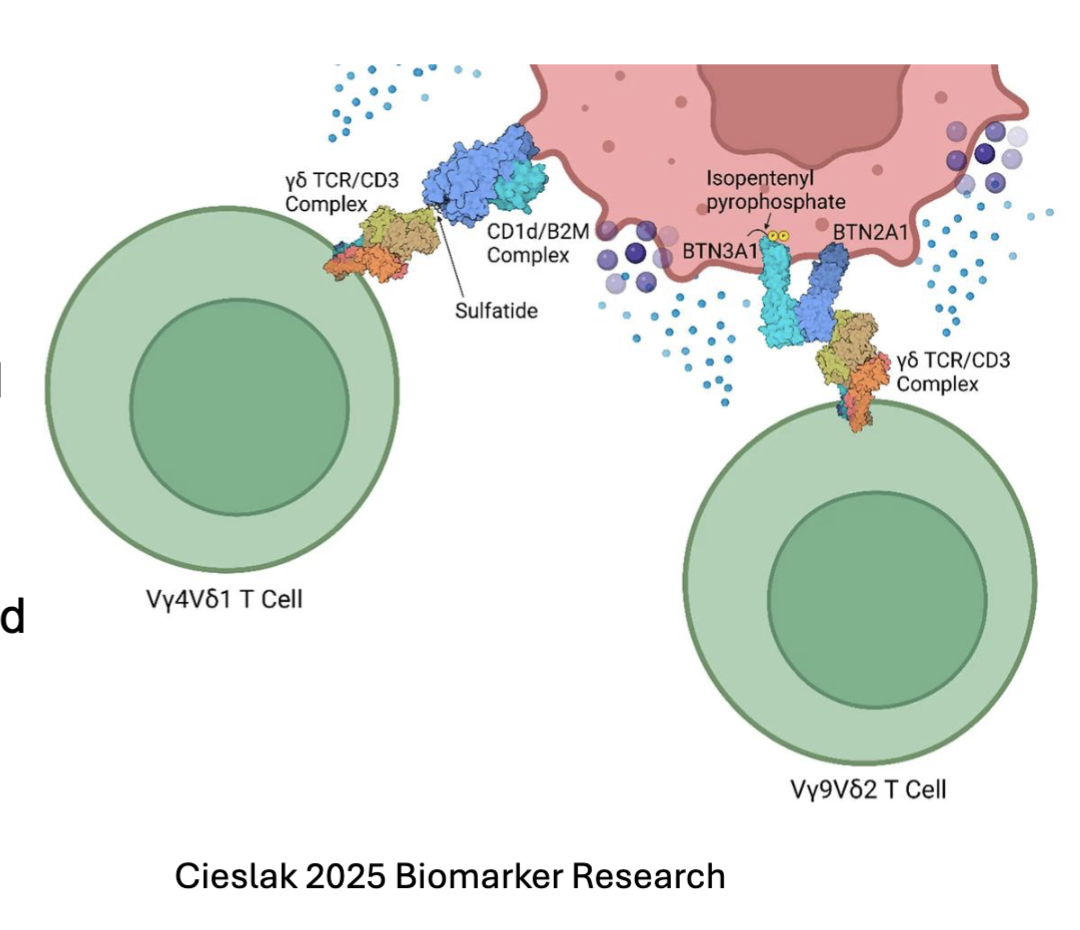
<ul><li><p>𝛾δ T cells <span><span>exit thymus at DN2-3 stage</span></span></p><ul><li><p><span><span>Limited TCR usage</span></span></p></li><li><p><span><span>Don’t require MHC for selection during thymic development</span></span></p></li><li><p><span><span>NOTCH signaling required for development</span></span></p></li><li><p><span><span>Accumulate in mucosal and epithelial tissues</span></span></p></li></ul></li><li><p><span><span>recognize </span><strong><span>lipids and phosphoantigens</span></strong><span> upregulated by stress or infection:</span></span></p><ul><li><p>TCR V𝛾4Vδ1 <span><span>: recognizes lipids loaded on MHC-like molecules CD1c and CD1d</span></span></p></li><li><p><span><span>TCR </span></span>V𝛾9Vδ2: binds <span><span>BTN21/BTN3A1 complex after that forms after sensing phosphoantigens</span></span></p></li></ul></li></ul><p>phosphoantigen binds to BTN3A1= conformational change</p>
79
New cards

What are the features of Atypical T Cell Populations: NKT cells?

  • Natural killer T (NKT) cells develop from DP thymocytes

    • Restricted TCR usage: V⍺24J⍺18 paired with Vβ11

    • Selected by CD1d on other DP cells rather than MHC I or MHC II

    • SLAM signals contribute to selection

    • Transcription factor PLZF drives development

  • recognizes lipids and glycolipids loaded on MHC-like molecule CD1d

    • self-glycolipids upregulated as stress response

    • foreign glycolipids from pathogens

CD1d widely expressed and don’t need the thymic epithelial cells for activation

SLAM (signalling lymphocyte activating molecule) make signals that help with survival and transcription factor PLZF
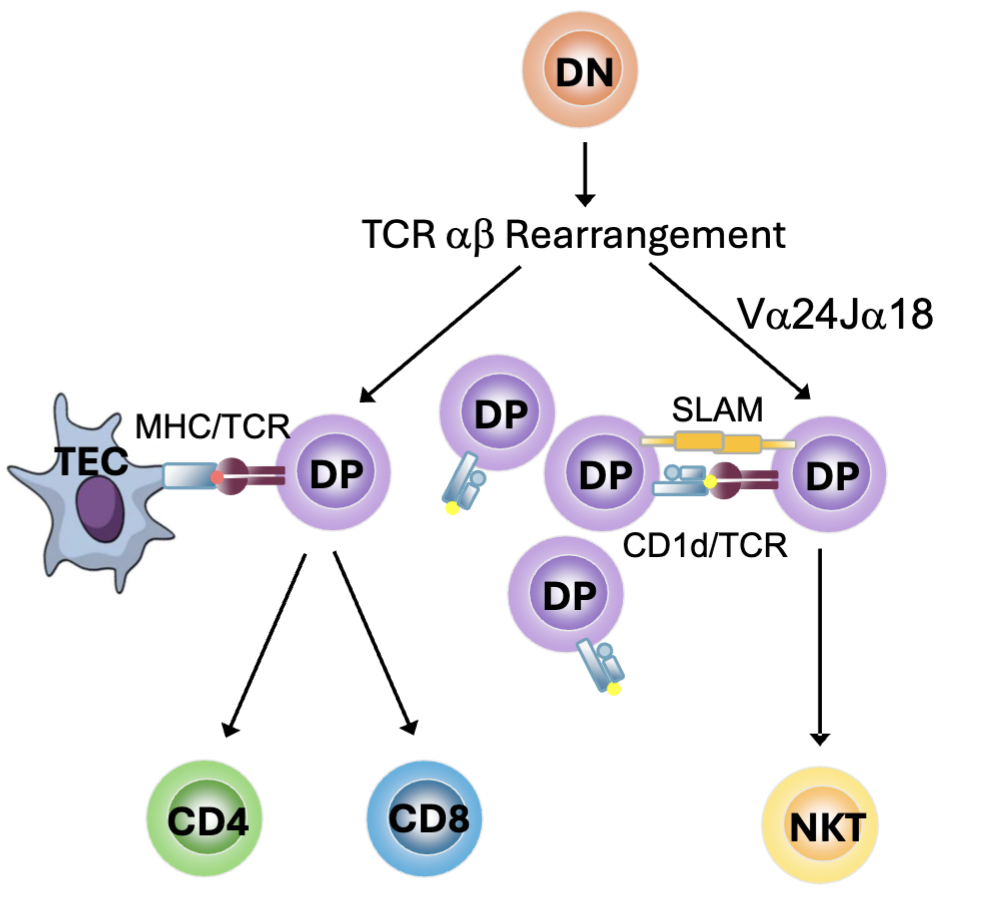
<ul><li><p><span><span>Natural killer T (NKT) cells develop from DP thymocytes</span></span></p><ul><li><p><span><span>Restricted TCR usage: </span></span><strong>V⍺24J⍺18</strong> paired with Vβ11</p></li><li><p><span><span>Selected by </span><strong><span>CD1d</span></strong><span> on other DP cells rather than MHC I or MHC II</span></span></p></li><li><p><span><strong><span>SLAM </span></strong><span>signals contribute to selection</span></span></p></li><li><p><span><span>Transcription factor </span><strong><span>PLZF</span></strong><span> drives development</span></span></p></li></ul></li><li><p>recognizes <strong>lipids and glycolipids</strong> loaded on MHC-like molecule CD1d</p><ul><li><p><span><span>self-glycolipids upregulated as stress response</span></span></p></li><li><p><span><span>foreign glycolipids from pathogens</span></span></p></li></ul></li></ul><p></p><p>CD1d widely expressed and don’t need the thymic epithelial cells for activation</p><p>SLAM (signalling lymphocyte activating molecule) make signals that help with survival and transcription factor PLZF</p>
80
New cards

What are the features of Atypical T Cell Populations: MAIT cells?

  • Mucosal-associated invariant T (MAIT) cells develop from DP thymocytes

    • Restricted TCR usage: V⍺7.2J⍺33

    • Selected by MHC-related protein 1 (MR1) on DP thymocytes

    • SLAM signals contribute to selection

    • Transcription factor PLZF mediates development

  • Recognize vitamin B (riboflavin)-related antigens produced by yeast and bacteria loaded on MR1

    • MAIT cells do not develop in germ free mice → Ag needs to be transported to thymus

    • MR1 is not expressed on surface in absence of antigen

specific TCR that is rearranged

selected by atypical MHC related protein: MR1

recognize Vitamin B (can’t be generated by us)

antigen goes from gut to thymus for positive selection

<ul><li><p><span><span>Mucosal-associated invariant T (MAIT) cells develop from DP thymocytes</span></span></p><ul><li><p><span><span>Restricted TCR usage: </span><strong><span>V⍺7.2J⍺33</span></strong></span></p></li><li><p><span><span>Selected by MHC-related protein 1 (</span><strong><span>MR1</span></strong><span>) on DP thymocytes</span></span></p></li><li><p><span><strong><span>SLAM</span></strong><span> signals contribute to selection</span></span></p></li><li><p><span><span>Transcription factor </span><strong><span>PLZF</span></strong><span> mediates development</span></span></p></li></ul></li><li><p><span><span>Recognize </span><strong><span>vitamin B</span></strong><span> (riboflavin)-</span><strong><span>related antigens</span></strong><span> produced by yeast and bacteria loaded on MR1</span></span></p><ul><li><p><span><span>MAIT cells do not develop in germ free mice → Ag needs to be transported to thymus</span></span></p></li><li><p><span><span>MR1 is not expressed on surface in absence of antigen</span></span></p></li></ul></li></ul><p>specific TCR that is rearranged</p><p>selected by atypical MHC related protein: MR1</p><p>recognize Vitamin B (can’t be generated by us)</p><p>antigen goes from gut to thymus for positive selection</p>
81
New cards

What happens in the lymph nodes with naive T cells?

  • Circulating naïve T cells enter LN at high endothelial venules (HEV)

    • L-selectin/ PNAd → rolling

    • CCR7/ CCL21 → activation

    • LFA-1/ ICAM-1 → arrest

  • Scan antigens presented by DCs

    • No Ag → Exit via efferent lymphatics (S1P)

    • Ag → Activated cells retained (CD69) → proliferation and differentiation

CD69 (inhibit the responsiveness to S1P)
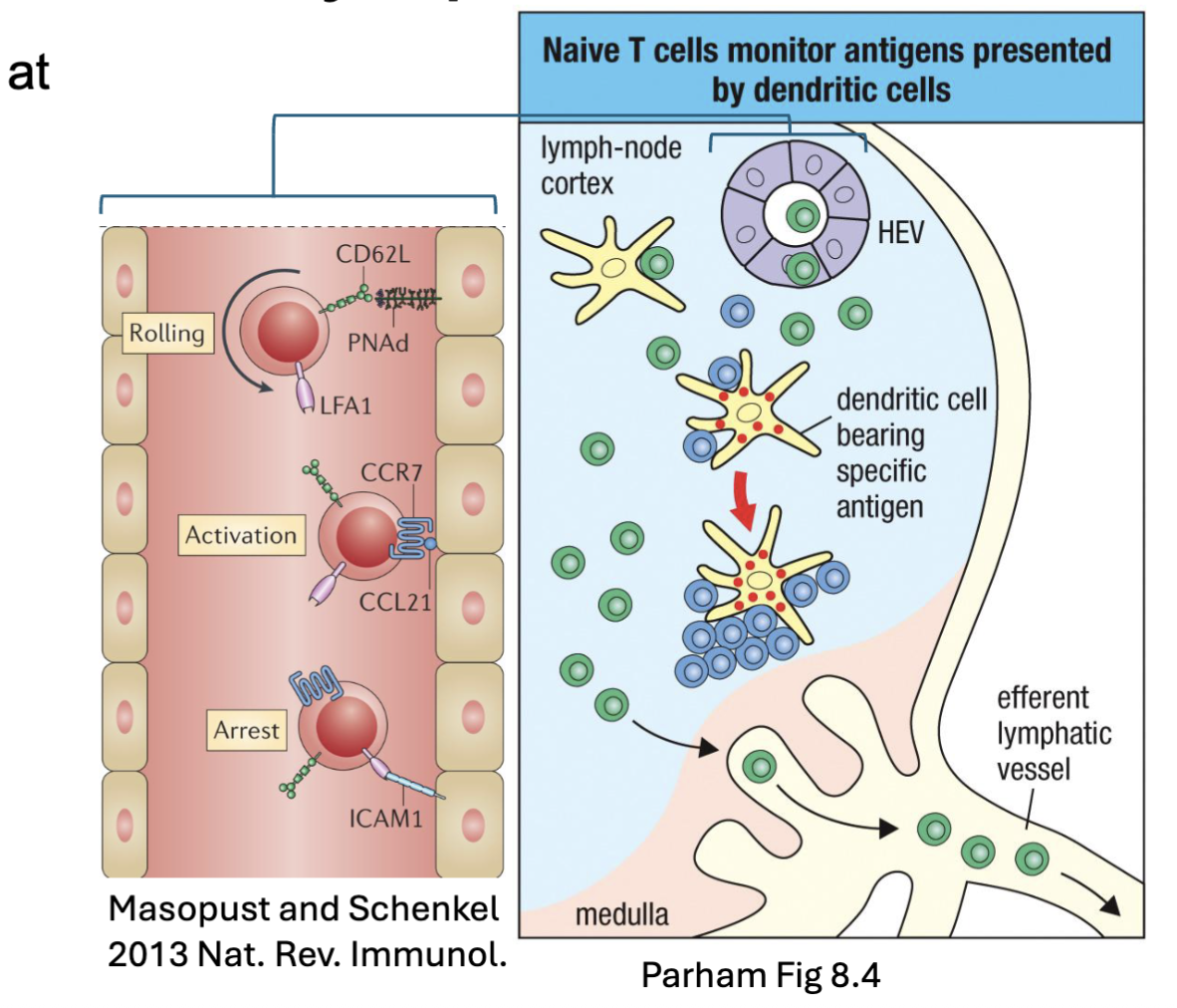
<ul><li><p><span><span>Circulating naïve T cells enter LN at high endothelial venules (</span><strong><span>HEV</span></strong><span>)</span></span></p><ul><li><p><span><span>L-selectin/ PNAd → rolling</span></span></p></li><li><p><span><span>CCR7/ CCL21 → activation</span></span></p></li><li><p><span><span>LFA-1/ ICAM-1 → arrest</span></span></p></li></ul></li><li><p><span><span>Scan antigens presented by DCs</span></span></p><ul><li><p><span><span>No Ag → Exit via efferent lymphatics (S1P)</span></span></p></li><li><p><span><span>Ag → Activated cells retained (CD69) → proliferation and differentiation</span></span></p></li></ul></li></ul><p>CD69 (inhibit the responsiveness to S1P)</p>
82
New cards

What is the T cell response (generally)?

Activated T cells proliferate and differentiate into different functional populations:

  • Memory T cell pools retain long term memory for recall responses

    • Stem cell and central memory T cells (TCM) recirculate through lymph nodes → recall response

  • Effector memory T cells (TEM) alter adhesion molecules → tissue homing

    • CD4 T cells differentiate into different T helper (Th) subsets: Th1, Th2, Th17, TFH

      • Depends on type of pathogen, cytokine environment, innate responses, type of APC

    • CD8 T cells differentiate into cytotoxic effectors
      (CTLs)
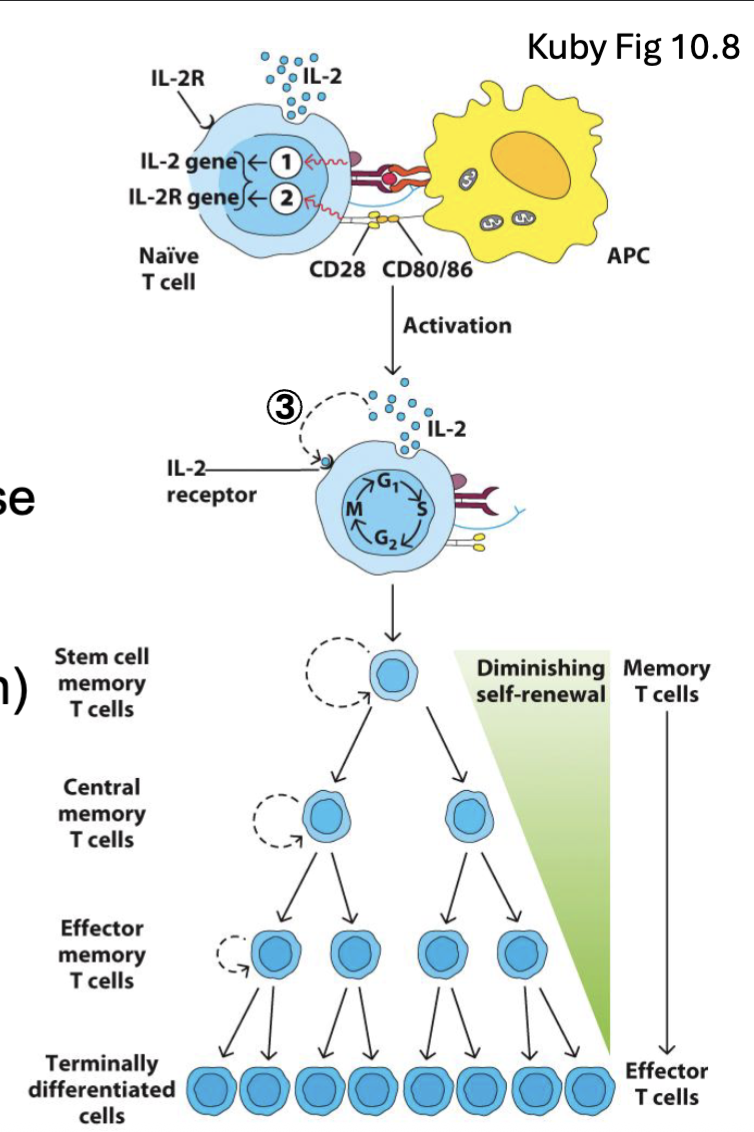
<p><span><span>Activated T cells proliferate and differentiate into different functional populations:</span></span></p><ul><li><p><span><strong><span>Memory T cell</span></strong><span> pools retain long term memory for recall responses</span></span></p><ul><li><p><span><span>Stem cell and </span><strong><span>central memory T cells</span></strong><span> (</span><strong><span>T</span><sub><span>CM</span></sub></strong><span>) recirculate through lymph nodes → recall response</span></span></p></li></ul></li><li><p><span><strong><span>Effector memory T cells</span></strong><span> (</span><strong><span>T</span><sub><span>EM</span></sub></strong><span>) alter adhesion molecules → tissue homing</span></span></p><ul><li><p><span><span>CD4 T cells differentiate into different T helper (Th) subsets: </span><strong><span>Th1, Th2, Th17, TFH</span></strong></span></p><ul><li><p><span><span>Depends on type of pathogen, cytokine environment, innate responses, type of APC</span></span></p></li></ul></li><li><p><span><span>CD8 T cells differentiate into cytotoxic effectors</span></span><br><span><span>(</span><strong><span>CTLs</span></strong><span>)</span></span></p></li></ul></li></ul><p></p>
83
New cards

What are the T Helper Subsets: Programs for Different Responses?

TH1: Protection vs. intracellular bacteria, viruses
→Macrophage, NK, CTL

TH2: Protection vs. parasites
→Eosinophils, ILC2

TH17: Protection vs. fungi, extracellular bacteria
→Epithelium, neutrophils

TFh: B cell help

in pink: master transcription factor

need IL-23 to make IL-17
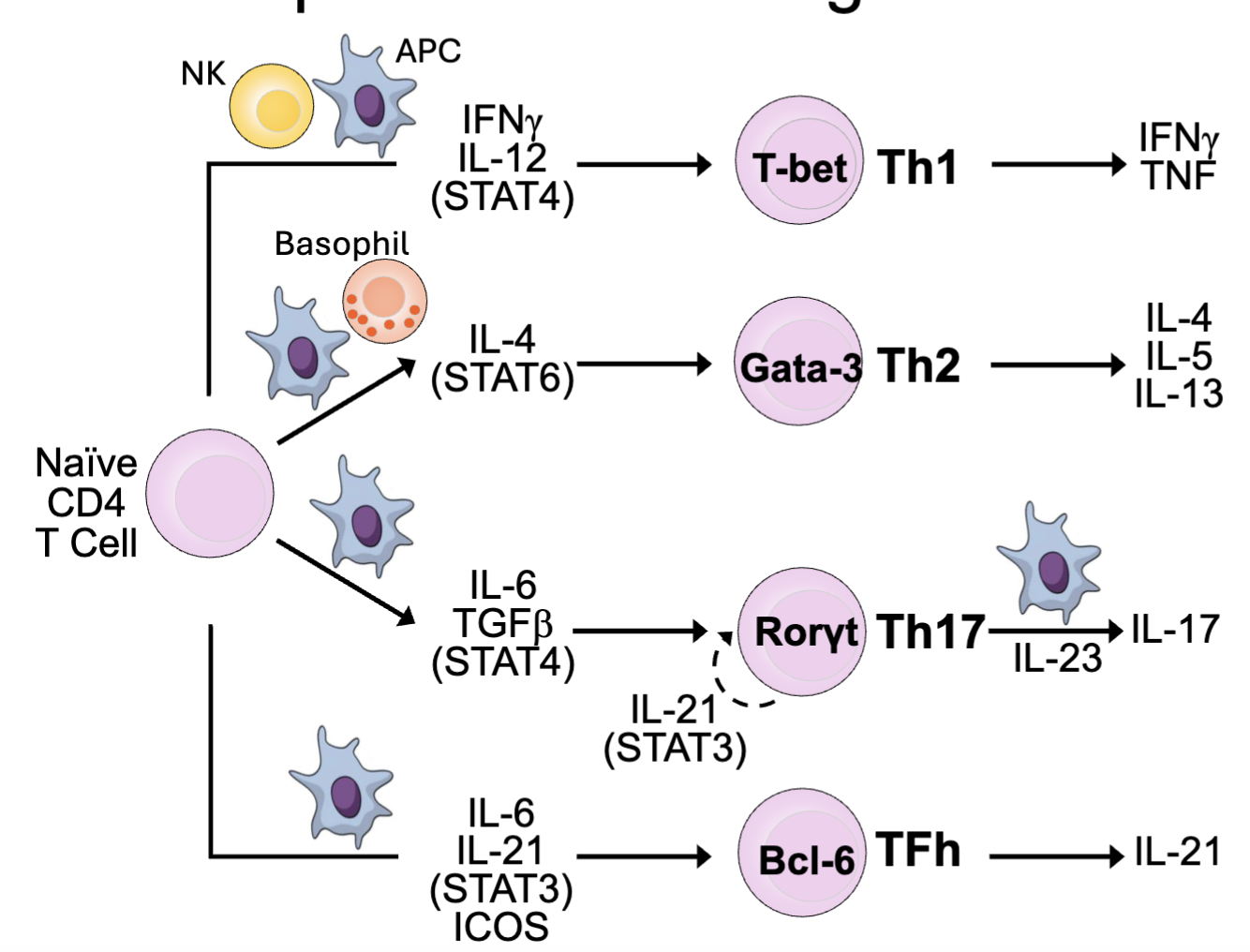
<p>TH1:&nbsp;<span><span>Protection vs. intracellular bacteria, viruses</span></span><br><span><span>→Macrophage, NK, CTL</span></span></p><p><span><span>TH2:&nbsp;Protection vs. parasites</span></span><br><span><span>→Eosinophils, ILC2</span></span></p><p><span><span>TH17: Protection vs. fungi, extracellular bacteria</span></span><br><span><span>→Epithelium, neutrophils</span></span></p><p><span><span>TFh: B cell help</span></span></p><p></p><p>in pink: master transcription factor</p><p>need IL-23 to make IL-17</p>
84
New cards

What are the features of CD8 Cytotoxic T Lymphocytes (CTLs): Serial Killers?

  • We can’t target pathogens hiding inside cells → kill the cell instead

  • Barrier to activation of naïve CD8 T cell is higher → need strong antigen or CD4 T cell help (IL-2)

    • Memory CD8 T cells need less costimulation

  • Memory CD8 T cells upregulate cytotoxic molecules (stored in granules):

    • Perforin / granulysin → pore formation

    • Granzyme → apoptosis via Bid-induced release of mitochondrial cytochrome-c and caspase activation

  • CTLs form synapse with targets and direct granular release

  • Each CTL can kill up to 16 target cells in succession
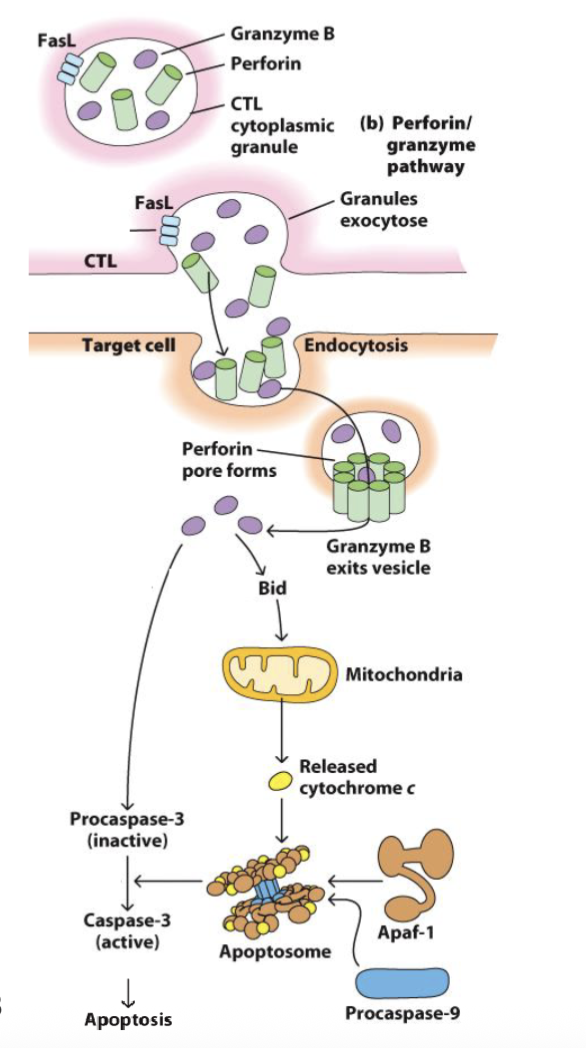
<ul><li><p><span><span>We can’t target pathogens hiding inside cells → kill the cell instead</span></span></p></li><li><p><span><span>Barrier to activation of naïve CD8 T cell is higher → need strong antigen or CD4 T cell help (IL-2)</span></span></p><ul><li><p><span style="color: red;"><span>Memory CD8 </span></span><span><span>T cells need less costimulation</span></span></p></li></ul></li><li><p>Memory <span><span>CD8 T cells upregulate cytotoxic molecules (stored in granules):</span></span></p><ul><li><p><span><strong><span>Perforin / granulysin</span></strong><span> → pore formation</span></span></p></li><li><p><span><strong><span>Granzyme</span></strong><span> → apoptosis via </span><strong><span>Bid</span></strong><span>-induced release of mitochondrial </span><strong><span>cytochrome-c </span></strong><span>and </span><strong><span>caspase</span></strong><span> activation</span></span></p></li></ul></li><li><p><span><span>CTLs form synapse with targets and direct granular release</span></span></p></li><li><p><span><span>Each CTL can kill up to 16 target cells in succession</span></span></p></li></ul><p></p>
85
New cards

What are barrier tissues?

Barrier tissues: interfaces separating our “insides” from the outside world (while allowing productive interactions)

  • Skin

  • Mucosal tissues: intestinal tract, respiratory tract, urogenital tract, lactating mammary gland

Combination of physical (epithelium, keratin, cilia) chemical (mucus, enzymes, peptides), and cellular mechanisms (immune cells) to protect against pathogens

Hosts a commensal microbiome that exists in equilibrium with the immune system

86
New cards

What is Commensal microflora?

The microbiome

Commensal microflora are the “friendly” bacteria, viruses, fungi, protozoa, and
worms that exist in equilibrium (symbiosis) with the host

  • Provide vitamins and nutrients (ex: Vitamin K, A, B-12)

  • Degrade toxins (inactivate toxins)

  • Protect from pathogens (competition) (outcompete pathogens)

*image important
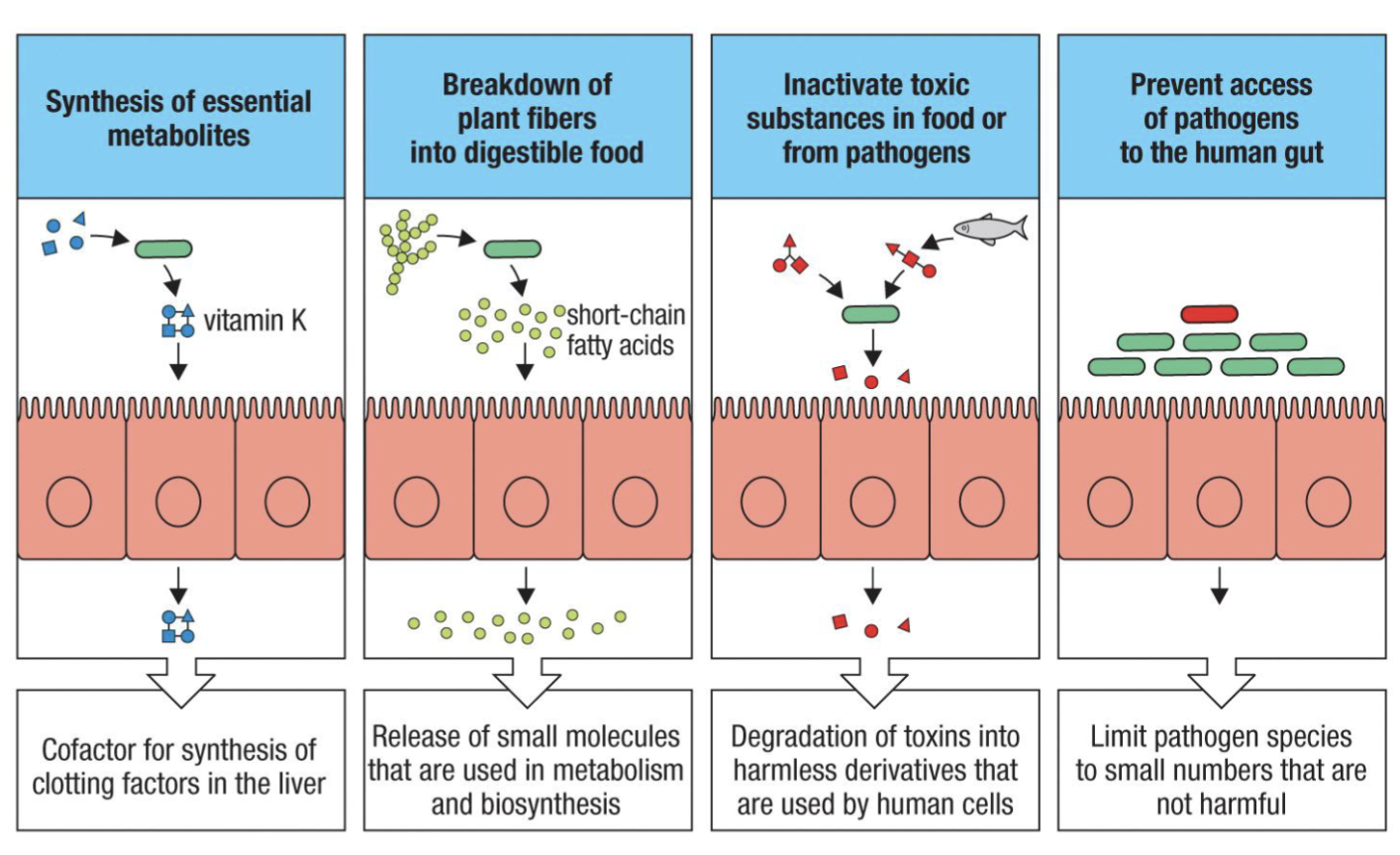
<p>The <strong>microbiome</strong></p><p><span><span>Commensal microflora are the “friendly” bacteria, viruses, fungi, protozoa, and</span></span><br><span><span>worms that exist in equilibrium (symbiosis) with the host</span></span></p><ul><li><p><span><span>Provide </span><strong><span>vitamins </span></strong><span>and </span><strong><span>nutrients (</span></strong></span>ex: Vitamin K, A, B-12)</p></li><li><p><span><strong><span>Degrade</span></strong><span> toxins (</span></span>inactivate toxins) </p></li><li><p><span><strong><span>Protect</span></strong><span> from pathogens (competition) (</span></span>outcompete pathogens)</p></li></ul><p>*image important </p>
87
New cards

How do we codevelop with our microbiome?

  • We are colonized during and early after birth

  • Microbiome mediates secondary lymphoid development in intestine and subsequent
    immune balance (figured out in germ free mice)

  • Pathology associated with dysfunctional/ altered microbiome (i.e. antibiotics, infection,
    diet, pollution, stress, genetics)

  • Emergence of fecal transplant therapies

defect in immune development in C section children
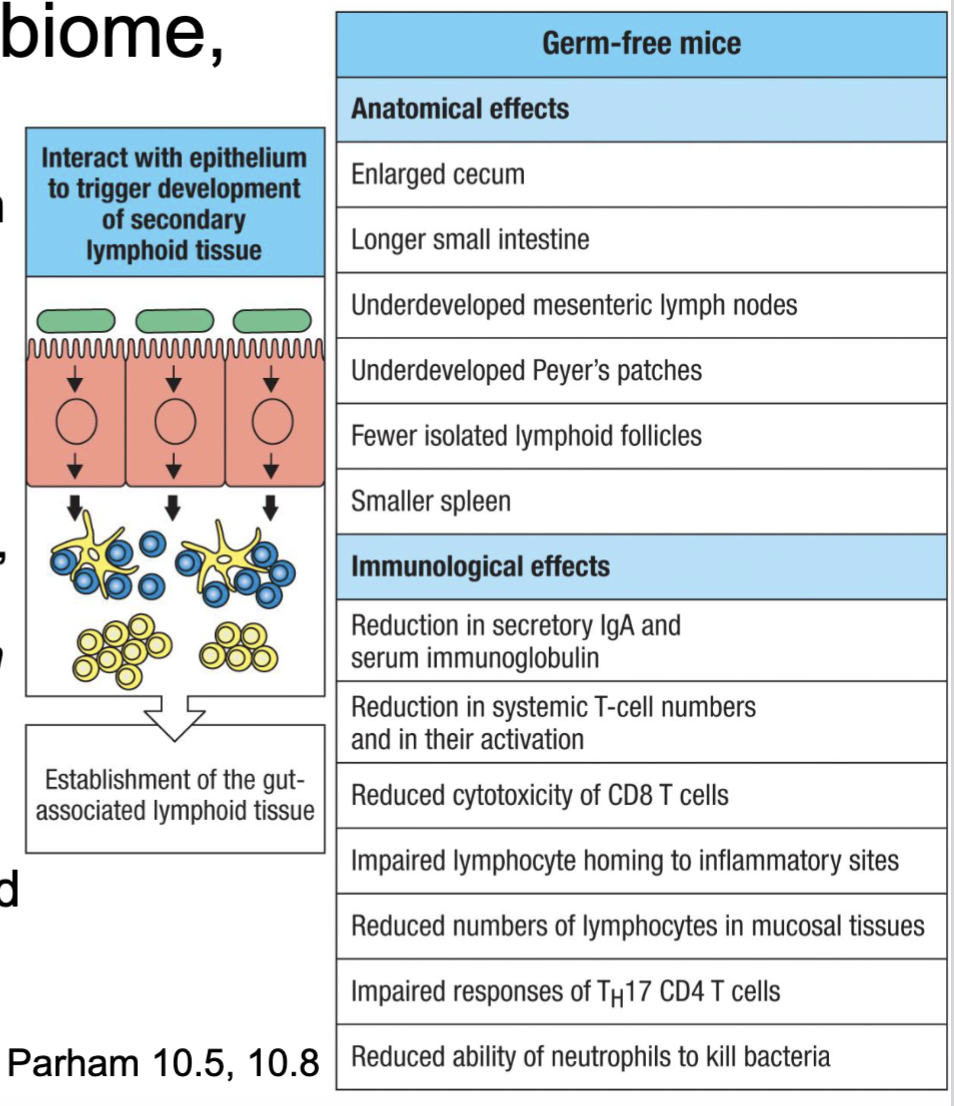
<ul><li><p><span><span>We are colonized during and early after birth</span></span></p></li><li><p><span><span>Microbiome mediates secondary lymphoid development in intestine and subsequent</span></span><br><span><span>immune balance (figured out in germ free mice)</span></span></p></li><li><p><span><span>Pathology associated with dysfunctional/ altered microbiome (i.e. antibiotics, infection,</span></span><br><span><span>diet, pollution, stress, genetics)</span></span></p></li><li><p><span><span>Emergence of fecal transplant therapies</span></span></p></li></ul><p>defect in immune development in C section children</p>
88
New cards

What are the various pathologies associated with dysfunctional/ altered microbiomes? What causes these alterations?

  • Susceptible to infection (e.g., Clostridium difficile) and nutritional defects

  • Associated with autoimmune diseases (IBD, T1D, MS, SLE, RA)

  • Impaired immune response to cancer and immunotherapies

dysfunctional/ altered microbiome:

  • antibiotics,

  • infection,

  • diet,

  • pollution,

  • stress,

  • genetics

<ul><li><p><span>Susceptible to infection (e.g., Clostridium difficile) and nutritional defects</span></p></li><li><p><span>Associated with autoimmune diseases (IBD, T1D, MS, SLE, RA)</span></p></li><li><p><span>Impaired immune response to cancer and immunotherapies</span></p></li></ul><p><span>dysfunctional/ altered microbiome:</span></p><ul><li><p><span>antibiotics, </span></p></li><li><p><span>infection,</span></p></li><li><p><span>diet, </span></p></li><li><p><span>pollution, </span></p></li><li><p><span>stress, </span></p></li><li><p><span>genetics</span></p></li></ul><p></p>
89
New cards

Why do we need to distinguish between friend and foe?

Healthy barrier in homeostatic balance (no inflammation) → tolerogenic response

  • Immune system samples contents from lumen (small numbers of microbes)

  • Trigger production of anti-inflammatory molecules (IL-10, TGFβ) → iTregs
    and IgA-producing B cells

Disrupted microenvironment → barrier damage → invasion
of pathogenic microbes → inflammation

  • Resolution or disease?

90
New cards

What are the features of the intestinal mucosa (epithelium and lamina propia)?

Single layer of epithelium separates host from luminal microbes:

  • Enterocytes – structural epithelial cells, transport nutrients

  • Paneth cells – secrete antimicrobial peptides (AMPs) – defensins, lysozyme

  • Goblet cells – secrete mucus, AMPs

  • Microfold cells (M cells) – transcytose antigen from lumen

Lymphoid tissues form in lamina propria directly under M cells:

  • Peyer’s patches – DCs, B cells, T cells

  • Isolated lymphoid follicles (cryptopatches) – B cell follicles

  • Lymphatics drain to mesenteric nodes

Peyer’s patch anologous to lymph node: B, T and DC

lymphoid follicle: mostly B cells in there
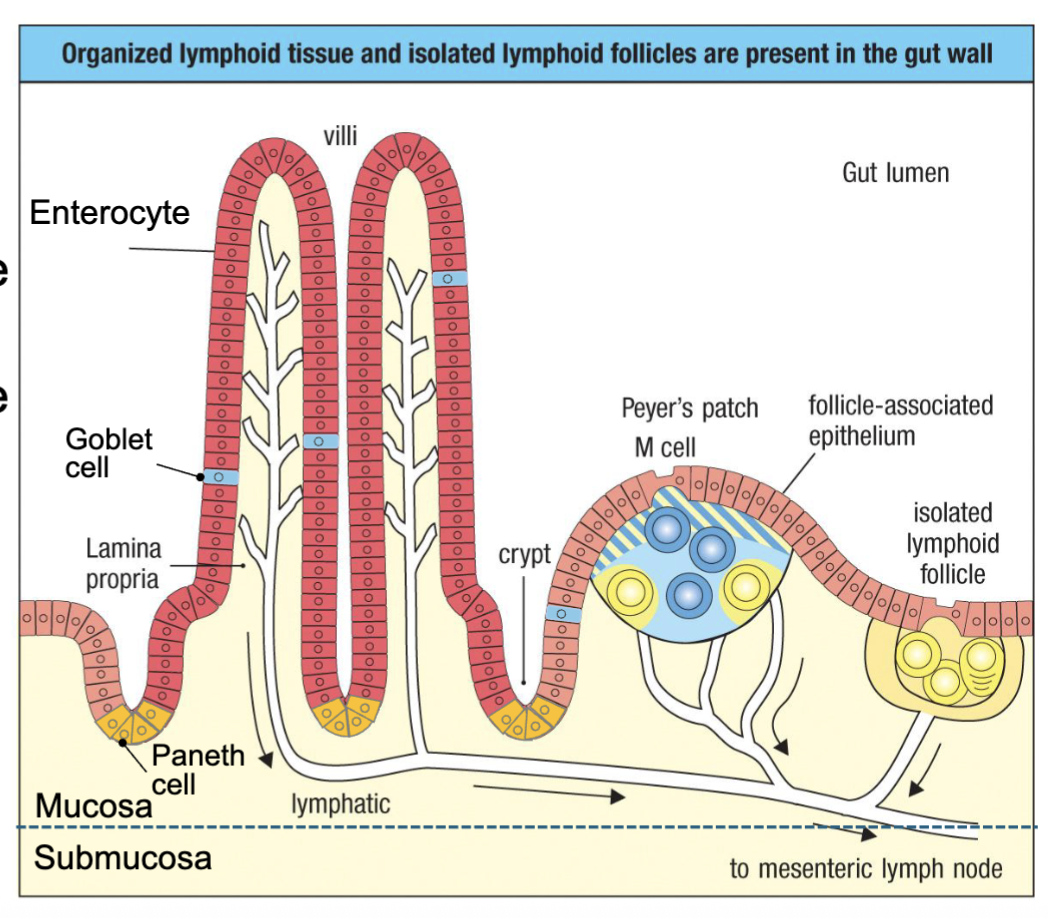
<p><span><span>Single layer of epithelium separates host from luminal microbes:</span></span></p><ul><li><p><span><strong><span>Enterocytes</span></strong><span> – structural epithelial cells, transport nutrients</span></span></p></li><li><p><span><strong><span>Paneth cells</span></strong><span> – secrete antimicrobial peptides (AMPs) – defensins, lysozyme</span></span></p></li><li><p><span><strong><span>Goblet cells</span></strong><span> – secrete mucus, AMPs</span></span></p></li><li><p><span><strong><span>Microfold cells</span></strong><span> (M cells) – transcytose antigen from lumen</span></span></p></li></ul><p><span><span>Lymphoid tissues form in lamina propria directly under M cells:</span></span></p><ul><li><p><span><strong><span>Peyer’s patches</span></strong><span> – DCs, B cells, T cells</span></span></p></li><li><p><span><strong><span>Isolated lymphoid follicles </span></strong><span>(cryptopatches) – B cell follicles</span></span></p></li><li><p><span><span>Lymphatics drain to </span><strong><span>mesenteric</span></strong><span> nodes</span></span></p></li></ul><p></p><p>Peyer’s patch anologous to lymph node: B, T and DC</p><p>lymphoid follicle: mostly B cells in there</p>
91
New cards

How do barriers maintain homeostasis?

  • Keep microbes away from epithelium

  • Mucus – viscous fluid formed by polymeric mucin glycoproteins → trap microbes → washed away (peristalsis)

    • Cysteine residues in globular heads bind each other → crosslinked networks

    • Covalently bind secreted IgA, IgM, and defensins

  • Antimicrobial peptides (AMPs) – kill microbes to keep them away

    • defensins (cause pores in bacterial membranes)

    • lysozyme (digests cell walls)

    • REG3 proteins (kill Gram-positives) - stimulated by IL-22 from ILC3

<ul><li><p><span><span>Keep microbes away from epithelium</span></span></p></li><li><p><span><strong><span>Mucus</span></strong><span> – viscous fluid formed by polymeric </span><strong><span>mucin</span></strong><span> glycoproteins → trap microbes → washed away (peristalsis)</span></span></p><ul><li><p><span><span>Cysteine residues in globular heads bind each other → crosslinked networks</span></span></p></li><li><p><span><span>Covalently bind secreted IgA, IgM, and defensins</span></span></p></li></ul></li><li><p><span><strong><span>Antimicrobial peptides</span></strong><span> (</span><strong><span>AMPs</span></strong><span>) – kill microbes to keep them away</span></span></p><ul><li><p><span><strong><span>defensins</span></strong><span> (cause pores in bacterial membranes)</span></span></p></li><li><p><span><strong><span>lysozyme</span></strong><span> (digests cell walls)</span></span></p></li><li><p><span><strong><span>REG3</span></strong><span> </span><strong><span>proteins</span></strong><span> (kill Gram-positives) - stimulated by IL-22 from ILC3</span></span></p></li></ul></li></ul><p></p>
92
New cards

How is homeostasis maintained? ( healthy barriers)

  • Tregs

  • Barrier tissues

  • Antigen sampling

  • IgA plasma cells

  • Dimeric IgA

93
New cards

How does antigen sampling maintain homeostasis?

Antigens can be transported across epithelium by multiple mechanisms:

  • M-cells – transport bacteria and antigens and deliver to APCs (microfold cells)

  • FcR – IgG-immune complexes can be transported by neonatal Fc receptor (FcRn)

  • Goblet cells – transport small soluble antigens

  • APCs – can reach across and directly sample lumen

Antigens delivered into a controlled environment (no inflammation) → tolerance

FcR: bind immunoglobulin

Fc receptor transports IgG

<p><span><span>Antigens can be transported across epithelium by multiple mechanisms:</span></span></p><ul><li><p><span><strong><span>M-cells</span></strong><span> – transport bacteria and antigens and deliver to APCs (microfold cells) </span></span></p></li><li><p><span><strong><span>FcR</span></strong><span> – IgG-immune complexes can be transported by </span><strong><span>neonatal Fc receptor</span></strong><span> (FcRn)</span></span></p></li><li><p><span><strong><span>Goblet cells</span></strong><span> – transport small soluble antigens</span></span></p></li><li><p><span><strong><span>APCs</span></strong><span> – can reach across and directly sample lumen</span></span></p></li></ul><p><span><span>Antigens delivered into a controlled environment (</span><u><span>no inflammation)</span></u><span> → tolerance </span></span></p><p>FcR: bind immunoglobulin</p><p>Fc receptor transports IgG</p>
94
New cards

How do Tregs maintain homeostasis?

Regulatory T cells (Tregs) – CD4 T cell subset that generates TGFβ and IL-10 → inhibit immune responses

DCs primed in presence of TSLP, TGFβ, retinoic acid (RA), short chain fatty acids (SCFA) take on tolerogenic phenotype (TGFβ, IL-10, ICOSL) → Treg induction

  • TGFβ and RA induce the FoxP3 transcription factor (Treg master regulator)

  • RA imprinting induces ⍺4β7 integrin and CCR9 → T cell homing back to intestinal tissue

Tregs maintained by in tissue by IL-10 (and IL-2) → inhibit T effectors

to get tolerance need to make T regs

need DC to be primed in certain way

survival signals IL-10 and IL-2 by macrophages
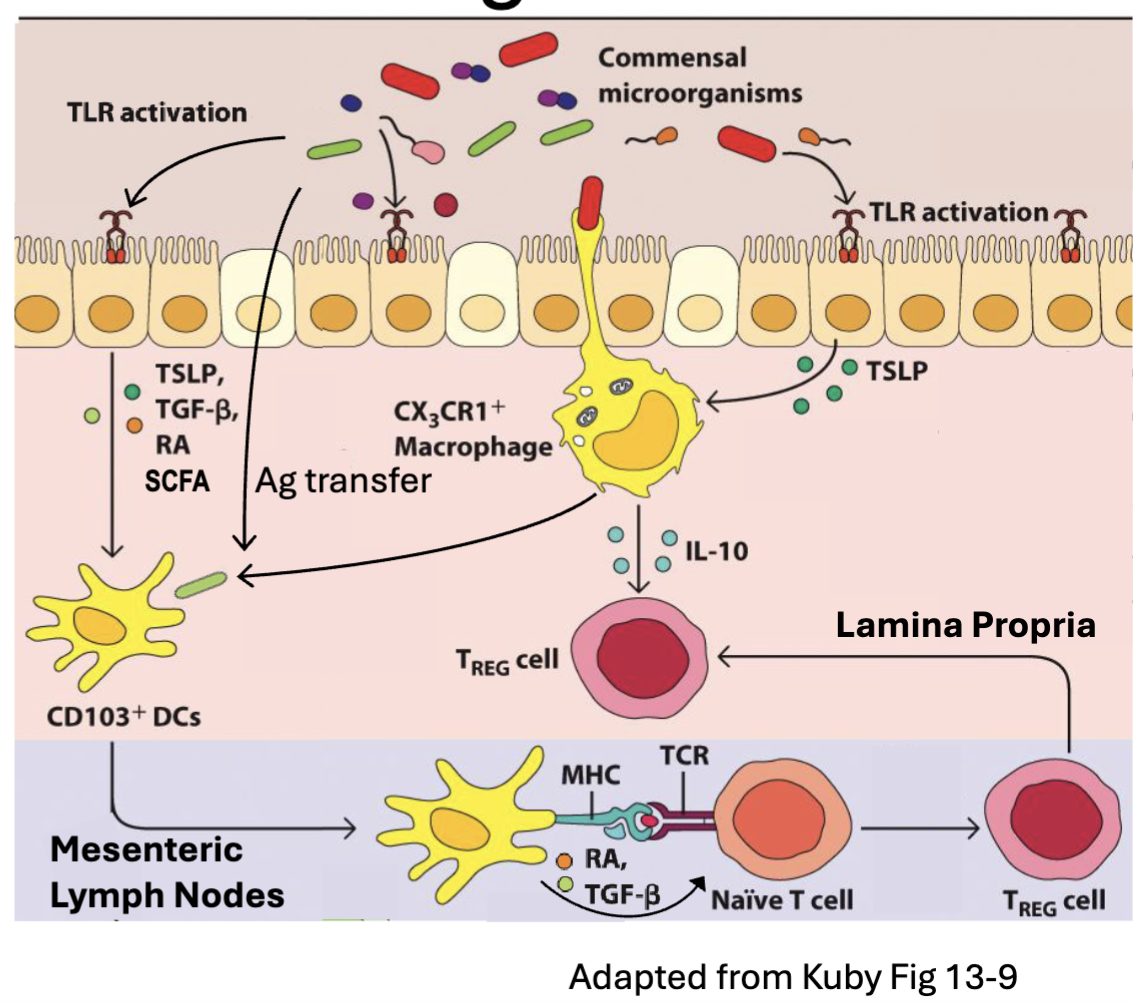
<p><span><strong><span>Regulatory T cells (Tregs)</span></strong><span> – CD4 T cell subset that generates TGFβ and IL-10 → inhibit immune responses</span></span></p><p><span><span>DCs primed in presence of </span><strong><span>TSLP</span></strong><span>, </span><strong><span>TGF</span></strong></span><strong><span>β</span></strong><span><span>, retinoic acid (</span><strong><span>RA</span></strong><span>), short chain fatty acids (</span><strong><span>SCFA</span></strong><span>) take on tolerogenic phenotype (TGF</span></span><span>β</span><span><span>, IL-10, ICOSL) → Treg induction</span></span></p><ul><li><p><span><span>TGF</span></span><span>β</span><span><span> and RA induce the FoxP3 transcription factor (Treg master regulator)</span></span></p></li><li><p><span><span>RA imprinting induces ⍺4</span></span><span>β</span><span><span>7 integrin and CCR9 → T cell homing back to intestinal tissue</span></span></p></li></ul><p><span><span>Tregs maintained by in tissue by IL-10 (and IL-2) → inhibit T effectors</span></span></p><p></p><p>to get tolerance need to make T regs</p><p>need DC to be primed in certain way</p><p>survival signals IL-10 and IL-2 by macrophages</p>
95
New cards

How do Tregs work?

FoxP3 drives an immunoregulatory T cell phenotype

Tregs suppress immunity by several mechanisms:

  • TGFβ and IL-10 → inhibit APC and T cell functions

  • Express high levels of CD25 → soak up IL-2

  • Upregulate CTLA4 → binds CD80 and CD86 → inhibitory signal

  • Induce IDO (converts tryptophan → kynurenine)

  • Inhibit inflammatory cytokine production (IL-6, TNF)

  • Downregulates CD80/ CD86 expression

Acquired Treg dysfunction → autoimmunity (RA, MS)Mutations in FoxP3 → IPEX (Immune dysregulation, Polyendocrinopathy, Enteropathy, X-linked) syndrome →autoimmune symptoms (neonatal T1D, IBD, dermatitis)

CTLA4 is inhibitory to the DC and upregulates IDO
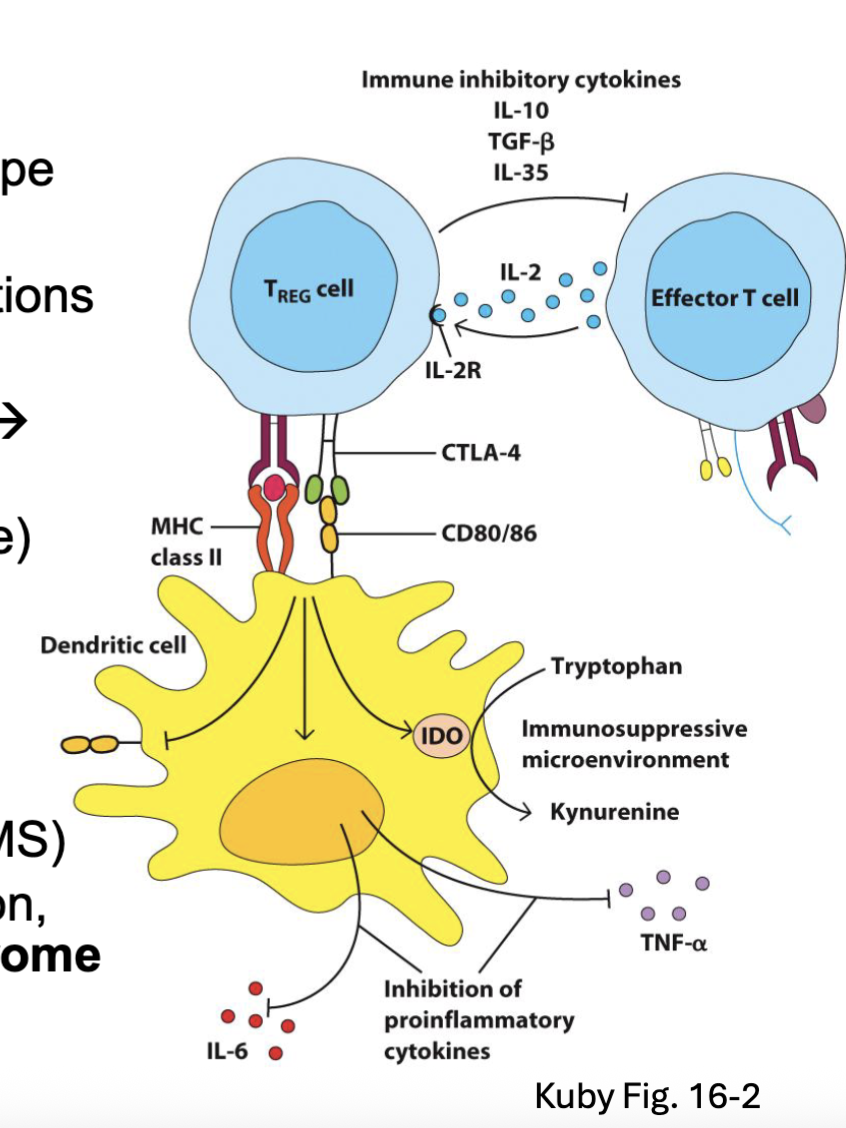
<p><strong><span>FoxP3</span></strong><span> drives an immunoregulatory T cell phenotype</span></p><p><span>Tregs suppress immunity by several mechanisms:</span></p><ul><li><p><strong><span>TGFβ</span></strong><span> and </span><strong><span>IL-10</span></strong><span> → inhibit APC and T cell functions</span></p></li><li><p><span>Express high levels of CD25 → soak up IL-2</span></p></li><li><p><span>Upregulate </span><strong><span>CTLA4</span></strong><span> → binds CD80 and CD86 → inhibitory signal</span></p></li><li><p><span>Induce </span><strong><span>IDO</span></strong><span> (converts tryptophan → kynurenine)</span></p></li><li><p><span>Inhibit inflammatory </span><strong><span>cytokine</span></strong><span> production (IL-6, TNF)</span></p></li><li><p><span>Downregulates </span><strong><span>CD80/ CD86</span></strong><span> expression</span></p></li></ul><p><span>Acquired Treg dysfunction → autoimmunity (RA, MS)Mutations in FoxP3 → </span><strong><span>IPEX</span></strong><span> (Immune dysregulation, Polyendocrinopathy, Enteropathy, X-linked) </span><strong><span>syndrome </span></strong><span>→autoimmune symptoms (neonatal T1D, IBD, dermatitis)</span></p><p></p><p>CTLA4 is inhibitory to the DC and upregulates IDO</p>
96
New cards

How do plasma IgAs maintain homeostasis?

Plasma cells in intestine generate IgA (and some IgM, IgG)

  • B2 B cells (T-dependent): TGFβ → IgA class switch in Peyer’s patch or MLN

  • B1 B cells (T-independent): APRIL and BAFF → IgA in lamina propria or isolated lymphoid follicles (faster but lower affinity)

APRIL and BAFF: cytokines

T-independent lower affinity (no affinity maturation)
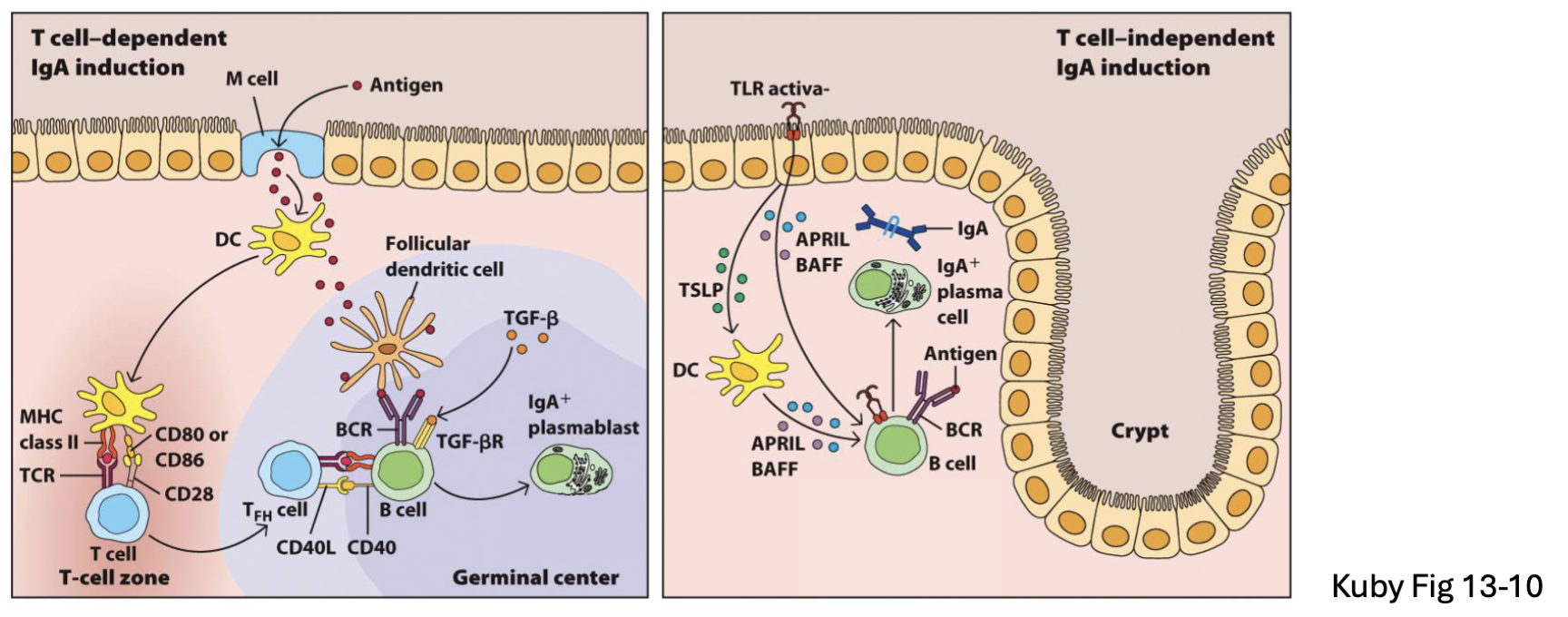
<p><span><span>Plasma cells in intestine generate IgA (and some IgM, IgG)</span></span></p><ul><li><p><span><u><span>B2 B cells (T-dependent</span></u><span>): </span><strong><span>TGFβ</span></strong><span> → IgA class switch in Peyer’s patch or MLN</span></span></p></li><li><p><span><u><span>B1 B cells (T-independent</span></u><span>): </span><strong><span>APRIL</span></strong><span> and </span><strong><span>BAFF</span></strong><span> → IgA in lamina propria or isolated lymphoid follicles (faster but lower affinity)</span></span></p></li></ul><p></p><p>APRIL and BAFF: cytokines</p><p>T-independent lower affinity (no affinity maturation)</p>
97
New cards

How does dimeric IgA maintain homeostasis?

  • Intestinal tissue generates 3-5g of IgA per day (respiratory and reproductive tracts also generate IgA)

  • IgA binds J chain and dimerizes → transported across epithelium via the polymeric immunoglobulin receptor (polyIgR) → cleavage of polyIgR leaves secretory component attached to luminal IgA (this also happens for IgM)

  • IgA neutralizes microbes but doesn’t cause inflammation (doesn’t activate Complement)

  • Secretory IgA is an important line of defense for mucosal surfaces against bacteria (e.g. Salmonella, Vibrio cholerae) and viruses (e.g. polio virus, reovirus)

IgA good at neutralizing salmonella, …

<ul><li><p><span><span>Intestinal tissue generates 3-5g of IgA per day (respiratory and reproductive tracts also generate IgA)</span></span></p></li><li><p><span><span>IgA binds </span><strong><span>J chain</span></strong><span> and dimerizes → transported across epithelium via the</span><strong><span> polymeric immunoglobulin receptor (polyIgR)</span></strong><span> → cleavage of polyIgR leaves </span><strong><span>secretory component </span></strong><span>attached to luminal IgA (this also happens for IgM)</span></span></p></li><li><p><span><span>IgA neutralizes microbes but doesn’t cause inflammation (doesn’t activate Complement)</span></span></p></li><li><p><span><span>Secretory IgA is an important line of defense for mucosal surfaces against bacteria (e.g. Salmonella, Vibrio cholerae) and viruses (e.g. polio virus, reovirus)</span></span></p></li></ul><p>IgA good at neutralizing salmonella, …</p>
98
New cards

What are the features of oral tolerance?

Tolerance to food antigens appears to work the same as tolerance induction to commensal microbes

  • Food antigens are taken up and presented in a tolerogenic steady state environment → Tregs
    and IgA

Guidance on food introduction to infants previously recommended delayed exposure to foods that
cause allergies (e.g., eggs, peanut, wheat, milk)

  • Changed by 2008 study showing exposure to peanut antigens during first year → 10-fold
    lower incidence in peanut allergy

Epidemiological evidence suggests infection precedes onset of food allergies

  • Rotavirus infection preceded celiac disease (gluten allergy) onset in genetically susceptible
    individuals

99
New cards

What are the pathogen responses of the barrier (controlled vs uncontrolled)?

Healthy epithelium samples microbes in a controlled way → tolerance

Excessive or “uncontrolled” exposure to microbes → inflammation → eradicate pathogen
and restore homeostasis

  • PRRs on epithelial basolateral surface or cytoplasm → inflammatory signals

  • Inflammatory signals > local tolerance signals → induction and effector responses

PRR’s recognize the excessive or uncontrolled

on basolateral surface means it has crossed the barrier

gauging the inflammatory signals and the local tolerance signals
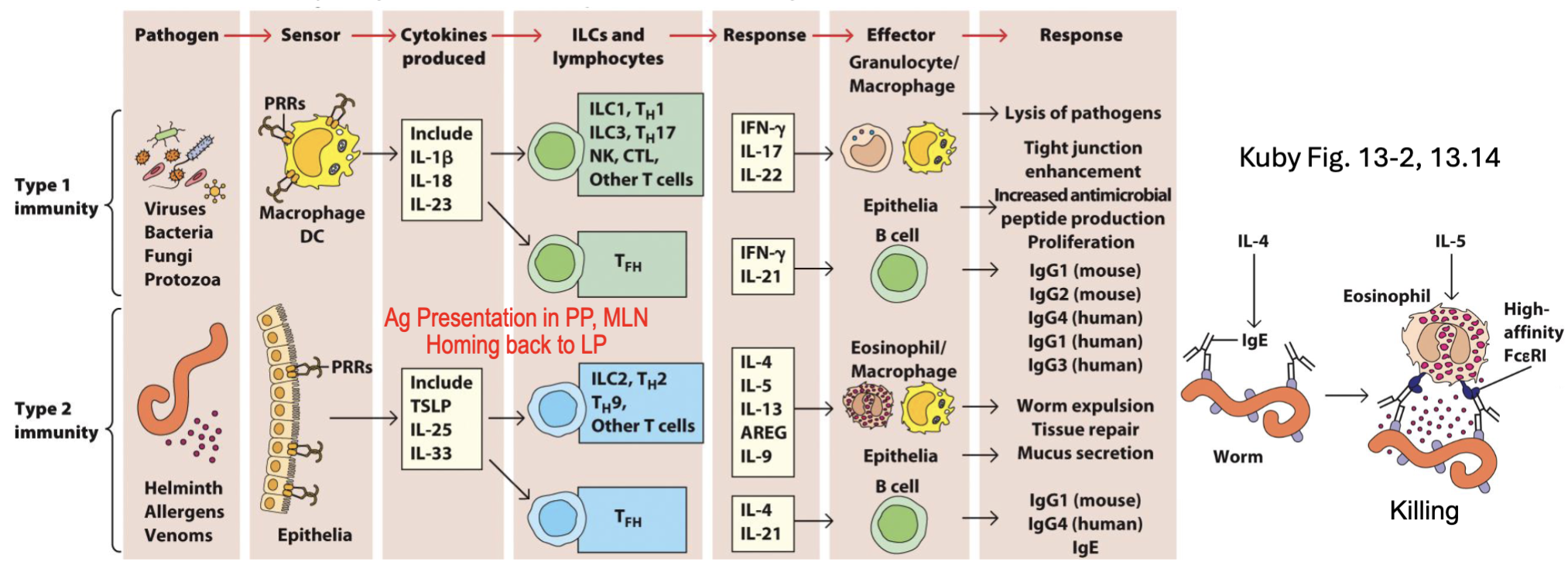
<p><span><span>Healthy epithelium samples microbes in a controlled way → tolerance</span></span></p><p><span><span>Excessive or “uncontrolled” exposure to microbes → inflammation → eradicate pathogen</span></span><br><span><span>and restore homeostasis</span></span></p><ul><li><p><span><span>PRRs on epithelial basolateral surface or cytoplasm → inflammatory signals</span></span></p></li><li><p><span><span>Inflammatory signals &gt; local tolerance signals → induction and effector responses</span></span></p></li></ul><p></p><p>PRR’s recognize the excessive or uncontrolled</p><p>on basolateral surface means it has crossed the barrier</p><p>gauging the inflammatory signals and the local tolerance signals</p>
100
New cards

What happens when there is excessive inflammation in the gut?

It is pathogenic

it can lead to IBD (inflammatory bowel disease)

there is also Celiac disease: (not IBD)

  • similar symptoms but represents an autoimmune response triggered by glutens in grains (antibodies when gluten appears)

medications: antibiotics can create this issue (imbalance)

<p><u>It is pathogenic</u></p><p>it can lead to IBD (inflammatory bowel disease)</p><p>there is also <span>Celiac disease: (not IBD)</span></p><ul><li><p><span>similar symptoms but represents an </span><u><span>autoimmune</span></u><span> response triggered by glutens in grains (</span>antibodies when gluten appears)</p></li></ul><p></p><p>medications: antibiotics can create this issue (imbalance)</p>

Explore top flashcards



