Lecture 4 - Risky choice & EUT
 Call Kai
 Learn
Learn Practice Test
 Spaced Repetition
 Match
Match Flashcards
 Knowt Play
1/16

There's no tags or description
Looks like no tags are added yet.
Name | Mastery | Learn | Test | Matching | Spaced | Call with Kai |
|---|
No analytics yet
Send a link to your students to track their progress
17 Terms
What is risk in action?
Decision maker knows the possible outcomes of a choice (action) and their probabilities but does not know which would happen
unless probability = 1
What is ambiguity in action?
Settings where some possible outcomes or some probabilities are not known
Risk vs ambiguity in the lab
Risk is more manageable to model than ambiguity
Lab is well suited to testing theories on risk
Expected value (EV) of a lottery

the probability weighted sum of all the possible outcomes of a lottery
What is: {EV(L) , 1}
The lottery comprising getting EV(L) for sure
L vs {EV(L) , 1} - risk preferences

Expected utility (EU) and how does it compare to EV

probability weighted sum of utilities of consequences
EU =/ EV
if decision maker satisfies classic EUT then max EU may not = max EV
EUT and risk attitudes
EUT represents different attitudes to risk by different shapes of utility function
e.g. risk averse - concave u(.)
To compare risk preferences, we need to compare u(EV(L)) to EU(L)
EUT vs EV graphically
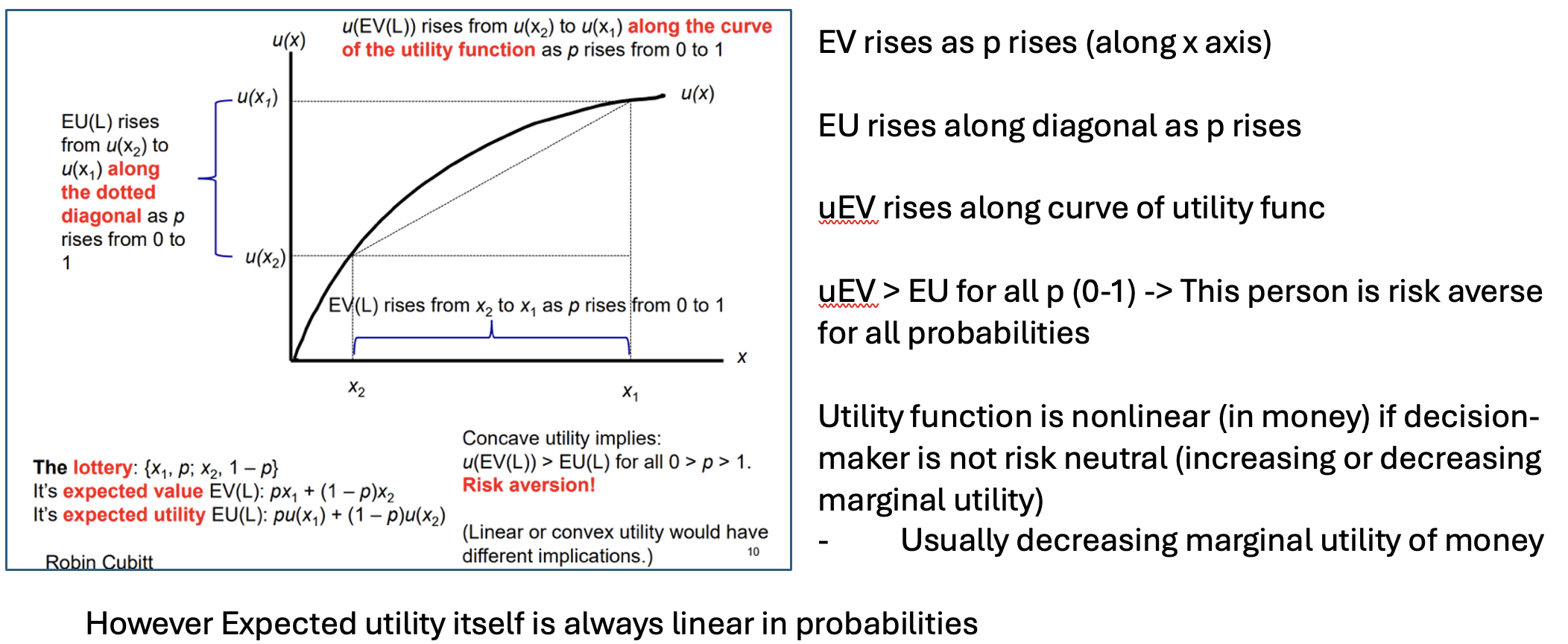
We compare u(EV(L)) to EU(L)
EU being linear in probabilities
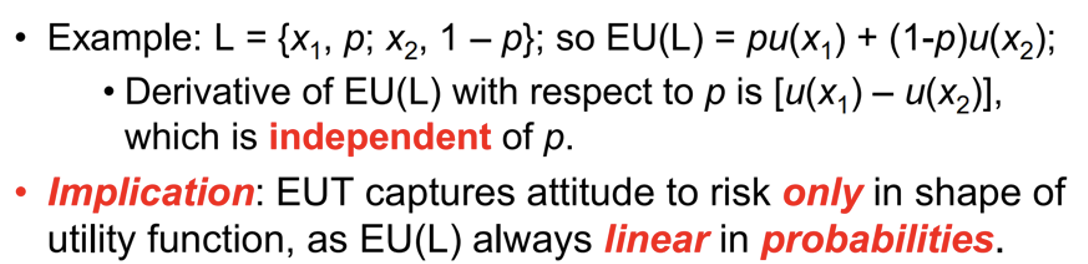
EUT only models utility function (no effects of probabilities)
impact of a given change in prob does not vary with level of prob
Relative weight of 2 utilities in EU(L) is ratio of probabilities of corresponding outcomes
Common consequence effect (CCE)
where people change their preferences between two risky options when a shared (common) outcome is added to or removed from both options
Tendency to choose the safer option when CC > 0
Reducing CC pushes more people towards riskier option
CCE example - Kahneman & Tversky (1979) RESULTS
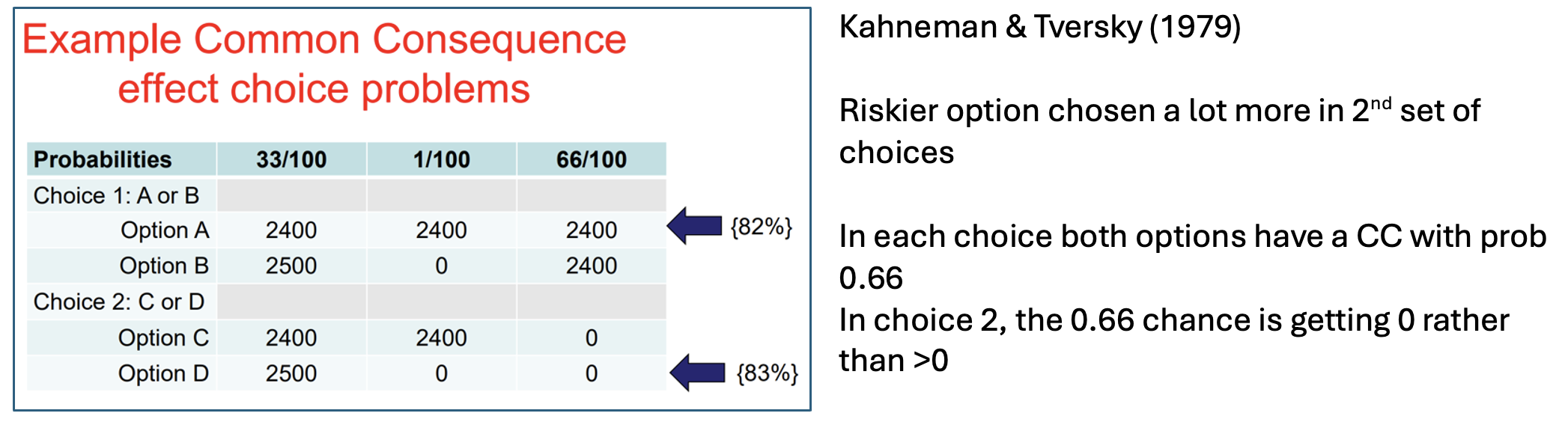
CCE & EUT (K&T 1979 example)

EUT says that CC should have no effect on comparison between options - preferences unaltered under EUT by CC
CCE suggests impact of extra chance of ‘winning’ > 0 (depending on level of that chance)
How is CCE observed in different subject design
Within subject:
Each subject faces the choices in a random order and incentivised by 1 round payout
Individuals displayed CCE pattern of A & D choices
Between subject:
Each subject assigned to a group that faces either choice 1 or 2 (and incentivised by chosen option being paid out)
Different proportions of subjects chose A or C - so not consistent in choices even when not same person making choices (unexplainable by EUT)
Common ratio effect (CRE)
When people switch from risk-averse to risk-seeking choices when the probabilities of outcomes in a gamble are scaled down by a common ratio
Switch from safer to riskier option as chance of winning (>0) is scaled down by a common ratio
effect violates the EUT's independence axiom, which posits that scaling probabilities should not change preference order.
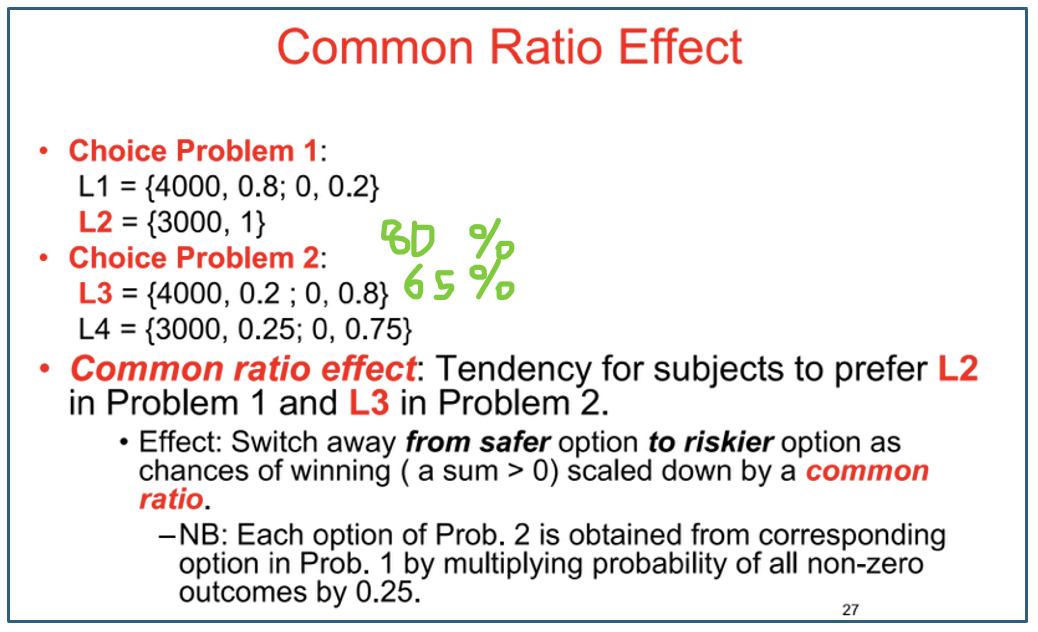
CRE & EUT
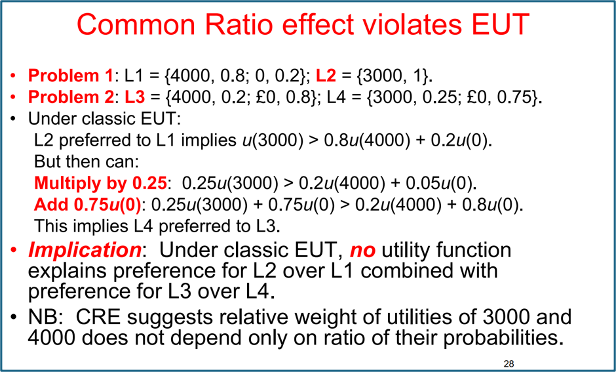
Under EUT, if L1 > L2 THEN L4 > L3
No utility function explains preferences differing between choices
CCE & CRE caveats
Many experiments found effects when replicated BUT not all did
CRE more robust
Not all subjects display effects in same experiment
Strength of effect varies with incentives + parameters
CRE & CCE show modelling EU as linear in probabilities not always best option

