Bio 171 Lecture 2: Scientific Process, Experimental Design, and Role of Evidence
 Studied by 0 people
 Call Kai
 Learn
Learn Practice Test
 Spaced Repetition
 Match
Match Flashcards
 Knowt Play
1/45

There's no tags or description
Looks like no tags are added yet.
Name | Mastery | Learn | Test | Matching | Spaced | Call with Kai |
|---|
No analytics yet
Send a link to your students to track their progress
46 Terms
Hypothesis:
Testable explanation for observations that make focused predictions and can be tested by experiments/observations/simulations/models. Must be falsifiable.
Theory:
Explanation for broad patterns in nature. Explanations have been tested many times with many hypotheses leading to valid predictions. However, always open to falsification if new substantiated evidence is presented.
Prediction:
Expected outcome of study. Reasoned from hypothesis. In controlled experiments all groups have separate predictions.
Correlation:
Measure of extent to which 2 factors vary together, and how well either factor predicts the other.
Causation:
Relationship in which one event leads to another.
Control group:
Group not exposed to variable in experiment.
Negative control:
Known outcome in group and tested variable not present.
Positive control:
Known outcome in group and variable w/ known effect is introduced.
Mean (also known as average):
Average value of a set of #. Useful way to summarize data.
Standard error (SE):
Measurement of the accuracy w/ which a sample distribution represents a population by using SD. In statistics, a sample mean deviates from the actual mean of a population; this deviation is the SE of the mean.
Sample size (also known as level of replication):
# of units (persons/animals/patients, etc.) in pop. to be studied. n should be big enough to have a high likelihood of detecting a true difference between two groups.
Test group (also known as experimental group or experimental condition):
Experimental group exposed to variable/treatment in experiment.
Variable:
Condition/treatment in studies.
Peer review:
Processes scientists use to evaluate each other manuscripts/grants. Determines if article/grant is funded, published and type of journal.
Replication (this term is used 2 different ways in Bio 171 – and science!):
1.. Repeating a study. Create more trusted conclusions if results are similar. 2. # of diff. experiment units subject to same treatment .
Dependent (Response) variable:
Outcome in study. Often plotted on y-axis.
Grant:
Money provided by govt./private to pay for research expenses (equipment, supplies, salaries).
Independent variable:
Influences dependent variable. Manipulated by researcher. (Time, space, location, species).
Manuscript (Article/paper):
Written document describing questions researcher addresses, experiments/studies done, results, interpretation, importance. Often published in scientific journals after peer-review.
Publication:
Manuscript is available to other scientists to read and peer evaluate (critically read results). Critical for communication and work advancement in understanding how natural world improves.
Reproducibility:
Extent to which consistent results are obtained in repeated experiments.
Describe the different ways biologists investigate how nature works.
Studies of cognition, behavior, biomechanics, physiology. Through hypotheses, observation/experimentation/simulation/math models.
Observational Study
Data collected w/o intentionally changing anything. Can only determine correlation. Generate hypotheses for testing.
Experimental Study
Intentionally manipulated variable and set of constant variables used to test hypothesis. Can determine causation.
Explain the central role that evidence (data) plays in building scientific knowledge.
Evidence provides unbiased facts to support scientific ideas and ensure the validity of scientific experiments. Provides the basis for objective and unbiased explanations of the natural world.
Given an experimental design, identify the hypothesis being tested, positive and/or negative controls, variable(s) tested, replicates, and the test group.
+ control confirms experimental setup works as expected by using a substance/condition known to produce the desired effect, while a - control shows what happens when the active variable is absent, confirming the absence of contamination/unintended effects, and validating that the experiment's conditions themselves don't produce a false + result.
Explain why larger sample sizes are more reliable than smaller sample sizes.
There’s less variation in larger n allowing more info for the true mean.
Why is mean useful to summarize raw data.
Includes every value in your data set as part of the calculation to represent the typical value.
Explain why the SE gets smaller as we increase sample size.
Always reported in relation to the mean value. Only can be derived from sampling multiple entities. SE gets smaller because the variation is smaller as values get closer to the true mean.
Explain how peer review and reproducibility correct and improve our understanding of nature.
It makes the reasoning for experimental choices are very clear and ensures that all explanations are tested using evidence correctly. Science is very self correctly because of this.
Describe the limitations of science.
Doesn’t make moral judgments, aesthetic judgments, show how to use scientific knowledge, and draw conclusions about supernatural explanations.
How do you know if a person is doing science?
Want to explain natural world.
What types of activities can be classified as science?
Asking questions, creating explanations based on evidence. Rejecting explanations that fail tests. Observational studies/experiments/simulations/math models. Evidence that support tests using evidence from natural world.
What are some activities that cannot be classified as science?
Evidence that fail tests using evidence from natural world. Not using fact/data.
How do scientists ensure that their work can be replicated?
Carefully document work. Have work be peer reviewed.
What is one role of observational studies in Dr. Duffy’s lab?
Give insight to what could be the problem.
Why does the lab also use experiments and mathematical models to investigate infectious disease outbreaks?
Experiments test a variable. Oftentimes it is either implausible/impossible to only use experiments so models are used to predict trends and create large scale generalizations.
Why is science an iterative rather than linear process?
Science constantly needs to be self-corrected. Gathering data leads to interpreting data which leads to more questions and more gathering data.
What type of studies allow for us to distinguish correlation and causation?
Well-controlled experiments where only a single variable is altered in the test group.
Whats an example of a spurious correlation?
Divorce rates in Maine are correlated with per capita consumption of margarine in the US.
What is the purpose of positive and negative controls in experiments?
Set up so researcher knows in advance what results should be expected if everything in study is working properly.
How do positive controls allow researchers to see if their study set up is working properly?
Provides researchers w/ info to explore a confounding variable if expected result doesn’t occur.
What is the difference between independent and dependent variables in a study?
Independent variables are what the researcher will change and control. The dependent variable is what the researcher will measure.
What kinds of data should be shown with standard error bars, and what happens to standard error as sample size increases?
Mean. As n increases SE decreases.
How should you interpret ± 2 standard error bars in Biology 171?
About 95% of the time the real mean will be located within the error bars.
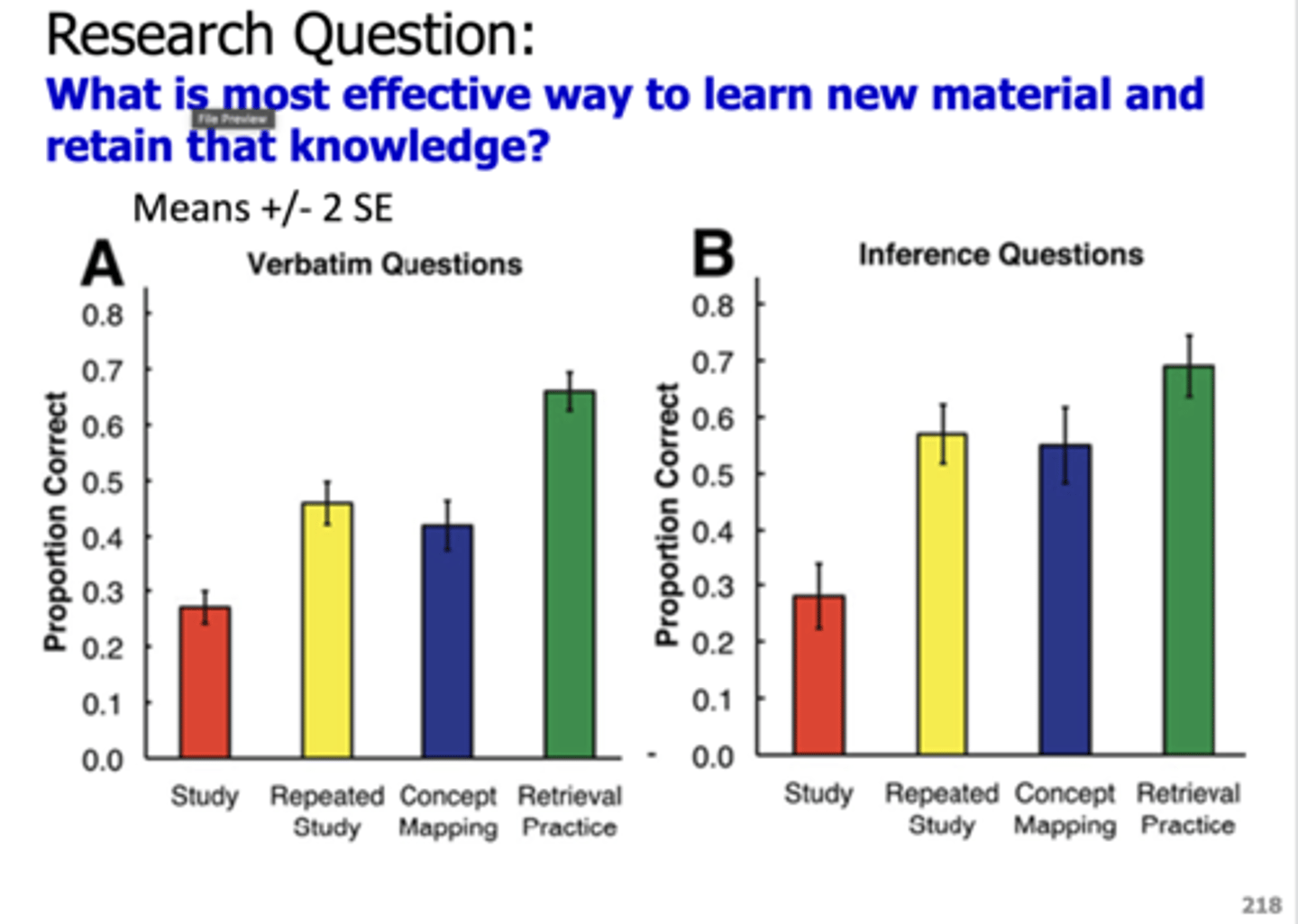
According to Karpicke & Blunt's 2011 study about study techniques, which technique is most effective for verbatim and inference questions? How do you know?
Retrieval practice b/c it had the highest proportion of problems correct and SE bars didn’t overlap w/ any of the other techniques.
 Note
Note  Flashcards (24)