Therio: Bovine Infertility, Poor Performance
 Studied by 0 people
 Call Kai
 Learn
Learn Practice Test
 Spaced Repetition
 Match
Match Flashcards
 Knowt Play
1/46

Earn XP
Description and Tags
lec 2
Name | Mastery | Learn | Test | Matching | Spaced | Call with Kai |
|---|
No analytics yet
Send a link to your students to track their progress
47 Terms
The best measure of reproductive efficiency is ..
Pregnancy Rate >25%
PR = Heat detection rate x Conception rate
Poor pregnancy rate results in ..
Increased age at first calving in heifers
Increased interval from calving to first service
Increased interval from calving to conception (Days open)
Increased service per conception
Early culling
Reasons for poor pregnancy rate
Poor heat detection or failure to cycle
Abnormal cycles
Poor conception
Reasons for poor conception ..
Cow factors (endometritis)
Semen/bull (quality)
Technician (technique, Artificial insemination timing)
Most common causes of Poor reproductive performance in heifers
Anestrus: Congenital abnormalities, Poor nutrition
Poor conception rate
Poor heat detection
How large should heifers be at breeding?
Heifers should be at 60-65% of mature weight and height at breeding
Conception rate per cycle should be __%
>65%
What is Freemartinism?
92% of females born co-twin to a male. Female fetus exposed to Anti-Mϋllerian hormone (AMH) and testosterone from the male fetus due anastomosis of placental vasculature
How does the genitalia present in a Freemartin cow?
External (may be normal, large amt of hair on the vulva)
Internal (abnormal development of tubular genitalia (paramesonephric duct) and ovaries)
What are the characterists of the internal genitalia of a Freemartin cow?
Underdeveloped cervix and uterine horns (cord like), Male accessory gland (seminal vesicles) may be present, Short vagina
How can you dx Freemartinism? -
Hx, Transrectal palpation if adult, Vaginal depth (calves less than 30 days of age), Cytogenetics (Gold standard),
Presenting Karyotype of Freemartinism
Most are Chimera (60XX/60XY). PCR is performed to detect “Y” antigen
What is White Heifer Disease?
AKA Segmental Aplasia
Recessive sex-linked gene of with white hair coat - common in Belgian blue & shorthorn
How does the genitalia present in White Heifer DIsease?
Segmental aplasia of the paramesonephric ducts and cervix, Normal ovaries, Variable persistent hymen (mostly in shorthorn cattle), Mucometra
Key difference in Freemartin vs White Heifer Dz
WHD: functional ovaries present
(neither condition can get pregnant)
What are causes of delayed cyclicity?
Poor growth
Nutritional
Trace mineral deficiencies
Calfhood diseases
Parasitism
At what age should you begin Reproductive tract scoring?
12 months of age
Indicators of poor reproductive efficiency in dairy cattle
Increased days open (interval from calving to conception)
Increased calving interval
Poor pregnancy rates
High early pregnancy loss
Indicators of poor reproductive efficiency in beef cattle
Low conception rate per cycle (>65% of pregnancies should be from the first cycle of the breeding season)
Low pregnancy rate at the end of the season
Increased length of the calving season
What is the optimum RTS score?
3 - 5; high RTS heifers had higher breeding season pregnancy rate, got pregnant earlier and responded better to synchronization and artificial insemination
Major causes of poor reproductive performance in adult cows
Abnormal cycles: Cystic ovarian diseases (dairy)
Anestrus
Poor conception rate
What is Cystic Ovarian Disease?
Cause: disrupted GnRH/LH secretion, unable to ovulate
Result: Follicles >17-20 mm persisting for at least 6 to 10 days in absence of corpus luteum
Incidence of Cystic Ovarian Disease
10 to 30% in dairy
Higher during the first 30 days postpartum
Behavioral signs of Cystic Ovarian Disease
anestrus (mc), nymphomania, normal cycles (rare)
Causative Factors of Cystic Ovarian Disease
Adrenal hyperfunction
Postpartum dz/uterine infection
High production (> 3rd parity)
Genetics
High selenium levels
Season?
Types of Ovarian cysts
Follicular (thin walled) vs Luteal (thick walled, may produce progesterone)
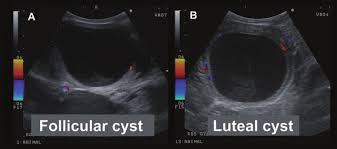
Tx Cystic Ovarian Disease
Goal: make the cyst more lutealized then resume cyclicity
Admin GnRH or hCG, followed by PGF2α (OvSynch)
More than 50% resolve spontaneously
Prevention Cystic Ovarian Disease
Difficult (involves many factors), review all farm protocols, nutrition, comfort, transition period
False Anestrus
due to Pregnancy, or heat detection problems
True Anestrus
Small inactive ovaries - smooth surface (postpartum in beef cattle)
Cystic ovarian diseases
Persistent corpus luteum
Pyometra
Postpartum anestrus in beef cattle
presents with small inactive ovaries
Causes of ovarian inactivity
Poor nutrition (dec BCS after calving)
Effect of lactation (beef cattle)
Chronic diseases, heavy parasitism
Trace mineral deficiencies
Negative energy balance ( dairy cows)
Cow factors of Poor conception rate
Uterine disease (endometritis) - major cause
Failure of ovulation
Loss of body condition
Environmental factors of Poor conception rate
Heat stress:
> 26°C / 78-79°F, … Temp-Heat Index THI
Inc RR & Temp
Decrease oocyte quality
Increased granulosa cells degeneration and decreased steroidogenesis
Decreased progesterone production
Reduced embryo quality
Effect can last over several cycles
Semen factors of Poor conception rate
Natural mating: Bull fertility/behavior (see lecture)
Artificial insemination: sperm quality
Human factors (AI) of Poor conception rate
Heat detection accuracy
Insemination timing
Semen handling (liquid nitrogen tank management, thawing temperature, time)
Insemination technique (site of semen deposition, cleanness)
What is Puerperal metritis?
Acute inflammation of all histological layers of the uterus, first 21 days postpartum
What is Clinical endometritis?
> 21 days postpartum, Purulent vaginal discharge, no systemic illness
What is Subclinical endometritis?
High prevelance, esp in dairy cattle
In cytology either:
a) 10% polymorphonuclear cells after 34 days postpartum
b) 5% 45 days postpartum'
Why are estrus and ovulation synchronization used ?
Beef herds (mostly for genetic improvement)
Use of artificial insemination
Embryo transfer technology
Dairy cattle
Poor heat detection is a major reason for poor pregnancy rate
Over 70% of dairy cows in the USA are inseminated after hormonal treatment
Over 80% of dairy herd use estrus/ovulation synchronization programs
What devices aid in improving heat detection?
Pressure sensitive devices: patches, or electronic
Activity monitors (rub off paint)
Bulls: penile translocation, vasectomy
How do you use PGF2a/analogues to synchronize heat?
1 injection + heat detection and AI
2 injections 11 to 14 days apart: Heat detection and AI or AI between 72 and 80 then 12 hours after heat detection
Controlled Internal Drug Releasing Device (CIDR®): Insertion for 7 days, 1 day prior to removal administer PGF2α, heat detection and AI
(don’t need to remember the days)
What stage must a cow be in to get the greatest response to PGF2a admin?
Days 5-16, while CL is present & before natural surge
Larger follicle will respond quicker
Controlled Internal Drug Release dispenser : CIDR Program
CIDR silicone elastomer contains 1.38 grams of progesterone
Insert, then on Day 6 admin PGF2α to lyse CL
Remove after 7 Days
Enough negative feedback on LH
Regulation of follicular waves
(don’t need to remember the days)
Ovsynch Program
Day 0 admin GnRH: synch follicular wave & ovulation or lutenization
Day 7 admin PGF2a: lyses CL or lutenized follicle
Day 9 admin GnRH: induce ovulation in all cows w a mature follicle
Timed AI 0-12h after
(don’t need to remember the days)
Double Ovsynch
Two synchs back to back!
Pros: dec anovular cows, inc % with CL at start of 2nd synch, dec % with low progestore at 2nd synch
Cons: complicated & costly
Study Guide Questions
In your analysis of reproductive records in a large dairy, you find that of 150 cows that should have been inseminated only 80 were seen in heat and inseminated over a period of 21 days. You perform a pregnancy diagnosis on all inseminated cows, and you find that 35 of the 80 cows inseminated are pregnant. Assuming that all cows are healthy and have cyclic, answer the following questions:
a. What is the pregnancy rate in this dairy?
b. What is the major problem in this herd?
c. How can you help the producer to improve pregnancy rate?
You are presented a 13 month-old heifer that was born co-twin to a male calf. The producer kept her as a replacement heifer because he discovered that her full sister from the previous year has a great genetic value.
a. What findings would you expect on transrectal palpation of her reproductive tracts if she is a freemartin?
b. What tests would you run to confirm a diagnosis of fremartinism?
c. Which hormones are implicated in the condition?
Regarding cystic ovarian disease in dairy cows.
a. What are the 2 types of cysts? and how do they differ in terms of endocrine activity?
b. c. List 3 predisposing factors for cystic ovarian disease in dairy cattle
c. What is the most common behavioral manifestation of cystic ovarian disease in cattle?
What is the reproductive tract scoring? What is it used for?
Endometritis is a major cause of poor conception rate. List 5 risk factors for clinical or subclinical endometritis in dairy cattle.
List 3 major mechanisms by which heat stress can negatively affect pregnancy rate in cattle.
You perform a transrectal palpation and ultrasonography of the reproductive tract on a healthy show cow that the owner wants to inseminate. Your findings are as follows: Left ovary follicle of 12 mm, Right ovary: Corpus luteum of 3.2 cm, the uterus is relaxed (i.e., LF12RCL3UN). Please fill in the blank on the following section.
The major circulating reproductive steroid in the blood of the cow is …………
She could be between day ……and day …… of the cycle. To hasten her return to estrus, she can be treated with a dose of ………. This treatment will induce ….. and the cows is expected to be in heat within ------- and ---- days. To avoid heat detection, another option would be to administer an Ovsynch program. In this case, you will administer a dose of GnRH on the first day which will cause ………., 7 days later the finding on the ovaries will be as follows………………..
Which hormones will you used to finish the Ovsynch program and when will she be insemination without heat detection?
 Note
Note  Flashcards (74)