Plant Transport, Nutrition, and Metabolism
 Call Kai
 Learn
Learn Practice Test
 Spaced Repetition
 Match
Match Flashcards
 Knowt Play
1/89

There's no tags or description
Looks like no tags are added yet.
Name | Mastery | Learn | Test | Matching | Spaced | Call with Kai |
|---|
No analytics yet
Send a link to your students to track their progress
90 Terms
What do plants need?
Light, CO2, H2O, Minerals, O2H
How do water and minerals transport in plants
Root to shoot
What direction transport does water and minerals move in plants
Unidirectional transport
How does food move in plants
Multiple directions!
How do bryophytes transport water?
Diffusion
Transport routes of large plants
In/Out of individual cells, within tissues, long distance
What are the processes when transporting water in/out cells
Passive and active transport
How does PASSIVE TRANSPORT use ATP
Doesn’t use! Down concentration gradient
How does ACTIVE TRANSPORT use ATP
Uses it! Against concentration gradient
What is chemiosmosis
Using active and passive transport
What is the water potential level in osmosis when there is a high concentration of solutes
Low water potential
What is the water potential level in osmosis when there is a low concentration of solutes
High water potential
In osmosis, water potential moves from ___ to ____
High; Low
What type of solution is a turgid cell typically in
Hypotonic
Hypotonic solution
Low solute concentration : High water potential
What type of solution is a plasmolyzed cell in
Hypertonic solution
Hypertonic solution
High solute concentration : Low water potential
What type of solution is a flaccid cell in
Isotonic solution
Isotonic solution
Equal solute concentration : Equal water potential
Components of water potential
Water potential = Solute potential (-) + Pressure potential (±/-)
Sign of solute potential
Negative
Sign of pressure potential
Negative or positive
Tissue-Level Transport: Transmembrane
Molecules repeatedly cross plasma membranes and cell walls
Tissue-Level Transport: Symplastic
Molecules move through the symplast
Tissue-Level Transport: Apoplastic
Molecules move through the apoplast
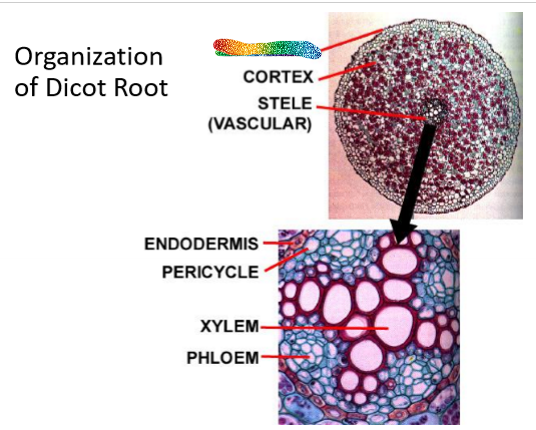
What is this part of the dicot root
Epidermis
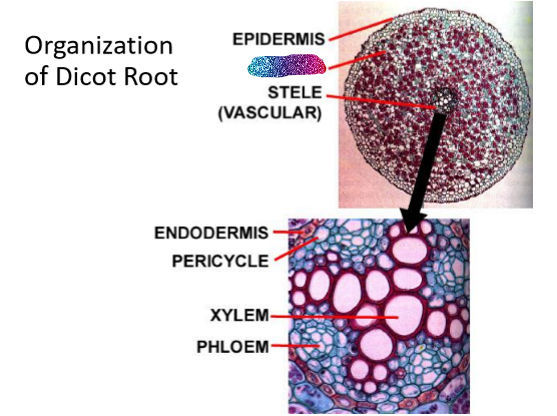
What is this part of the dicot root
Cortex
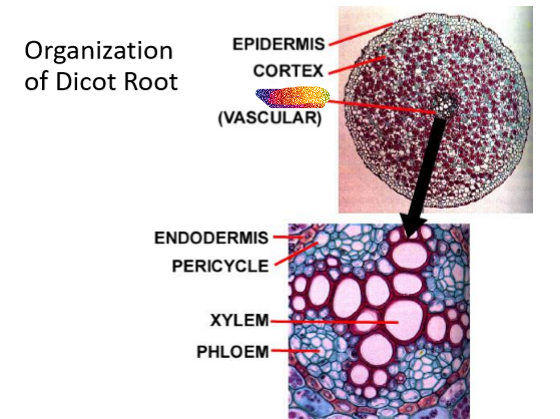
What is this part of the dicot root
Stele
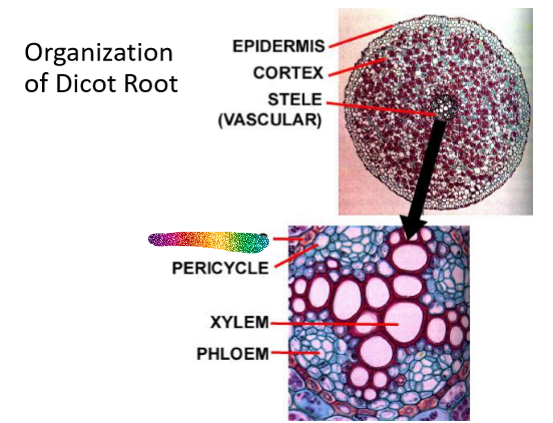
What is this part of the dicot root
Endodermis
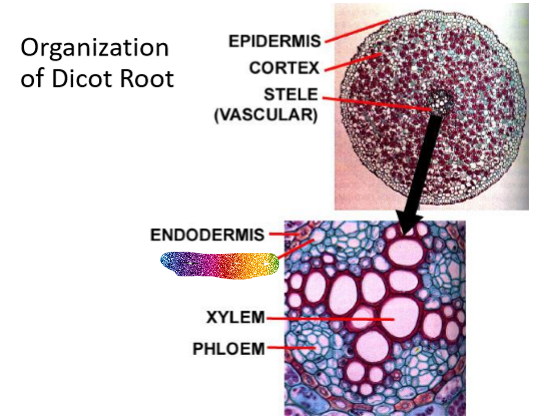
What is this part of the dicto root
Pericycle
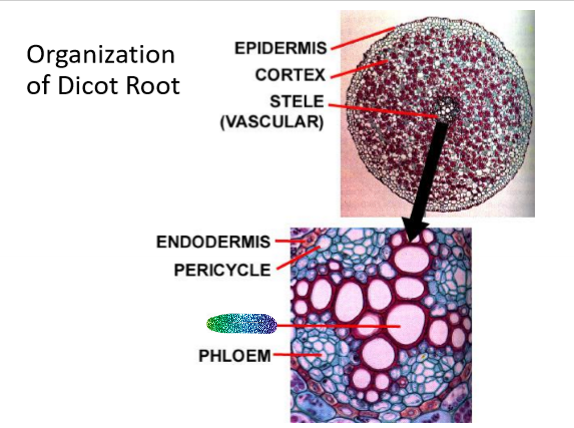
What is this part of the dicot root
Xylem
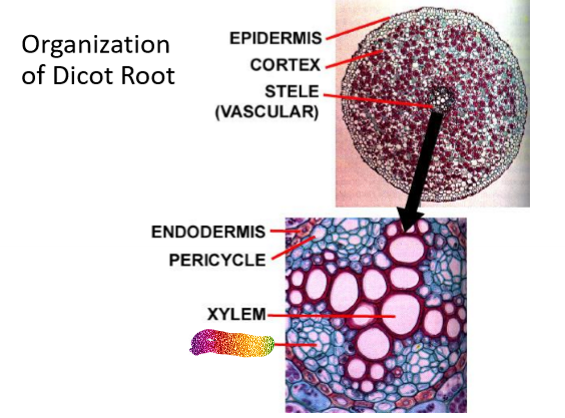
What is this part of the dicot root
Phloem
Function of the Casparian strips
Regulates mineral transport through intracellular spaces
Steps in plant transport
Creation of membrane potential and proton gradient —> Chemiosmosis —> Water uptake and osmosis
What is root pressure created by
Flow of water into stele
Pressure can drive water ___ without transpiration
UP
Guttation
Leaking of water out of tips of vasculature tips in leaves due to root pressure
Transpiration
Movement of water through plant, driven by evaporation
What type of environment causes LESS evaporation
Dry, hot air climate
What type of environment causes MORE evaporation
Moist, cool air climate
What powers the movement of water from roots to leaves
Water pressure gradient
What is transpiration regulated by
Stomata!
Stomata
Little pores in surfaces of leaves
Closed stomata
Empty of water, flaccid, deflated
Open stomata
Full of water, turgid
How do plants open/close stomata
Uses active transport
What is the first step in stomatal closing
Potassium ions moveout of the vacuole and out of the cells
What is the second step of stomatal closing
Water moves out of the vacuoles, following potassium ions
What is the third step of stomatal closing
Guard cells shrink in size
What is the fourth step in stomatal closing
Stoma closes
What is the first step of stomatal opening
Potassium ions move into the vacuoles
What is the second step of stomatal opening
Water moves into the vacuoles
What is the third step of stomatal opening
Guard cells expand
What is the fourth step of stomatal opening
Stoma opens
How does water get to the stomata?
Xylem and Phloem tissues
What are xylem called in gymnosperms
Tracheid
What are xylem called in angiosperm
Vessel element
Wood, aka:
Secondary xylem
Components of tracheids
End wall, pits
Characteristics of vessel elements and tracheids
Dead at maturity, thick cell walls
What cell type are xylem
Sclerenchyma
Transport in phloem
Organic molecules and some minerals; Source to sink
Phloem transport status changes depending on ____
Conditions
Components of phloem
Sieve plate pore, sieve plate, sieve-tube element, companion cell
Characteristics of sieve-tube element
Lacks organelles, has cytoplasm
Characteristics of companion cell
Has nucleus(active), adjacent to STE, lots of connections to STE
Function of companion cell
Plays role in delivery of substances from sources into phloem, phloem to sink
Direction of companion cell
high to low OR low to high
Symplastic phloem loading
Passive transport
(Partly) Apoplastic phloem loading
Active transport
First step of transport in phloem
“Phloem Loading” of sucrose - ACTIVE/PASSIVE, water potential decreases in phloem, water enters
Second step of transport of phloem
Water absorption creates PRESSURE, forcing movement down pressure gradient - PASSIVE
Third step of transport of phloem
Pressure gradient maintained by “unloading” sucrose at sink (ACTIVE/PASSIVE)
Fourth step of transport of phloem
Water potential so water returns to xylem
What is long distance transport in xylem driven by
Transpiration, cohesion-adhesion-tension, water potential gradients
First step in plant metabolism
Energy converted in organized steps
Second step in plant metabolism
ATP generated and used
Third step in plant metabolism
Reducing power generated and used
Fourth step in plant metabolism
Requires membranes: Chloroplast, mitochondria
When does photosynthesis and respiration occur in plants during the day
Photosynthesis respiration (usually)
When photosynthesis and respiration occur in animals during the day
Respiration
When does photosynthesis and respiration occur in plants during the night
Respiration
When does photosynthesis and respiration occur in animals during the night
Respiration
________ alone can result in the transportation of water up a stem
Root pressure
_________ is the pull of water through the plant, driven by evaporation of water
Transpiration
__________ opens and closes and control the rate of transpiration
Stomata
___________ explains the movement of water in the _____
Cohesion-adhesion-tension theory; xylem
Phloem move materials from sources to sinks using ______ and the _______
Phloem loading; Pressure-flow hypothesis
Plant metabolism includes both _____ and ______
Respiration; Photosynthesis

