Materials 3.1
 Call Kai
 Learn
Learn Practice Test
 Spaced Repetition
 Match
Match Flashcards
 Knowt Play
1/103

There's no tags or description
Looks like no tags are added yet.
Name | Mastery | Learn | Test | Matching | Spaced | Call with Kai |
|---|
No analytics yet
Send a link to your students to track their progress
104 Terms
Silviculture
(Fajardo, 1993) is the science of growing timber crops of valuable variety for commercial purposes
Stand Tending
Harvesting
Regeneration
Timber Forest Cycle
Wood
the most common building material
Wood
is the fibrous substance which composes the trunk and branches of a tree that lies between the pith and the bark
Strong
Durable
Light in weight
Easy to work on
With natural artistic beauty
Properties of Wood
Wood is stronger than other materials in proportion to weight
Easily worked on with tools and fabricated into many shapes, sizes and designs
Excellent non-conductor of heat
Its grains and appearance is conducive to artistic and architectural design
Abundant in many shapes, color, sizes and is a renewable resource
Small wood members can be used as connectors in trusses, spans, towers, etc.
Does not deteriorate in value if properly handled and protected
Not readily affected by changing styles
Has a prompt resale value
Not seriously affected by heat, cold or climate
Advantages of Wood
Strength
Weight
Hardness
Cleavability
flexibility/Toughness
Durability
Physical Properties of Wood
Strength
the ability of wood to resist stress and strain
Weight
heavy woods are strong while light woods are weak
Hardness
resistance to indentation or cutting across the grain
Cleavability
the resistance of wood to cleavage along the grain
Flexibility/toughness
the strength, shock resistance and pliability of wood
Durability
the ability to resist decay
There is no direct relation between the physical and mechanical properties of wood and its durability.
However, there is a relation between the color of the heartwood and its durability
The darker the heartwood, the more durableis the wood
Relationship between Physical, Mechanical Properties and Durability
Mode of Growth
Density
Leaves
Color of the Wood
Grain of Wood
Nature of wood surface when sawed
Classification of Wood
exogenous
indogenous
(2) Mode of Growth
Exogenous
outward growing tress which are preferred for lumbering
Indogenous
inside growing trees which are less preferred for lumbering since its center core is soft and brittle
Softwood
hardwood
types of density
Softwood
also known as the conifers or evergreen
Hardwood
generally deciduous and with broad leaves
Needle-shaped
Broad-shaped
types of Leaves
White
Yellow
Orange
Red
Brown
Black
Color of the Wood
Straight grain
Cross grain
Fine grain
Coarse grain
Grain of Wood
Plain
Grained
Marked
Nature of wood surface when sawed
Logging
Sawing
Lumbering
Preparation of Wood
Logging
the harvesting of mature trees
Felling
Skidding
Bucking
Logging Operations
Felling
cutting of the mature tree
Skidding
transporting the felled logs from the forest to the sawmill
Bucking
the process of sawing the entire log into smaller pieces
Axe
Saw
and Wedges
In the old days, all the cutting and bucking operations were done using:
Lower labor cost
Greater production
Time element
Nowadays, the cutting of trees are done using powered machine cutters and chain saws due to the following advantages:
Lumbering
involves all the operations in the preparation of wood for commercial purposes
Sawing
the cutting of a log into small pieces using a saw
Two-man logging rip saw
Power band saw
Two types of Saw
Plain Sawn
Quarter Sawn
Rift Sawn
Live Sawn
Manner of Log Sawing
Lumber
the resulting wood pieces after a log has been sawed or sliced into boards, planks, sticks, etc. for commercial purposes
Rough Lumber
unplaned or undressed lumber
Surfaced/Dressed Lumber
a planed lumber having at least one smooth side
Rough Lumber
Surfaced/Dressed Lumber
S2S
S4S
Lumber Surface Classification
Slab
Timber
Plank
Board
Flitch
Types / Forms of Lumber
Surfaced/Dressed Lumber
a planed lumber having at least one smooth side
S2S and S4S
a planed or dressed lumber of which the number connotes the smooth side. Hence S2S is smooth on two sides while S4S is smooth on four sides.
Slab
a kind of rough lumber cut tangent to the annual rings of wood running the full length of the log and containing at least one flat surface
Timber
a piece of lumber 5 inches or larger in its smallest dimension
Plank
a wide piece of lumber 2-5 inches thick
Board
a piece of lumber less than 1 ½ inches thick and at least 4 inches wide
Flitch
a thick piece of lumber
Defect
any irregularity found in wood
Wood Defects due to Abnormal Growth
Wood Defects due to Deterioration
Defects in Wood
Shakes
Knots
Wood Defects due to Abnormal Growth
heart shakes
ring shakes
wind/cup shakes
star shakes
shakes
dead/decayed knots
live knots
knots
knots
usually occurs at the starting point of a branch
Heart shakes
radical cracks originating from the heart of the log.
Ring shakes
when cup shakes cover the entire, they are known as ____________
Wind/Cup shakes
cracks/breaks across the annual rings at the timber during its growth caused by excessive bending by wind
Star shakes
composed of several heart shakes radiating from the center of the log in a star-like manner
dry rot
wet rot
Wood Defects due to Deterioration
Dry rot
the presence of little moisture (<20%) is seasoned woods invites fungi to grow and cause dry rot
Wet rot
caused by a relatively high moisture saturation (>20%) in woods. Tales place during the growth of the tree or after the wood is assembled
constitute about 1/3 to more than 2/3 of its weight
After cutting, trees still contain moisture in their cells. The water contained in a freshly cut wood:
preserve the lumber from shrinkage or decay
The moisture has to be expelled out thoroughly to:
Seasoning
the process of the removal of this moisture content from lumber
Natural or Air Seasoning
Artificial Seasoning
Methods in Seasoning Lumber
Natural or Air Seasoning
considered as one of the best method in seasoning lumber. The lumber is piled horizontally or at a slanting position outdoors
Artificial seasoning
the lumber is stacked inside a drying kiln and subjected to steam and hot air under pressure
Forced air drying
Kiln drying
Radio frequency dielectric drying
Artificial Methods in Seasoning Lumber
Forced air drying
electrical fans are used to booster the circulation of air in the preparation for kiln drying
Kiln Drying
the lumber is dried in a special room where temperature, humidity and air circulation is controlled
Radio frequency dielectric drying
a fast method in drying lumber using radio frequency dielectric heat
constantly dry or continuously submerged in water
Wood does not decay naturally through age nor will it decay as long as it is kept _________________ or _____________________
good seasoning
The essential requirement in achieving a successful preservation of wood is ________________
External processing
Internal processing
Methods in Wood Preservation
External Processing
the wood is coated with preservative chemicals (solignum, tar, used engine oil, etc.) by brush, spray or immersion that penetrate the fibers.
Internal Processing
the wood is impregnated with a chemical preservative at a specific pressure in order to permeate into the wood thoroughly
thickness (inches) x width (inches) x length (foot)
Measuring Wood (Lumber)
Board foot (bdft)
the volume of a piece of wood 12 inches wide, 1 inch thick, and 12 inches long. It is equal to 144 in³
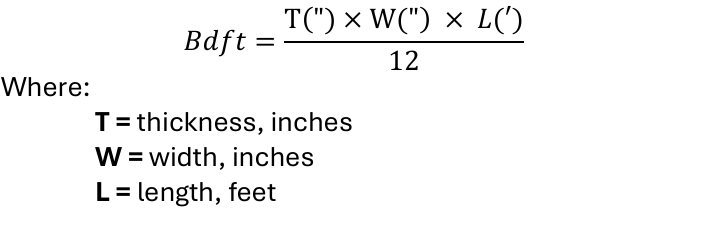
Formula in determining the value of the board foot of a single piece of lumber:
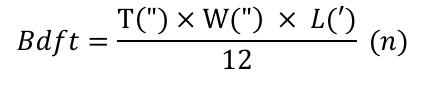
Formula in determining the value of the board foot of several pieces (n) of lumber:
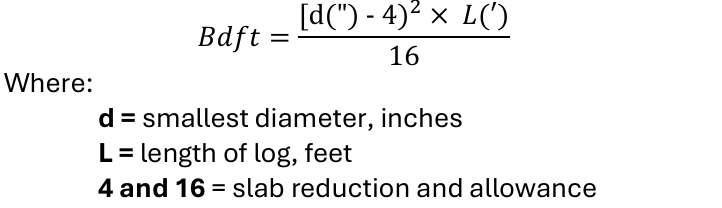
Formula in determining the value of the board foot of a log (Doyle Log Rule):
Manufactured boards
are made of wood but does not appear in their natural state.
Manufactured boards
This type of building material can be classified as a type of lumber as they are by-products in the manufacture of lumber.
Plywood
Hardwood
Particle board
Types of Manufactured Board
Plywood
is made of an odd number of veneer sheets glued together with the grains running at right angle to each other.
Veneer Sheets
It refers to thin slices of wood, usually thinner than 3 (1/8 inch). It is obtained either by “peeling” the trunk of a tree or by slicing large rectangular blocks of wood.
Plywood
is also light in weight but strong enough that a screw or nail can be driven close to the edges without danger of splitting.
soft plywood
hardwood plywood
exterior or marine plywood
different types of plywood:
Soft plywood
the most common for structural use
Hardwood plywood
used for paneling and finishing where usually only one face is hard finished
Exterior or Marine plywood
made for external use, sometime used for construction of boats
Hardwood
hardboard or pressed wood is made from wood chips which are exploded into fibers under steam of high pressure. The lining in the wood itself binds pressed wood together with no filters or artificial adhesives applied. Pressed wood is equally strong in all directions but very brittle. Its color varies from light to dark brown.

