10. How to teach READING Online - Sample Lesson
 Studied by 0 people
 Call Kai
 Learn
Learn Practice Test
 Spaced Repetition
 Match
Match Flashcards
 Knowt Play
1/19

Earn XP
Description and Tags
10. Sample READING lesson
Name | Mastery | Learn | Test | Matching | Spaced | Call with Kai |
|---|
No study sessions yet.
20 Terms
Sample Online READING Lesson:
Read about one couple’s long-lasting marriage and their secret to success.
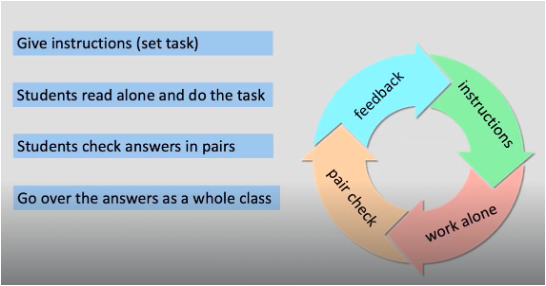
Use the Task Cycle for each activity and each stage
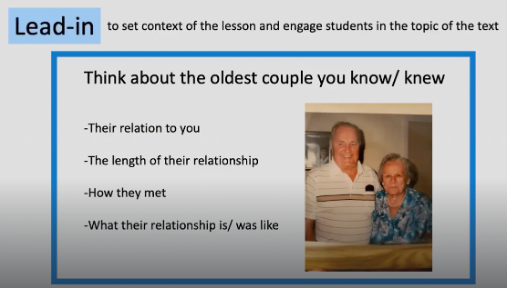
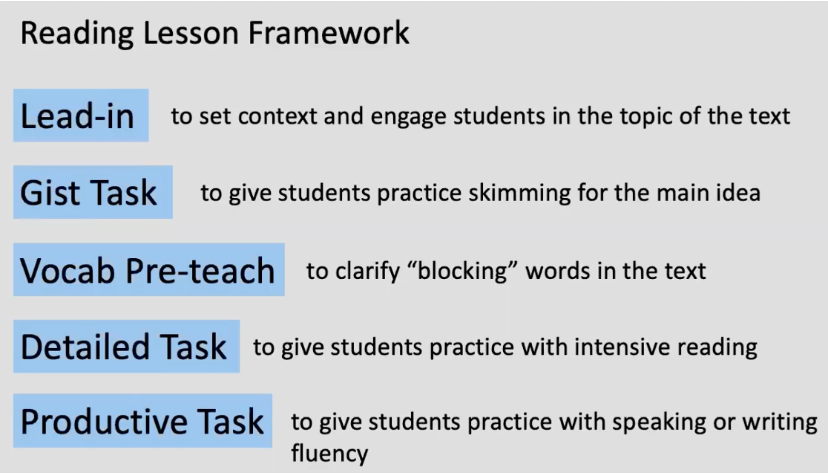
Lead-in = 5 minutes
Introduce the topic to Ss: Relationships
Ppt slide w/ 4 questions
Demo: Talk about your own grandparents and answer the 4 questions (20-30 seconds)
Lead-in - TASK CYCLE
Instructions -Think about the oldest couple you know. Answer the 4 questions.
Work Alone: Ss think
Pair Check: (If time allows) Ss discuss their answers in BORS or
Whole Class Feedback (WCFB): 2-3 Ss answer
GIST Task
Introduce the text we will be working with in the lesson.
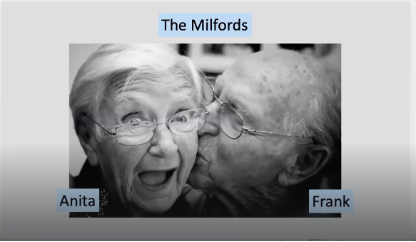
Introduce the couple in the news article
“These are the Milfords”
Show a stock image photo of a happy elderly couple.
Engage Ss in the story by asking them to make PREDICTIONS on what article is about.
“Look at this picture.
What do you think about this couple?
How long do you think they’ve been together?
How do you think they met?”
GIST Task - 5 minutes
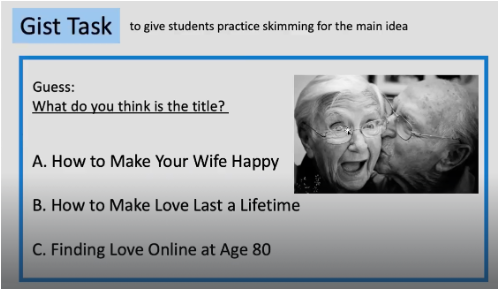
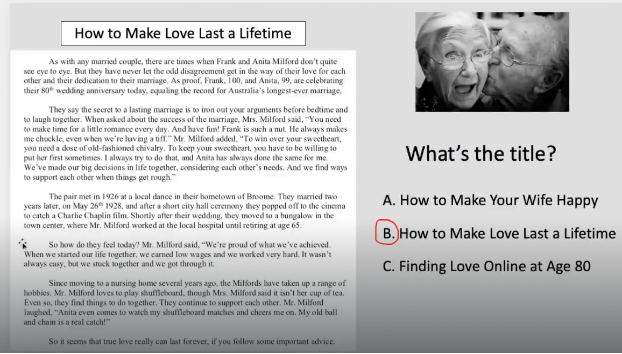
Show slide with 3 possible titles and picture of Milfords.
“Ok we have met the Milfords. We are going to read a news article about them. But it’s missing a title.”
GIST Task - TASK CYCLE
Instructions - “Based on the picture and everything we’ve talked about so far, what do you think the title will be?”
Work Alone: Let Ss read alone and choose a title alone in the time you’ve allotted.
Pair Check: In BORs, Ss discuss their choices in pairs.
Whole Class Feedback (WCFB): 2-3 Ss answer. Reveal the correct answer on a slide.
GIST Task - WCFB
Pre-Teach Vocab - 5 minutes
Choose words that will block Ss understanding of the article.
.
These are your best guess only.
.
Check these words against the upcoming tasks to ensure they’re actually needed.
.
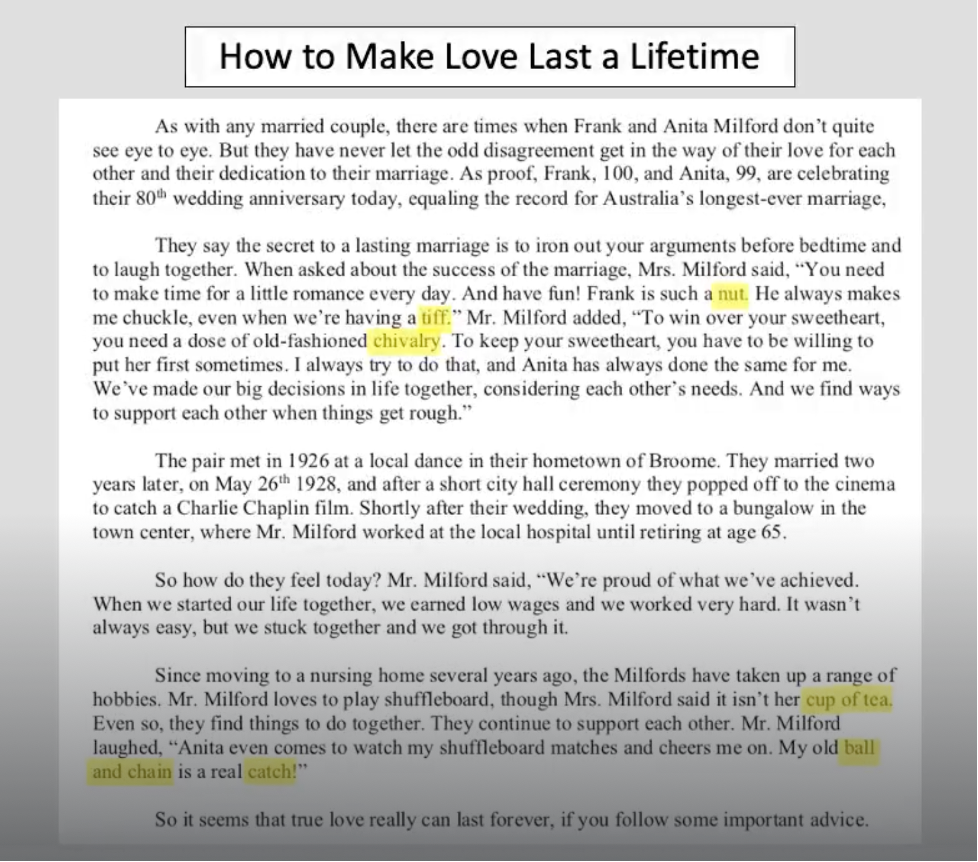
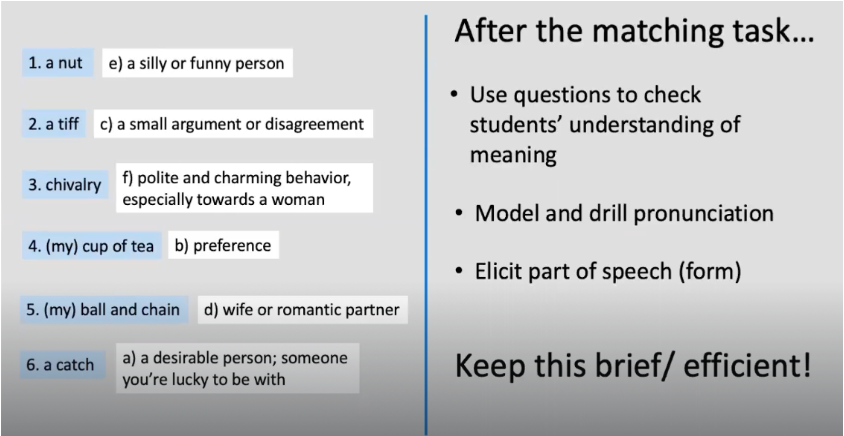
Create a task to introduce these words to Ss eg: a matching task.
Pre-Teach Vocab - TASK CYCLE
Instructions - Ask Ss to match the words and the definitions.
Work Alone: Let Ss work alone and match words as best they can.
Pair Check: In BORs, Ss compare their answers.
Whole Class Feedback (WCFB): 2-3 Ss answer. Reveal the correct answer on a slide.
Pre-teach Vocab -TASK CYCLE
WCFB is a time to check Ss answers
and also to check
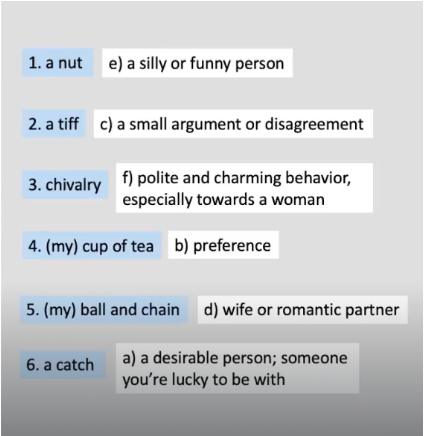
MEANING, PRONUNCIATION and FORM.
Use Concept Checking Questions (CCQs)
Pre-teach Vocab -TASK CYCLE - WCFB
*MEANING
.
Use CCQs to ensure Ss really understand the meaning of a word, especially its severity or nuance.
.
“A tiff: if I have a tiff with my partner does that mean we are never speaking again? or are we just a bit upset?"
Pre-teach Vocab -TASK CYCLE - WCFB
*PRONUNCIATION
.
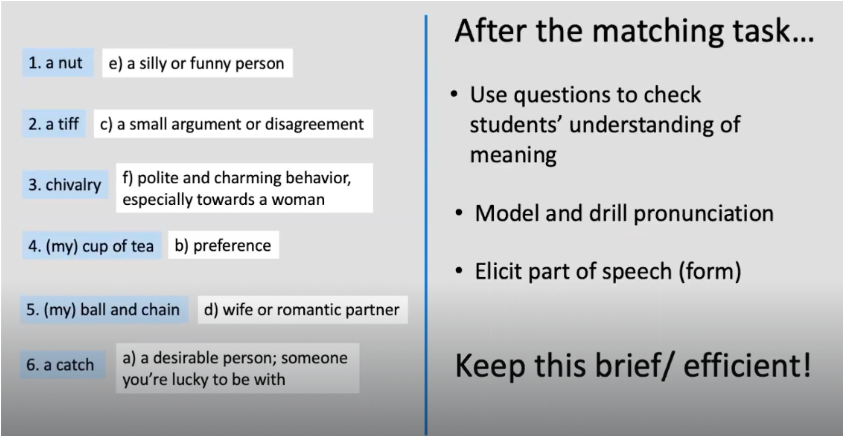
Model the pronuciation for Ss.
.
Have Ss repeat (drill) the correct pronunciation
Pre-teach Vocab -TASK CYCLE - WCFB
*FORM
.
Elicit the part of speech (Form)
.
“A nut: is that a noun, a verb or an adjective?”
.
Highlight or write that on the slide for Ss to have a visual confirmation of the answer.
Pre-teach Vocab -TASK CYCLE - WCFB
.
Keep WCFB brief and efficient.
.
Remember this is not the focus of the lesson.
.
The aim is to remove any blocking words for the next part of the lesson.
Detailed Task = 5 minutes
More intensive reading and more detailed comprehension.
.
The detailed task is the reason for the lesson.
.
Gives Ss a solid opportunity to master the text. All the earlier tasks have lead to this point.
.
Ss know the context, they’re familiar with the text and gotten more and more from it each time, and they understand blocking words.
Detailed Task - TASK CYCLE
Instructions - “Read the text again and answer the questions.”
Show the comprehension questions on the same page as the text for easy reference.
Work Alone
Pair Check: (If time allows) Ss discuss their answers in BORS or
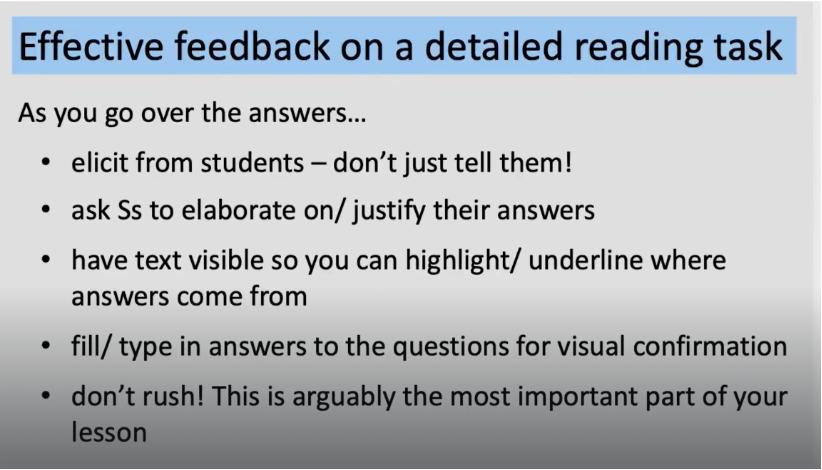
Whole Class Feedback (WCFB): 2-3 Ss answer. Important: Elicit answers (don’t give answers)
Detailed Task - TASK CYCLE - WCFB - Very Important
.
Don't: "The answer to No. 1 is no their relationship isn't perfect because they still have disagreements."
Do: "[student name] what is the answer to No. 1?"
Do: "Oh right, their relationship is not perfect. How do you know? What did you read in the text that tells you that?"
*If Ss can't provide further information, ask another Ss.
.
*Highlight answers on the text as they are given.
Productive Task
You can have more than one productive task.
.
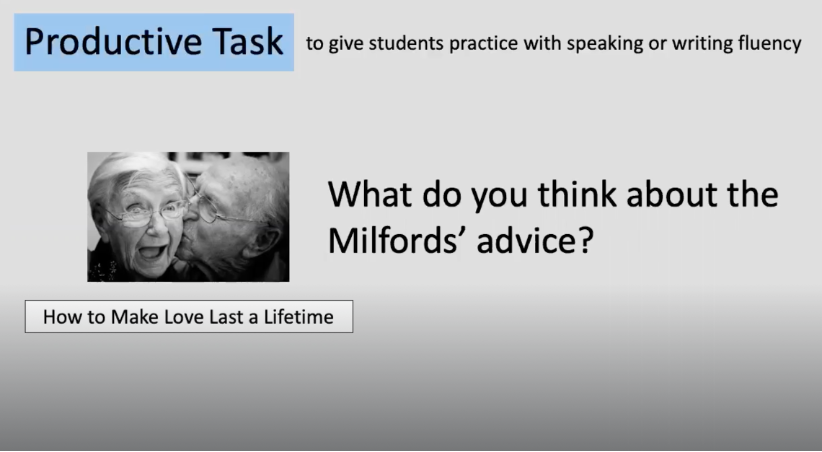
Productive Task 1: Briefly ask Ss their opinions on what they’ve just read.
We usually like to discuss things we’ve read.
Keep this section brief if you have more advanced tasks coming up.
Productive Task
Purpose: To give Ss practice with speaking or writing fluency depending on the task design.
.
The whole reading lesson has so far been about Ss receiving information. Practicing productive skills gives them a chance to create output.
.
It helps balance their skills (receptive /productive).
Productive Task
Allows Ss respond to what they've read.
.
Personalises the lesson and maximises relevance to Ss.
.
Makes lesson more authentic. Usually after you've read something , you want to share it and talk about it with others.
Productive Task 2 - TASK CYCLE
Instructions -Think of 3 pieces of advice of your own for how to make love last a lifetime.
Work Alone: Ss think
Pair Check/ Small groups (BORs): Ask Ss to share their advice and discuss and come up with the group's top 3 pieces of advice.
(Note: this is a COMMUNICATIVE goal.)
Whole Class Feedback (WCFB): 2-3 Ss answer
Productive Task - a Communicative Goal
ie: “Discuss and come to an agreement about x.”
.
Much better than simply ‘discussing’ a topic with no aim.
.
Gives Ss a reason to express their thoughts and listen to others.
.
Ss must communicate clearly, listen to each other, discuss and decide on their answers as a group.
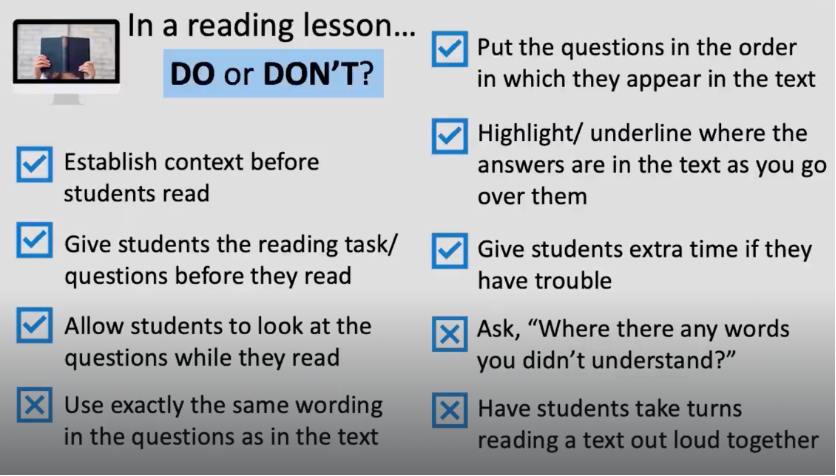
Is this READING lesson framework the only way to do a reading lesson?
No, there are other ways. But this is a tried and tested way of conducting a successful reading lesson.
.
By the end of the lesson, Ss will be able to understand a lot more than they could at the start.
Should you give Ss extra time if they need it?
Yes.
The main aim of a reading lesson is to improve Ss reading comprehension so you need to allow Ss enough time to do this.
.
So if Ss are having trouble, perhaps more trouble than you anticipated, you want to be able to give them extra time.
Why does it matter that Ss have enough time to do the reading tasks?
So that at the end of the lesson Ss feel like they had time to develop their reading comprehension and weren’t rushed along.
.
You don't want Ss leaving the lesson feeling like they didn't actually have time to understand the text or get anything from it.
What are the most important things that Ss will need to have time for?
They need a proper amount of time to do the reading tasks (ie: Gist task and Detailed Task).
.
You also need enough time to give them feedback.
Where can you find this extra time if you anticipate Ss will need it (or if you realise during the lesson that they need it)?
Shorten Lead-in.
Shorten or omit the Vocab Pre-teach.
Omit the Productive Task.
 Note
Note  Flashcards (59)