BINOCULAR BALANCE/THEORY OF REFRACTION/DUOCHROME
 Call Kai
 Learn
Learn Practice Test
 Spaced Repetition
 Match
Match Flashcards
 Knowt Play
1/46

There's no tags or description
Looks like no tags are added yet.
Name | Mastery | Learn | Test | Matching | Spaced | Call with Kai |
|---|
No analytics yet
Send a link to your students to track their progress
47 Terms
If astigmatism didn’t exist, End point criterion for subjective refraction would be
Maximum plus lens (minimum minus lens) power for best VA
When astigmatism is present, a point image exists. True or False
FALSE, POINT IMAGE DOES NOT EXIST
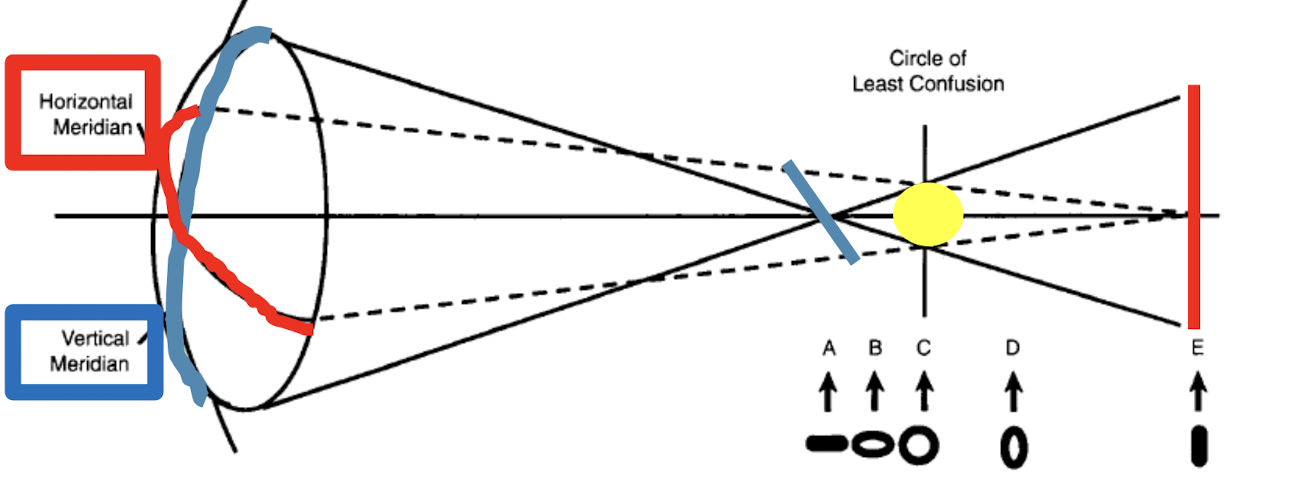
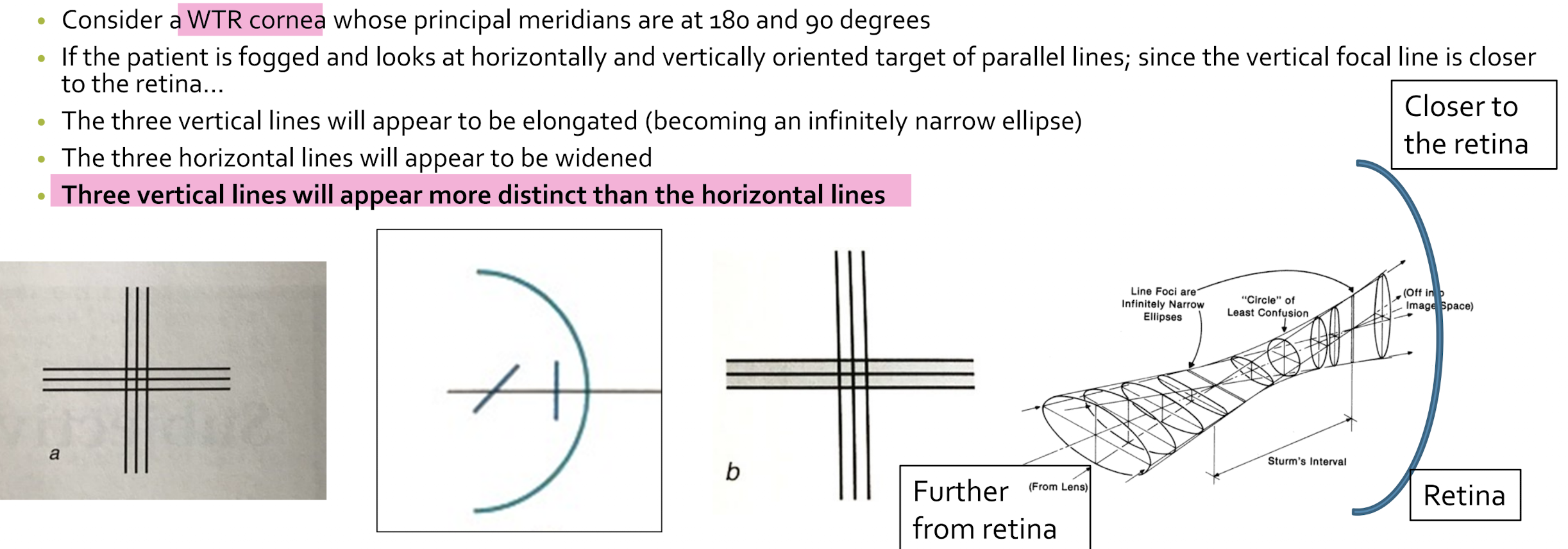
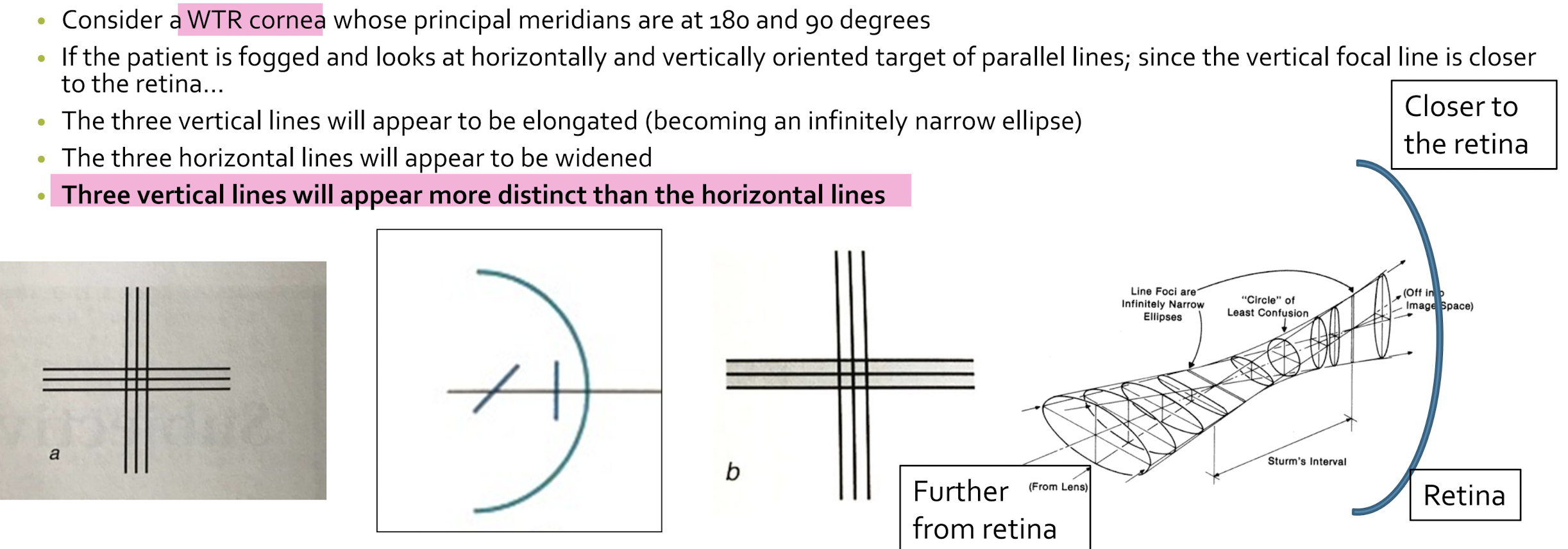
A WTR CORNEA, the refracting power of the eye is greatest in the vertical meridian and least in the horizontal meridian
Rays traveling through the vertical meridian (blue) will form a point first or after? What focal line is observed?
Rays traveling through the horizontal meridian (red) will form a point first or after? What focal line is observed?
Why?
Rays traveling through the vertical meridian (blue) will form a point first. Horizontal focal line is observed
Rays traveling through the horizontal meridian (red) will form a point after. Vertical line is observed
Because the refracting power is greatest in the vertical meridian — the horizontal focal line will be closer to the aperture of the optical system than the vertical focal line
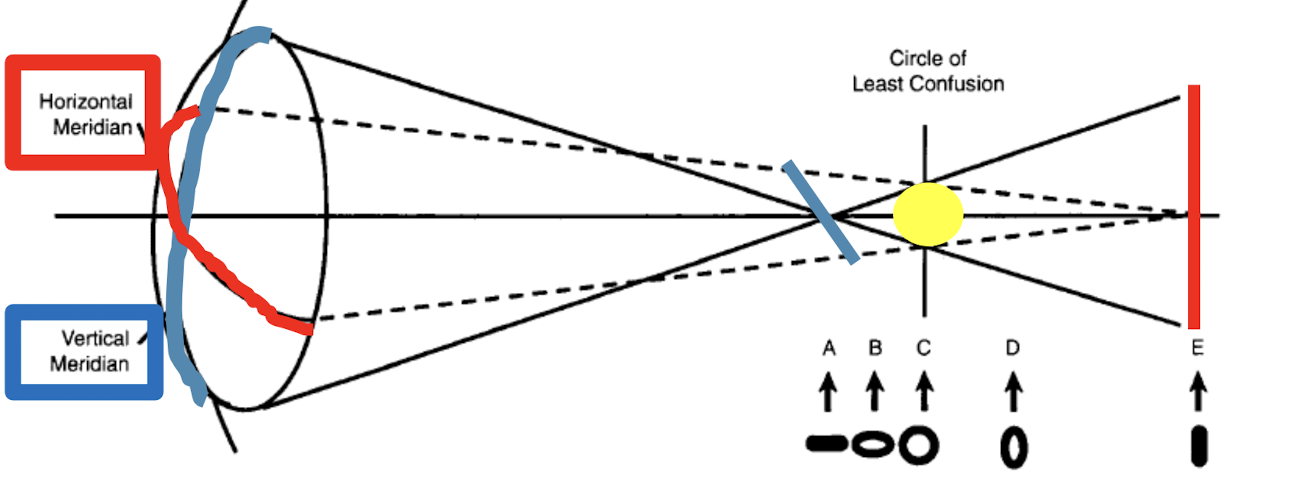
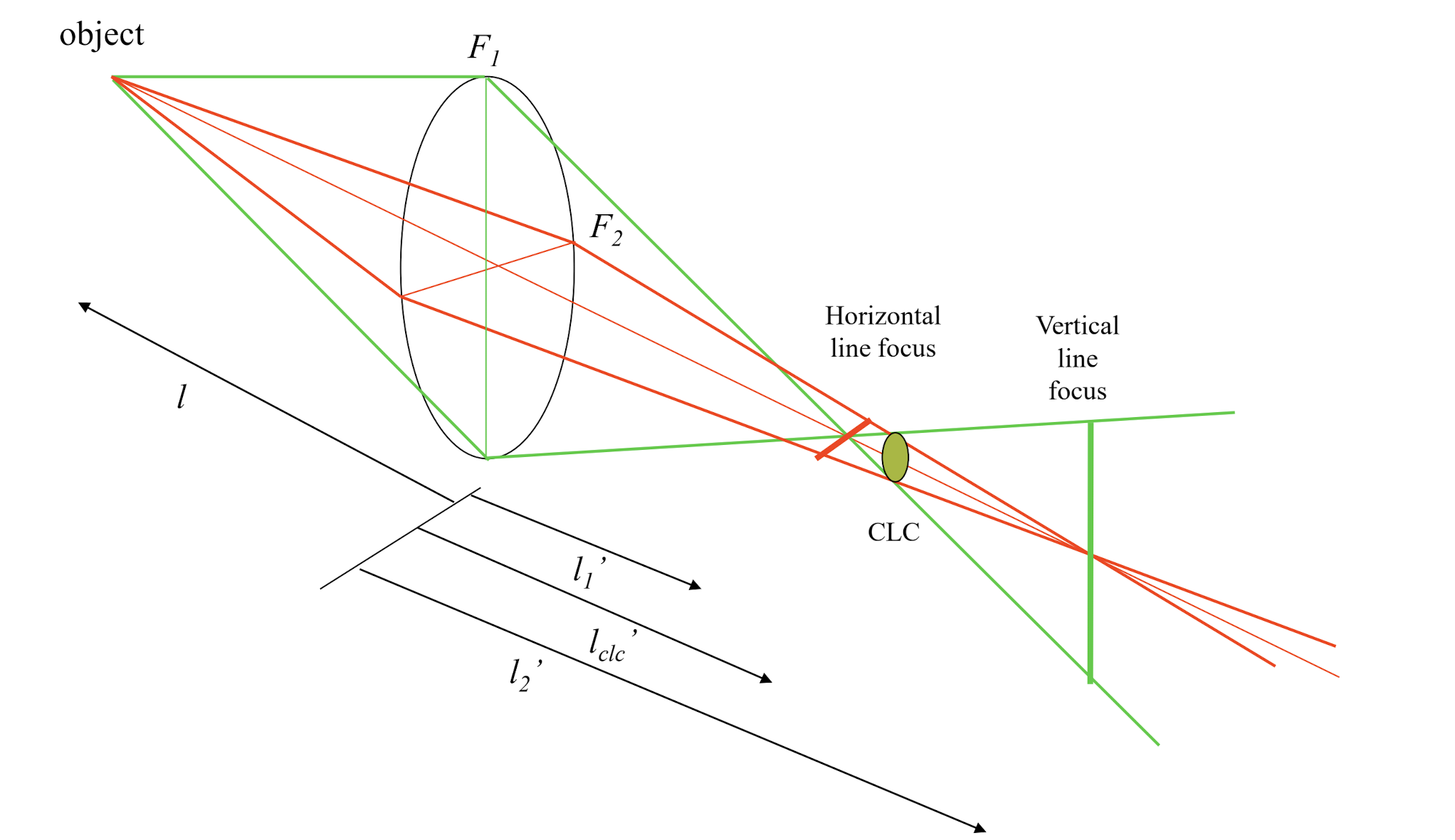
Lens has a higher power in what meridian? Where this meridian focus, you see which line focus?
What meridian has the lower power? It focuses further back or forwards where you see the vertical line focus?
Lens has a higher power in vertical meridian (F1;green) so where this meridian focuses, you see the horizontal line focus;
lower power in horizontal meridian (F2;red) focuses further back where you see the vertical line focus
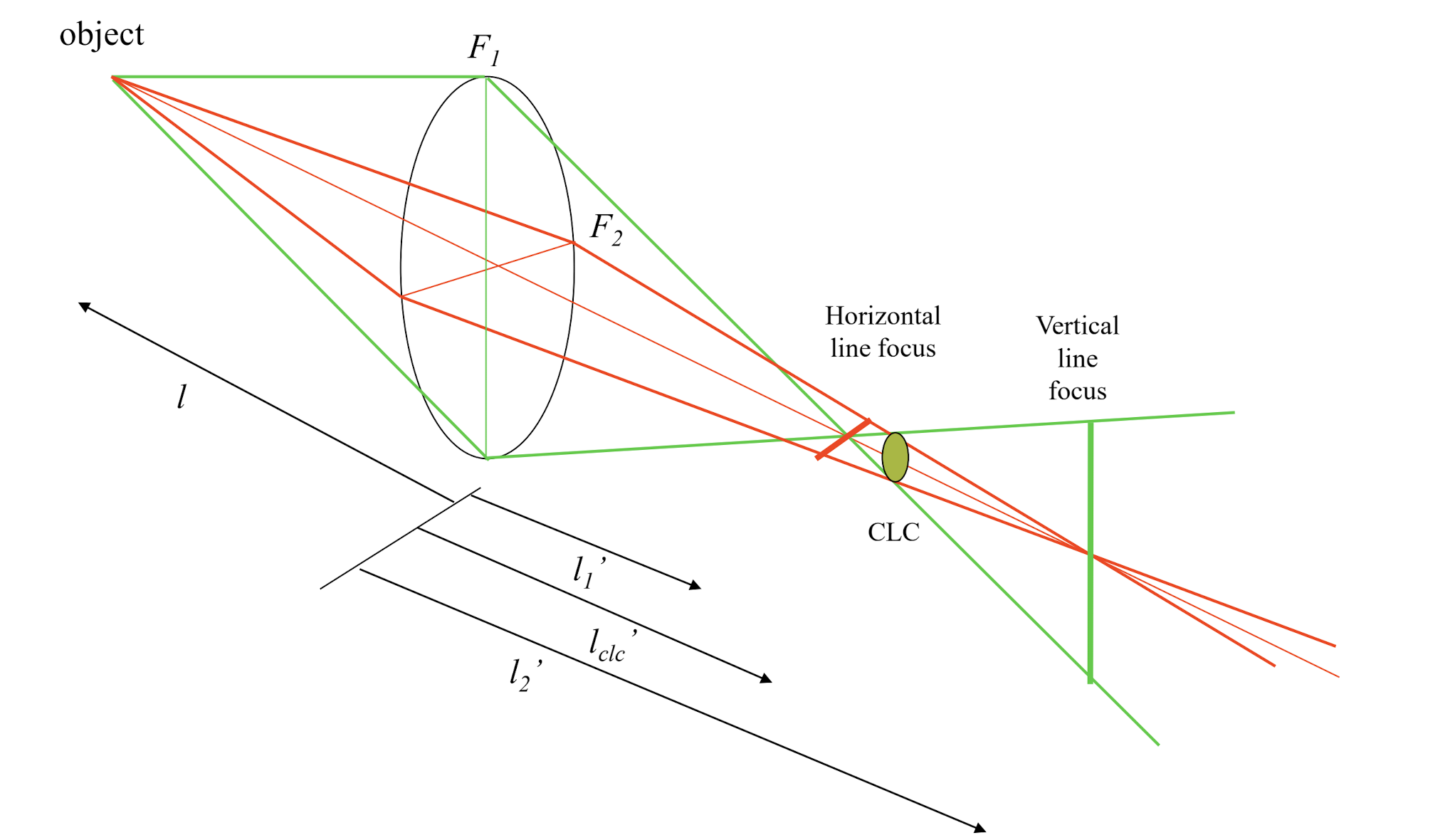
Region between the horizontal and vertical lines in a astigmatic system is known as the
Interval of Sturm A
At all image planes other than those on the two focal lines; images are in the form of
Blur elipses
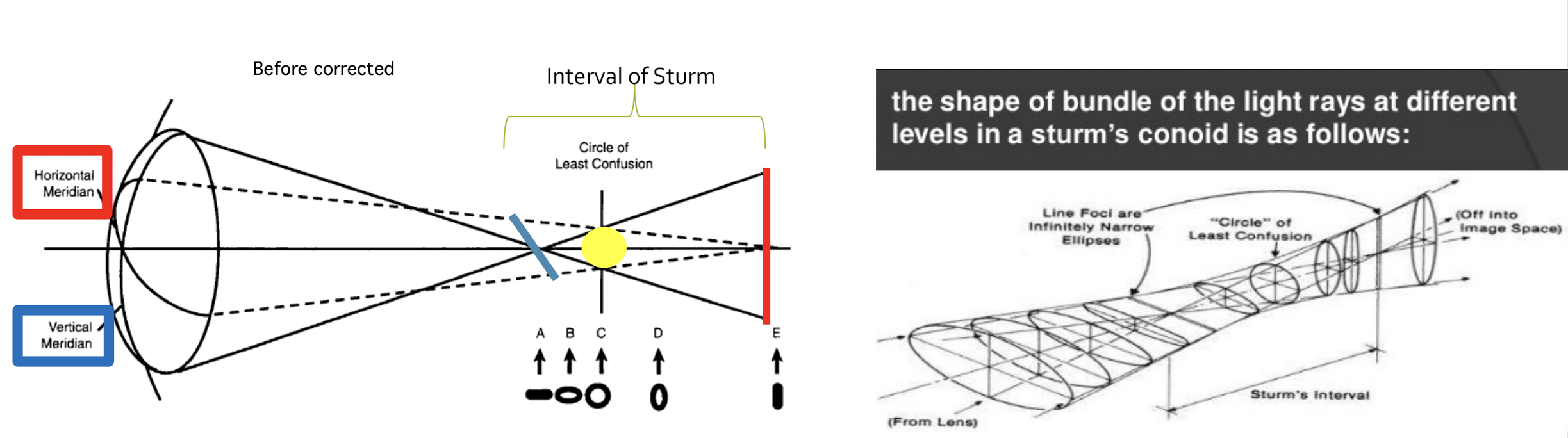
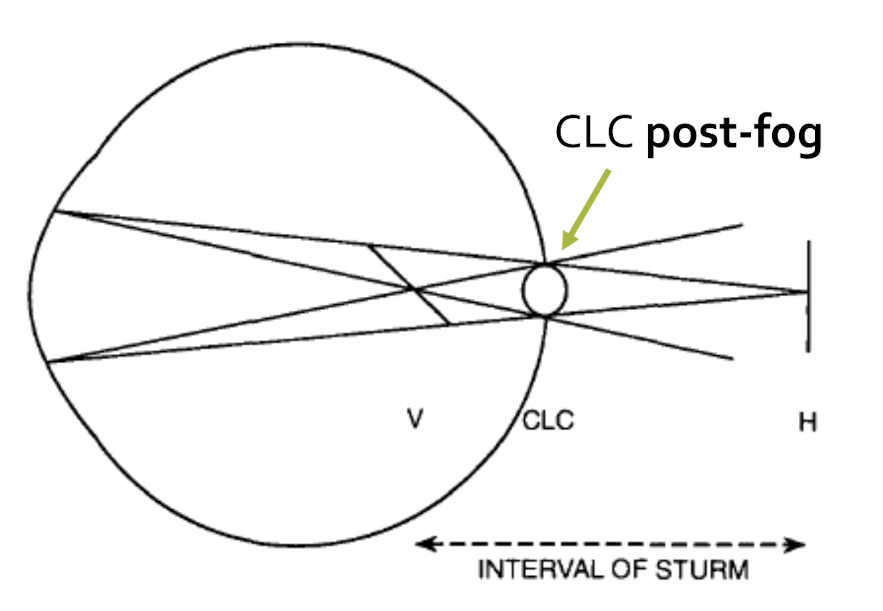
For an astigmatic eye, the closest thing to a point image on the retina for a point object in space is the
CLC
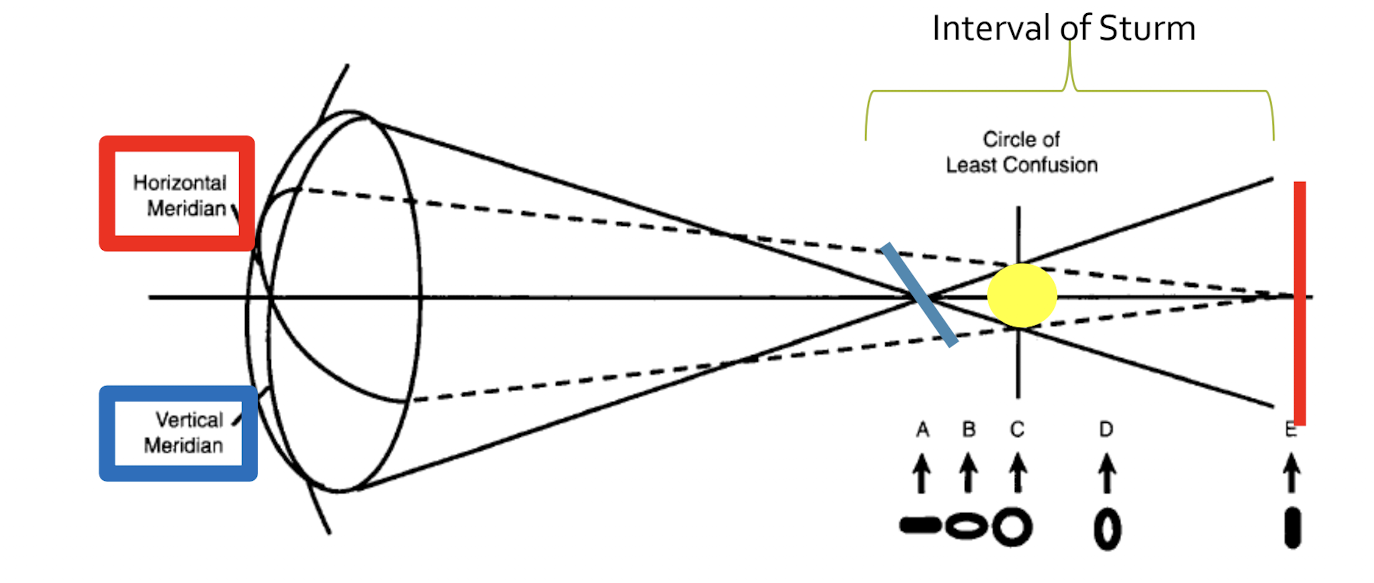
CLC is located at the ?
Where do we want the CLC to be centered over to provide the best VA?
Dioptric midpoint between the horizontal and vertical focal lines
Keeping the CLC centered over the patient’s macula during refraction provides the best vision in both meridians to elicit accurate responses from the patient.
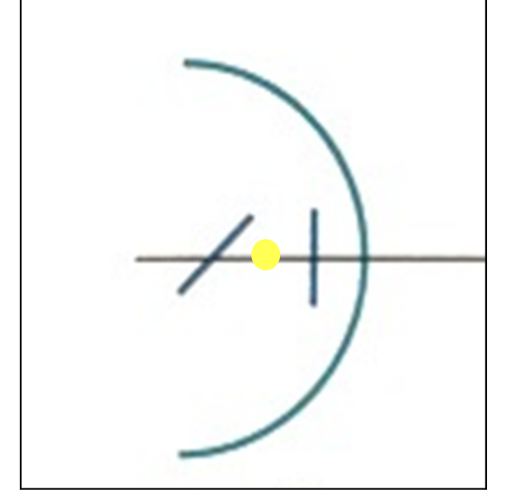
If a WTR eye is fogged sufficiently what happens to IOS?
Which focal line will be closer to retina?
Entire Interval of Sturm is moved forward, both focal lines will be located in front of the retina
Plus converges light — moves forward
Vertical focal line will now be closer to the retina than the horizontal focal line in this fogged state.
The unfog process places the CLC where?
Each 0.25D of minus moves the CLC where? What does this allow?
On the outer limiting membrane of the retina
Each 0.25D of minus moves the CLC closer to the macula
This allows JCC test to be most effective
note* Astigmatism fixes two focal lines not on top of each other
When patient is fogged, if you present a vertical and horizontal line target, the patient will report ?
Vertical line is more distinct than the two
REVIEW/STUDY
REVIEW/STUDY
When horizontal and vertical focal lines are located in the same plane after sufficient minus cylinder is added, we are essentially….
The vertical and horizontal focal lines are now replaced by a?
Because the point image is not on the retina, the image will be?
Now, when fog is removed the image should be a ?
Collapsing the Interval of Sturm
Replaced by a point image
Image will be a blur circle
Point image on the retina
JCC Theory
Starting the JCC test calls for placing the CLC at the? What step is this accomplished in during refraction?
Places the CLC at the outer limiting membrane (OLM) of retina. This step is accomplished during STEP 1
GROSS SPHERE DETERMINATION
Cylinder Axis Refinement Theory
If the axis of the correcting cylinder is in the phoropter at 090 degrees, then the crossed cylinder is oriented so that it’s two principal meridians are located at what two degrees?
What is this doing?
045 and 135 degrees
Making the CLC smaller, circular, tigther
Cylinder Axis Refinement Theory
When the +0.25/-0.25 D crossed cylinder is used to refine cylinder axis, in one position the axis of the combination of the correcting cylinder in the phoropter and the crossed cylinder is moved in one direction
When the crossed cylinder is flipped over to the other side, the position of the axis of the combination of the correcting cylinder and the crossed cylinder is moved an equal amount in what direction?
Equal amount in the opposite direction
Cylinder Axis Refinement Theory
For one position of the crossed cylinder lens, the plus cylinder (white dots) of the JCC lens may be oriented more closely with the axis of the residually more (what meridian)?
Patient will not prefer if using what power?
Residually more hyperopic/less myopic principal meridian
Patient will not prefer if using (-) cylinder power
Cylinder Axis Refinement Theory
The minus cylinder axis (red dots) may be oriented more closely with the axis of the residually (what meridian)
Residually less hyperopic/more myopic principal meridian
Cylinder Axis Refinement Theory
Because we use minus cylinder lenses the patient is expected to notice better VA when the JCC minus axis is (red dot) is closer to the? Compared with when the JCC plus axis (white dots) is in the same position
In this position, the CLC is ? and VA is ?
Closer to the minus cylinder axis of the residual cylinder. Compared with when the JCC plus axis (white dots) is in the same position
In this position, the CLC is reduced and VA is improved
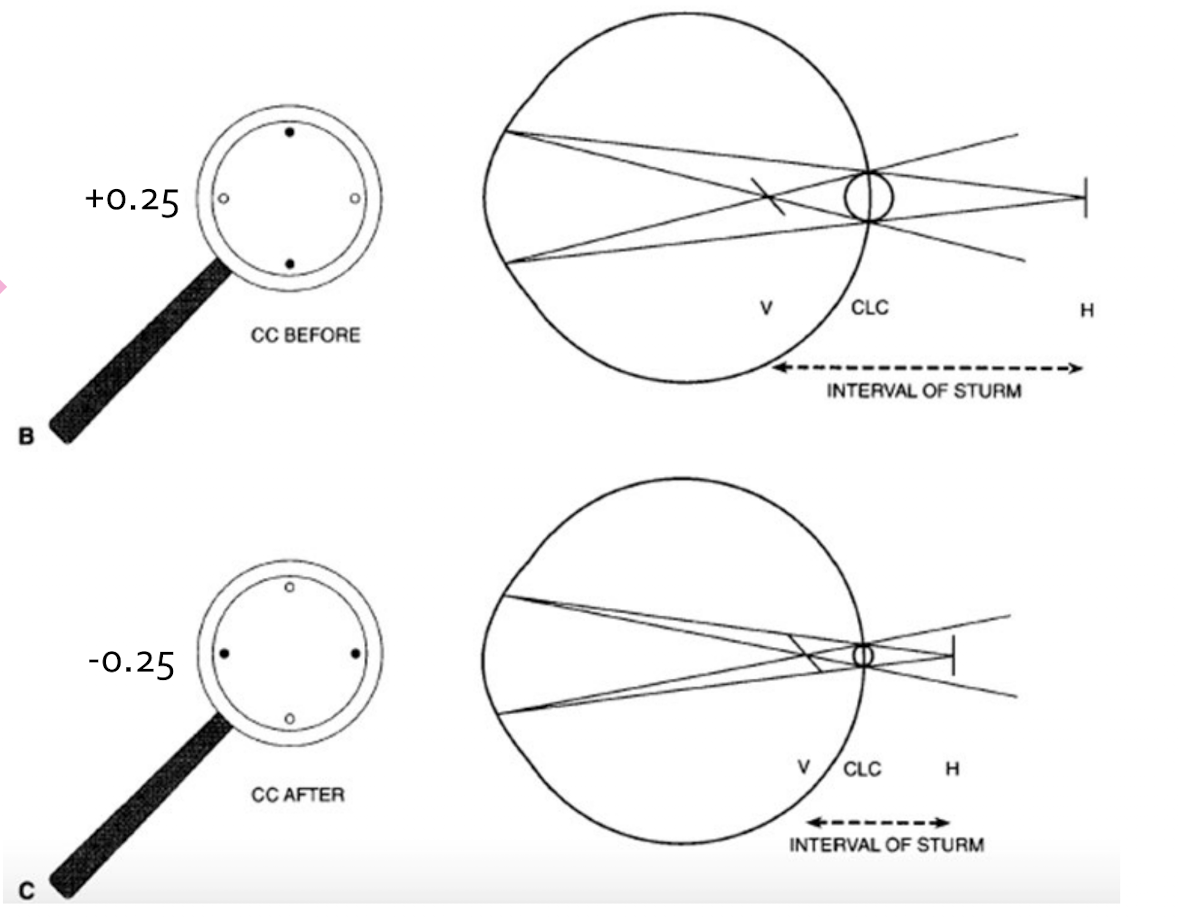
Cylinder power refinement theory
What is it doing optically when we flip?
It is changing the Interval of Sturm
It is either making it further apart or closer together
Our goal is to collapse the Interval of Sturm
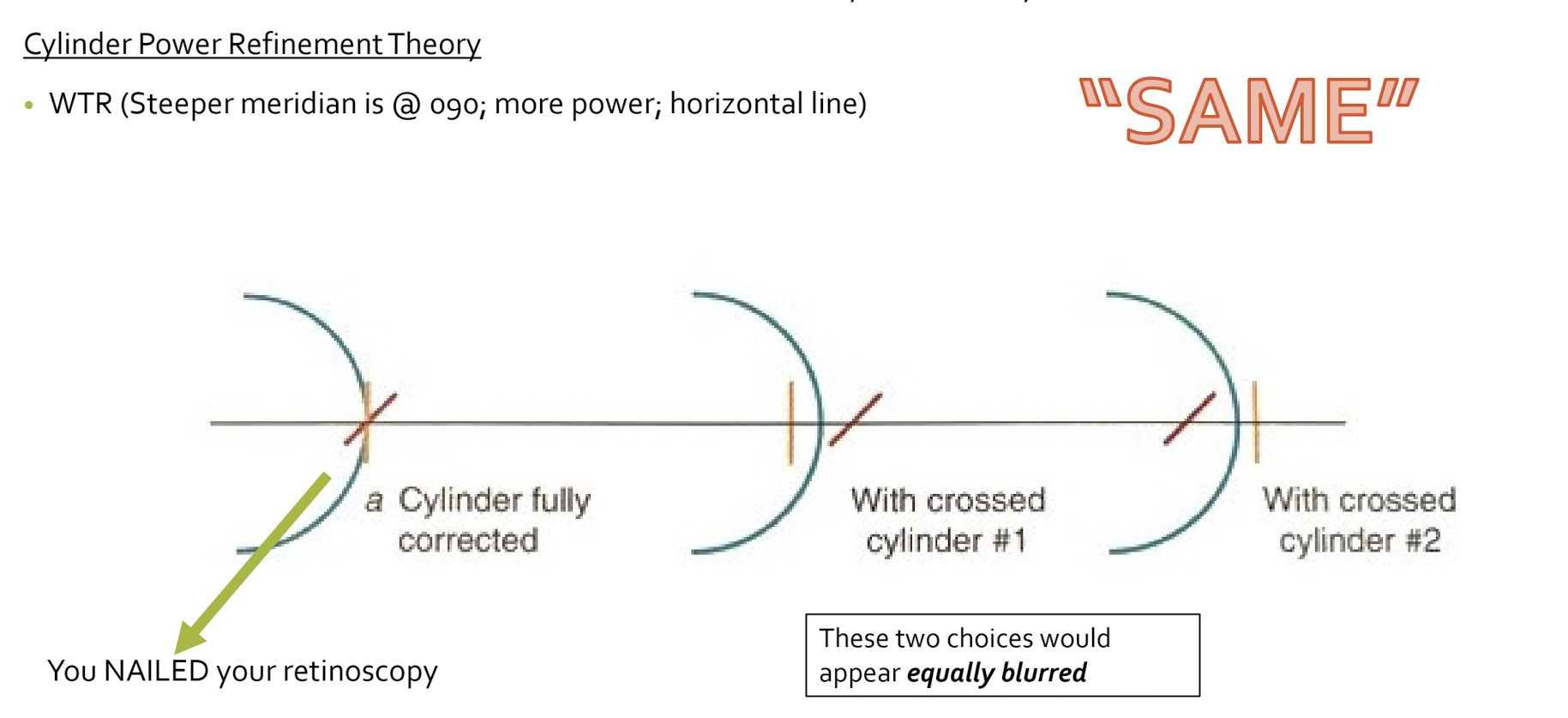
Cylinde power refinement theory
STUDY/REVIEW
STUDY/REVIEW
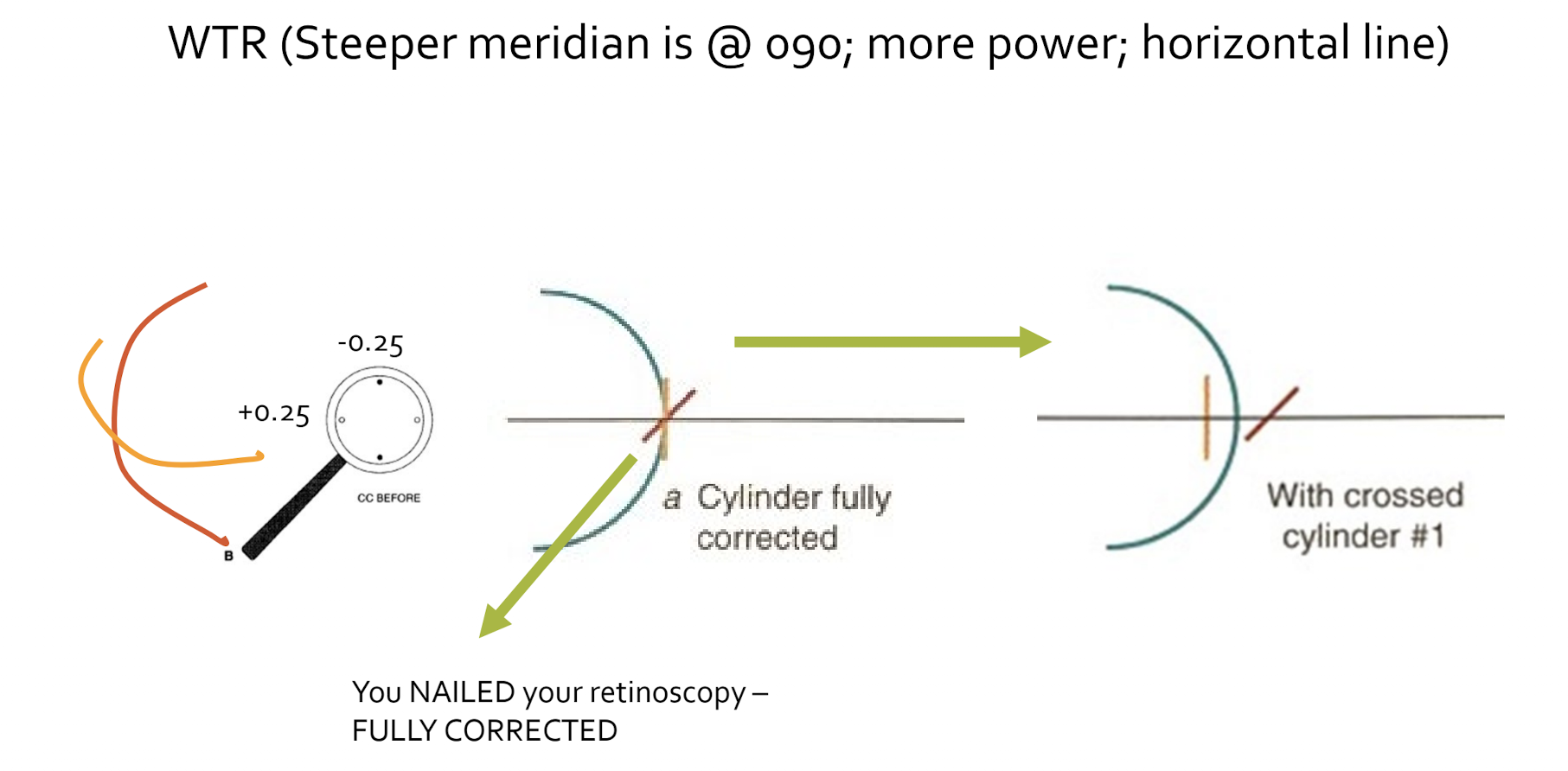
Cylinde power refinement theory
STUDY/REVIEW
STUDY/REVIEW
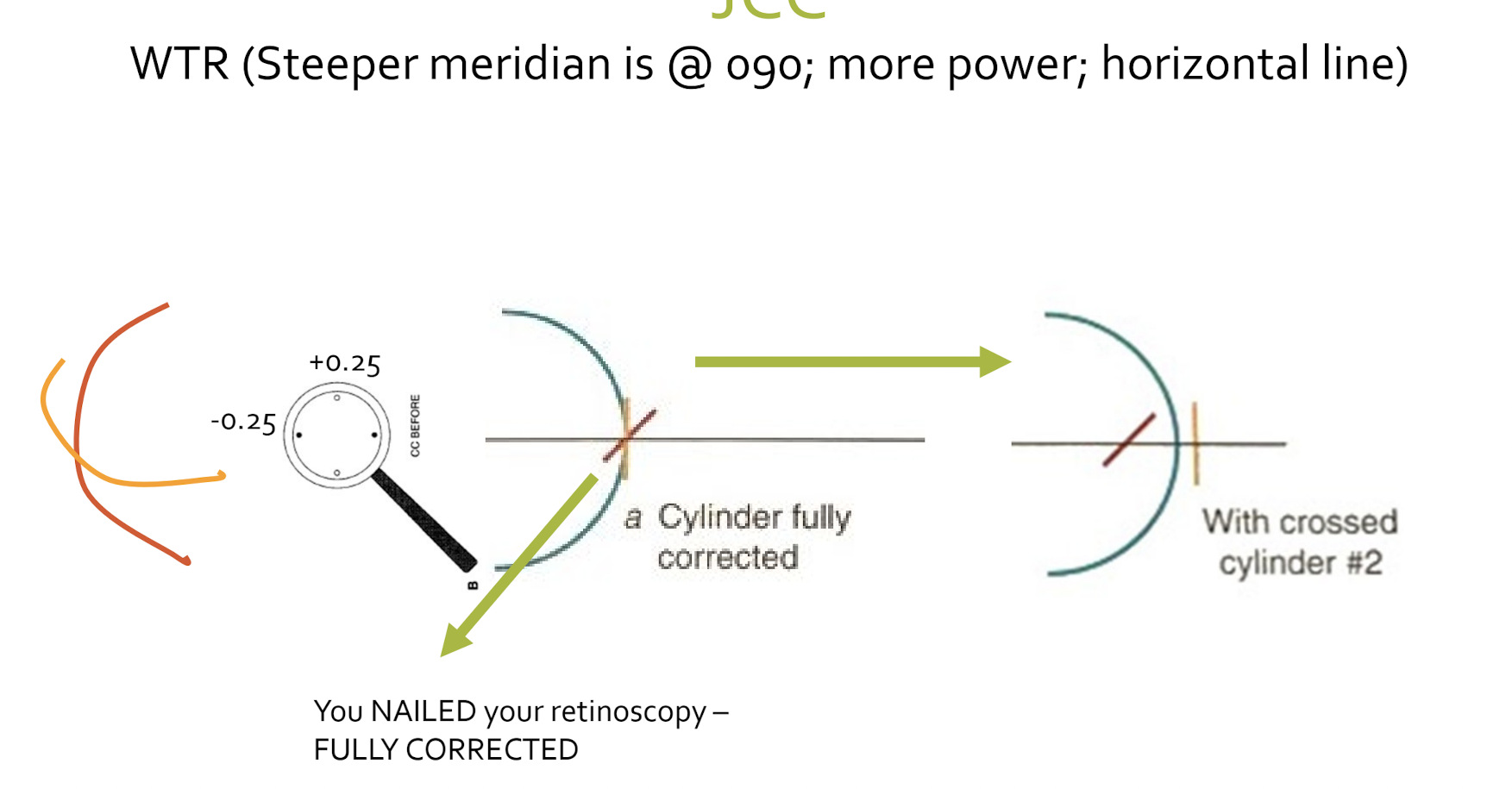
Cylinde power refinement theory
STUDY/REVIEW
STUDY/REVIEW
Binocular Balance
RAPID FIRE
Each eye is refracted separately, but we use our eyes as a team so there needs to be a way to balance _____ between the eyes
Pt. sometimes are able to ____ accommodation in one eye more than the other during refraction
Pts. may accept more ____ in binocular settings compared to monocular
-Esp. in what type of pts?
The need for Binocular balance decreases as patient’s ___? and become?
Each eye is refracted separately, but we use our eyes as a team so there needs to be a way to balance accomodation between the eyes
Pt. sometimes are able to relax accommodation in one eye more than the other during refraction
Pts. may accept more PLUS in binocular settings compared to monocular
-Esp. in what type of pts? HYPEROPIC PTS.
The need for Binocular balance decreases as patient’s AGE? and become? PRESBYOPIC
Binocular balance can only be performed when ?
There is one line or less of BVA difference between the eyes
Name the techniques associated with Binocular Balance
Prism dissociation —-What we use
Alternate occlusion
Humphriss immediate contrast
Procedure for Binocular balance
First two steps:
Isolate a line at least two lines above BVA
-Generally a 20/30 or 20/40 line
Partially fog the patient’s vision by +0.50D sphere OU
-Educate pt. that their vision will be slightly blurred
Binocular balance procedure cont.
Rest of steps
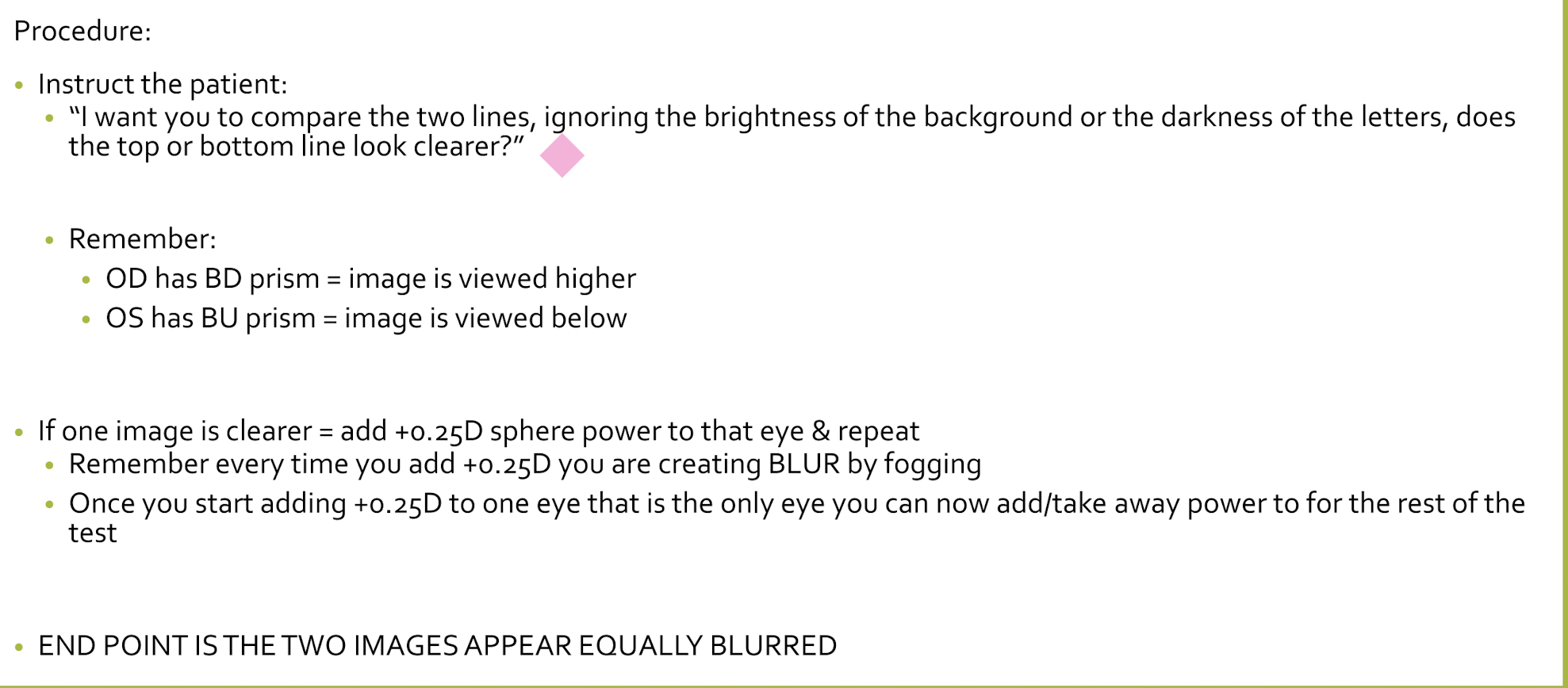
What do you put in prism for OD? OS?
REVIEW/STUDY
3 BD for OD ,, 3 BU for OS
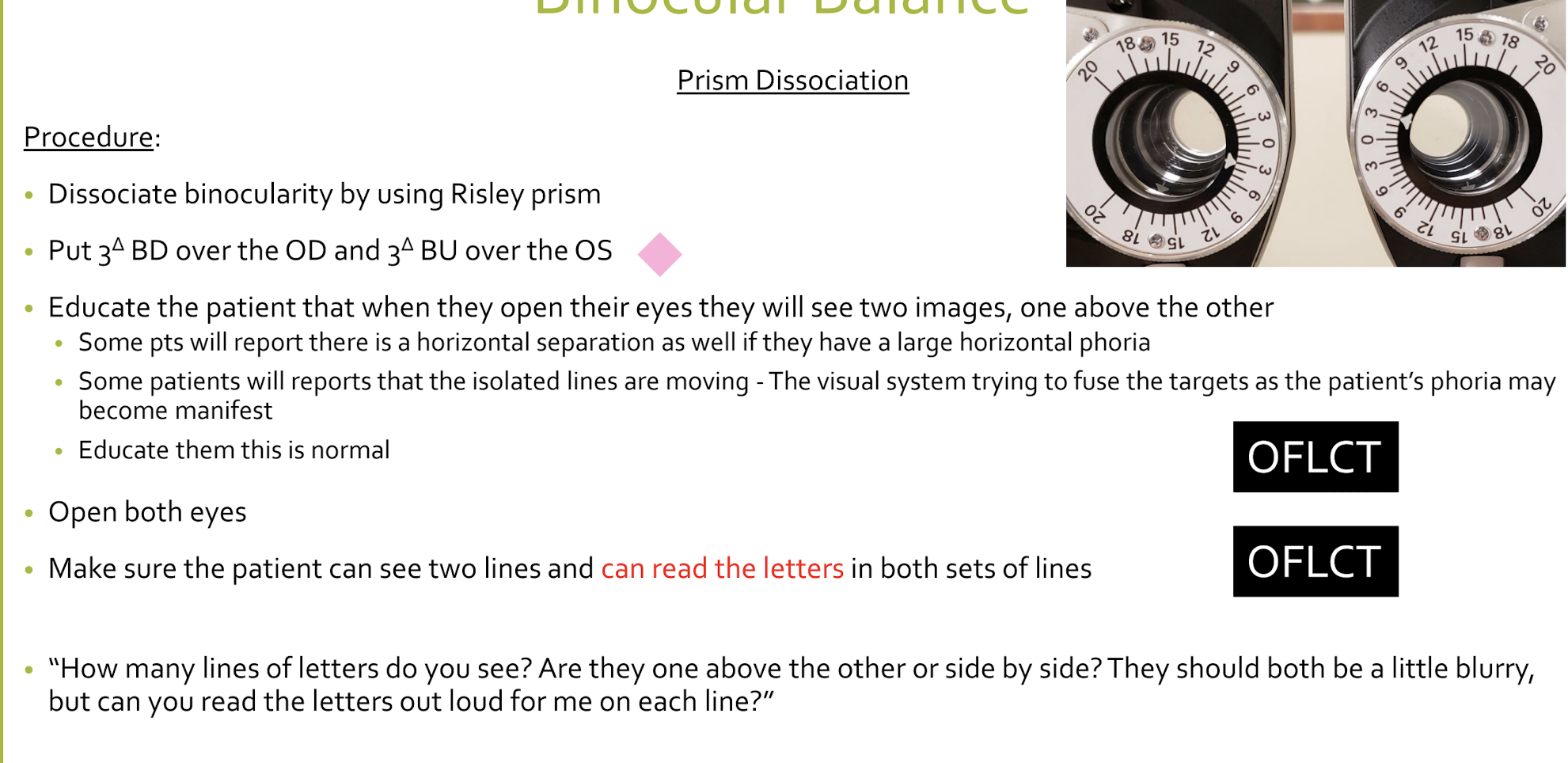
What do you instruct the patient?
If OD has BD prism, the image is viewed higher or lower? What about OS with BU prism?
If one image is clearer add what power to the eye and repeat?
Every time you are adding that power , what are you essentially doing?
END POINT IS?
REVIEW/STUDY
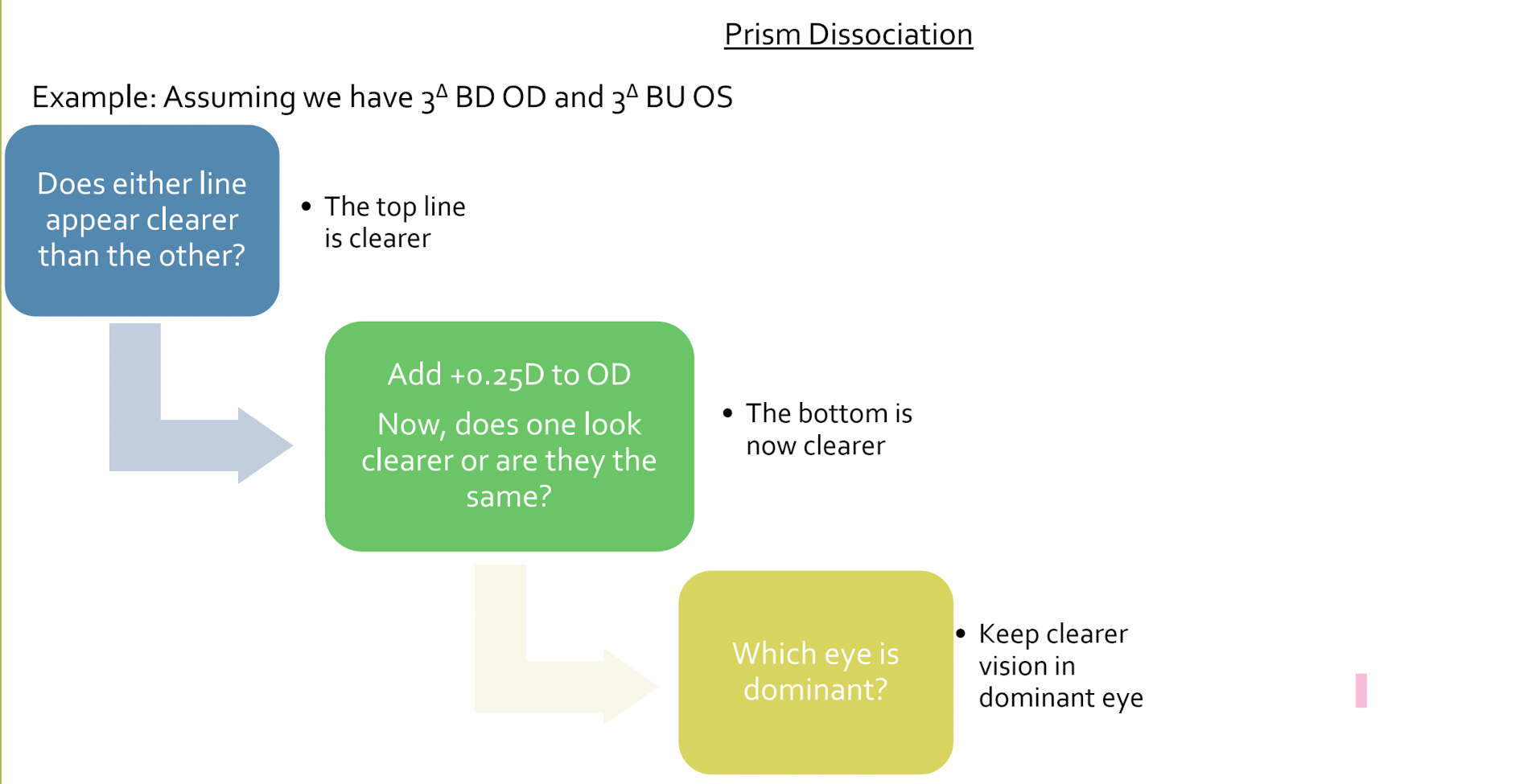
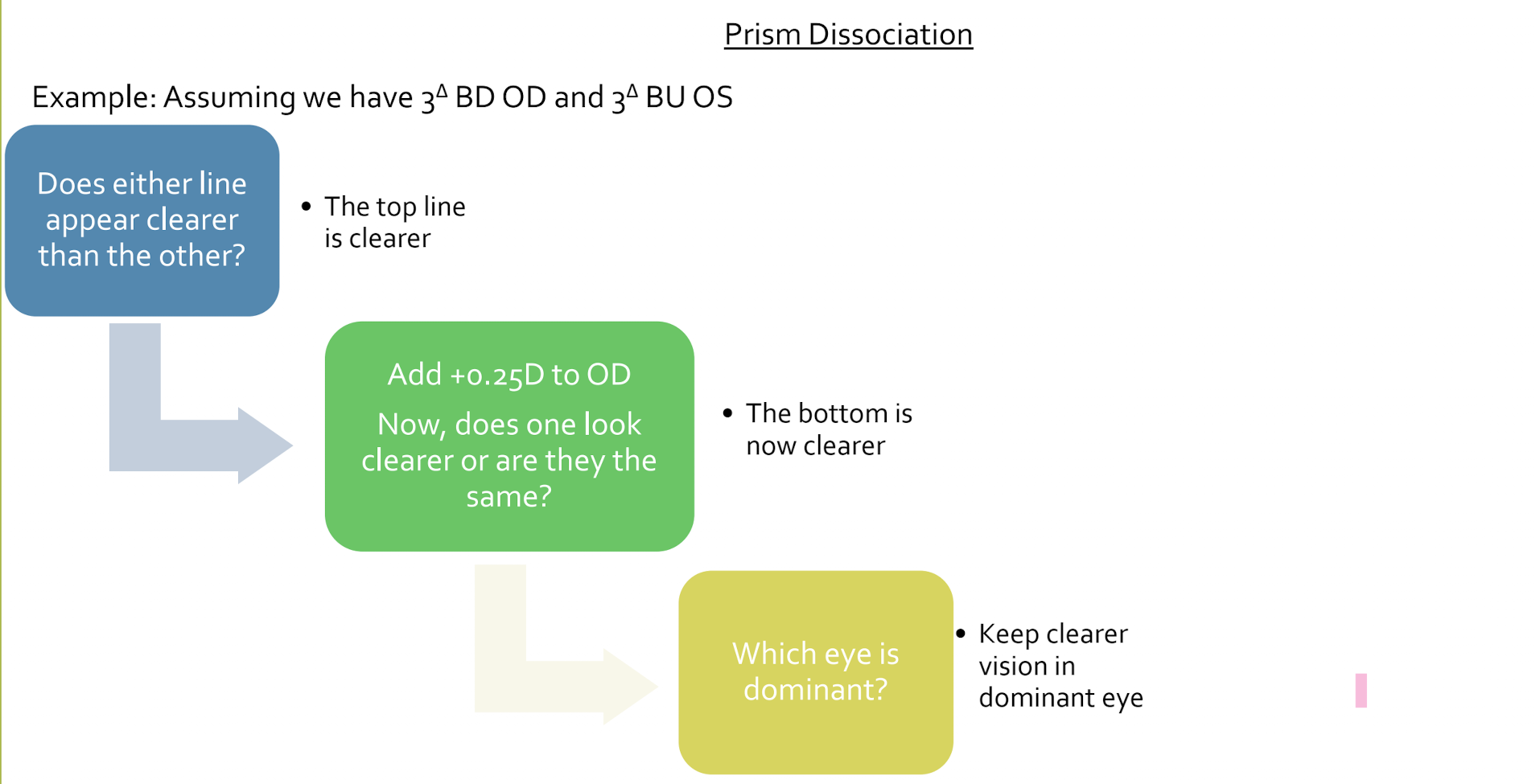
What if you add +0.25 D to the clearer eye and the pt. reports the opposite eye is clearer? What is the goal now?
Goal is to keep the dominant eye the clearer eye
What if however the patient reports EQUAL on the first response?
You must double check that the patient understands the test.
Add +0.25D sphere power over either eye to see if that eye then blurs
-Example) Add +0.25 D over the right eye and ask the pt. which line now appears clearer—they should respond the bottom line (since the left eye has BU prism over it)
If the correct eye blurs, take away the +0.25D and stop—-you are done
If the correct eye DOES NOT BLUR, continue the test as if it were from the beginning, the patient’s initial response was skewed
REVIEW/STUDY
Once you have reached the endpoint, you have achieved?
What to do now?
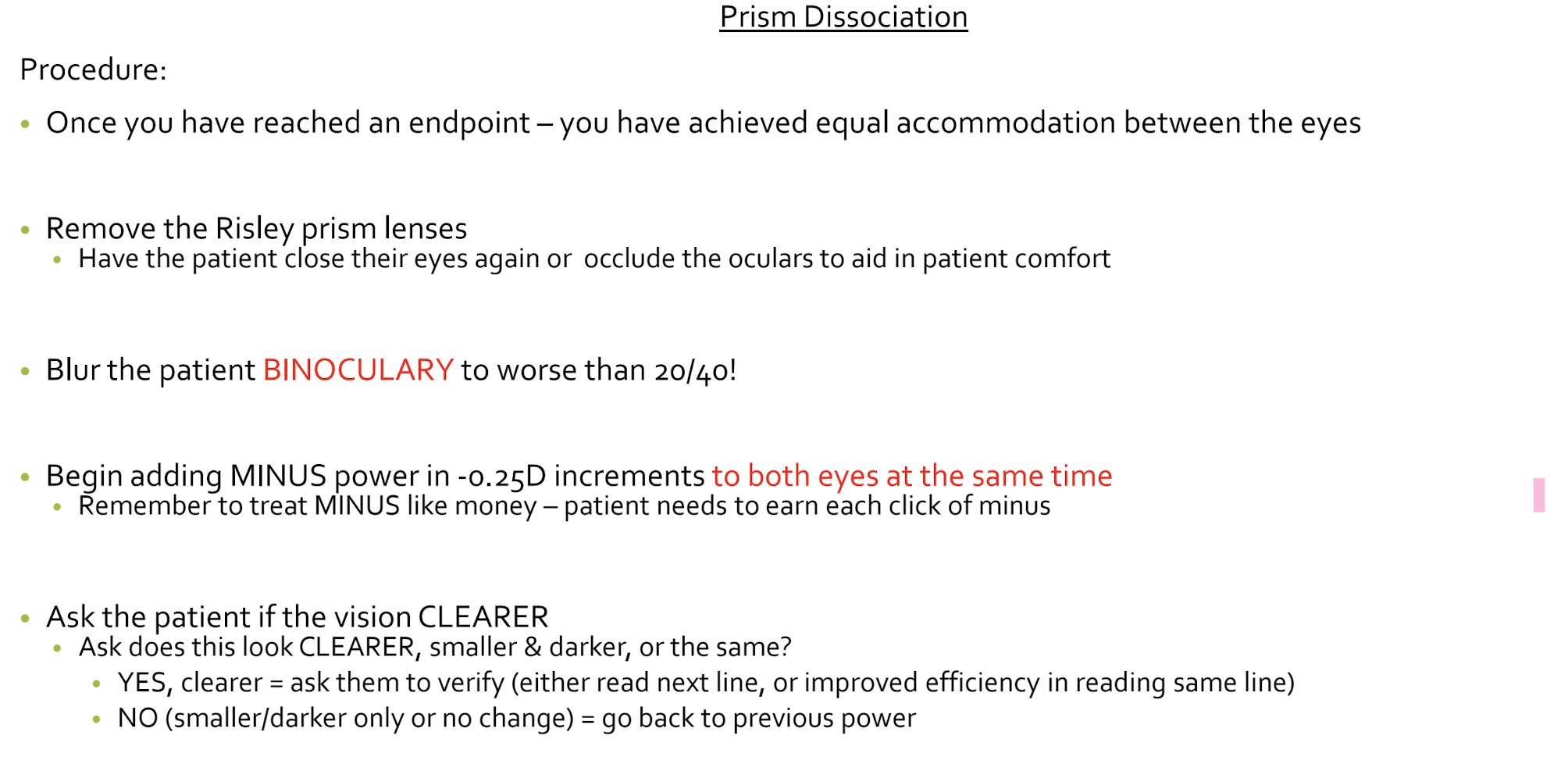
The goal of prism dissociation is?
Most plus (least minus) power to best visual acuity OU
Remember: BVA may not be 20/20
Then take visual acuity monocular OD/OS
Remember: One eye may have worse acuity because we balanced accommodation
If a patient is unable to see 2 lines, they may have a small ____ phoria and may need more separation so what do we do?
Small vertical phoria
Increase prism to 6 diopters
-don’t induce too much prism bc it can cause the line to move off the chart or be too far apart to easily compare targets
If pt. is still seeing 1 line that pt. may be? What to do?
Suppressing
Try to cover and uncover the eye to force awareness
First one eye—- do you see 2 lines? NO, try other eye —- do you see 2 lines now?
If a pt. is unable to see both lines after covering each eye what’s next?
Nothing. Pt. is unable to perform this test
What technique is used if a patient is unable to perform binocular balance?
Alternate occlusion
You do humphriss immediate contrast in patients with CPOE (opthalmoplegia?)
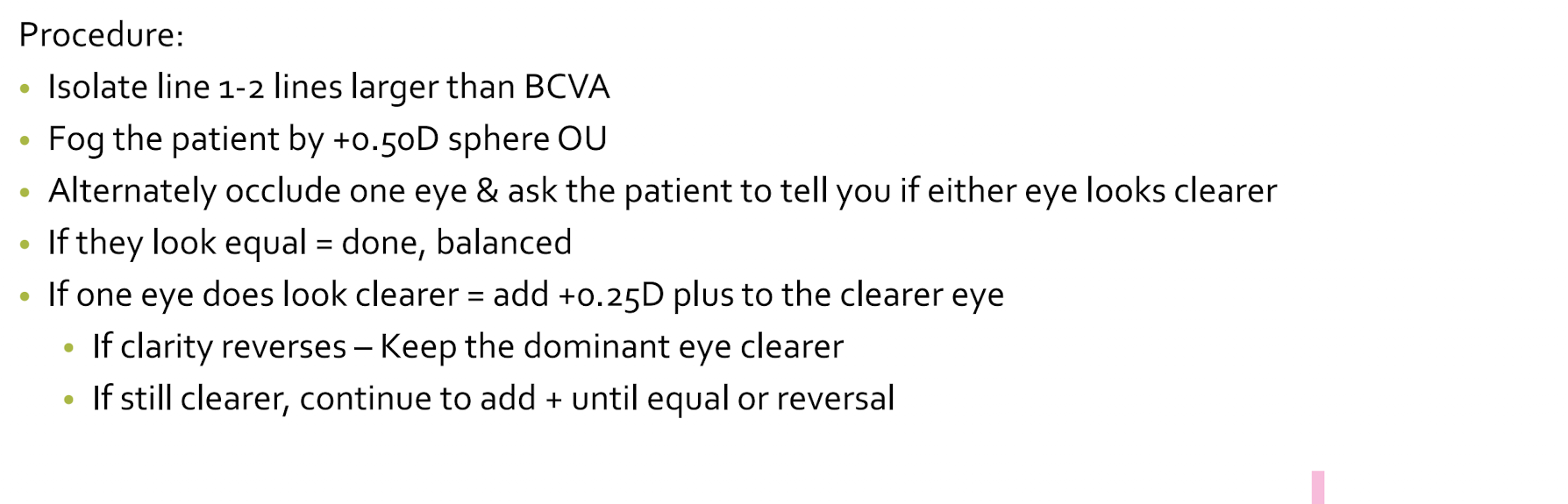
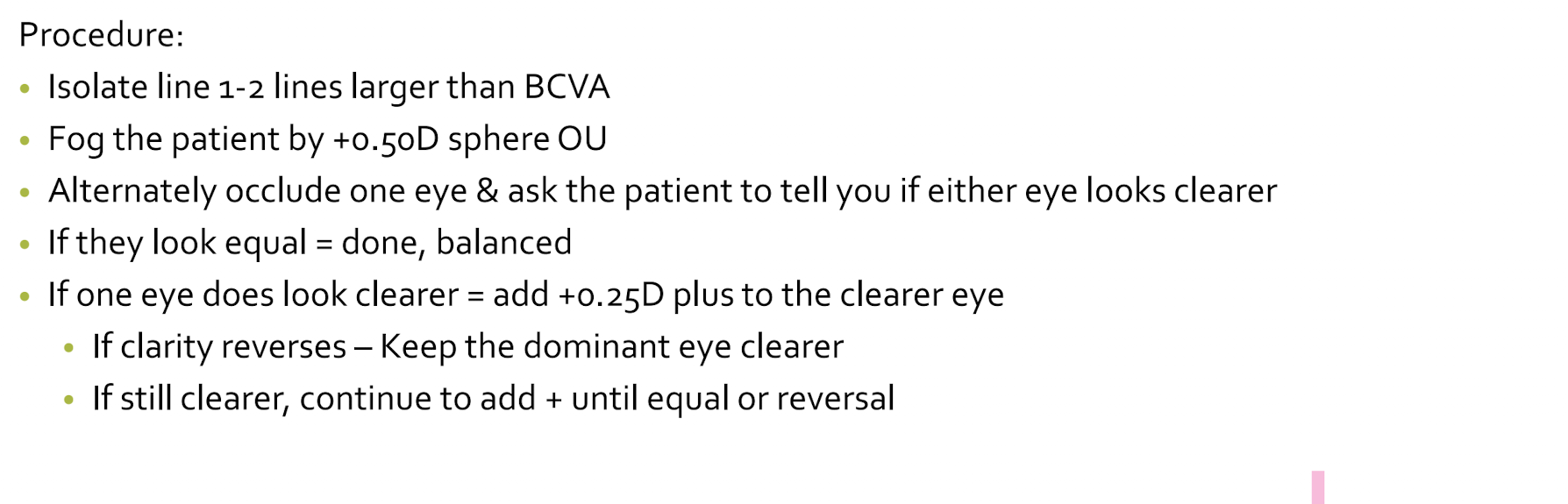
Procedure for alternate occlusion just review
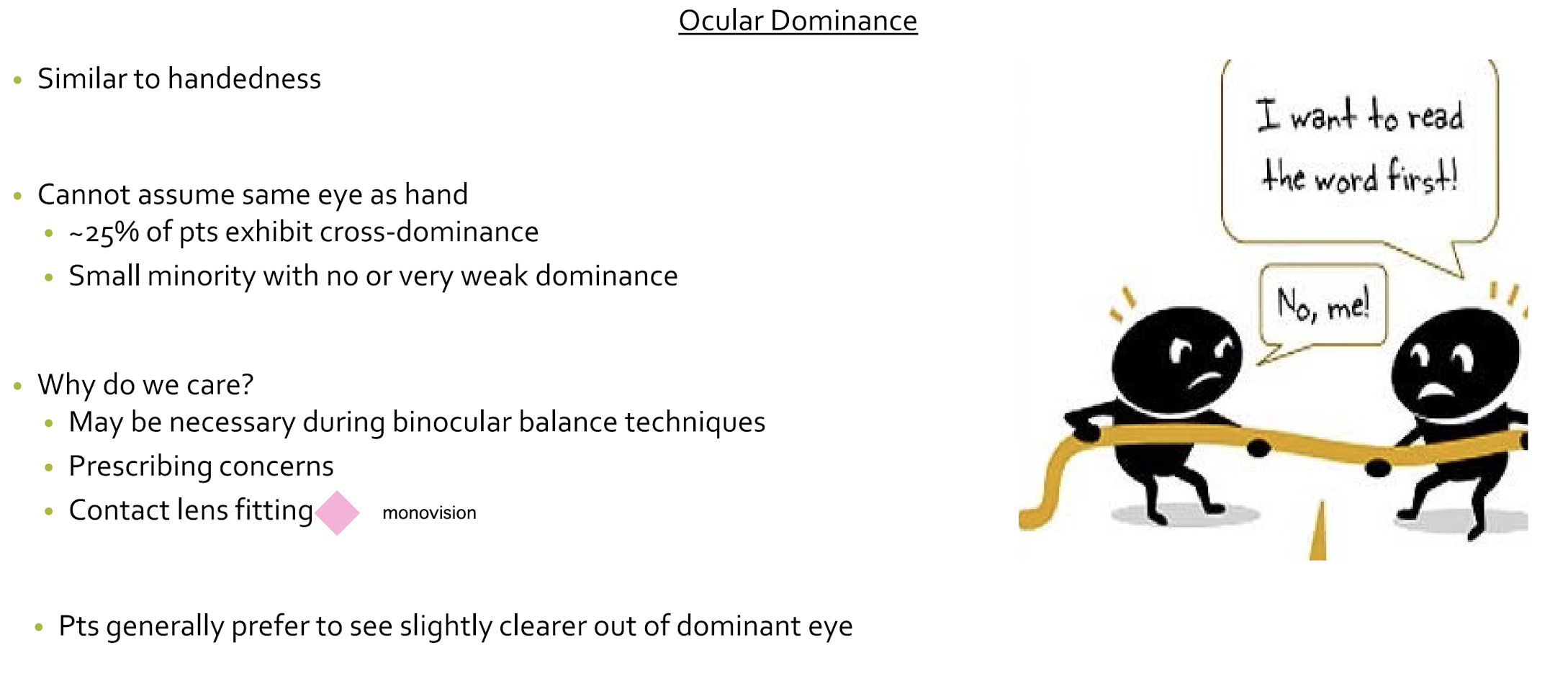
Why do we care ab. ocular dominance?
May be necessary during binocular balance techniques
Prescribing concerns
Contact lens fitting (monovision)
Ways to determine ocular dominance?
Ask the pt. which eye they use for critical viewing tasks
Isolate a letter, have the pt. binocuarly view through a small opening
—Close one eye, can they still see or does the letter disappear?
—-Eye that sees is the dominant eye
Ask the patient to make a small triangle with their hands
—-Extend their arms to focus on your nose binocularly
—The eye YOU CAN SEE is the DOMINANT EYE
Duochrome/Bichrome test
Utilizes difference in refraction of different ___?
Proper correction causes both wavelengths to be?
May be performed?
Where should it be performed?

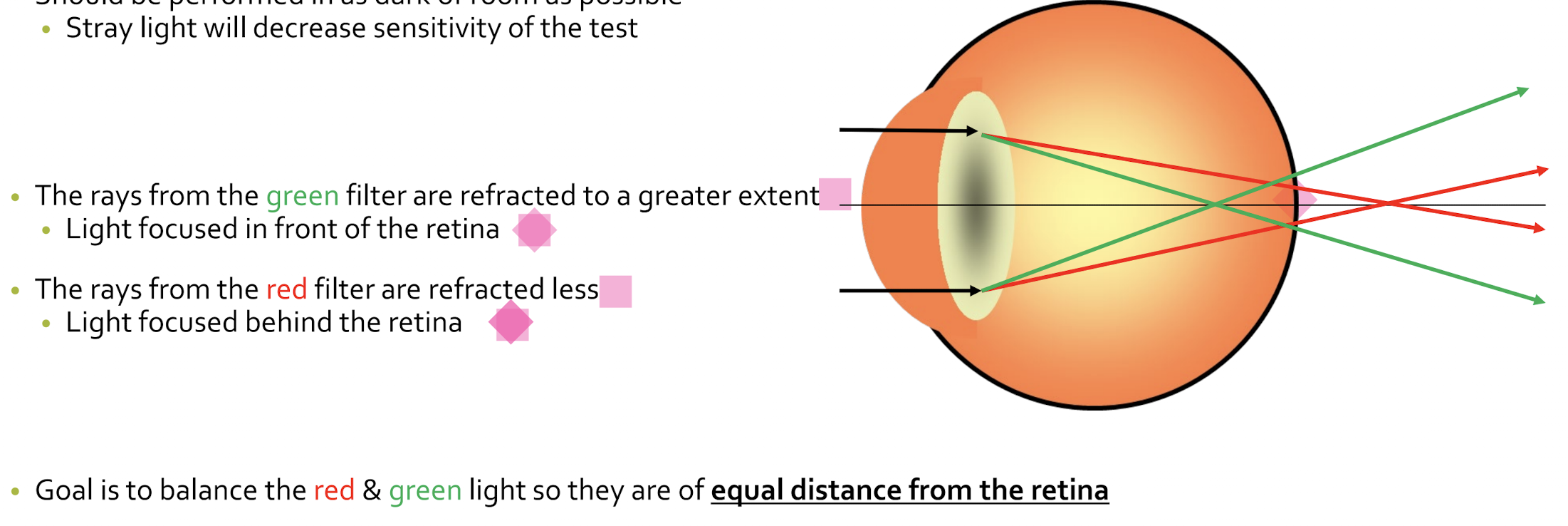
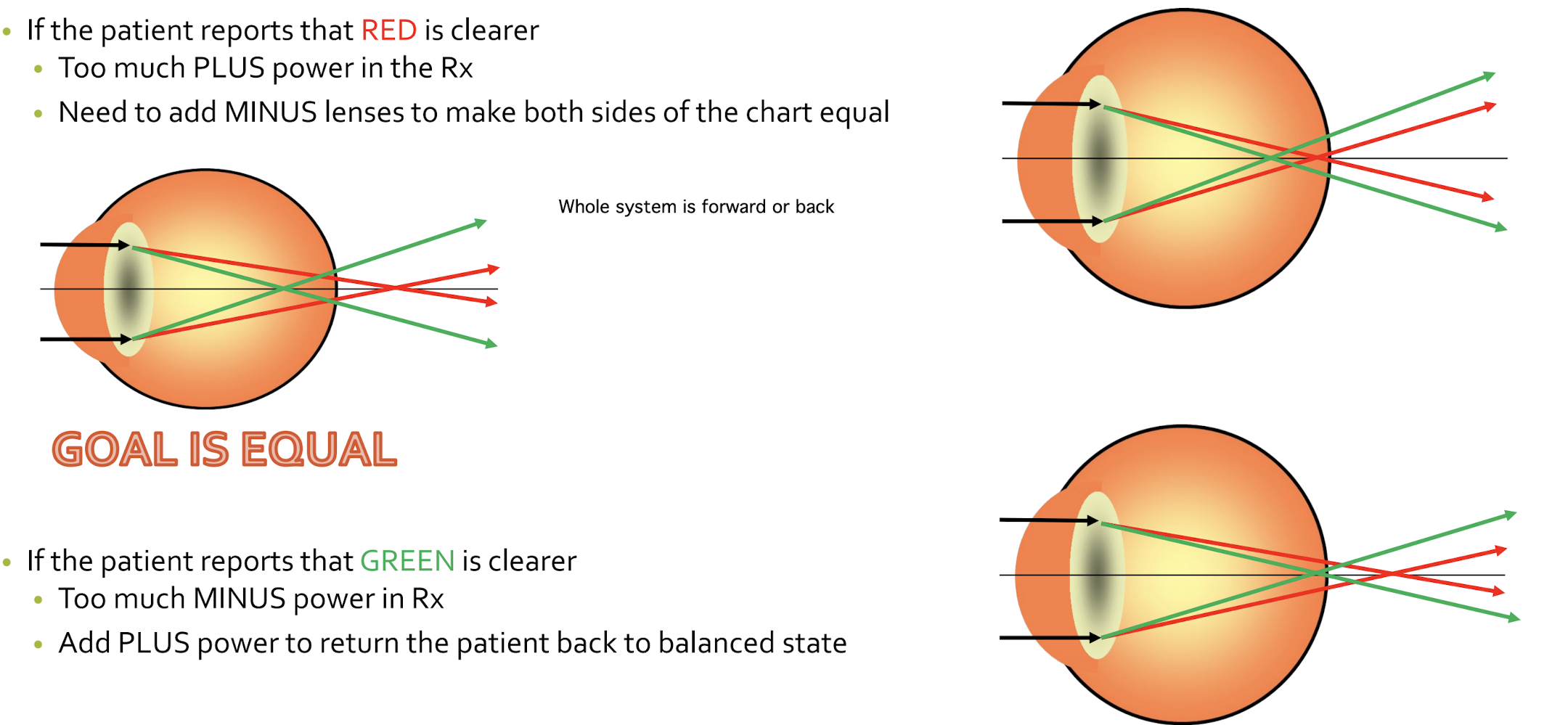
Rays from green light are refracted to a ___ extent? Where is the light focused?
Rays from red light are refracted to a ____ extent? Where is the light focused?
What is the goal of Duochrome/Bichrome test?
If the pt. reports RED is clearer?
If the pt. reports GREEN is clearer?
Red —- TOO MUCH PLUS POWER IN RX , GOTTA ADD MINUS LENS TO MAKE BOTH SIDES OF CHART EQUAL
GREEN —- TOO MUCH MINUS POWER IN RX , GOTTA ADD PLUS LENS TO RETURN PT. BACK TO BALANCED STATE
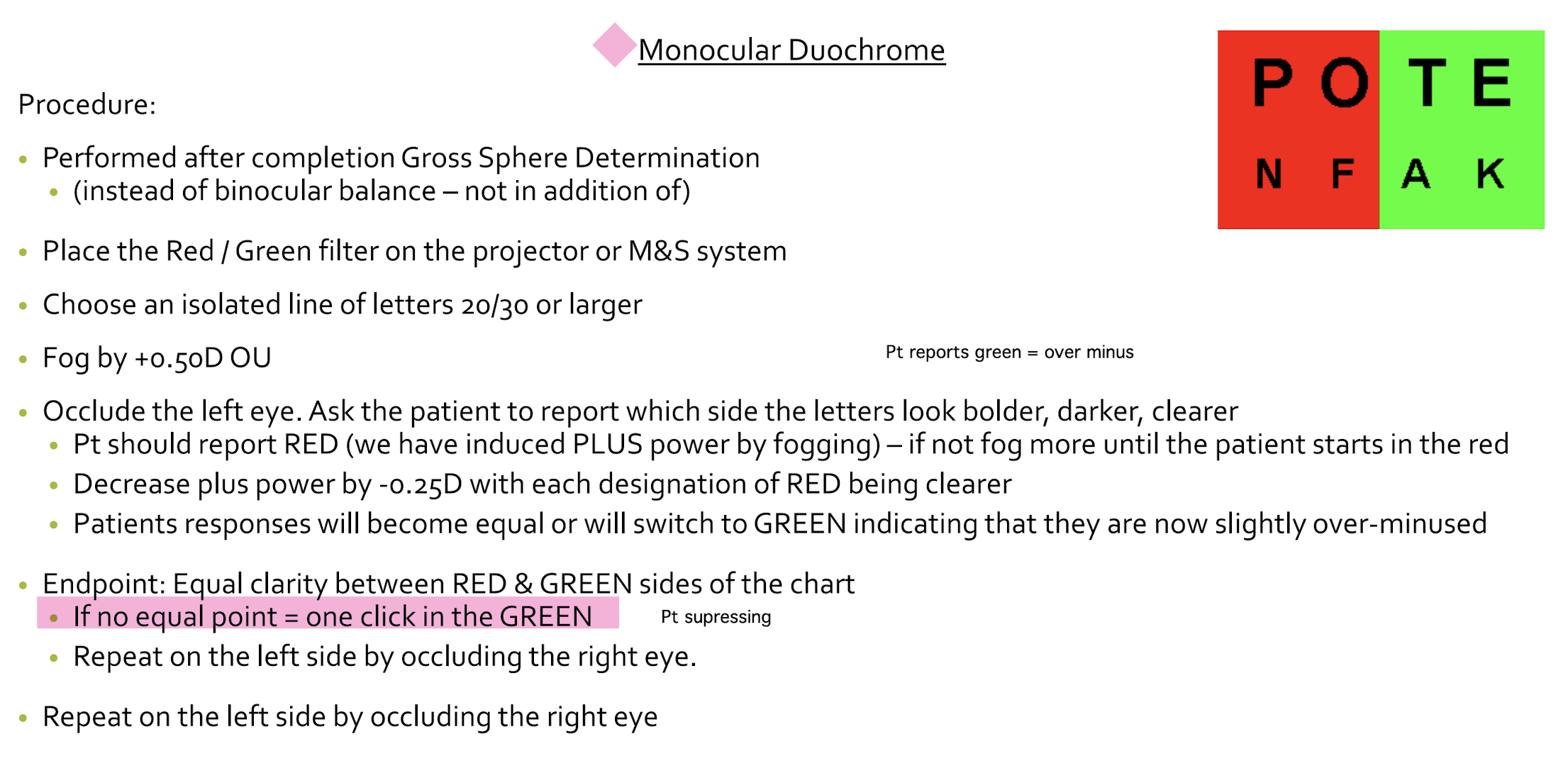
Procedure of MONOCULAR DUOCHROME
REVIEW
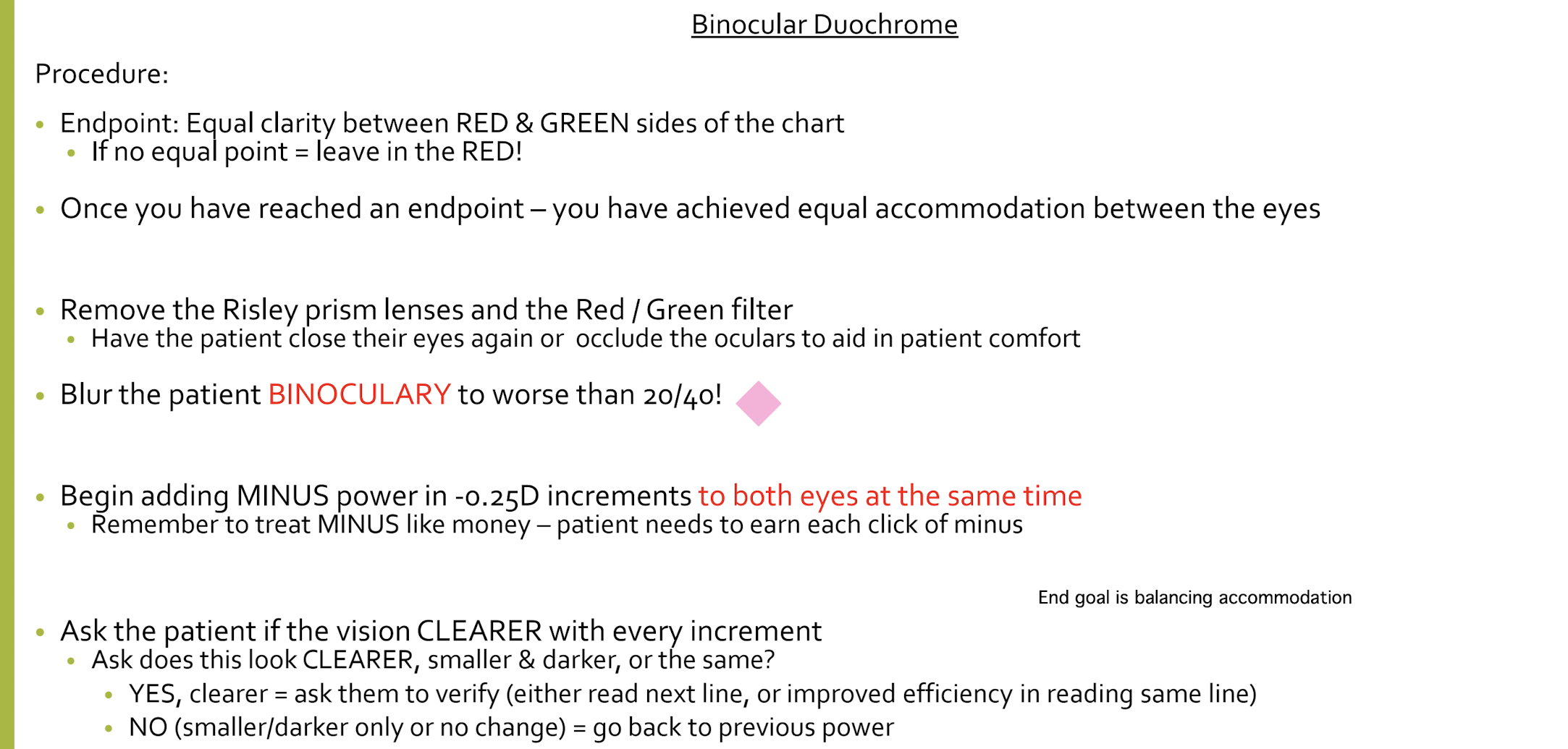
PROCEDURE OF BINOCULAR DUOCHROME
REVIEW
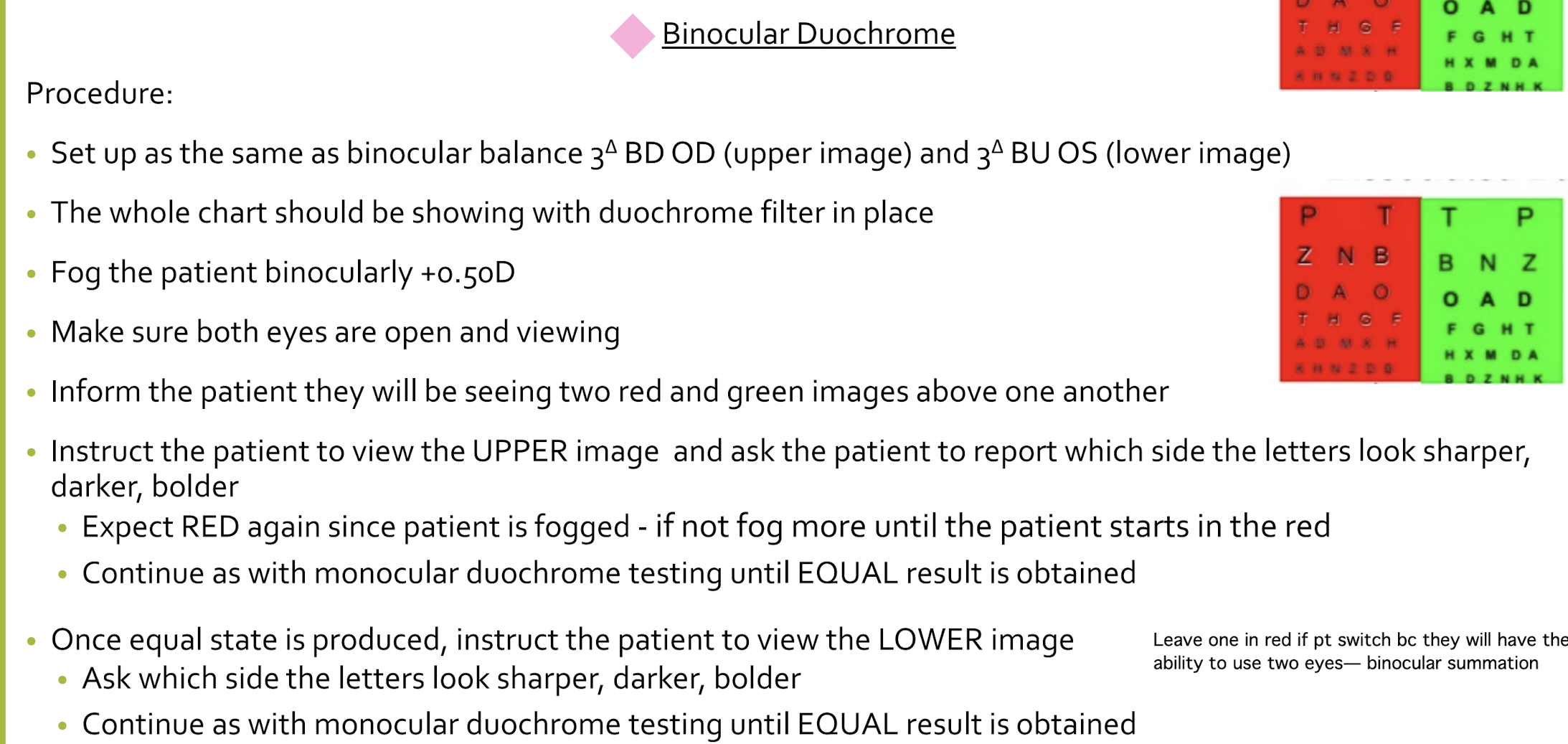
Cont. Procedure of Binocular duochrome
REVIEW