Control of Ectoparasites
 Studied by 0 people
 Call Kai
 Learn
Learn Practice Test
 Spaced Repetition
 Match
Match Flashcards
 Knowt Play
1/24

There's no tags or description
Looks like no tags are added yet.
Name | Mastery | Learn | Test | Matching | Spaced | Call with Kai |
|---|
No analytics yet
Send a link to your students to track their progress
25 Terms
Ectoparasiticides kill ______
Including ____ and ______
ectoparasites, insects, arachnids
So insecticides kill _____
Acaricides kill ______
Insects, acarhnids
What are the main reasons to control ectoparasites?
• Cause important diseases: e.g. Mange (mites), FAD (fleas), Blowfly Strike (flies)
• Debilitating irritant to host
• Source of infestation - other animals and humans
• Vectors of disease: Ticks, Mosquitoes, Fleas
• Economic loss - reduce yields - downgrading of hides
• Compromise animal welfare
Why are ectoparasites difficult to control?
Large seasonal increases in populations
• Tick population increases in spring/autumn
• Blowflies increase in late spring and early summer
• Sheep scab mite (psoroptes ovis) increase winter
Infestations can be highly contagious
• High stocking density - notable
• Location - transport - close contact
Can be widespread in the environment,
although some are more localised
What are some basic strategies used to control ectoparasite infection?
Deployment and application of drugs to kill and repel insects and arachnids (all)
• Quarantine and treatment of incoming stock (e.g. scab)
• Farm biosecurity and coordinated treatment (e.g. scab)
• Treatment of all in contact animals (e.g. sarcoptic mange)
• Treatment of the local environment/habitat (e.g. flea allergy dermatitis)
• Treatment of underlying condition (e.g. adult onset pustular demodecosis)
• Vaccines against ectoparasites (Rhipicephalus tick)
Mechanical removal - traps (e.g. tsetse fly) and vacuums (fleas)
Legislation to report and treat infestations/disease (e.g. Scab)
What are the main classes of ectoparasiticides?
• Macrocyclic Lactones
• Isoxazolines
• Phenylpyrazoles (Fipronil)
• Neonicotinoids
• Pyrethrins and Synthetic Pyrethroids (SPs)
• Organophosphates
• Insect Growth Regulators (IGRs)
Reminder** What is selective toxicity?
... is the ability of a chemical or drug to harm an invading organism without harming the host
Target using
• location
• pharmacokinetics
• pharmacodynamics
Reminder** What are key features of the macrocyclic lactones?
Highly lipophilic → persist for a long time ESPECIALLY if applied topically as it will remain in the fat below the epidermis
Crosses membrane easily

What is the mechanism of action for Isoxazolines?
e.g. alfoxolaner, fluralaner
Mechanism of action
• Inhibit GABA-gated chloride channels
• Glutamate-gated chloride channels also implicated
• Irreversible hyperexcitation in insects and ticks
Drug is highly protein bound, ingested by fleas and ticks upon ingesting within hours
Describe the ADME of Isoxazolines.
Absorption:
Is well absorbed from the gastrointestinal tract, no matter what route of entry.
Distribution:
It is very lipophilic, allowing it to distribute widely into body tissues. It has a high volume of distribution (greater than 2.5 L/kg) and is highly plasma protein bound (about 99%).
High PPB is important so parasite ingests a high concentration through the blood
Excretion:
Elimination is slow due to the high lipophilicity, has a long half-life (2 weeks)
Dosing:
Afoxolaner is administered monthly, while fluralaner is given every three months.
Describe the selective toxicity of the Isoxazolines.
Any Side effects
Spectrum of Activity
Nature of selective toxicity:
• More selective for GABA- and Glutamate-gated channels in insects and ticks than mammals (More selective for parasite channels than mammals)
Side effects
• Rare
• Vomiting/diarrhoea, lethargy and anorexia
Spectrum of activity
• Fleas, ticks
What is the mechanism of action for the Phenylpyrazoles.
e.g. Fipronil
Mechanism of action
• Non-competitive blockade of GABA-gated and Glutamate-gated chloride channels
Stopping the “inhibition” → hyperexcitation
Selective Toxicity
Binding to mammalian GABA-gated channels is less effective
Mammals do not have Glutamate-gated chloride channels
Describe key features of Phenylpyrazole pharmacokinetics.
• High affinity for oils in the skin due to lipophilic nature
• Following topical application (e.g., a "spot-on" treatment), the compound spreads or "translocates" over the entire surface of the animal's body via the natural movement of skin oils, rather than relying on systemic absorption through the bloodstream.
• Significant deposition in sebum, sebaceous glands and hair follicle, acts as a reservoir for continued release over a long period of time
Describe the key features of the phenylpyrazoles, noting:
Side effects
Spectrum of Activity
Side effects
• Wide margin of safety
• At toxic dose hyperactivity, hyperexcitability, convulsions
Spectrum of activity
• Adult fleas, all stages of ticks
• Approved for dogs, cats and puppies/kittens >8weeks
• 30 days (potentially longer)
Describe the mechanism of action for the Neonicotinoids.
e.g. Imidacloprid, Spinosad
Mechanism of action
• Competitive inhibition at nicotinic Acetylcholine receptors
widely distributed in the insect CNS
highly specific for the insect nicotinic receptor subtype
Biphasic response
• increased frequency of spontaneous discharge
• followed by a block in nerve pulse propagation
What is the ADME for the neonicotinoids?
• Topical application results in surface translocation over the entire body
• Efficacy as a result of the insect contacting the chemical at the skin surface
• Rapidly absorbed by the insect on contact, limited systemic absorption as most of the drug remains on the skin’s surface
• Limited systemic absorption in host
• Efficacy up to 4 weeks (Due to lipid solubility)
What is the nature of selective toxicity in the neonicotinoids?
Also note side effects
Spectrum of activity
Nature of selective toxicity:
• do not bind effectively to mammalian Nicotinic or Muscarinic receptors
Side effects
• Very few reports following dermal exposure
• Nicotinic effects/hepatic effects in studies of oral exposure
Should not be normal route of administration
Spectrum of activity
• Adult fleas on dogs and cats
• Crop insecticide
Describe the mechanism of action for Pyrethrins and Synthetic Pyrethroids.
Pyrethrins, naturally occurring compounds;
Gradually replaced with synthetic pyrethroids:
e.g. permethrin, cypermethrin, deltamethrin, flumethrin
Mechanism of action:
• Causes voltage-gated sodium channels to stay open, when normally they need to open and close
• Slows both the activation and inactivation process
• Channel in a stable hyperexcitable state
Describe the ADME for the Pyrethrins and SPs.
Absorption:
Dermal absorption is very limited due to the drug's high lipophilicity and large molecular weight
Distribution:
The molecules remain mainly in the stratum corneum (outer skin layer) with little or no penetration into systemic circulation.
Metabolism:
Any absorbed portion is rapidly detoxified by the liver and blood.
Excretion:
Metabolites are quickly cleared from the body, minimizing systemic exposure.
What is the nature of selective toxicity in pyrethrins and SPs, as well as the:
Side effects
Spectrum of activity
Nature of selective toxicity:
• Rate of metabolism of the compound is more rapid in vertebrates, and has very limited absorption via topical application to have any adverse effects
Selective for insect voltage-gated sodium channels
Side effects
• Dermal exposure rarely causes toxicity
• BUT grooming can result in significant oral ingestion - life threatening for cats!
• Tremors, twitches, hyperthermia, seizures
Spectrum of activity
• Application varies
• Shampoos, sprays, collars, dips, dusts, ear tags to repel or treat most known ectoparasites
Also reported to be a good repellant
What is the mechanism of action of the Organophosphates?
e.g. Diazinon
Mechanism of action - Anti-ectoparasitic drugs, also used as antithelmentic drugs, but safer drugs exist
• Irreversible inhibition of acetylcholinesterase
• Accumulation of acetylcholine leads to overstimulation, paralysis and death of the parasite
**Because acetylcholinesterase breaks down acetylcholine, inhibiting it makes acetylcholine build up
Describe the ADME of the organophosphates?
Absorption:
Applied topically as a dip (formerly also in shampoos, collars, sprays, and dusts).
Distribution:
Primarily remains on the skin and hair coat with minimal systemic absorption.
Allows it to become absorbed by the parasite
Metabolism:
Metabolized in the mammalian liver by hydrolysis.
What is the nature of selective toxicity in the organophosphates, also noting:
Side effects
Spectrum of Activity
Nature of selective toxicity
• Less selective for mammalian AChE
• More readily metabolised by mammals
• But:
Risk of significant toxicity
Restrictions on use - certificate of competence required
Side effects
More pertinent to handlers of animals than the handler themselves
Autonomic (muscarinic) effects
Nicotinic effects (NMJ)
CNS
Drug interactions
Spectrum of activity
Insecticidal, ascaridicidal, helminthicidal (Broad spectrum parasiticide)
Primary use in UK - treatment of sheep scab (mobile operators)
Require a special license to work with this drug
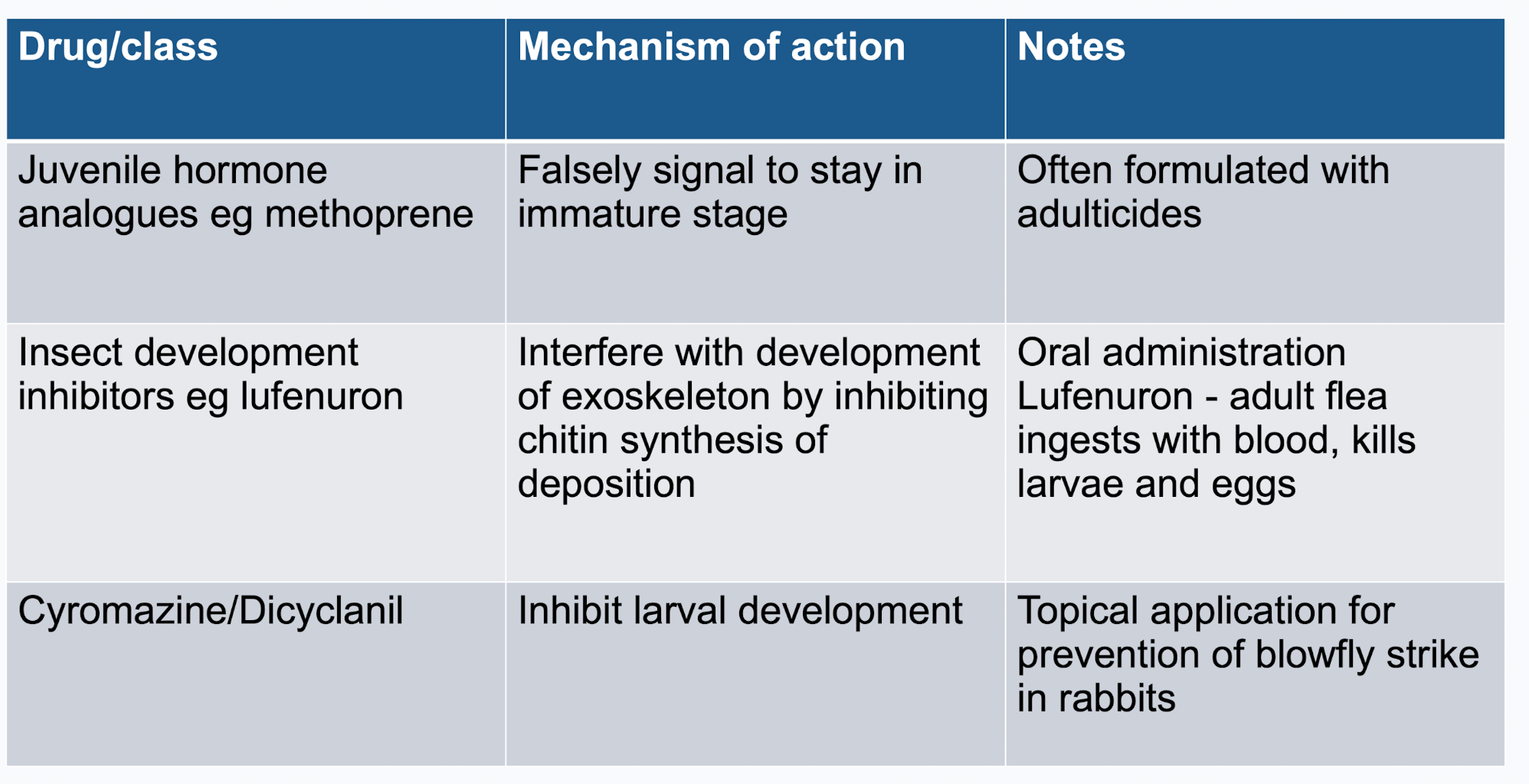
Describe the mechanism of action and any notes for Insect Growth Regulators:
Juvenile Hormone Analogies
Insect Development Inhibitors
Cyromazine / Dicylanil
They are not “killing” the parasite, they target early stages of development and impede maturation into adulthood
Why is there significant concern about the environmental impact of ectoparasiticides?
Environmental Impact → Veterinary use contaminates environment and kills insects in the environment
Impacting populations necessary for ecosystem health
 Note
Note  Flashcards (40)