RP 6: Investigation of the emf and internal resistance of electric cells and batteries by measuring the variation of the terminal pd of the cell with current in it.
 Call Kai
 Learn
Learn Practice Test
 Spaced Repetition
 Match
Match Flashcards
 Knowt Play
1/12

There's no tags or description
Looks like no tags are added yet.
Name | Mastery | Learn | Test | Matching | Spaced | Call with Kai |
|---|
No analytics yet
Send a link to your students to track their progress
13 Terms
What is the method used to determine the EMF and internal resistance of a cell using a variable resistor? (7)
- Set up a circuit including a battery or cell, a switch, a voltmeter in parallel across the battery, an ammeter in series, and a variable resistor.
- With the switch open, record the terminal potential difference using the voltmeter. This gives an estimate of the EMF.
- Set the variable resistor to its highest resistance, close the switch and record the current using the ammeter and the potential difference using the voltmeter.
- Open the switch again to minimise heating.
- Decrease the resistance of the variable resistor in steps and repeat the readings of current and potential difference over a wide range of currents.
- Record multiple pairs of current (I) and potential difference (V) values, then plot a graph of V against I.
- Use the graph to determine the EMF and internal resistance.
What equipment is required to determine the EMF and internal resistance of a cell? (6)
- Battery or cell.
- Voltmeter.
- Ammeter.
- Variable resistor.
- Switch.
- Connecting wires.
What does a diagram of the setup used to determine the EMF and internal resistance of a cell using a variable resistor look like? (3)
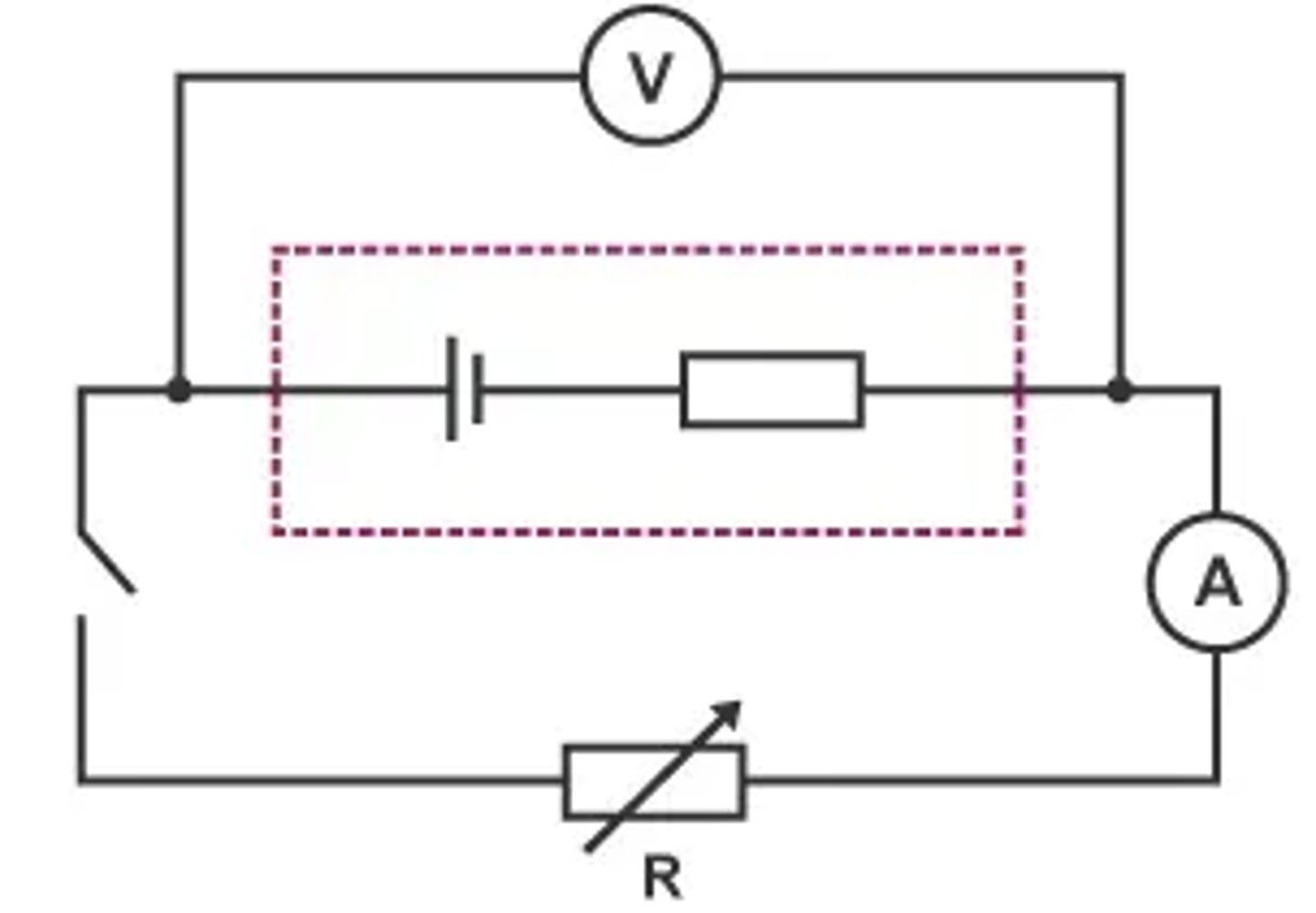
What is the independent variable in the EMF and internal resistance experiment? (2)
- The independent variable is the current.
- This is controlled by adjusting the variable resistor.
What is the dependent variable in the EMF and internal resistance experiment? (1)
The dependent variable is the terminal potential difference across the cell.
What are the controlled variables in the EMF and internal resistance experiment? (2)
- Controlled variables include the type of battery.
- Another controlled variable is external conditions such as temperature.
What graph is plotted in the internal resistance experiment? (1)
Plot a graph of terminal potential difference (V) against current (I). This should be a straight line.
What does the graph plotted in the internal resistance experiment look like? (3)
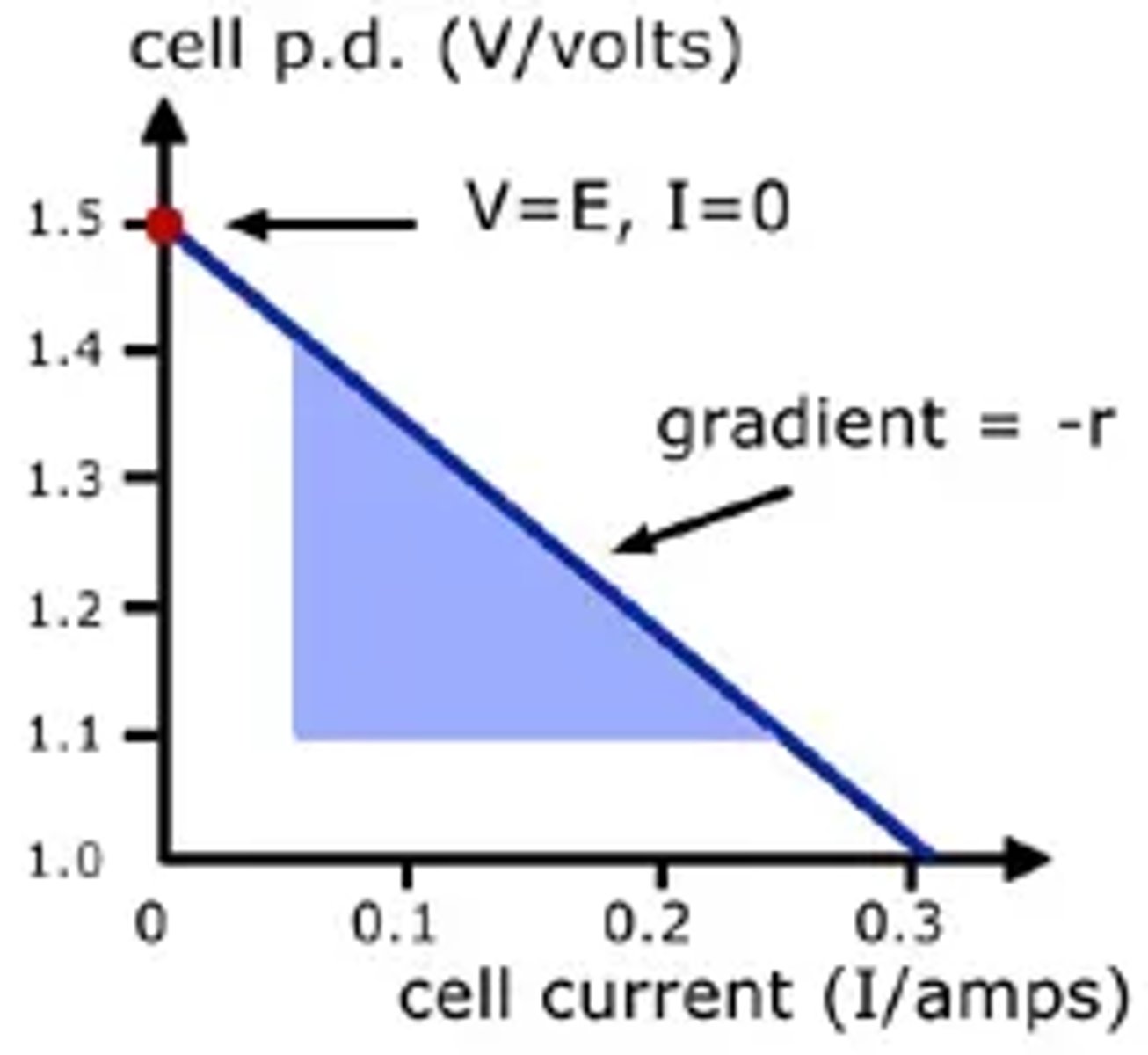
How is the EMF of the cell found from the graph? (1)
The y-intercept of the graph gives the emf of the cell.
How is the internal resistance found from the graph? (3)
- The gradient of the graph is equal to the negative of the internal resistance.
- The equation is
V = -rI + ε.
- Where V is the terminal p.d (V), r is the internal resistance (Ω), I is the current (A), and ε is the emf (V).
What is one safety precaution in the internal resistance experiment? (2)
- Another resistor can be included in series to limit the current and prevent the wires from overheating.
- This reduces the risk of burns or damage.
How can heating effects be minimised in the internal resistance experiment? (1)
Only close the switch briefly while taking measurements to prevent the internal resistance from changing due to heating.
How can the EMF and internal resistance be kept consistent during the experiment? (1)
Use fresh batteries or cells to ensure consistent EMF and internal resistance throughout the experiment.