Electron Transport Chain + Oxidative Phosphorylation
 Call Kai
 Learn
Learn Practice Test
 Spaced Repetition
 Match
Match Flashcards
 Knowt Play
1/15

Earn XP
Description and Tags
SBI4U - Birrell
Name | Mastery | Learn | Test | Matching | Spaced | Call with Kai |
|---|
No analytics yet
Send a link to your students to track their progress
16 Terms
electrons involved in the electron transport chain are carried by ______ and ______ molecules, that bring them to the ______ _______ of the mitochondria
NADH, FADH2, inner membrane
where did the NADH and FADH2 molecules get their electrons from?
sugar molecules, during Krebs and Glycolysis
e- are passed through a series of _______ in the _______ via ______ reactions
proteins, membrane, redox
energy is ________ in the proteins’ redox reactions, and is then used to ____ __ ions
released, pump, H+
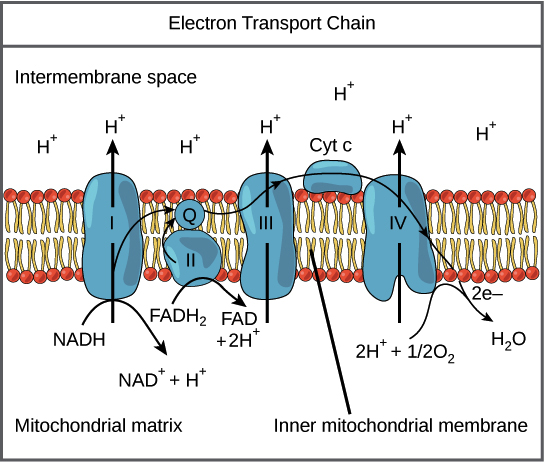
what do proton pumps do?
pump H+ ions out of the matrix into the intermembrane space
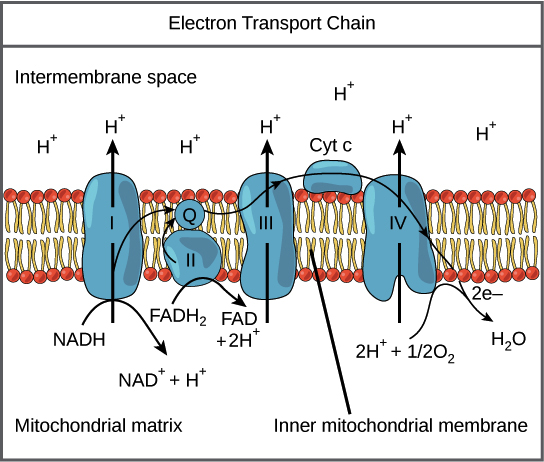
electrons are passed through a series of acceptors in the ETC, but the final acceptor of electrons is:
oxygen!
The driving force of the ETC is oxygen, and without it we die. Explain how oxygen is the driving force.
it’s highly electronegative, so it removes e- from complex 4, which kicks off electron transport (complex 4 takes from complex 3, and so on)
Thanks to protein pumps, hydrogen ions accumulate in the intermembrane space. What does this create?
an electrochemical gradient across the inner membrane
☆ stores free energy! (🔋)
___ ________ is a membrane-spanning ________ _______ used after ETC, during __________ __________.
ATP synthase, protein complex, oxidative phosphorylation
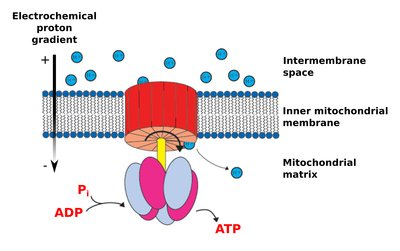
explain how ATP synthase synthesizes ATP
acts like a water turbine 🌊
the flow of H+ ions back down their electrochemical gradient turns the turbine 🛞
as it turns, it catalyzes the phosphorylation of ADP ⚡
this forms ATP in the matrix
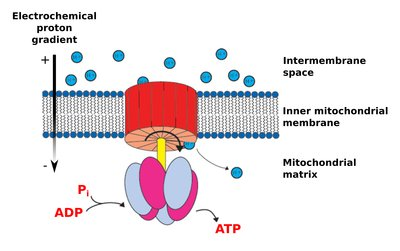
NADH vs FADH2
NADH | FADH2 |
|
|
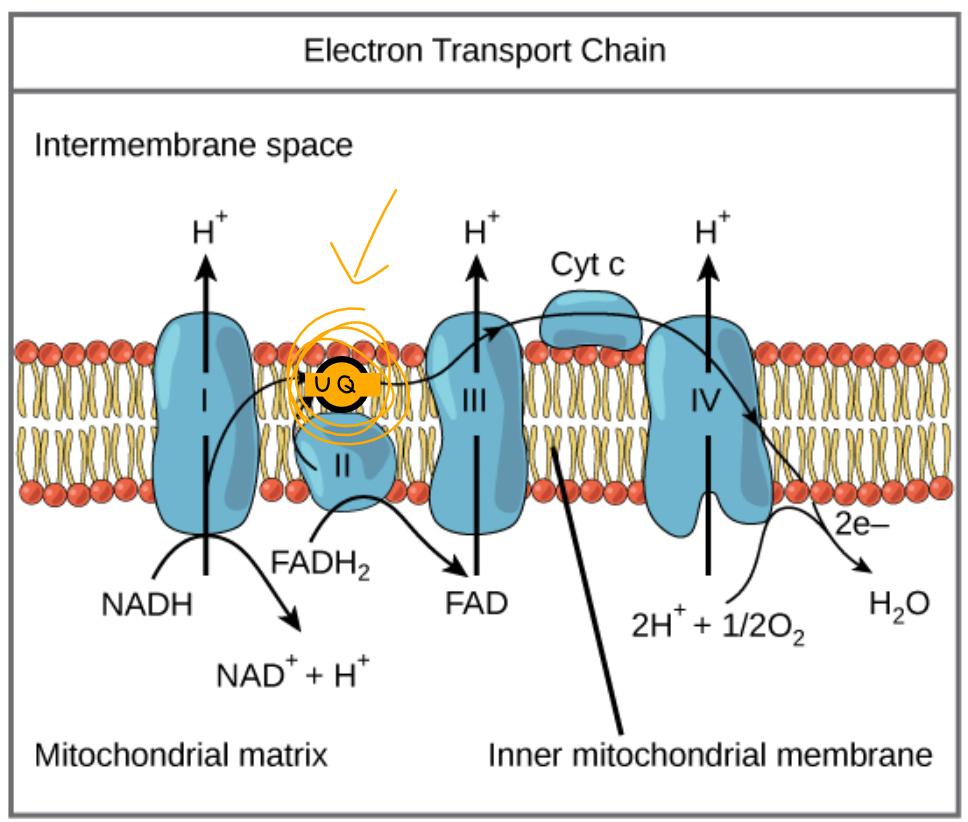
UQ
a mobile protein that is trapped inside the bilayer
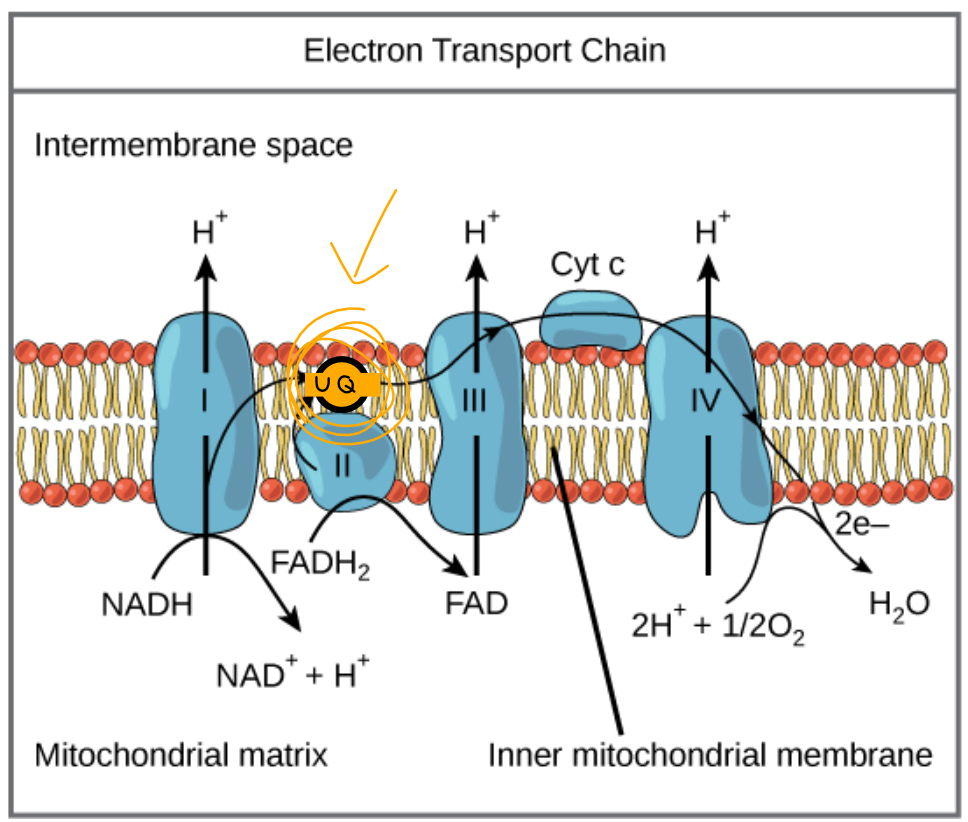
besides UQ, another mobile protein involved in the ETC is __ _, which acts as an ________ _______
cyt c, electron carrier
recall that NADH and FADH2 are ________. When they are _________, giving their electrons to the _________, they reform NAD+ and FAD, and return to the ____ ____.
reusable, oxidized, complexes, krebs cycle
Cystolic NADH
NADH made in glycolysis 🍰
⇨ too big to pass through inner membrane, so has to transfer e- to one of 2 e- shuttles
for our purposes, we assume that cystolic NADH uses which shuttle?
🚋 one that will transfer the electrons to another NAD+ inside the matrix

