Ch6 - Cell Signals and Responses
 Studied by 0 people
 Call Kai
 Learn
Learn Practice Test
 Spaced Repetition
 Match
Match Flashcards
 Knowt Play
1/37

There's no tags or description
Looks like no tags are added yet.
Name | Mastery | Learn | Test | Matching | Spaced | Call with Kai |
|---|
No analytics yet
Send a link to your students to track their progress
38 Terms
true or false. •All organisms are able to detect and respond to some environmental variables, including light, temperature, sound, touch, magnetic fields, gravitational fields, p H, various chemicals.
true
what are the 3 steps for cell detection
signal detection
signal transduction
cellular response.
when does signal detection occur
Signal detection occurs when a chemical signal (ligand) binds to a receptor, causing a conformational change (tertiary structure). This triggers a signal transduction cascade that leads to a specific cellular response.
what are the 2 types of ligands involved in cell detection and what do they do
Agonist (activator)
•Binds a receptor and activates signaling
•Mimics the effect of the natural ligand
Antagonist (inhibitors)
•Binds a receptor but prevents activation
•Blocks the effect of the ligand
does signal transduction involve enzymes, if yes, what do these enzymes do
•exhibit allosteric regulation. Allosteric changes are often caused by phosphorylation.
•Responses may be short term (e . g ., opening an ion channel), or long term (e . g ., alteration of gene expression).
what are the two signal molecule receptors
Intracellular receptors
Membrane receptors
what are receptors
Receptors are specialized proteins located on the cell surface or within cells that detect and bind specific signals.
what are intracellular receptors
located inside a cell; ligands are small or nonpolar and can diffuse across the cell membrane. (e.g. steroid hormone receptor)
what are membrane receptors
located on the cell surface; ligands are large or polar and can’t cross the lipid bilayer.
if something is nonpolar, it is also hydrophobic
yes
what are the 3 types of membrane receptors
Ligand-gated ion channel receptors
G protein–coupled receptors (G P C R s)
Protein kinase receptors
do ligand-gated ion channel receptors change shape when a ligand binds
yes
what are G protein-coupled receptors (GPCRs):
a membrane receptor that senses outside signals and relays them inside the cell by activating G proteins (large G protein).
The α subunit binds GDP in the absence of a ligand. When a ligand binds to the GPCR, GDP is exchanged for GTP, the α subunit dissociates, and it activates an effector enzyme that initiates cellular responses.(guanosine diphosphate (GDP); guanosine triphosphate (GTP)) WATCH YT VID ABOUT THIS
true or false. G proteins are heterotrimers — they have 3 subunits
true
what is a “short” signallng pathway
Signaling pathways can be short: the bound receptor directly causes the cellular response, e . g ., steroid hormones.
what is the protein kinase receptors
when a ligand binds, conformation change exposes or activates a cytosolic domain that has protein kinase activity
Modify target proteins by adding phosphate groups, thereby changing their activity.
what is Autophosphorylation
activation of some protein kinase receptors such as the insulin receptor can result in phosphorylation of residues on the receptor itself.
are most signaling pathways short?
No! Most pathways involve multiple sequential steps, a signal transduction cascade. e.g., mitogen-activated protein kinases (M A P K s).
what is a second messenger and what is its main function
a small nonprotein molecule that regulates target enzymes by binding to them noncovalently (allosteric regulation).
main function is propagating and amplifying signals from cell
what is signal transduction
The process by which a cell responds to substances outside the cell through signaling molecules found on the surface of and inside the cell
define cell-to-cell signaling
one cell produces a signal to be detected by another cell.
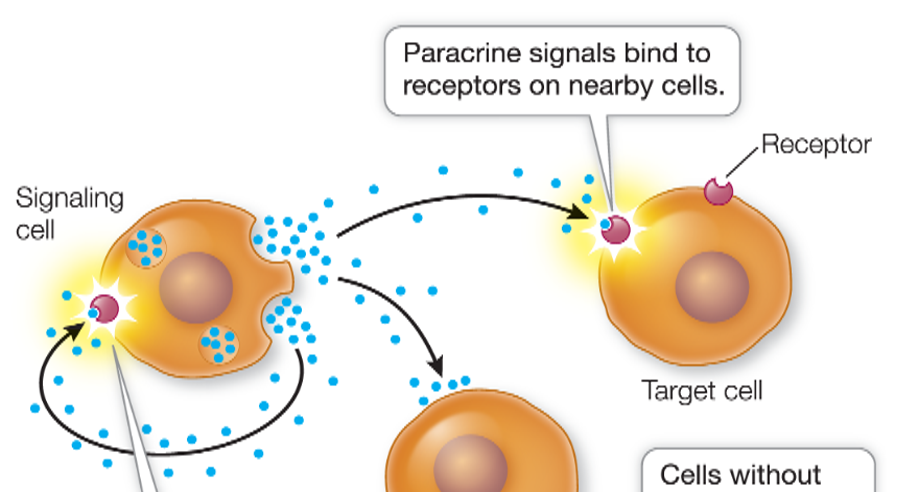
is this example cell-to-cell signaling?
A signal between cells:
•Is produced by the signaling cell
•Conveys specific information
•The recipient is the receiver or target cell
The goal is to elicit a response in the target cell.
yes
during cell-cell signaling, how do cells signal to eachother and spread the signal?
•Binding of ligand to receptor protein is very specific. Signals can be targeted to specific groups of cells.
•The same signals may be detected by different receptors on different cells.
•Cells that do not express a receptor for a ligand cannot detect the signal.
list the 4 types of cell signaling
Juxtacrine signaling,
Autocrine signaling
Paracrine signaling
Endocrine signaling
what is juxtacrine signaling (cell-to-cell)
Juxtacrine signaling requires direct contact between the two cells. (e.g. gap junction)
what is autocrine signaling (cell-to-cell)
Autocrine signals affect the same cells that release them.
a form of cell communication where a cell secretes signaling molecules (ligands) that bind to receptors on its own surface, triggering self-stimulation or response
what is paracrine signaling (cell-to-cell)
Paracrine signals diffuse to and affect nearby cells.
what is endocrine signaling (cell-to-cell)
Endocrine signaling: hormones are transported long distances by bulk flow.
true or false. all cells contain the same dna, but they all do not express the same proteins
true
true or false. A target cell can only respond to a hormone if it contains specific and functional receptors for that hormone
true
what are the 3 ways signal transduction can be turned off
•1. Receptors are recycled: endocytosis of membrane receptors; turnover of intracellular receptors.
•2. Loss of the signal molecule: Some second messengers, such as the gas nitric oxide, simply diffuse out of the cells, quickly reaching low concentrations and shutting down a response.
•3. Signal molecules can convert transduction molecules back to their inactive precursors.
which 3 signals lead to the production of active signal transduction molecules
•Phosphatases remove phosphate groups from target proteins, thus reversing phosphorylation.
•G proteins have G T P a s e activity, which removes a phosphate group from G T P, converting it to G D P, which inactivates the α subunit of the G protein.
•Phosphodiesterase coverts cAMP to A M P, ending the activation of c A M P-dependent enzymes.
define homestasis
Homeostasis: a state of biological balance
true or false. Cell response is also determined by integration of signaling pathways.
true
how does the epinephrine signal transduction pathway work
release of glucose stored in glycogen,
decreasing fatty acid synthesis,
increasing triglyceride breakdown,
increasing gluconeogenesis (producing glucose from non-carbohydrate sources).
true or false. several signals/pathways play a role in cell response.
true
describe the insulin signal transduction pathway
The insulin receptor is a protein kinase receptor. This pathway activates phosphodiesterase, which lowers c A M P levels, inhibiting the signal transduction pathway for glucagon and epinephrine, and preventing activation of glycogen phosphorylase and the release of glucose.
true or false. Some common disorders are due to problems with cell signaling, such as diabetes.
true
 Note
Note  Flashcards (35)