PARA_Prelims_Lab: AMOEBA SARCODINA (in progress)
 Studied by 0 people
 Call Kai
 Learn
Learn Practice Test
 Spaced Repetition
 Match
Match Flashcards
 Knowt Play
1/32

There's no tags or description
Looks like no tags are added yet.
Name | Mastery | Learn | Test | Matching | Spaced | Call with Kai |
|---|
No analytics yet
Send a link to your students to track their progress
33 Terms
2 stages of Protozoan Development
Cysts
Trophozoite
Cyst
Non-motile, Non-Feeding stage, Resistant to acid
Infective stage
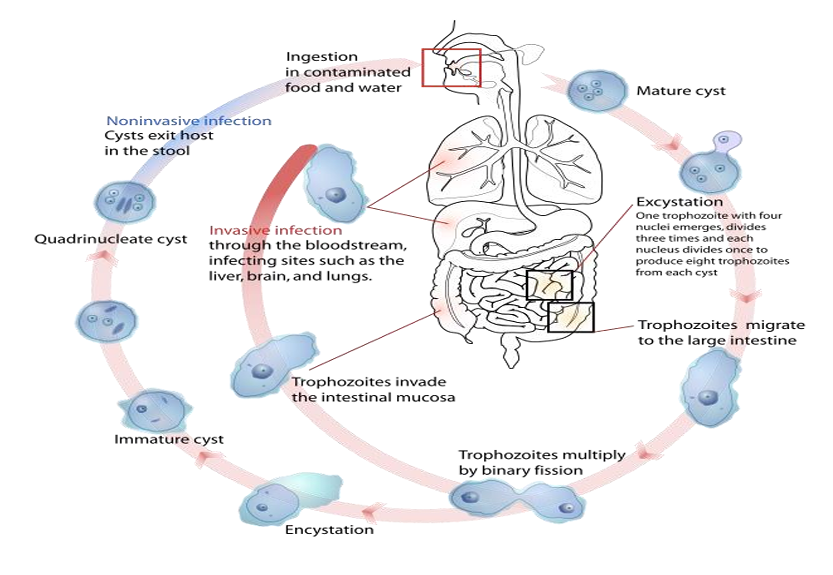
Encystation vs Excystation
Encystation: Trophozoite → Cyst
Excystation: Cyst → Trophozoite (exit the cyst stage)
Entamoeba Histolytica (Trophozoite)
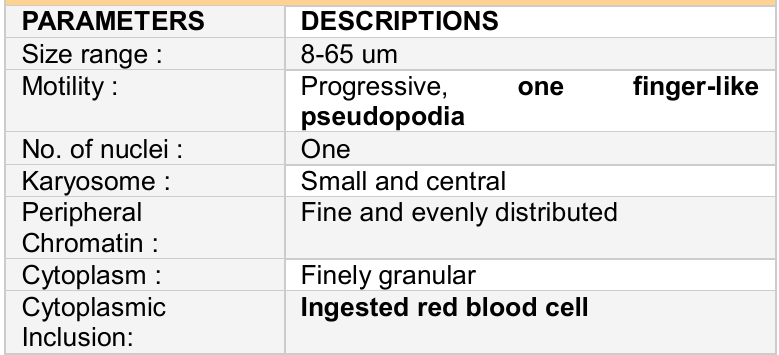
Trophozoite
a stage that is Motile, Feeding stage, Fragile
Feeds, multiplies and use pseudopods
True
T/F:
Easily destroyed by gastric juices of the stomach and susceptible in the environment
Trophozoite
(Trophozoite/Cysts) are not usually transmtted to human
Pseudopods
is the extension of the cytoplasm that is used for motility
karyosome
the chromatin found inside the nucleus
Things to consider: size, and location
Peripheral chromatin
This is the chromatin that surrounds the nuclear memrbane
Things to consider: distribution (even or uneven)
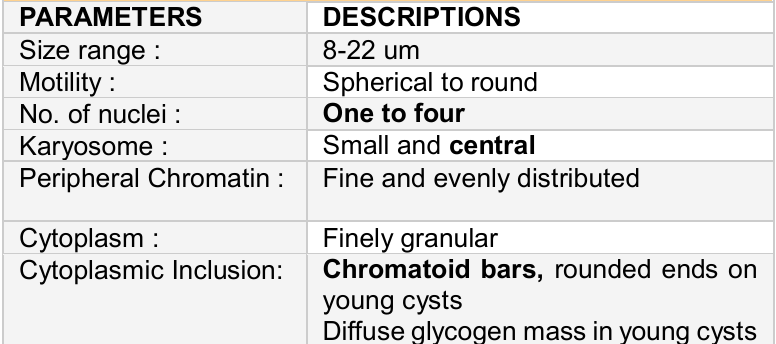
Entamoeba histolytica (cyst)
Life Cycle of Entamoeba histolytica
Clinical Symptoms fro E. histolytica
Symptomatic Intestinal Amebiasis
Symptomatic Extraintestinal Amebiasis
Entamoeba coli (Trophozoite)
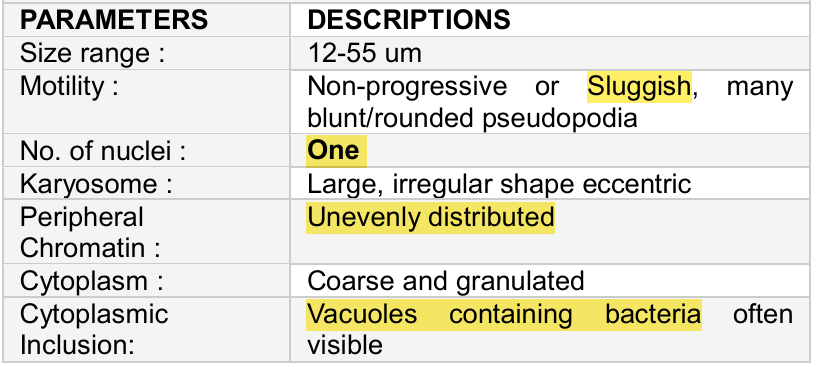
What form is the pseudopods for Entamoeba coli
blunt pseudopod
Blunt pseudopods
this type of pseudopod is sluggish and nonprogressive
broad and short
Finger-like pseudopods
this type of pseudopods is rapid and progressive
narrow and long
Entamoeba coli (Cyst)
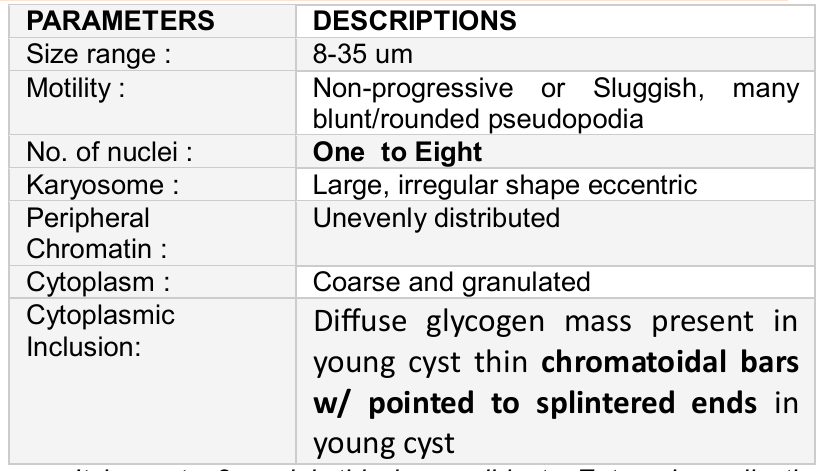
Entamoeba coli (trophozoite)
Motility | |
No. of nuclei | |
Cytoplasmic inclusion |
Motility | Blunt pseudopod |
No. of nuclei | one |
Cytoplasmic inclusion | Vacuoles containing bacteria |
Entamoeba coli (Cyst)
Motility | |
No. of nuclei | |
Cytoplasmic inclusion |
Motility | Blunt pseudopodia |
No. of nuclei | 1-8 |
Cytoplasmic inclusion | pointed to splintered ends Chromatoid bars |
Entamoeba hartmanii (trophozoite)
Motility | |
No. of nuclei | |
Cytoplasmic inclusion |
Motility | Finger-like pseudopod |
No. of nuclei | One |
Cytoplasmic inclusion | Ingested bacteria may be present |
Entamoeba hartmanii (Cyst)
Motility | |
No. of nuclei | |
Cytoplasmic inclusion |
Motility | Spherical |
No. of nuclei | 1-4 |
Cytoplasmic inclusion | Chromatoidal bars, rounded ends in young cysts Diffuse glycogen mass |
Endolimax nana (trophozoite)
Motility | |
No. of nuclei | |
Karyosome | |
Cytoplasmic inclusion |
Motility | blunt pseudopods |
No. of nuclei | One |
Karyosome | Large, irregular, blotlike |
Cytoplasmic inclusion | Bacteria |
Endolimax nana (Cyst)
Motility | |
No. of nuclei | |
Karyosome | |
Cytoplasmic inclusion |
Motility | Spherical, ovoid, ellipsoid |
No. of nuclei | 1-4 |
Karyosome | Large, blotlike, usually central |
Cytoplasmic inclusion | Chromatin granules nondescript small mass Diffuse glycogen mass in young cyst |
Shape of Karyosome in Endolimax nana (trophozoite)
Blot-like karyosome
Iodameoba butschlii (trophozoite)
Motility | |
No. of nuclei | |
Cytoplasmic inclusion | |
Peripheral Chromatin |
Motility | Sluggish, usually progressive (blunt) |
No. of nuclei | one |
Cytoplasmic inclusion | Bacteria Yeast Other debris |
Peripheral Chromatin | Absent |
Iodameoba butschlii (cyst)
Motility | |
No. of nuclei | |
Peripheral Chromatin | |
Cytoplasmic inclusion |
Motility | Ovoid, ellipsoid, triangular |
No. of nuclei | One |
Peripheral Chromatin | Absent |
Cytoplasmic inclusion | Well-defined glycogen mass Granules may be present |
Balantidium coli (Trophozoite)
Size Range | |
Motility | |
No. of nuclei | macronucleus: micronucleus: |
Size Range |
|
Motility | Rotary, Boring |
No. of nuclei |
|
Balantidium coli (Cyst)
Size Range | — |
Number and apparatus of nucleus |
|
Other features |
Size Range | — |
Number and apparatus of nucleus |
|
Other features |
|
 Note
Note  Flashcards (72)