Uke 8 B-N kap 3: neurophysology
 Call Kai
 Learn
Learn Practice Test
 Spaced Repetition
 Match
Match Flashcards
 Knowt Play
1/21

There's no tags or description
Looks like no tags are added yet.
Name | Mastery | Learn | Test | Matching | Spaced | Call with Kai |
|---|
No analytics yet
Send a link to your students to track their progress
22 Terms
What is the cause of neurons resting membrane potential? At what mV is this?
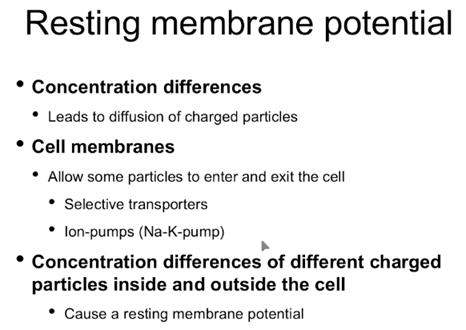
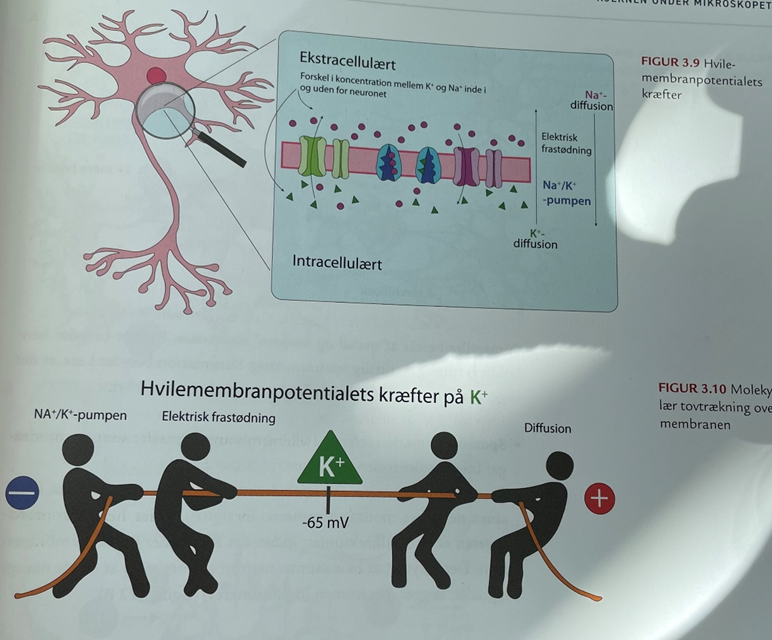
The resting potential is due to balance between the procesess of diffusion, the electrostatical stream an the sodium-potassium pump
Electrostatical pressure leads oppositely charged particles to come together
+
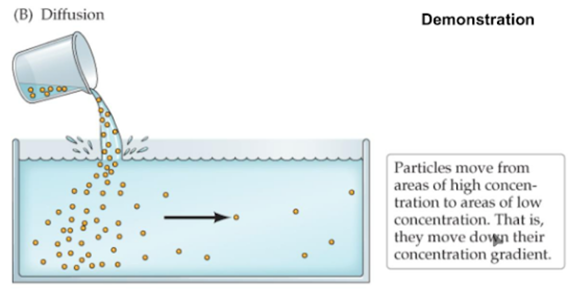
Diffusion: molecules in a substance spread away from regions with high consentration to other regions with a lower concentration —> molecules move from down their concentration gradiant until they are evently spread
+
the sodium-potasium pump leading to a build-up of K+-ions on the inside of the cell —> negative electrical load on the inside of the neuron working against the processes of diffusion and the electrostatical stream
The balance i acheved between diffusion, electrical stream and the sodium-pottasium pump —> resting potenial at -65 mV
What are ion channes?
Tube-like pores on the membrane of the neuron
Makes it possible for ions of a specific type to pass through the membrane
What is the sodium-potasium pump and its function?
Neurons use the sodium-pottasium pump, making the innside more concentrate with K+-ions than the outside, and te outside more concentrated with Na+-tions than the inside.
Pumps out 3 Na+-ions out of the neuron for every 2 Ca+-ion that is pumped in
The pump leads to a buildup of K+-ions on the innside of the cell —> causes a negative charging on neurons inside
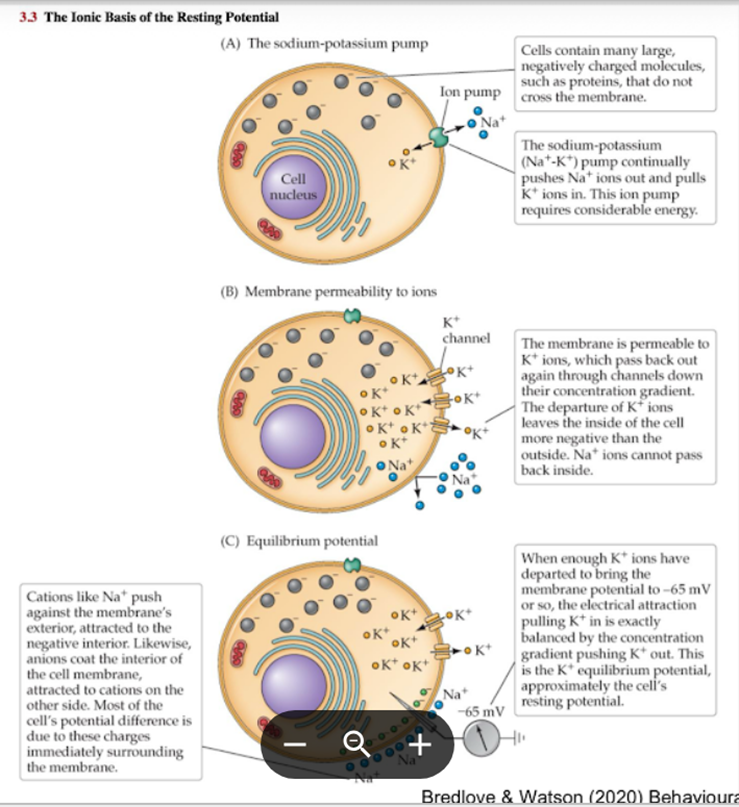
Follow up Q connected to the pump: what is the membrane permability to ions?
When the negative charge inside the neuron builds up, the neuron begins to send out electrostatic pressure —> positiv charced K+-ions come inn to the cell while old K+-ions are sent out
This process is done to acheve equibrilium potential (balansepotensial) —> hvilemembranpotensiale
What makes an action potential start, going from resting membrane potential to action potential?
The summation/whole of the neurons signal leads the neuron to have a more positive or negative membranepotential, making the resting membrane potential of -65 mV be more positive/negative, depending on if the signals are in total exitatory or inhibitory respectivly.
The summation of these signals make up the spatial and temporal summation
These summations + if the signals in total are exitatory or inhibotory leads to a action potential starting, because the membrane potential is then at -40 mV
What is an action potential and what is the goal of it?
A local change of the neurons electrical charging, which runs along the axon of the neuron
The goal of it is to transfer information to other cells
The action potential has 5 stages, lets go through them
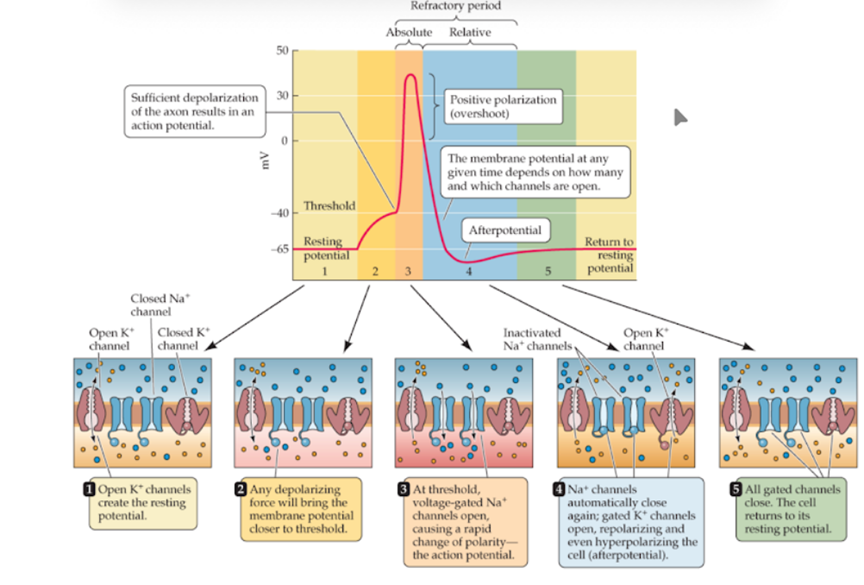
Stage 1: from resting potential to action potential through depolarisation
This change in potential is called a graded response
Signals from other neurons leads to a lessening in the negativity of the neurons membrane —> the neuron becomes more positively charged —> depolarisation to a level of -40 mV —> threshold is reached at the neurons axon hillock —> action potential is triggered
Stage 2: Action potential is made through movements of Na+-ions that go in to the neurons membrane, through channels that open up at the membrane
Na+-channels at the neurons membrane are opens —> Na+-ions stream inn to the neuron and run down the axon —> the neuron becomes depolarized to threshold-levels
This polarization leads to voltage-gated Na+-ion-channels opening at the membrane —> the neuron rapidly and shortly becomes permeable to Na+-ions —> leads to hypoerpolarizated making the membranepotential go from around 0 mv to 35 mV
The Na+-ion-channels then close, and the mebrane potential goes from 35 mV to 65 mV
This “overload” of positive charge inside the neuron is pushed out of the membrane through K+-ion-channels
Step 3: refractory period
There is a refractory period after this hypoerpolarization, where the neuron is inactive
No stimuli can lead to a new action potential
Step 4: Repolarization
Na+-ions come into the neuron and K+-ion are pushed out of the neuron throught the membrane
This is followed by a preiod of reduced sensitivity: relative refractory phase: very unlikely that stimuli can cause a new action potential
Stage 5: resting membrane potential is acheived again
All voltage gated channels are closed
How does the action potential travel along the lenght of the axon?Where does it start and where does it end? What makes this process so fast?
“Spread of fire”
The action potential in one part of the axon leads to a depolarization in the next part of the axon, making a new action potential be triggered
It starts at the axon hillock and ends at the axon terminal
Myelin sheating, wrapped around axons, make the action potential be sent faster along the axons lenght
Makes the potential “jump” from "one “node of Raniver” to the next one (saltasory conduction)
What are synapses?
Is the connection between two neurons
The tranfer of information from one cell to others through action potential, is only possible through the synapses
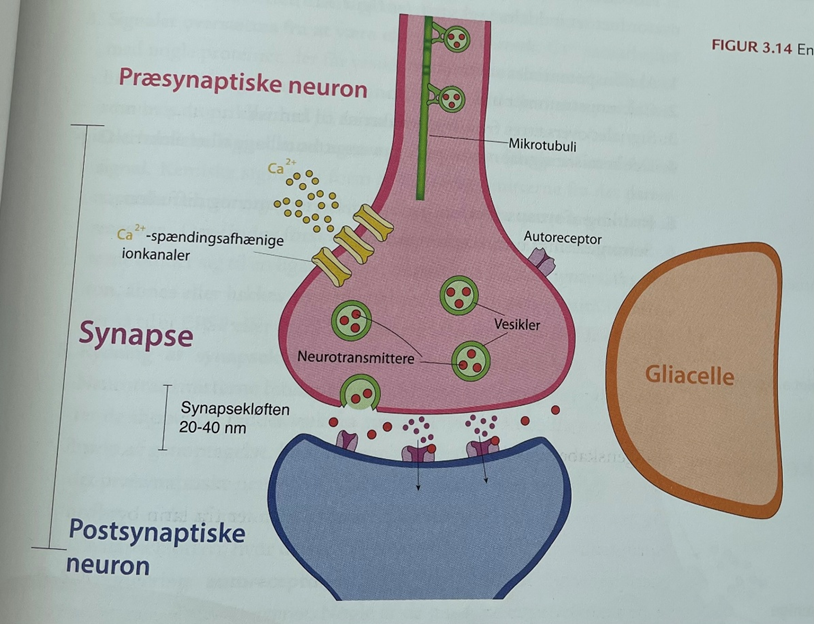
How is information-transfer from the presynaptic cell to the post synaptic cell possible?
When an action potential is triggered in an exitatory presynaptic neuron, this stimulation eads to neurotransmitters being sent out in the synaptic clift between the pre- and post-synaptic neuron.
Leads to a small local depolarization in the postsynaptic ce —> exittatory postysynaptic potential (EPSP) —> The post synaptic neuron is triggered, changing its threshold making it closer to starting a action potential of its own.
And so on and so on
There is also something called inhibotory postsynaptic potential (IPSP), what is this?
There is another presynaptic neuron what is inhibitory, the inhibitory oresynaotic neuron
When this is stimulated and activated due to a action potential in the presynaptic neuron, it leads a hyperpolarization that increases the resting membrane potential —> less change of the post synaptic neuron reaching its threshold for action potential
what makes the post-synaptic neuron fire its own action potential? (spatial and temporal summation)
The over all baance of the signals from the pre synaptic neuron is “avgjørende” for if the post synaptic neuron will fire its own action potential
If the signals in total are exitatory —> the post synaptic neuron will be closer to action-potential-threshold
It also depends on the signals in totals, spatial and temporal summation:
Spatial summation: the sum of potentials in the axon hillock from different physical locations along the neuron
Temporal summation: the sum of potentials that arrive at the axon hillock at different times
If the spatial and temporal summation of all potentials, both EPSP and IPSP is enough to depolarize the post synaptic cell, leading to the threshold being reached, the action potential will be triggered
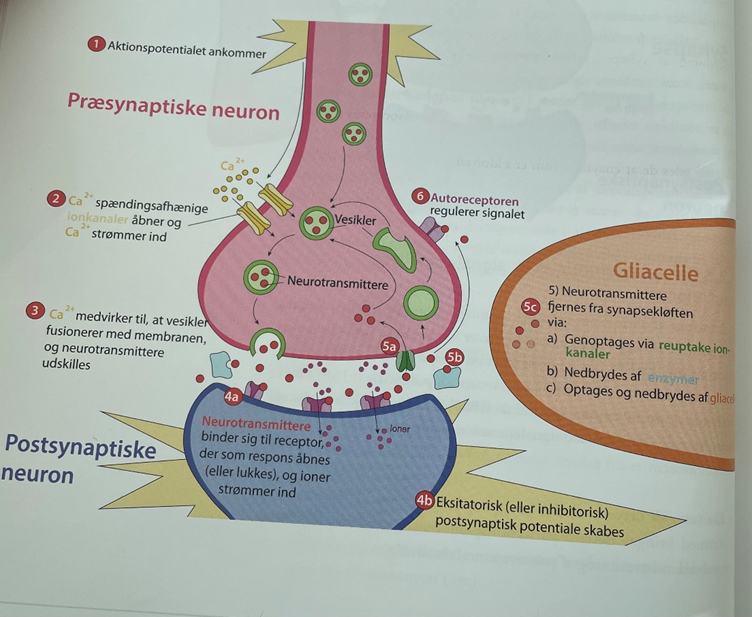
Explain the processes of the transfer of information from pre- to post-synaptic neuron —> synaptic potential:
o 1: action potential ankommer synapsen fra presynaptisk neuron
Action potential når aksonterminalen som depolariseres
o 2:Kalsium strømmer inn i synapsen:
Ca2+-voltage-gated kanaler åpnes og kalsium strømmer inn
I aksonterminalen er det små vesikler som inneholder neurotransmittere som har blitt transportert ned med action potential
o 3: Det elektriske signalet fra action potential endres fra å være elektrisk til kjemisk signal:
Kalsiumet i samarbeid med noen proteiner fører til at vesikler med neurotransmittere fusisonerer med membranen (exocyposis) —> neurotransmittere utskilles i synapsekløften
o 4: Det kjemiske signalet mottas og oversettes tilbake til et elektrisk signal i den postsynaptiske neuronen
Det kjemiske signalet fra presynaptisk neuron registreres av postsynpatisk neuron ved hjelp av reseptorer
Neurotransmittere binder seg til reseptoren som på respons åpnes eller lukkes —> ioner strømmer inn i post synaptisk neuron
Fører til at et eksitatorisk eller inhibitorisk postsynaptisk potensiale skapes (ESPS eller IPSPS)
o 5: rydding av synapsekløften: gjenopptagelse, enzymer og diffusjon
Neurotransmittere fjernes gjennom
Gjennopptagelse via reuptake ion-kanaler,
Nedbrytelse av enzymer og
Diffusjon: Opptagelse og nedbrytelse av gliaceller
o 6. selvregulering: autoreseptoren regulerer signalet
Noen neurotransmittere som frigis binder seg til neutoreseptorene, og det gis et signal til den presynaptiske neuronen om bestanden av neurotransmittere i synapsen —> neuonet kan regulere frigivelsen av neurotransmittere på bakgrunn av denne informasjonen
Explain how neurotransmitters stick to the right receptor, and what happens when it sticks?
Neurotransmitter stick to the right receptor, because the neurotransmitter is a ligand
A lignad is a molecule that only can stick to a receptor that “fits”
The neurotransmitter will therefore not stick to a receptor that does not fit.
When the neurotransmitter has found the right receptor it can block or activate it.
How does neurotransmitters kontroll ion-channels?
They controll ion-channells through the receptors they stick to, where they either åpen or block the openings of the channels.
Explain the two different receptor types
Iotropic/lLigand gated receptors
Chemical gated ion channels, where the transmitter directly controlls the receptor through the ion-channel openin and ion streaming through the membrane
Quick
Metapotropic receptors
Slow
When neurotransmitter is attached, the ion-channels are controlled through the receptors molecular complex of G-proteins
What is a neuronal circut?
A circut is a group of neurons and their synaptic interconnections —> an arrangement of components that together performe a special function
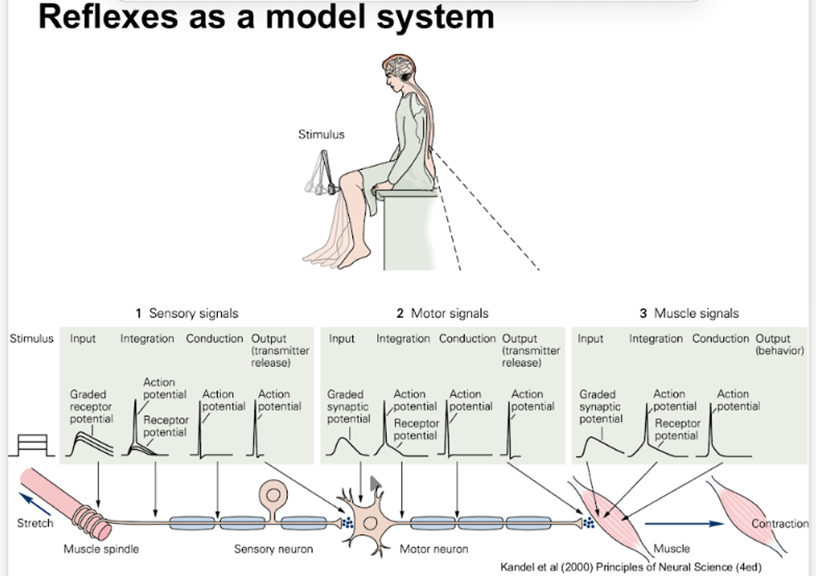
An example is the neural chain: a straight-forward linking of a series of neurons like the knee-jerk reflex