cc3 - cell membranes and transport
 Call Kai
 Learn
Learn Practice Test
 Spaced Repetition
 Match
Match Flashcards
 Knowt Play
1/26

There's no tags or description
Looks like no tags are added yet.
Name | Mastery | Learn | Test | Matching | Spaced | Call with Kai | Chat |
|---|
No analytics yet
Send a link to your students to track their progress
27 Terms
two main components of plasma membranes
phospholipids and proteins
phospholipids
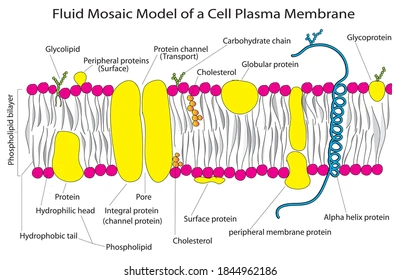
glycerol ‘head’ (hydrophilic) bonded to two fatty acid ‘tails’ (hydrophobic) and a phosphate group, form a bilayer in cells
intrinsic proteins
proteins found within the phospholipid bilayer, includes channel proteins and carriers
roles: structural support, carrying water-soluble molecules, forming ion channels to allow active transport
extrinsic proteins
proteins found at the edges of the phospholipid bilayer
roles: receptors, acting as antigens, enabling cell recognition, helps cells adhere to each other
location of R group
hydrophilic= R group is charged and around the head
hydrophobic= R group is uncharged and near the tails
cell membranes are selectively permeable
hydrophobic layer in the middle of the bilayer is impermeable to polar/charged particles but non-polar molecules like oxygen, carbon dioxide and fat-soluble vitamins (A, D, E, K) dissolve so can cross by diffusion
channel proteins
have hydrophilic R groups which are specific to particular charged/polar molecules which can diffuse by facilitated diffusion
protein carriers
involved in active transport and facilitated diffusion across the membrane
glycocalyx
complex carbohydrate group surrounding some cells
glycolipid if on phospholipid
glycopotein if on protein
role of cholestrol
regulate fluidity of the membrane, found in between the fatty acid tails, high cholesterol= too rigid, low cholseterol=too fluid
fluid mosiac model
created in 1972 by Singer and Nicolson, fluid refers to the lateral movement of molecules in the membrane, mosaic refers to the random arrangement of proteins, shown by hybridisation (2 cells fusing)
passive transport
ATP not required, movement is from high to low concentration
diffusion
random movement of particles from an area of high to low concentration through the phospholipid bilayer
factors effecting rate of diffusion
size and solubility of molecule - more = faster
surface area - more = faster
length of diffusion pathway - shorter= faster
concentration gradient - steep = faster
temperature - increased = faster
membrane permeability - effected by salt concentration, presence of detergents and organic solvents
facilitated diffusion
passive process, specific protein carriers/channels are used, charged/polar molecules and molecules too big to simply diffuse are transported across membrane
osmosis
net movement of particles from an area of high to low water potential across a selectively permeable membrane, passive process, can move in both directions, achieves equilibrium
water potential
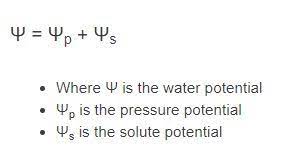
tendency of water to leave a system by osmosis, depends on solute concentration and pressure, measured in kPa (kilopascals)
hypotonic solutions
a solution that has a higher water potential value than the cells, causing cells to swell as water moves into them by osmosis, possibly leading to haemolysis if they burst which releases red pigment
isotonic solutions
solutions that have the same solute concentration/water potential as the cell, leading to no net movement of water across the selectively permeable membrane.
hypertonic solutions
where a solution has a lower water potential value than the cells, causing cells to shrink as water moves out of them by osmosis, leading to crenation
water potential equation
plasmolysis
occurs when cells are in solutions with a lower water potential, water leaves cell, shrinking vacuole and cytoplasm forming a visible gap between membrane and wall
incipient plasmolysis occurs when 50% of cells in na tissue have plasmolysed
active transport
movement of substances from a low concentration to a high concentration (against the concentration gradient) using specific protein carries and energy in the form of ATP
endocytosis
movement of substances into a cell by surrounding them with a section of the cell membrane - an active process
phagocytosis=movement of solids
pinocytosis=movement of liquids
exocytosis
movement of substances out of the cell by packing them into secretory vesicles formed in the Golgi body which then fuse with cell membrane to release contents
what is cyanide
a respiratory inhibitor - therefore preventing active transport as limited ATP can be produced from respiration
co transport
type of facilitated diffusion that brings different molecules into the cell together on the same transport protein