War economy
 Call Kai
 Learn
Learn Practice Test
 Spaced Repetition
 Match
Match Flashcards
 Knowt Play
1/10

There's no tags or description
Looks like no tags are added yet.
Name | Mastery | Learn | Test | Matching | Spaced | Call with Kai |
|---|
No analytics yet
Send a link to your students to track their progress
11 Terms
To what extent did Nazi Germany achieve total war economy (the majority)
→German victories at the start of the war, partially part of “Blitzkrieg” gave the impression the economy had not been overstrained (which explains why there was only partial economic mobilisation until 1942)
To what extent did Nazi Germany achieve total war economy (others)
→others thought Germany faced economic problems before war began
→despite victory against Poland the German army needed more tanks and
→Some argue that this was the reason why the invasion of France was delayed for months as they lacked the necessary resources to confront the much more powerful French army
What did the German leadership want to avoid and what did they do about it
→ avoid all problems that confronted Germany, therefore, a series of economic decrees were issued in December 1939 (outlining vast programmes for war production)
What was the result of the economic decrees and what was introduced and what did it lead to
→German expenditure doubled from 1939-41, introducing food rationing/ clothes later on
→labour force was mobilised for war, so by 1941, 55% of workforce worked on war related projects
what fell but had little impact - give examples
consumer goods fell, however armament production remained low
→Number of planes produced increased from 8,290 1939, but only
to 10,780 in 1941
→Tank production also low, so when Germany invaded USSR in 1941, it
had just 800 more tanks then when it invaded the West in 1940.
What were some reasons for disappointing results
→poor coordination: war declared in 1939, but key projects were not finished till 1942
→different demands for people: ministries of armament, economics etc- all continued to function in their own ways
→armed forces wanted quality over quantity
→labour shortages due to 4 million being called into army
What did Germany try to do to fix labour shortages
→they recruited foreign workers, creating further problems and had to be policed - ensuring no undesirable racial contract between non-germans and germans
→woman called into workforce despite regimes reluctance to do this due to their view of women
what % of women made up the work force
37% of the labour force
what attempt did the right labour ministry do based on women and result
introduce female conscription for single women, but that was unpopular and another reason why foreign labour was used
what was the concern of using women in the work force
→ concern within the regime that to maintain morale the armed forced need to know that their women were being looked after
→if they were not, people though that there would be a repeat of 1918 and a collapse of morale
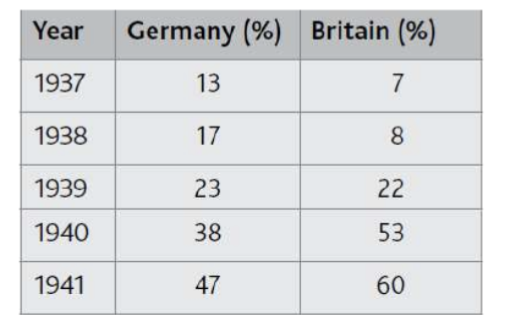
failure to mobilise at the start of the war is made clear in the percentage chart of the GDP spent on military compared to Britain