precalc
 Note
Note Call Kai
 Learn
Learn Practice Test
 Spaced Repetition
 Match
Match Flashcards
 Knowt Play
1/47

There's no tags or description
Looks like no tags are added yet.
Name | Mastery | Learn | Test | Matching | Spaced | Call with Kai | Chat |
|---|
No analytics yet
Send a link to your students to track their progress
48 Terms
What is a function?
A rule describing the dependence of one quantity, A, on another, B.
Domain
The set of all inputs for a function.
Range
The set of all outputs for a function.
Interval Notation - Hard
Includes end values, denoted by [ ].
Interval Notation - Soft
Excludes end values, denoted by ( ).
Set Builder Notation Example
{ x | x > 0 } means 'The set of all x such that x is greater than 0'.
Denominator Restriction
The restriction that the denominator of a function cannot equal zero.
Radicand Restriction
The restriction that the radicand must be greater than or equal to zero.
Average Rate of Change Formula
ARC = (f(b) - f(a)) / (b - a).
Even Function Definition
A function symmetric over the y-axis, satisfying f(-x) = f(x).
Odd Function Definition
A function symmetric about the origin, satisfying f(-x) = -f(x).
Greatest Integer Function
Denoted as f(x) = [[x]], it is the greatest integer less than or equal to x.
Transformation Formula
y = a f(b(x - c)) + d describes the transformations of a function.
One-to-One Function
A function where only one x-value corresponds to every y-value.
Cancellation Property
If f-1(x) is the inverse of f(x), then f(f-1(x)) = x and f-1(f(x)) = x.
Involution
A function that is equal to its own inverse.
Law of Sines
In any triangle, the lengths of the sides are proportional to the sines of the corresponding angles.
Law of Cosines
Used for SAS and SSS cases, given by the formula a² = b² + c² - 2bc * cos(A).
Pythagorean Identity
An identity involving sine and cosine that holds true for any angle.
Area of a Non-Right Triangle
A = 1/2ab sin(C), where A is the area and a, b are sides forming angle C.
Angle Addition Formula
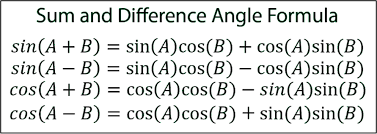
Double Angle Formula
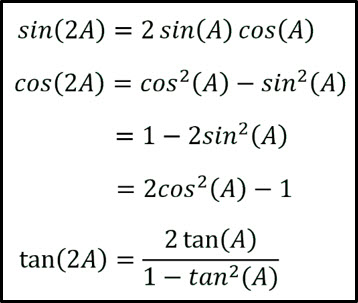
Half-Angle Formula
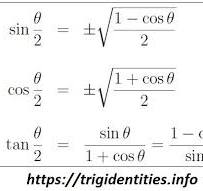
Reciprocal Identities
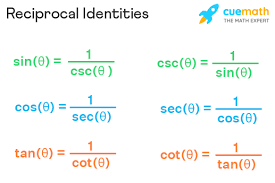
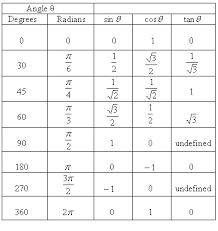
Basic Trigonometric Values
Sine Wave Equation
y = a sin(bx) + d, where d represents mean position or midline.
Cosine Wave Period
The period of a cosine function is determined by 2/b.
Amplitude
In a trigonometric function, the amplitude is |a|, representing the maximum displacement.
Periodic Functions
Functions like sine and cosine that repeat values after a certain interval.
Damped Harmonic Motion
A phenomenon where the amplitude of oscillation decreases over time.
Trigonometric Inverses
Functions that 'undo' trigonometric functions, with limited domain and range.
Modulus of a Complex Number
The absolute value of a complex number z = a + bi, calculated as |z| = √(a² + b²).
Polar Coordinates to Rectangular Coordinates
x = r cos(θ), y = r sin(θ), transforming polar coordinates to rectangular form.
De Moivre's Theorem
Used to raise complex numbers in polar form to a power or to find roots.
Complex Number Multiplication
(z1 * z2) = r1 r2 [cos(θ1 + θ2) + i sin(θ1 + θ2)].
Symmetry Tests for Polar Equations
Methods to determine symmetry such as using r = -f(θ) for origin symmetry.
Unit Circle Relationships
The relationships of sine and cosine for various angles on the unit circle.
Composition of Functions
Combining two functions to create a new function with its own domain and range.
Even-Odd Properties of Trigonometric Functions
Sine and cosecant are odd; cosine and secant are even; others depend on sine.
Greatest Integer Function Notation
Often written as [[x]], indicating the greatest integer ≤ x.
Transforming Rectangular to Polar Coordinates
Using r² = x² + y² and tan(θ) = y/x.
Phase Shift
Horizontal shift of a function graph, represented by c in the transformation.
Frequency in Simple Harmonic Motion
Number of cycles per unit time, calculated as f = 1/T.
Graphing Polar Equations
Finding the graph of polar equations by converting to rectangular form.
Cardioids and Limacons
Types of polar curves that have specific shapes and properties.
Trigonometric Identities
Equations involving trigonometric functions that are true for all angle values.
Unit Circle
A circle of radius one centered at the origin of the coordinate plane.
Characteristics of Sine and Cosine Graphs
Periodic, continuous functions defining oscillatory motion.