Organisational psychology - wellbeing at work
 Studied by 0 people
 Call with Kai
 Learn
Learn Practice Test
 Spaced Repetition
 Match
Match Flashcards
 Knowt Play
1/46

There's no tags or description
Looks like no tags are added yet.
Name | Mastery | Learn | Test | Matching | Spaced | Call with Kai |
|---|
No study sessions yet.
47 Terms
Global goals for sustainable development
No poverty
Zero hunger
Good health and well-being
Quality education
Gender equality
Clean water and sanitation
Affordable and clean energy
Decent work and economic growth
Industry, innovation and infrastructure
Reduced inequalities
Sustainable cities and communities
Responsible consumption and production
Climate action
Life below water
Life on land
Peace and justice, strong institutions
Partnerships for the goals
Factors which may affect productivity
Organisational factors
Individual factors
Context
Organisational factors may play a role into the inviduals mental health and vice versa
Eg. Work load, relationships at work, organisational culture
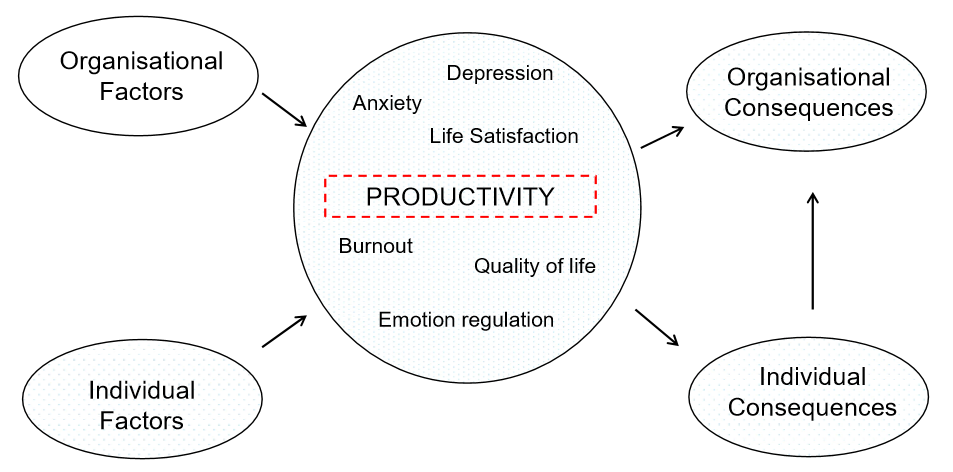
Individual factors which may affect productivity
Resilience and coping skills
Eg. anxiety, depression
Occupational factors which may affect productivity
Some jobs tend to be more stressful than others
Some factors may lead to consequences
Organisational consequences
Individual consequences
Organisational consequences
Productivity
Absenteeism
Reaching targets / goals
Individual consequences
Link between stress and burnout
Poor work-life balance
Increased alcohol consumption
Lack of sleep
Poor relationship problems
Substance abuse problems
Background
21% of adults experience a diagnosable mental health condition each year, with depression and anxiety being the most common in the working population
1 in 4 employees experience significant mental health problems each year
60-70% of disability costs in most organisations are related to mental health conditions
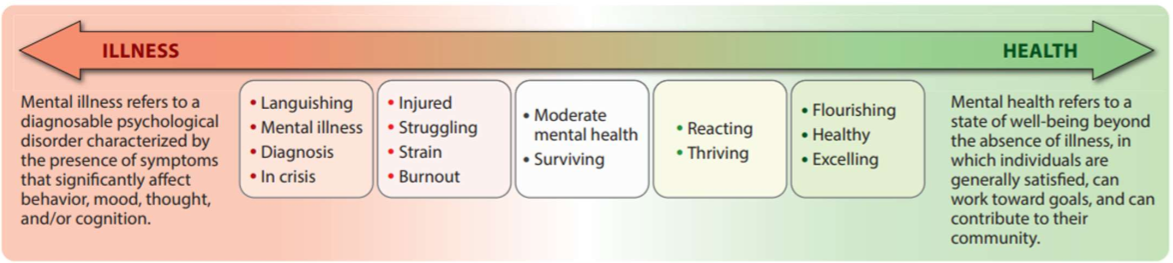
Understanding mental health
Shows the definition of mental health
Comprehensive definition but there are many definitions of mental health
Continuum from low (illness) to high (good wellbeing)
Described using models like Keyes’ mental health continuum
How mental health problems manifest in the workplace
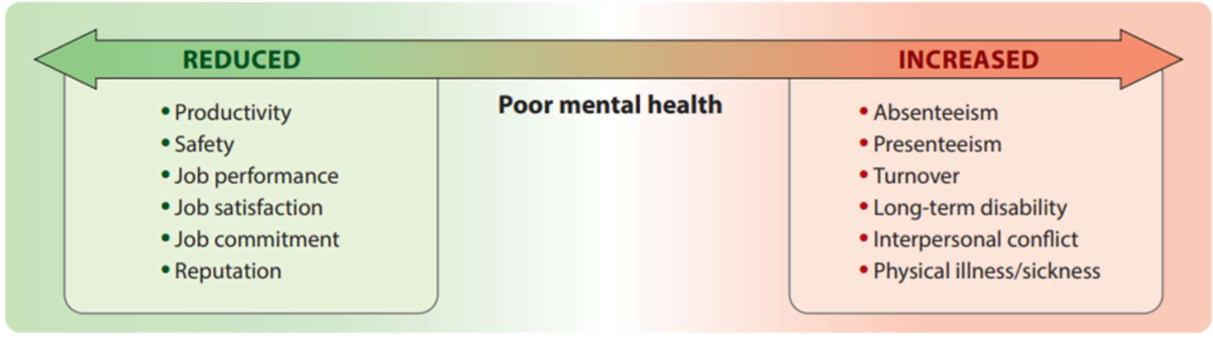
Work outcomes of poor mental health
Poor mental health is associated with negative work outcomes
Burnout
Characterised by
Emotional exhaustion
Cynicism
Detachment due to prolonged workplace stress
Associated with
Decreased job performance
Higher absenteeism and turnover
Leads to
Interpersonal conflicts with colleagues and supervisors
Classified as an occupational phenomenon by the WHO
Increasing phenomenon in the UK but also worldwide
It is a borderline condition as it is not included in the DSM-5 but is in the ICD-10 and defined by the world health organisation
Lots of overlap woth depression
Emotional exhaustion
Feeling depleted because of work
Examples
I feel emotionally drained from my work
I feel fatigued when I get up in the morning and have to face another day on the job
I feel used up at the end of the workday
I feel overwhelmed by my work responsibilities
I feel like I am at the end of my rope
Depersonalisation
Cynicism
No energy to spend with others, starts to detach from the world outside
Do not want to meet others outside of the workplace
Examples
I feel detached from my job
I feel indifferent about my work
I have become more cynical about the impact of my work
I feel less empthetic toward my colleagues or students
I have a negative attitude toward my job
Reduced personal accomplishment
Not a major component of burnout
Examples
I feel ineffective in my job
I feel like I am not making a meaningful contribution through my work
I doubt the signficance of my work
I feel like I am not reaching my full potential at work
I feel like my work doesn’t really matter
When stress becomes burnout
Physical fatigue → physical symptoms as well as emotional
Cognitive weariness → reduced cognitive abilities due to the stress
Linked to making mistakes at work
The cycle of burnout
Difficult to address due to this cycle
Occupational burnout
Context
Work realted stress
Symptoms
Emotional exhaustion
Cynicism
Reduced profesional efficacy
Impact
Primarily affects professional life
Reversibility
Often reversible with changes in work conditions
Treatment
Stress management
Workplace interventions
Improved work-life balance
Depression
Context
Clinical mental health condition
Symptoms
Persistent sadness
Loss interest
Signifcant weight change
Sleep issues
Fatigue
Feelings of worthlessness
Difficulty concentrating
Thoughts of suicide
Impact
Affects all areas of life
Reversibility
Requires medical or psychological intervention
Treatment
Therapy
Medication
Lifestyle changes
Strain / distress
Refers to a prolonged state of distress and tension due to ongoing stressors, such as job demands and poor work-life balance
Symptoms
Fatigue
Poor sleep quality
Decreased performance
Anxiety
Strain is often linked to high job demands with limited resources and contributes to mental health deterioration
Both burnout and strain fit within the injured or struggling states of mental health continuum
Distress = generalised condition where individuals are not doing well, a prolonged state of stress / strain
Can be an early warning of burnout
Occupationla stress models
Transactional stress model (Lazarus et al)
Stress is a result of an individual’s appraisal of stressors and their ability to cope
Job demands-resources theory (Karasek)
High job demands lead to strain while job resources help cope with stress
Most useful tool in terms of burnout
Stress and burnout often due to high job demand and low job resources
Conservation of resources theory (Hobfoll)
Stress occurs when valuable resources are threatened or lost
Allostatic load model (McEwen)
Chronic stress leads to dysregulation of bodily systems, increasing health risks
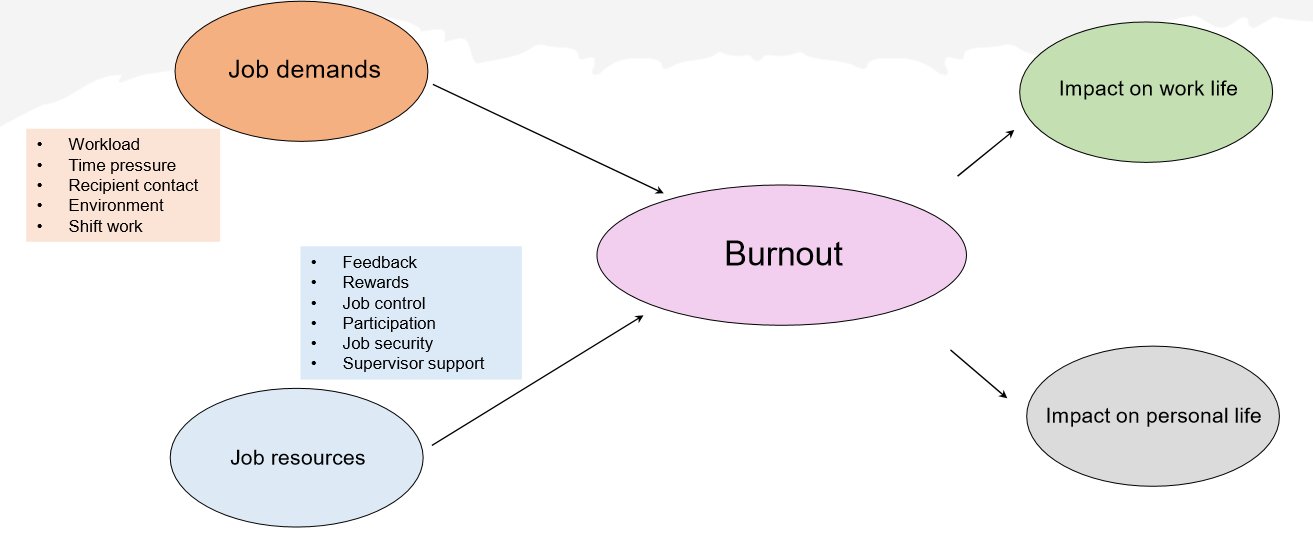
Job-demands resources (JD-R) model (Bakker & Demerouti)
Job demands
Physical, psychological, social or organisational aspects of ajob that require sustained effort and are associated with physiological and psychological cost
High workload
Time pressur
Emotionally demanding interactions
Job resources
Aspects of the job that help employees meet their job demands, reduce stress, and promote personal growth
Autonomy
Support from colleagues / supervisors
Feedback
Opportunities for development
Job resources can buffer the impact of job demands on stress, promote engagement, and improve well-being
Causes and consequences of stress
The workplace as a resource (also part of the JD-R model)
Having a job that people like is an important factor
The work itself
Good quality training of line managers to support employees
Support from organisation
Opportunity to actually self-manage teams and have job control
Factors
The work itself
Leadership
Meaning
Support
Autonomy and control
The psychologically healthy workplace
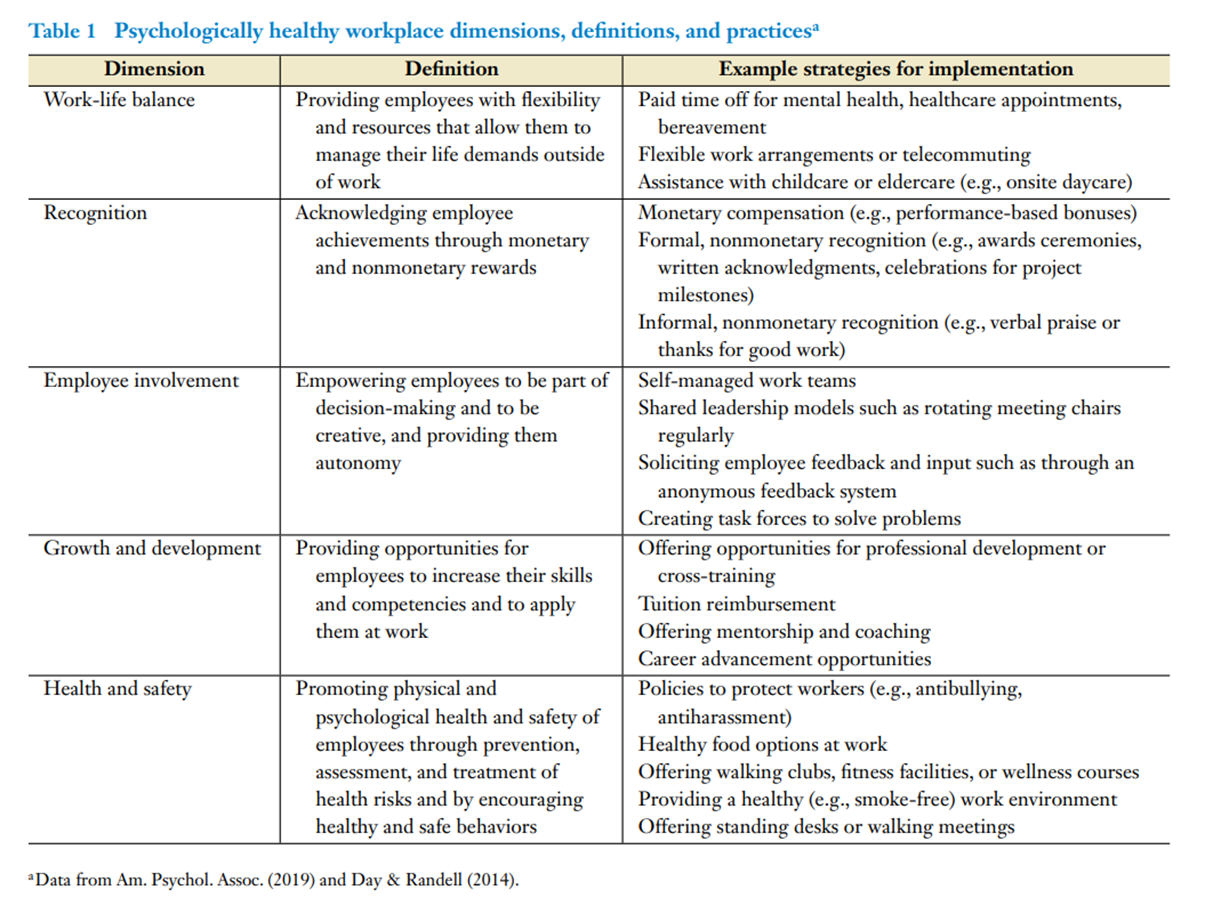
The signs of struggle
Emotional distress
Crying, complaining
Withdrawal
Reduced social interaction, effort
Attendance changes
Lateness, Absenteeism
Preformance reductions
Quality and quantity
Extreme behaviours
Hygeine issues, substance abuse, harmful expressions
Managers role
Recognising and adressing these signs, providing support and resources
Three pillars of workplace mental health
Three pillars of workplace mental health categorise interventions into 3 different pillars
Prevention
Intervention
Accomodation
Usually organisational level interventions
Target organisational issues
Can’t always be a quick change as it is complex
Typically very effective as you are changing the root of the problem
Intervention focuses on addressing or preventing mental health issues through proactive or reactive strategies, such as therapy or stress management workshops
In contrast, accomidation involves making workplace adjustments, such as flexible hours or reduced workloads, to support employees with mental health challenges to stay at work or help those who have left employment return to work
Prevention
Prevention involves improving the balance between job stressors and resources to protect employees’ mental health
This can be accomplished by engaging in proactive efforts that address environmental and job factors
Identifying what issues in the business may be present down the line and aiming to stop this
Adopted earlier on
Target employees who have mild levels of distress
Target is the environment and the job factors
Intervention
Mental health interventions typically aim to empower workers by increasing access to resources
Eg. Social support at work, psychological counselling, training and development opportunities
Mental health literacy training can reduce stigma and improve social support in the workplace
Helping line managers how to support employees
Mental health programmes
Accommodation
Accommodation takes the form of workplace programs and policies designed to provide support for employees who are experiencing significant compromises in mental health
Such programs typically include stay-at-work options and return-to-work plans
Type of intervention that is specifically aimed at a particular group of the workforce which tends to be those with current known conditions
The IGLO model (Nielson et al)
Suggests that when we work with an organisation we need to think about the different layers of a system
We cannot just change one thing, we need to think about the whole thing
Multilevel intervention
Organisational change (Nielson et al)
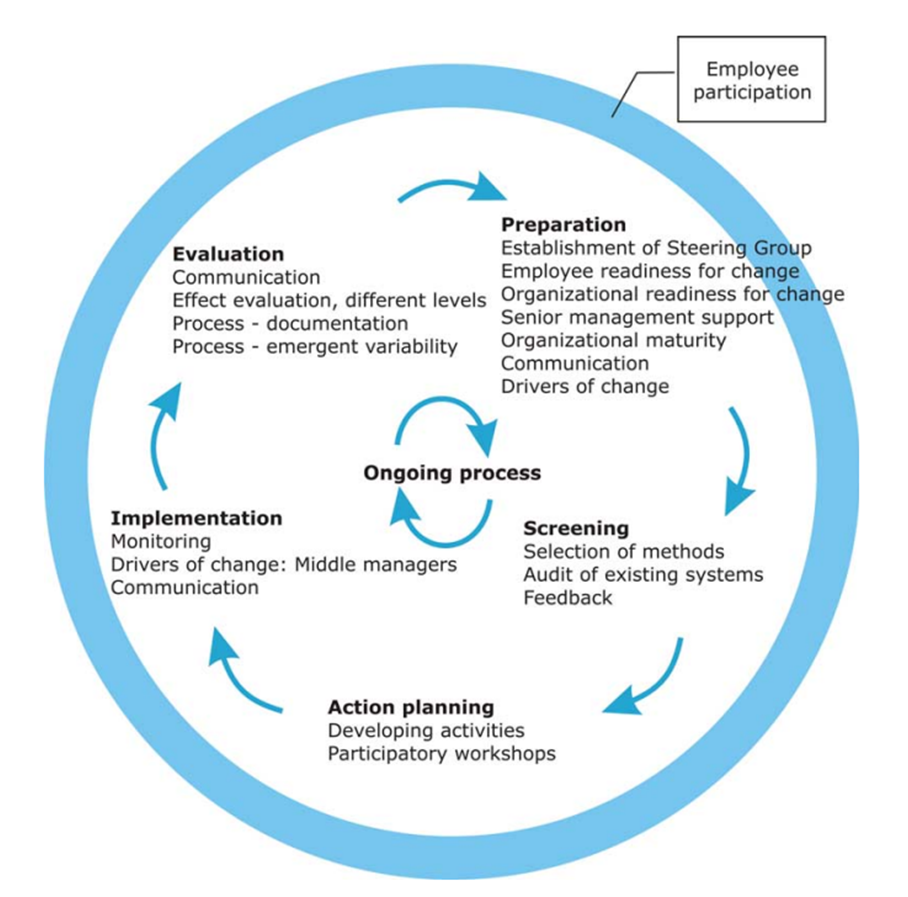
Prep → screening → action planning → implementation → evoiluation
Employee participation is key
Preparation
Objective
Identify the need for change and create awareness
Key elements
Leadership communicates the vision for change, and employees are informed about why chnage is necessary
building readiness and preparing both the organisational structure and employees are critical
Focus
Emphasise employee participation during this phase to reduce uncertainty and resitance
Screening
Objective
Identify and prioritise what needs to change before designing solutions
Key elements
Data triangulation - KPI like absence/turnover/incidents; baseline psychosocial survery; brief qualitative pulse
Team / unit profiling - heatmaps, thresholds
Sense-making workshops with staff & managers
Root-cause hypotheses
Short list 3 - 5 priorities
Focus
Converting broad concerns into a small, evidence-based set of priorities with initial SMART objectives
Action planning
Objective
Develop a detailed plan for implementing the change
Key elements
Establish goals, timelines and allocate resources
Involvement of employees in the planning process can enhance commitment
Focus
Nielson advocates for employee involvement in the design phase to ensure their concerns are addressed and to increase buy-in, promoting a sense of ownership over the change
Implementation
Objective
Implement the planned changes
Key elements
This stage involves putting the change into action
Clear communication and monitoring are essential, along with managing an resistance or issues that arise
Focus
Support employee well-being during implementation
She emphasises minimising stress and ensuring employees ahve the necessary resources, training, and support during this period of change
Evaluation (Monitoring of change)
Objective
Assess the impact of the change
Key elements
Collect feedback and analyse whether the change is meeting the goals set out during the planning phase
This phase ensures that any negative impacts on employee well-being are addressed
Focus
Nielson emphasises the importance of evaluating both the effectiveness of the change and its impact on employees’ mental heralth and jobs satisfaction
Her work highlights the need for continuous monitoring of employee well-being during organisational transitions
Additional - Sustaining and embedding the change
Objective
Ensure the change is fully integrated into the organisation
Key elements
Make adjustments based on feedback, ensure long-term sustainability and embed the change into the organisational culture
Focus
Nielson advocates for embedding a culture of openness and continued employee participation, ensuring that employees feel supported in the long term
Additional - Reflection and learning
Objective
Reflect on what went well and what didn’t, to learn for future change initiatives
Key elements
Organisations should document lessons learned and apply them to future change efforts
Focus
Learning from the change process, particularly from an employee well-being perspective, is important
Organisations should assess the psychological impect on employees and consider how future changes can be implemented more smoothly
Nielsons key themes
Employee participation
Nielson’s work emphasises that involving employees throughout the change process is essential for reducing resistance, enhancing enagagement, and fostering a sense of control
Mental health and well-being
She highlights that organisational changes can increase employee stress and negatively impect mental health if not managed properly making employee well-being a core consideration
Tailoring interventions
Nielson often suggests that change management interventions should be adapted to specific context of the organisation, with a flexibility approach to ensure the best outcomes for both the organisation and its employees
Experimental research studies
Experimental research involves testing the effects of specific interventions on workplace outcomes by manipulating variables and comparing results across control and experimental groups
Randomised Controlled Trials (RCT’s)
Assigning participants randomly to intervention or control groups
Pre-post test designs
Measuring outcomes before and after the intervention
Control groups
Essential to determine whether the intervention caused changes, compared to a group that does not recieve the intervention
Key outcomes
Employee well-being
Psychological wellbeing
Mental health
Burnout reduction
Productivity
Task performance
Efficiency
Output
Job satisfaction
Employee engagement
Motivation
Job commitment
Organisational outcomes
Turnover rates
Absenteeism
Overall team performance
Examples of interventions
Mindfulness-based stress reduction (MBSR)
Studies showing reduced stress and improved employee well-being in high pressure environments
Leadership training programmes
Studies testing the impect of leadership styles on employee engagement and performance
Flexible work arrangements
Studies on remote or hybride work impacting jobs satisfaction and productivity
Challenges in experimental workplace research
Ethical considerations
Ensure informed consent
Balancing organisational and employee needs
Practical constraints
Difficulties with random assignment
Controlling for external factors
Maintaining participant engagement over time
Generalisability
Ensuring findings from one workplace are applicable to others
Benefits of experimental research
Causal relationships
Establishing direct links between interventions and outcomes
Evidence-based practice
Providing strong, actionable insights for improving workplace policies
Implications of future directions
Adopt multidisciplinary approaches that integrate theories of mental health
Examine moderators of relationships between work variables and mental health / illness variables
Develop and evaluate primary intervention strategies that promote mental health
Identify boundary conditions of mental health intervention strategies
Conduct research using theory-driven and application-focused approaches to derive implication for both research and practice
Legal and ethical considerations
Antidiscrimination law (Equality Act 2010)
Requirements for reasonable accommodations
Ethical considerations
Balancing organisational needs with employee wellbeing, maintaining confidentiality
Implications for practice
Evidence based
Organisations should adopt interventions that have been proven effective
Such as CBT, mindfulness programs & resillience training
Organisational recommendations
Mental health climate
Supportive supervision
Meaningful work opportunities
 Note
Note  Flashcards (62)