Animal Behavior Exam 3
 Studied by 0 people
 Call Kai
 Learn
Learn Practice Test
 Spaced Repetition
 Match
Match Flashcards
 Knowt Play
1/138

There's no tags or description
Looks like no tags are added yet.
Name | Mastery | Learn | Test | Matching | Spaced | Call with Kai |
|---|
No analytics yet
Send a link to your students to track their progress
139 Terms
Orientation
Coordinated movement that occurs in response to external stimuli.
Adaptive value of orientation
Avoid predators, find food, and mate.
Categories of orientation
short distance, long distance, and dispersal.
Short-distance orientation
Distance is short enough that the animal can sense the stimulus; taxis and kinesis; one-way trip.
Long-distance orientation
Distance is too long to detect the stimulus; migration; two-way trip (there and back).
Dispersal
One-way trip from natal site (place where born).
Arctic tern
travels 244,000 miles from the Arctic to Antarctica.
Taxis
Movement directly toward (positive) or away (negative) from a stimulus.
Kinesis
increase in random movement, lasts until a favorable environment is reached
Taxis vs. kinesis classification
Not categorized by stimulus type, but by type of movement.
Stimuli
Light, chemicals (pheromones), magnetic field, humidity, sound, wetness.
Taxis and innate behavior
Type of stimulus is not important in terms of behavior; behaviors are innate.
Positive phototaxis (kinesis)
Movement toward a light stimulus.
Negative phototaxis (kinesis)
Movement away from a light stimulus.
Cockroach response to light
negative phototaxis (kinesis) they do no like light
Types of taxis
Klinotaxis and tropotaxis
Klinotaxis
Side-to-side motion of head or body with successive comparison of stimulus intensity
Organisms using klinotaxis
Small organisms
Sensory receptors in klinotaxis
One sensory receptor or two sensory receptors that are very close to each other.
Euglena klinotaxis example
Moves toward dim light or away from bright light. One stimulus detected by eyespot; sways side to side in a zigzag pattern.
Human scent example
Humans like the scent of food and sniff to locate it.
Male moth orientation example
Male follows female using chemical stimuli with the same swaying movement.
Tropotaxis
Stimulus is sensed by paired (two) sensory receptors that are far enough apart to allow movement in a straight line toward or away from the stimulus.
Tropotaxis example human
Humans hearing a bell and moving directly toward the sound.
Tropotaxis example snake
snakes have a forked tongue with distance between sensory receptors.
Types of taxis by stimulus
Phototaxis, chemotaxis, etc.
Kinesis
Random walk.
Types of kinesis
Change in speed of movement and change in rate of turning; both are directly proportional to stimulus intensity.
Klinokinesis
Turning movements that change the rate of turning.
Klinokinesis in preferred conditions
Animals prefer the condition and increase turning rate.
Cockroach kinesis example
No direct movement; random movement or walks. Turning rate increases with darkness, not with light.
Dracula lacteum (planaria)
Spins and prefers darkness.
Lice habitat preference
Prefer darkness and cool areas; do not prefer heat and light.
Soil nematodes feeding behavior
Circle around food
Orthokinesis
Speed of movement is related to intensity of stimulus.
Wood louse / pill bug habitat example
Found under rocks, logs, and leaves. Prefer moist, warm areas. Low humidity is dry; high humidity is moist. Movement in preferred conditions: Little distance covered per unit time; slow movement with many turns.
Cricket phonotaxis
Males hear female calls and follow them.
Karl von Frisch
Studied bees.
Bee communication (signal)
Occurs when a sender produces a signal that contains information.Signal is transmitted through the environment, detected by the receiver, interpreted, and responded to.
Honey bee menotaxis
Directional movement using contrast angles relative to a source.
Honey bee foraging timing
Sugar bowls checked by foragers in the morning at sunrise.
Hive orientation
Occurs inside the hive.
Foragers dance to communicate the location and type of food. Opening of the hive faced the sun in the east.
Round dance
Big circular back-and-forth movement. Food source is less than 50 meters away. Repeated several times; forager gives samples to other bees for taste; gives distance but no location.No specific location given; only east.
Waggle dance
Dance with NESW direction and an angle.Food source is greater than 150 meters away. Communicates angle and distance; used when food is too far away; every second equals 1 km.
Honey bee dance communication experiments (Karl von Frisch)
Bees communicate food location inside the hive using dances. In experiments, hives were placed with food straight east of the opening; 19 bees found the food and 17 returned and performed the round dance. Food was later placed 10 meters up on a pole; bees did not change the angle, and a 2005 experiment proved von Frisch was correct. Unmarked foragers moved southwest still went 200 miles east. Bees communicate socially.
2025 bee prob solving experiment
Tested whether bees can solve problems. Bees were trained to taste sugar water. A tail was attached so bees had to pull it.
Long-distance movement (migration)
Movement with costs and benefits that occurs between hemispheres and regions with seasonal differences in food and predators.
Pre-migration costs
Energy use, pre-migration foraging with predators present, and high winds.
Pre-migration benefits
Access to food, differences in predators, and seasonal advantages between Northern and Southern Hemispheres.
Migration costs
Different predators, strong wind currents (especially over water), traveling alone or in flocks (11–14 help in updraft beat), crashing into buildings, buildup, planes, cars, getting lost, and wind.
Proximate cues for migration
Photoperiod (sunlight); temperature is not reliable.
Migration near the equator
Photoperiod is not accurate, so animals rely on quality and quantity of food resources.
Serengeti migration example
Wildebeest migration based on quantity and quality of food; biomass of grass for nutrition; no winter/summer but dry and wet seasons.
Serengeti dry season
January to October; decreased rainfall and sunny days; grass grows slower and has decreased nutritional value.
Migration timing in birds
Birds migrate at night; zugunruhe begins around April.
Zugunruhe
Restlessness indicating readiness to migrate, shown as two bounds of activity.
Emlen funnel
Experimental tool used to study migratory orientation.
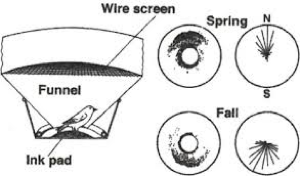
Indigo bunting migration (Emlen experiments)
Birds showed pre-migration ink marks in funnels oriented southwest toward Central America using stars; lab birds showed the same behavior; in March they migrated to the U.S.; spring migration from South America back northeast.
Star navigation
Birds migrate using stars; Polaris (North Star) is close to the north celestial pole and moves very little.
Planetarium star manipulation experiment
Betelgeuse (southwest of Polaris) was made stable while Polaris was moved; birds oriented toward Betelgeuse.
Examples of bird migration routes
European starling migrates in flocks; Arctic tern migrates over ocean; ruby-throated hummingbird migrates to Guatemala.
True navigation
Knowing how to find home no matter location or compass direction; accurately determining and moving in the correct direction.
Indigo bunting and navigation
Birds know to go southwest and then northeast; birds orient but do not show true navigation.
European starling displacement experiment
Conducted in the 1940–50s by Arthur Reredeck; 14,000 birds captured (fledglings and adults) from the Netherlands and displaced to Switzerland. Fledglings went to Spain or North Africa; adults went to France and some fledglings followed; experiment was messy and showed most birds are not true navigators.
Pigeons and navigation
Pigeons have true navigation and know where they are; some use sun, stars, and magnetic cues (water).
Dispersal
One-way trip from the natal site (place where born).
Sex-biased dispersal
In some species, males or females disperse more than the other sex.
Ecologist perspective on dispersal
Focuses on the number of animals that disperse and the movement into and out of a population that affects population growth and gene flow.
Behaviorist / ethologist perspective on dispersal
Focuses on what causes an animal to disperse and why they leave.
Behavioral questions about dispersal
Asks whether dispersal is linked to age, sex, or behavioral history, and whether behavioral syndromes make some individuals more likely to disperse than others.
Who disperses
Adolescents or young individuals.
Natal dispersal
Dispersal that occurs when individuals leave their birthplace.
Reason for natal dispersal
Young individuals lack experience and strength, cannot take over favored locations from parents, or are driven out of parental territory.
Sex differences in dispersal
Males leave in most mammals; females leave in most birds.
Mammal male-biased dispersal
Common in polygamous systems with one dominant male controlling territory and multiple females.
Polygamous mammal social structure
One dominant male controls land with many females and defends it against other males and sons.
Reasons young males disperse in mammals
Must find territory, avoid inbreeding, and avoid family competition.
Visibility and dispersal in mammals
Males are large, active during the day, and easily seen.
Wild horse dispersal
Young males (1–5 years old) form groups and are kicked out.
Bachelor herds
Groups of displaced males that are not strong enough to control territories or females.
Mature male horses
Males aged 27 years or older that can control territories and females.
Female dispersal in mammals
Females generally do not leave.
Why female mammals do not disperse
Females are suitable for mating, and males with territory will accept them into their harem.
Female-biased dispersal in birds
Females disperse more than males. Birds are on average monogamous or serially monogamous; females need to find males, so they leave.
Male role in bird dispersal
Males defend resources and females and therefore do not leave.
Benefits of dispersal
Access to mates, avoidance of inbreeding, reduced resource competition, better sites, increased reproductive success.
Costs of dispersal
Increased predation risk, poorer habitat, and good sites already being taken.
Gunnison prairie dogs dispersal
Females continue dispersing because females become pregnant and must leave.
Red-backed salamander dispersal
Males disperse more than females.
Egyptian vulture dispersal
Females disperse.
Competition dispersal
Dispersal caused by competition related to density and food availability.
Competition dispersal experiment variables
Manipulated diversity of individuals and amount of food.
Density-based dispersal result
When food amount is the same but density differs, individuals leave high-density sites.
Springtail (Hexapoda)
Small wingless organism (~6 mm), six legs, lives in moist environments, jumps using a furcula, always lands on its feet.
Springtail density experiment
Group A had 30 individuals; Group B had 900 individuals; dispersal occurred from high-density groups.
Food-based dispersal result
When density is the same but food differs, individuals leave low-food sites.
Bird dispersal timing
Birds disperse after birth when competition with kin is high.
Nothern Goshawk
Hatch in April; independent by August (~80 days). Lives in forests; breeding pairs defend territories ~2 km; produce 1–2 offspring per year.
Goshawk experiment
28 broods total; radio transmitters placed on chicks at day 21; EX group received dead Japanese quail every other day; control received no extra food. Control offspring dispersed earlier and farther (~25 km); EX offspring stayed closer due to higher perceived food density.
Inbreeding avoidance
Dispersal reduces mating with close relatives.
 Note
Note  Flashcards (39)