A3.1 Diversity of Organisms

0.0(0)
studied byStudied by 6 people
call kaiCall Kai
learnLearn
examPractice Test
spaced repetitionSpaced Repetition
heart puzzleMatch
flashcardsFlashcards
GameKnowt Play
Card Sorting

1/95

Last updated 2:40 PM on 4/12/24
Name
Mastery
Learn
Test
Matching
Spaced
Call with Kai

No analytics yet

Send a link to your students to track their progress

96 Terms

1
New cards

What is an organism?

An individual plant, animal, bacterium or any living thing

2
New cards

What is variation and what are the three types of variation?

The difference between organisms e.g.

  1. Visual appearances - fur colour and body length

  2. Behaviour - mating rituals or levels of aggression

  3. Biochemistry - antibiotic resistance or metabolic products

3
New cards

What are patterns of variation used for?

They are the basis of naming and classifying organisms

4
New cards

Are any two individuals identical?

No - there are even variations between members of the same species

5
New cards

Is there more variation between members or the same of different species?

Different species

6
New cards

What is variation the result of?

Both genetic and environmental factors

7
New cards

What do genes do?

They determine which proteins an organism can produce

8
New cards

How is genetic variation generated?

When mutations occur or different combinations of alleles during sexual reproduction

9
New cards

What does the term ‘species’ mean?

It is the term used for a group of organisms with shared traits and is how species have been named and classified

10
New cards

When was is developed?

17th century by biologists

11
New cards

What is the Morphological concept?

That a species is a group of organisms with a characteristic outward form and inner structure (size, shape, and body structure) - expectation that there is clear differences in the structure of all species

12
New cards

Who invented it?

Carl Linnaeus

13
New cards

Give an example of the Morphological concept

Mice of similar traits, from different countries, that have similar traits and are considered to be part of the same species, despite being unable to breed with each other.

14
New cards

Why system is used to give a species a scientific name?

Binomial system

15
New cards

What are the two parts of a scientific name using the binomial system?

The Genus (the first part of the name) and the species (the second part)

16
New cards

What has a capital letter?

Genus

17
New cards

e.g. what is the scientific name for humans?

Homo sapiens

18
New cards

What is the second way of classifying species?

Biological species concept

19
New cards

What is the biological species concept?

A species is a group of organisms that can successfully interbreed and produce fertile offspring

20
New cards

What does interbreeding allow?

Members of a species to share genes in a gene pool so they share many traits

21
New cards

What are the 3 limitations of the Biologicals species concept?

  1. Asexual reproduction

  2. Fertile hybrids

  3. Extinction

22
New cards

Why is asexual reproduction a limitation?

Asexually reproducing organisms don’t interbreed, meaning their offspring is considered a new species according to the biological concept (more detail later)

23
New cards

Fertile hybrid limitations?

On rare occasions, animals of difference species can breed and produce fertile offspring. According to the concept, the offspring should be a new species, but according to scientists, for it to be a new species it needs to be a regular occurrence.

24
New cards

Extinction limitation?

If the animal is extinct, it is not possible to breed them so how do we know what species they belong to e.g. Woolly mammoths and elephants

25
New cards

What is speciation

Splitting of one population into two

26
New cards

How can this happen?

Natural selection or genetic drift

If a population lives in 2 different places and their traits diverge over time to adapt to their environment

27
New cards

Is this process immediate or gradual?

Gradual - over thousands of years

28
New cards

Is it east or hard for taxonomists to classify organisms into species?

Sometimes very hard as the accumulation of differences between the populations happens over a variety of times (negligible to rapid)

29
New cards

What is the decision regarded as?

Arbitrary

30
New cards

What is a characteristic feature of members of a species?

Number of chromosomes

31
New cards

What chromosome number is given to a species?

diploid number

32
New cards

Is it odd or even?

even

33
New cards

How many chromosomes do humans have?

46

34
New cards

How many chromosomes do chimpanzees have?

48

35
New cards

What is a karyotype?

The number and type of chromosomes in a cell or organism

36
New cards

What is a karyogram?

Photos and diagrams where chromosomes of an organism are shows in homologous pairs of decreasing length
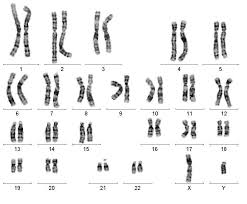
<p>Photos and diagrams where chromosomes of an organism are shows in homologous pairs of decreasing length</p>
37
New cards

What stage must a cell be in to prepare a karyogram?

Metaphase of mitosis where they are examined microscopically

38
New cards

Can the cells be overlapping?

No

39
New cards

They are digitally classified into homologous pairs using what 3 things?

  1. Stains

  2. Chromosome sizes

  3. Centromere

40
New cards

How are stains used?

They give chromosomes distinct patters with different bonding patterns, with different bonding in each type of homologous chromosome.
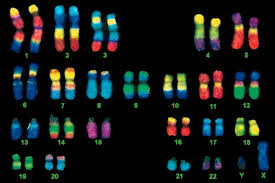
<p>They give chromosomes distinct patters with different bonding patterns, with different bonding in each type of homologous chromosome. </p>
41
New cards

How are chromosome sizes used?

The sizes vary between chromosomes but each chromosome pair is approximately the same length

42
New cards

How s the centromere used?

Each chromosome has a centromere where there is a constriction of the chromatids. Its position is the same in a chromosome pair and can be anywhere from the middle to the ends
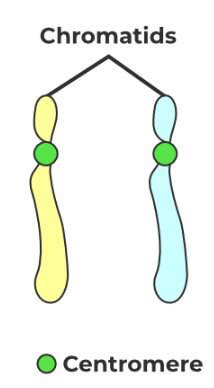
<p>Each chromosome has a centromere where there is a constriction of the chromatids. Its position is the same in a chromosome pair and can be anywhere from the middle to the ends</p>
43
New cards

What is the hypothesis involving our chromosome 2?

Humans = 46, Chimpanzees = 48

That million of years ago, our ancestors had 48 chromosomes but during human evolution, 2 fused together.

44
New cards

What evidence is there to support this?

Chromosome bonding patterns. The patters of human chromosome 2 is very similar to that of chromosome 12 & 13 in chimps
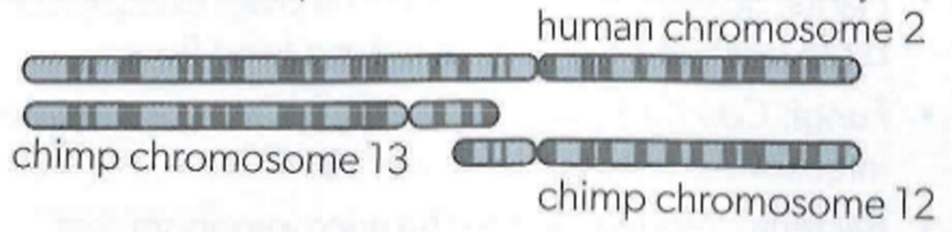
<p>Chromosome bonding patterns. The patters of human chromosome 2 is very similar to that of chromosome 12 &amp; 13 in chimps</p>
45
New cards

Is this strong evidence?

Yes - The bonding patterns and remnants of extra telomeres as well as the extra chromosome are strong evidence.

46
New cards

How can a hypothesis be scientifical?

If it is testable either experimentally or observably so the hypothesis can be proven false

47
New cards

Is the chromosome hypothesis scientifical?

Yes because evidence would be obtained to prove it false

48
New cards

What is a genome?

All the genetic information of one individual or a group of organisms. Its is the entire base sequence of the DNA molecule.

49
New cards

What functional units does a genome have?

Genes

50
New cards

What is a gene?

A length of DNA carrying hundreds/ thousands if bases.

51
New cards

Do members of the same species have the same genes?

Yes - they often have the same genes, in the same sequence, in each of their chromosomes

52
New cards

What does this do?

Promotes genetic diversity through meiosis

53
New cards

What does the genome of a species and the arrangement of genes on the chromosome illustrate?

the unity of living organisms

54
New cards

What are alternative forms of genes?

alleles - alleles of a gene differ from each other in the base sequence

55
New cards

What does SNPs stand for?

Single Nucleotide Polymorphins

56
New cards

What is a SNP

Positions in a gene where alternative bases may be found - 100 million have been discovered in humans

57
New cards

What does G - G mean between paternal and maternal alleles?

The child is homozyguos because the alleles inherited are the same

58
New cards

What does A- C mean between paternal and maternal alleles?

The child is heterozygous because the alleles inherited are different

59
New cards

What are the two types of variation in genomes?

  1. Variation in genome size

  2. Variation in base sequence

60
New cards

What is genome size?

The total amount of DNA in a species

61
New cards

There is a huge variation of genome sizes in….

Eukaryotes

62
New cards

Can gene numbers be changed in eukaryotic cells?

Yes - they can be added, removed, with sections of chromosomes duplicated or deleted.

63
New cards

Define a polyploidy?

The addition of whole sets of chromosomes

64
New cards

Genomes vary in the amount of ……….

non-coding DNA

65
New cards

What will differ in two populations of a species?

The position of their base sequence

66
New cards

What happens if the two populations diverge?

More differences will accumulate

67
New cards

After hundreds of millions of years, what will have happened?

Immense diversity will have developed in the base sequence.

68
New cards

How come in some gene base sequences there are few differences?

Because they are genes with a vital function e.g. cytochrome c-a protein used in respiration

69
New cards

What is genome size variations linked with

Organism complexity (not not always proportional with some unexpectedly large genomes)

70
New cards

How are genome sizes given in eukaryotes?

As nuclear DNA contents haploid cells like gametes

71
New cards

How are genome sizes given in prokaryotes?

As DNA content of a typical cell

72
New cards

What are the 2 types of measurement

  1. In mass (pictograms e.g. 1pg = 10^-12 grams)

  2. N° of base pairs/ megabase pairs (1 Mbp = 10^6 base pairs)

73
New cards

Define whole genome sequencing

Determining the entire base sequence of an organisms DNA.

74
New cards

The speed of sequencing is _________ and the cost is __________.

increasing rapidly, decreasing

75
New cards

What would happen if we sequenced the genomes of all species?

Would reveal relationships and evolutionary origins

76
New cards

What are the current uses of whole genome sequencing?

  1. Allows an understanding of human origins and worldwide migration

  2. Provides data about genetic diseases and genes affecting health

77
New cards

What are its future uses?

  1. The possibility of sequencing every humans genome

  2. Creating personalized medicine to predict and treat health problems

78
New cards

What happens if members if the same species interbreed by sexual reproduction?

Their traits are remixed generationally

79
New cards

Does the biological species concept work if a species interbreed BOTH sexually and asexually

Yes, so long as divergences between individuals is prevented

80
New cards

What do species reproducing asexually produce

Clones

81
New cards

What do mutations cause in clones

Causes them to split creating even more different species e.g. black berries

82
New cards

Define vertical gene transfer

Parents passing their genes to their offspring.

83
New cards

What is the evolution of life thought to be like?

A tree growing. When a new species forms, a new branch of the tree grows. The branch cant then rejoin (because different species in interbreed)

84
New cards

What organism does this not work for?

Bacteria

85
New cards

What transfer does bacteria have

Horizontal transfer

86
New cards

Define horizontal transfer

Genes sometimes transfer from one species to another, even if they are distantly related.

87
New cards

How does horizontal transfer work in bacteria?

How antibiotic resistant genes can move from one species to another.

88
New cards

What questions does this raise?

If the biological species concept works with prokaryotes.

89
New cards

What happens if 2 organisms with different chromosome numbers mate?

Their offspring would likely be unable to carry out meiosis (cant reproduce)

90
New cards

In terms of chromosomes, why would they not be able to reproduce?

Because some chromosomes would not be homologous to any other chromosome, so they would not be able to pair during metaphase 1. Then segregation of chromosomes into 2 haploid groups during anaphase 1 would fail

= No gametes produced

91
New cards

What is used to identify species that are not immediately recognised?

A dichotomous key :)

92
New cards

Explain how they work

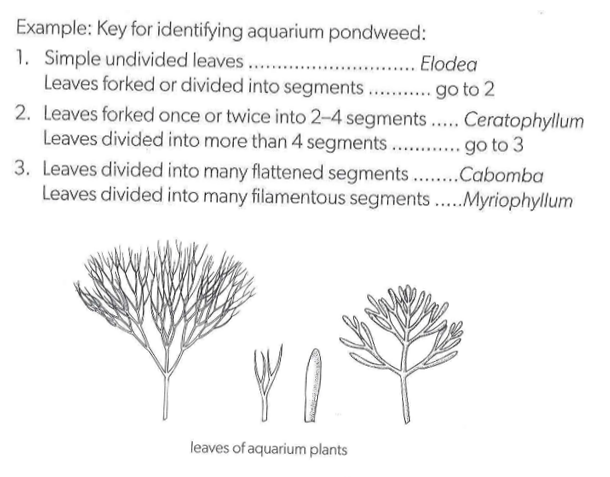
  1. They consist of a series of numbered stages

  2. Each stage consists of a pair of alternative characteristics

  3. Some will state where to go next, the others will name the species

93
New cards

Example of dichotomous key:

knowt flashcard image
94
New cards

Define DNA barcode

A short section of DNA from a gene to identify a species

95
New cards

Define Environmental DNA

DNA obtained from soil, water, parts of abiotic environments. There are lots of organisms that interacted with the sample of environment.

96
New cards

What does DNA barcoding allow us to do with the environmental DNA?

It allows us to identify the biodiversity of habitats and investigate them. We can find what species have been where.

Explore top notes

Imperialism Rise in Nationalism • During the French and Industrial Revolution, nationalism continued to inspire nations to increase their political and economic power. • Nationalism became the ideal force in the political, economic, and cultural life in the world, becoming the first universal ideology-organizing all people into a nation state. Nationalism Defined • The strong belief that the interest of a particular nation-state is of primary importance. o Nation-State – a state where the vast majority shares the same culture and is conscious of it. It is an ideal in which cultural boundaries match up with political ones. • As an ideology, it is based on the idea that the individual’s loyalty and devotion to the nation-state surpass other individual/group interests. • Exalting one nation’s belief above all others and placing primary emphasis on promotion of its culture and interests, excluding the interests of others. Changing the World through a Nationalistic Vision • The French Revolution significantly changed the political world and how countries govern. • The Industrial Revolution significantly changed the economic world. • The Age of Imperialism (1870-1914) dramatically changed the political, economic, and social world. What is Imperialism? • Imperialism- The policy of extending the rule of authority of an empire or nation over foreign countries, or of acquiring and holding colonies and dependencies. Power and influence are done through diplomacy or military force. Reasons for Imperialism • There are 5 main motives for empires to seek to expand their rule over other countries or territories: 1. Exploratory • Imperial nations wanted to explore territory unknown to them. • The main purpose for this exploration of new lands was for resource acquisition, medical or scientific research. o Charles Darwin • Other reasons: o Cartography (map making) o Adventure 2. Ethnocentric • Europeans acted on the concept of ethnocentrism o Ethnocentrism- the belief that one race or nation is superior to others. • Ethnocentrism developed out of Charles Darwin’s “survival of the fittest” theory. Philosophers used the theory to explain why there were superior races and inferior races. o This became known as Social Darwinism. • Most imperial nations believed that their cultural values or beliefs were superior to other nations or groups. • Believed imperial conquest would bring successful culture to inferior people. 3. Religious • Imperial expansion promoted a religious movement of people setting out to convert new members of conquered territories. • With the belief that Christianity was superior, missionaries believed it was their duty to spread Christianity to the world. • Christian missionaries established churches, and in doing so, they spread Western culture values as well. • Typically, missionaries spread the imperial nation's language through education and religious interactions. 4. Political • Patriotism and Nationalism helped spur our imperial growth, thus creating competition against other supremacies. • It was a matter of national pride, respect, and security. • Furthermore, European rivalry spurred nations for imperial conquest. Since land equaled power, the more land a country could acquire the more prestige they could wield across the globe. • Empires wanted strategic territory to ensure access for their navies and armies around the world. • The empire believed they must expand, thus they needed to be defended. 5. Economic • With the Industrial Revolution taking place during the same time, governments and private companies contributed to find ways to maximize profits. • Imperialized countries provided European factories and markets with natural resources (old and new) to manufacture products. • Trading posts were strategically placed around imperialized countries to maximize and increase profits. o Such places as the Suez Canal in Egypt which was controlled by the British provided strategic choke hold over many European powers. o Imperial powers competed over the best potential locations for resources, markets, and trade. History of Imperialism • Ancient Imperialism 600 BCE-500 CE o Roman Empire, Ancient China, Greek Empire, Persian Empire, Babylonian Empire. • Middle Age Imperialism (Age of Colonialism-1400-1800s) o Great Britain, Spain, Portugal, France, Netherlands (Dutch), Russia. • Age of Imperialism 1870-1914 o Great Britain, Spain, Portugal, France, Germany, Belgium, Italy, Japan, United States, Ottoman Empire, Russia. • Current Imperialism...? o U.S. Military intervention (i.e. Middle East) o Russia’s Invasion of Ukraine. Imperialism Colonialism • Refers to political or economic control, either legally or illegally. • Refers to where one nation assumes control over the other. • Creating an empire, expanding into neighboring regions and expanding the dominance far outside its borders. • Where a country conquers and rules over other regions for exploiting resources from the conquered country for the conqueror's benefit. • Foreign government controls/governs a territory without significant settlement. • Foreign government controls/governs the territory from within the land being colonized. • Little to no new settlement established on fresh territory. • Movement to settle to fresh territory. Age of Colonialism WHEN? • Started around the late 1400s and ended around the late 1700s/early 1800s. WHY? • Primary Reason: European countries, wished to find a direct trade route to Asia (China & India) and the East Indies. o Quicker and relatively more effective than land routes over Asia. • Secondary Reason: Empire expansion (land power) WHO? • Countries involved: Great Britain, France, Spain, the Dutch & Portugal. • Individuals’ knowns as Mercantilists believed that maintaining imperialized territory and colonizing the region could serve as a source of wealth, while personal motives by rulers, explorers, and missionaries could therefore promote their own agenda. o This agenda being “Glory, God and Gold”. Mercantilism • Mercantilism was a popular and main economic system for many European nations during the 16th to 18th centuries. • The main goal was to increase a nation’s wealth by promoting government rule of a nation’s economy for the purpose of enhancing state power at the expense of rival national power. • It was the economic counterpart of political absolutism. Why did mercantilists want colonies? • Mercantilists believed that a country must have an excess of exports over imports. • By colonizing territory, it provided the nation with indispensable wealth of precious raw materials. • Therefore, the claimed territory served as a market and supplier of raw materials for the mother country. Which, in time, provided an excess of exports for the nation and thus created wealth. o Development of Trading Companies to support this economic system. Hudson Bay Company – (1670). Controlled primarily North America. o Dutch East Indie Trading Company (1682) o East Indian Trading Company (1600) o Royal African Trade Company (1672) WHERE? • European nations begun to colonize the America, India and the East Indies to create a direct trade route. • Great Britain was the leading power in India, Australia and North America, South Africa. • Spain colonized central and South America. • French held Louisiana, coastal land of Africa and French Guinea. • The Dutch built an empire in the East Indies. • The Portuguese was able to take control of present-day Brazil and the southern tip of South America and Japan. Age of Colonialism • As countries started to imperialize these regions, eventually the concept of colonization took hold: • This is what makes the Age of Colonialism extremely different! End of Colonialism • By 1800, colonialism became less popular • Why? o Revolutions (Spain, France & American) o The Napoleonic Wars o Struggle for nationalism and democracy. o Exhausted all money and energy to supervise their colonies. Waiting to wake again • Imperialism would stay quiet for close to 50 years before Great Britain and France’s economies revitalized. • The outbreak of the Industrial Revolution only encouraged and revitalized European nations to begin their conquest for new territory and resources. Age of Imperialism THE SCRAMBLE FOR AFRICA 1870-1914 Conditions Prior to Imperialism of Africa  European interest in exploiting Africa was minimal.  Their economic interests & profit in Africa primarily came through coastal trade that took place during the 1500-1700s.  The slave trade became the main source of European profit.  Furthermore, disease, political instability, lack of transportation and unpredictable climate all discouraged Europeans from seeking territory. Slave Trade & the Trans-Atlantic Slave Voyages  Forced labor was not uncommon during the 13-17th Centuries. Africans and Europeans had been trading goods and people across the Mediteranea for centuries.  This all changed from 1526 to 1867, as a new system of slavery was introduced that became highly “commercialized, racialized and inherited”  By 1690, the America and West Indies saw approximately 30,000 African people shipped from Africa. A century later, that number grew to 85,000 people per year.  By 1867, approximately 12.5 million people (about twice the population of Arizona) left Africa in a slave ship. What Changed? 1. End of the Slave Trade- Left a need for trade between Europe and Africa. 2. Innovation in technology- The steam engine and iron hulled boats allowed Europe 3. Discovery of new raw materials- Explorers located vast raw materials and resources and this only spurred imperialism with Europe in the wake of the Industrial Revolution. 4. Politics- Unification of Germany and Italy left little room to expand in Europe. Germany and Italy both needed raw materials to “catch up” with Britain and France so they looked to Africa. The Scramble for Africa  The scramble started in 1870.  Although some coastal land had previously been acquired before 1870, the need for territory quickly accelerated as European countries looked t get deeper into Africa.  Within 20 years, nearly all continents were placed under imperialistic rule. Who was Involved?  Great Britain  France  Germany  Italy  Portugal  Belgium  Spain (kind) Violent Affairs  Violence broke out multiple times when European nations looked to claim the same territory.  Germ Chancellor. Otto van Bismarck. Attempted to avert the possibility of violence against the European powers.  In 1884, Bismarck organized a conference in Berlin for the European nations. The Berlin Conference (1884-85)  The conference looked to set ground rules for future annexation of African territory by European Nations.  Annexation is the forcible acquisition and assertion of legal title over one state’s territory by another state, usually following military occupation of the territory.  From a distant perspective, it looked like it would reduce tensions among European nations and avert war.  At the heart of the meeting, these European countries negotiated their claims to African territory, made it official and then mapped their regions.  Furthermore, the leaders agreed to allow free trade among imperialized territory and some homework for negotiating future European claims in Africa was established. Further Path  After the conference, european powers continued to expand their claims in Africa so that by 1900. 90% of the African territory had been claimed. A Turn towards Colonization?  Upon the imperialization of African territory, European nations and little interest in African land unless it produced economic wealth.  Therefore, European governments put little effort and expertise into these imperialized regions.  In most cases, this emat a form of indirect rule. Thus, governing the natin without sufficient settlement and government from within the mother country. Some Exceptions  There were some exemptions through in Africa as colonization was a necessary for some regions i n Africa.  Some regions where diamonds and gold were present. Government looked to protectorate the regions and establish rule and settlement in the regions.  Protectorates: A state controlled and protected by another state for defense against aggression and other law violations. Would  Some examples include South Africa, Botswana, Zimbabwe and Congo. Conclusion  Although it may appear that the Berlin Conference averted war amid the African Scramble, imperialism eventually brought the world into worldwide conflict.  With the continued desire to create an empire by European nations. World War 1 would break out which can be linked to this quest at imperialism.
Updated 490d ago
note Note
Imperialism Rise in Nationalism • During the French and Industrial Revolution, nationalism continued to inspire nations to increase their political and economic power. • Nationalism became the ideal force in the political, economic, and cultural life in the world, becoming the first universal ideology-organizing all people into a nation state. Nationalism Defined • The strong belief that the interest of a particular nation-state is of primary importance. o Nation-State – a state where the vast majority shares the same culture and is conscious of it. It is an ideal in which cultural boundaries match up with political ones. • As an ideology, it is based on the idea that the individual’s loyalty and devotion to the nation-state surpass other individual/group interests. • Exalting one nation’s belief above all others and placing primary emphasis on promotion of its culture and interests, excluding the interests of others. Changing the World through a Nationalistic Vision • The French Revolution significantly changed the political world and how countries govern. • The Industrial Revolution significantly changed the economic world. • The Age of Imperialism (1870-1914) dramatically changed the political, economic, and social world. What is Imperialism? • Imperialism- The policy of extending the rule of authority of an empire or nation over foreign countries, or of acquiring and holding colonies and dependencies. Power and influence are done through diplomacy or military force. Reasons for Imperialism • There are 5 main motives for empires to seek to expand their rule over other countries or territories: 1. Exploratory • Imperial nations wanted to explore territory unknown to them. • The main purpose for this exploration of new lands was for resource acquisition, medical or scientific research. o Charles Darwin • Other reasons: o Cartography (map making) o Adventure 2. Ethnocentric • Europeans acted on the concept of ethnocentrism o Ethnocentrism- the belief that one race or nation is superior to others. • Ethnocentrism developed out of Charles Darwin’s “survival of the fittest” theory. Philosophers used the theory to explain why there were superior races and inferior races. o This became known as Social Darwinism. • Most imperial nations believed that their cultural values or beliefs were superior to other nations or groups. • Believed imperial conquest would bring successful culture to inferior people. 3. Religious • Imperial expansion promoted a religious movement of people setting out to convert new members of conquered territories. • With the belief that Christianity was superior, missionaries believed it was their duty to spread Christianity to the world. • Christian missionaries established churches, and in doing so, they spread Western culture values as well. • Typically, missionaries spread the imperial nation's language through education and religious interactions. 4. Political • Patriotism and Nationalism helped spur our imperial growth, thus creating competition against other supremacies. • It was a matter of national pride, respect, and security. • Furthermore, European rivalry spurred nations for imperial conquest. Since land equaled power, the more land a country could acquire the more prestige they could wield across the globe. • Empires wanted strategic territory to ensure access for their navies and armies around the world. • The empire believed they must expand, thus they needed to be defended. 5. Economic • With the Industrial Revolution taking place during the same time, governments and private companies contributed to find ways to maximize profits. • Imperialized countries provided European factories and markets with natural resources (old and new) to manufacture products. • Trading posts were strategically placed around imperialized countries to maximize and increase profits. o Such places as the Suez Canal in Egypt which was controlled by the British provided strategic choke hold over many European powers. o Imperial powers competed over the best potential locations for resources, markets, and trade. History of Imperialism • Ancient Imperialism 600 BCE-500 CE o Roman Empire, Ancient China, Greek Empire, Persian Empire, Babylonian Empire. • Middle Age Imperialism (Age of Colonialism-1400-1800s) o Great Britain, Spain, Portugal, France, Netherlands (Dutch), Russia. • Age of Imperialism 1870-1914 o Great Britain, Spain, Portugal, France, Germany, Belgium, Italy, Japan, United States, Ottoman Empire, Russia. • Current Imperialism...? o U.S. Military intervention (i.e. Middle East) o Russia’s Invasion of Ukraine. Imperialism Colonialism • Refers to political or economic control, either legally or illegally. • Refers to where one nation assumes control over the other. • Creating an empire, expanding into neighboring regions and expanding the dominance far outside its borders. • Where a country conquers and rules over other regions for exploiting resources from the conquered country for the conqueror's benefit. • Foreign government controls/governs a territory without significant settlement. • Foreign government controls/governs the territory from within the land being colonized. • Little to no new settlement established on fresh territory. • Movement to settle to fresh territory. Age of Colonialism WHEN? • Started around the late 1400s and ended around the late 1700s/early 1800s. WHY? • Primary Reason: European countries, wished to find a direct trade route to Asia (China & India) and the East Indies. o Quicker and relatively more effective than land routes over Asia. • Secondary Reason: Empire expansion (land power) WHO? • Countries involved: Great Britain, France, Spain, the Dutch & Portugal. • Individuals’ knowns as Mercantilists believed that maintaining imperialized territory and colonizing the region could serve as a source of wealth, while personal motives by rulers, explorers, and missionaries could therefore promote their own agenda. o This agenda being “Glory, God and Gold”. Mercantilism • Mercantilism was a popular and main economic system for many European nations during the 16th to 18th centuries. • The main goal was to increase a nation’s wealth by promoting government rule of a nation’s economy for the purpose of enhancing state power at the expense of rival national power. • It was the economic counterpart of political absolutism. Why did mercantilists want colonies? • Mercantilists believed that a country must have an excess of exports over imports. • By colonizing territory, it provided the nation with indispensable wealth of precious raw materials. • Therefore, the claimed territory served as a market and supplier of raw materials for the mother country. Which, in time, provided an excess of exports for the nation and thus created wealth. o Development of Trading Companies to support this economic system. Hudson Bay Company – (1670). Controlled primarily North America. o Dutch East Indie Trading Company (1682) o East Indian Trading Company (1600) o Royal African Trade Company (1672) WHERE? • European nations begun to colonize the America, India and the East Indies to create a direct trade route. • Great Britain was the leading power in India, Australia and North America, South Africa. • Spain colonized central and South America. • French held Louisiana, coastal land of Africa and French Guinea. • The Dutch built an empire in the East Indies. • The Portuguese was able to take control of present-day Brazil and the southern tip of South America and Japan. Age of Colonialism • As countries started to imperialize these regions, eventually the concept of colonization took hold: • This is what makes the Age of Colonialism extremely different! End of Colonialism • By 1800, colonialism became less popular • Why? o Revolutions (Spain, France & American) o The Napoleonic Wars o Struggle for nationalism and democracy. o Exhausted all money and energy to supervise their colonies. Waiting to wake again • Imperialism would stay quiet for close to 50 years before Great Britain and France’s economies revitalized. • The outbreak of the Industrial Revolution only encouraged and revitalized European nations to begin their conquest for new territory and resources. Age of Imperialism THE SCRAMBLE FOR AFRICA 1870-1914 Conditions Prior to Imperialism of Africa  European interest in exploiting Africa was minimal.  Their economic interests & profit in Africa primarily came through coastal trade that took place during the 1500-1700s.  The slave trade became the main source of European profit.  Furthermore, disease, political instability, lack of transportation and unpredictable climate all discouraged Europeans from seeking territory. Slave Trade & the Trans-Atlantic Slave Voyages  Forced labor was not uncommon during the 13-17th Centuries. Africans and Europeans had been trading goods and people across the Mediteranea for centuries.  This all changed from 1526 to 1867, as a new system of slavery was introduced that became highly “commercialized, racialized and inherited”  By 1690, the America and West Indies saw approximately 30,000 African people shipped from Africa. A century later, that number grew to 85,000 people per year.  By 1867, approximately 12.5 million people (about twice the population of Arizona) left Africa in a slave ship. What Changed? 1. End of the Slave Trade- Left a need for trade between Europe and Africa. 2. Innovation in technology- The steam engine and iron hulled boats allowed Europe 3. Discovery of new raw materials- Explorers located vast raw materials and resources and this only spurred imperialism with Europe in the wake of the Industrial Revolution. 4. Politics- Unification of Germany and Italy left little room to expand in Europe. Germany and Italy both needed raw materials to “catch up” with Britain and France so they looked to Africa. The Scramble for Africa  The scramble started in 1870.  Although some coastal land had previously been acquired before 1870, the need for territory quickly accelerated as European countries looked t get deeper into Africa.  Within 20 years, nearly all continents were placed under imperialistic rule. Who was Involved?  Great Britain  France  Germany  Italy  Portugal  Belgium  Spain (kind) Violent Affairs  Violence broke out multiple times when European nations looked to claim the same territory.  Germ Chancellor. Otto van Bismarck. Attempted to avert the possibility of violence against the European powers.  In 1884, Bismarck organized a conference in Berlin for the European nations. The Berlin Conference (1884-85)  The conference looked to set ground rules for future annexation of African territory by European Nations.  Annexation is the forcible acquisition and assertion of legal title over one state’s territory by another state, usually following military occupation of the territory.  From a distant perspective, it looked like it would reduce tensions among European nations and avert war.  At the heart of the meeting, these European countries negotiated their claims to African territory, made it official and then mapped their regions.  Furthermore, the leaders agreed to allow free trade among imperialized territory and some homework for negotiating future European claims in Africa was established. Further Path  After the conference, european powers continued to expand their claims in Africa so that by 1900. 90% of the African territory had been claimed. A Turn towards Colonization?  Upon the imperialization of African territory, European nations and little interest in African land unless it produced economic wealth.  Therefore, European governments put little effort and expertise into these imperialized regions.  In most cases, this emat a form of indirect rule. Thus, governing the natin without sufficient settlement and government from within the mother country. Some Exceptions  There were some exemptions through in Africa as colonization was a necessary for some regions i n Africa.  Some regions where diamonds and gold were present. Government looked to protectorate the regions and establish rule and settlement in the regions.  Protectorates: A state controlled and protected by another state for defense against aggression and other law violations. Would  Some examples include South Africa, Botswana, Zimbabwe and Congo. Conclusion  Although it may appear that the Berlin Conference averted war amid the African Scramble, imperialism eventually brought the world into worldwide conflict.  With the continued desire to create an empire by European nations. World War 1 would break out which can be linked to this quest at imperialism.
Updated 490d ago
note Note

Explore top flashcards

Unit 5: Genetics
Updated 375d ago
flashcards Flashcards (29)
La familia
Updated 784d ago
flashcards Flashcards (38)
CMS III Final: EM
Updated 255d ago
flashcards Flashcards (212)
2b: Cell structure
Updated 1171d ago
flashcards Flashcards (30)
deelsteppen
Updated 1065d ago
flashcards Flashcards (87)
PSYC 14
Updated 148d ago
flashcards Flashcards (64)
Unit 5: Genetics
Updated 375d ago
flashcards Flashcards (29)
La familia
Updated 784d ago
flashcards Flashcards (38)
CMS III Final: EM
Updated 255d ago
flashcards Flashcards (212)
2b: Cell structure
Updated 1171d ago
flashcards Flashcards (30)
deelsteppen
Updated 1065d ago
flashcards Flashcards (87)
PSYC 14
Updated 148d ago
flashcards Flashcards (64)