D2- SPI, Attenuation, Reflection, Refraction, Transmission
 Studied by 1 person
 Call Kai
 Learn
Learn Practice Test
 Spaced Repetition
 Match
Match Flashcards
 Knowt Play
1/15

There's no tags or description
Looks like no tags are added yet.
Name | Mastery | Learn | Test | Matching | Spaced | Call with Kai |
|---|
No analytics yet
Send a link to your students to track their progress
16 Terms
reflection
occurs due to impedance - the resistance to the propagation of sound through a medium
when there is a difference in impedance, reflection occurs
the ↑ IMPEDANCE = ↑ REFLECTION
the amount of reflection from a boundary is determined by the acoustic impedance mismatch (diff in size and tissue)
↓ diff in acoustic impedance = ↓ reflection & significant transmission
↑ diff in acoustic impedance = ↑ reflection & minimal transmission

Types of Reflection
Specular Reflection
Diffuse Reflection (Scattering)
Rayleigh Scattering (Back Scattering)
Specular Reflection Criteria
Criteria:
Angle dependent (90 degrees)
normal incidence, orthogonal, right angle, perpendicular
Large smooth surface with a ↑ propagation speed (ex: bone, thyroid, clavicle)
the size of the reflector (large smooth surface) is larger than the wavelength of the incident beam
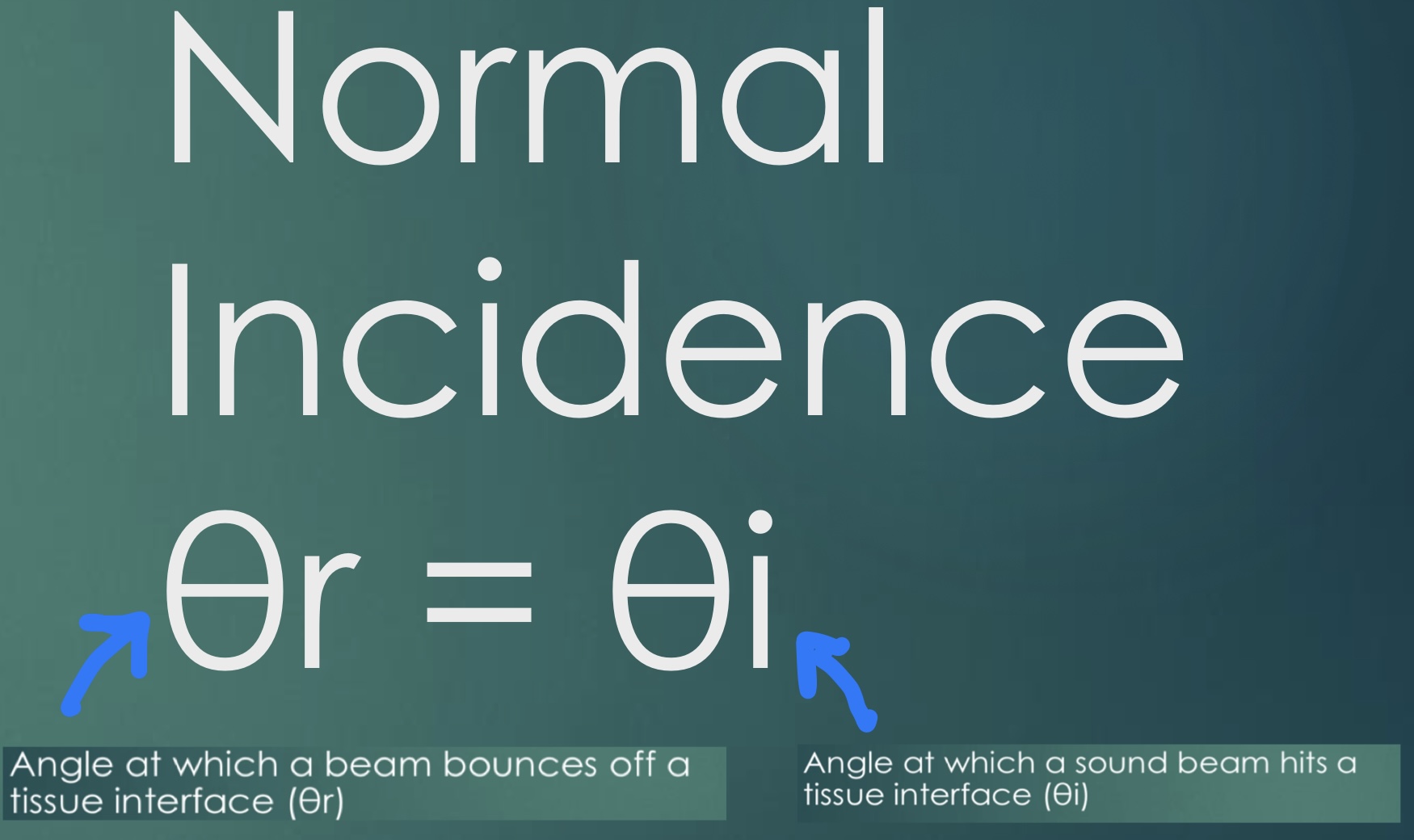
Obeys Luez’s Law - angle of incidence = angle of reflection
only applies with specular reflectors
Specular Reflection (cont. 1)
mirror like reflections created when a sound wave strikes a large, smooth surface at a 90 degree angle of incidence
occurs along organ boundaries - sound bounces back only in one direction
oblique angle = echoes may not return to TDR Specular Reflection
2 criteria:
(1) difference in acoustic impedance between 2 tissue media = z (rayls) = pV
(2) sound beam must strike boundary between 2 media at 90 degrees (normal, perpendicular, orthogonal incidence)
the size of the reflector (large smooth surface) is larger than the wavelength of the incident beam
As a sound wave meets a boundary between 2 media, there is:
(Specular Reflection, (cont. 2))
Angle of Incidence (incident beam)
angle at which which a sound beam hits a tissue interface (Θi)
Angle of Reflection (reflected beam)
angle at which a beam bounces off a tissue surface (Θr)
returns to the transducer if at 90 degrees or away from transducer if oblique
Transmission (transmitted beam)
portion of a sound beam that travels through a tissue interface
*what is reflected back depends on what is transmitted*
Diffuse Reflection/Scattering
Scattering- permits the ability to see through tissues that are not smooth (ex: thyroid, liver, pancreas)
lower than specular intensity
not angle dependent compared to specular
increases with higher frequency transducer
small irregularities in tissue accentuate the texture of the image
some terminology includes: back scatter, diffuse scattering
Rayleigh Scattering
occurs when the reflector is smaller than the sound wavelength (ex: RBC)
useful for blood flow detection applications of Doppler Ultrasound
useful in detecting contrast bubbles (injected in heart chamber)
Acoustic energy reflected to transducer is reflected in multiple equal directions
Rayleigh Scattering ∝ Frequency^4
↑ freq. = ↑ scattering by the 4th power
NOT angle dependent
Specular vs Non Specular Table
Acoustic Impedance (Z)
medium characteristics: SIZE DIFF BETWEEN 2 MEDIUMS
resistance to ultrasound through a medium
the amount of impedance (Z) is related to:
medium density
propagation speed through a medium
↓ diff in acoustic impedance = ↓ reflection & significant transmission
↑ diff in acoustic impedance = ↑ reflection & minimal transmission
Impedance (cont.)
Impedance = Density x Propagation Speed
Z = p x c
the amount of reflection from a boundary is determined by the acoustic impedance mismatch (how different the tissues are)
Z (impedance) ↑ when p (density) ↑
reflection occurs when there is a difference in density and speed
reflections can still occur even if 2 media have the same densities but different propagation speeds
Impedance EXs
No Impedance (Z) = NO reflections
Large Impedance (Z) = STRONG reflections
Small Impedance (Z) = WEAK reflections
Impedance mismatches
small impedance mismatches can result in the inability to visualize a structure, even if the structure is relatively large (isoechoic)
ex: mass can be missed bc it can blend into the tissue if impedance differences are small
Oblique Incidence
incident beam strikes at a large non-perpendicular angle
angle of incidence ≠ 90 degrees
reflected sound does not return to transducer, travels in another direction, does not produce an image on display
Reflection and Transmission Intensities
Incident Intensity- initial intensity (always = 100%)
Reflected Intensity- intensity that returns to the transducer
Transmitted Intensity- intensity that is continues through the medium
Incident Intensity = Reflected Intensity + Transmitted Intensity
Reflection and Transmission Coefficients
Intensity Reflection Coefficient (IRC)
percentage of incident sound intensity reflected back
↑ impedance mismatch = stronger reflection
If tissue impedances are the same —> there is 100% transmission and reflection = 0%
If tissue impedances are different —> there is 1% transmission and reflection = 99%
 Note
Note  Flashcards (73)